
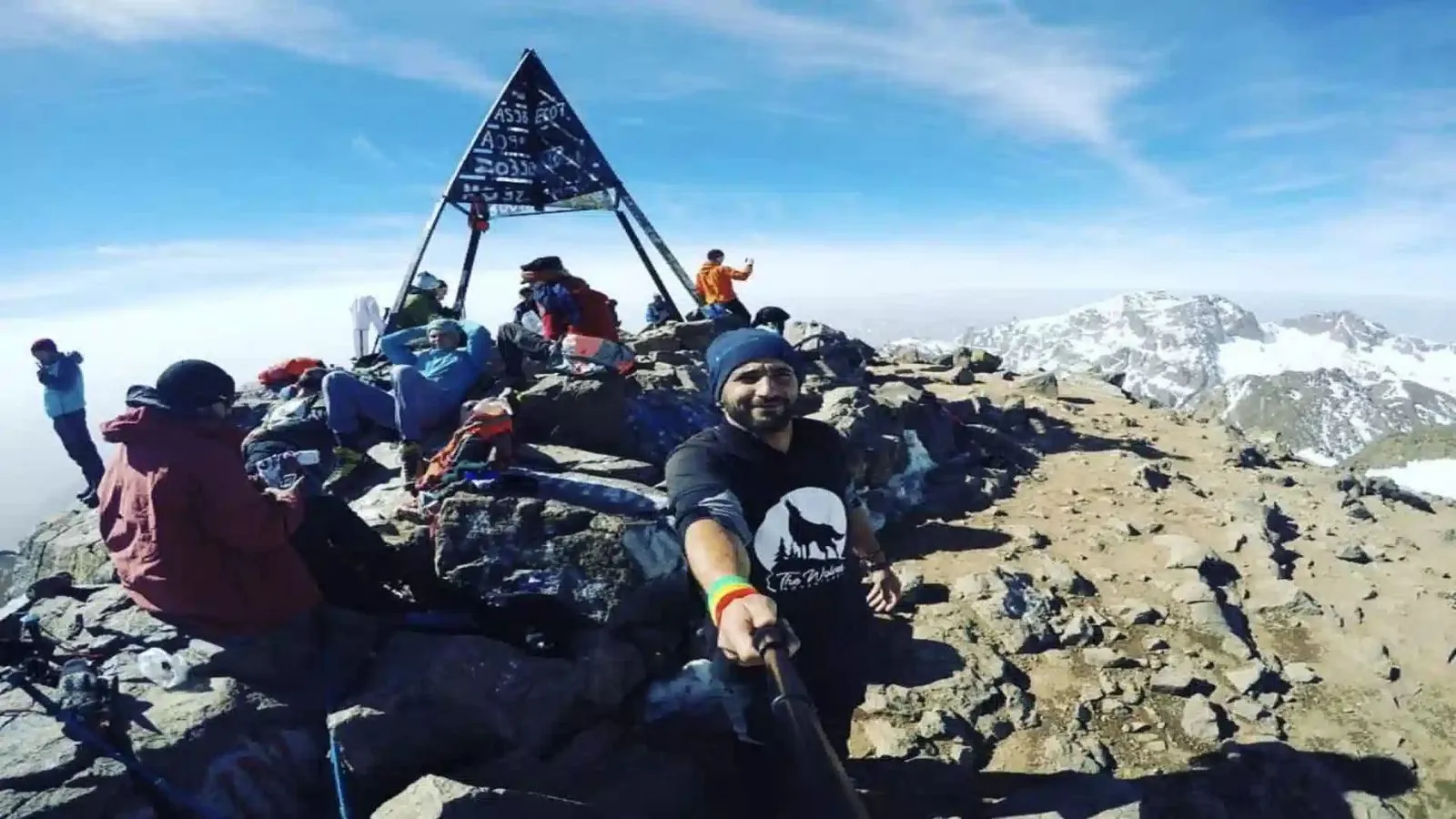
Mount Toubkal Trek: The Complete Guide to Climbing North Africa’s Highest Peak (2026)
Table of Contents
Mount Toubkal Trek: Why North Africa’s Highest Peak Belongs on Your Morocco Itinerary
The Mount Toubkal trek is the most significant high-altitude adventure available within reach of Marrakech – and one of the most accessible genuine mountain summit experiences anywhere in Africa or the wider Mediterranean region. Rising to 4,167 meters (13,671 feet) above sea level, Mount Toubkal is the highest peak in North Africa, the highest in the Arab world, and the dominant summit of the High Atlas Mountains of Morocco, located inside Toubkal National Park approximately 63-65 kilometers south of Marrakech – reachable from the city in roughly 90 minutes by road. Despite this extraordinary statistic, Toubkal requires no technical climbing skills in most seasons, no specialist equipment beyond good trekking gear, and no prior high-altitude experience for the standard summer and autumn routes, making it one of the most achievable high-altitude summit experiences available to non-technical trekkers anywhere in the world. At Over Morocco Tours, we are increasingly asked about Toubkal by guests combining a Sahara desert circuit with a day or two in the Atlas Mountains, and this guide gives you the full picture: altitude, routes, difficulty, the best time to trek, what to pack, what it costs, and the practical realities that make the difference between a summit and a turnaround.
Executive Summary: Mount Toubkal Trek Guide
Mount Toubkal Altitude: Understanding What 4,167 Meters Actually Means
Mount Toubkal’s altitude of 4,167 meters is the number every aspiring trekker reads first and processes differently depending on their previous experience. For context: 4,167m places Toubkal significantly higher than any peak in the European Alps outside Mont Blanc, higher than any summit in the contiguous United States, and high enough that altitude sickness is a genuine and common concern for trekkers who ascend too quickly without proper acclimatization. The standard base village of Imlil sits at approximately 1,740 meters elevation, meaning the total elevation gain from Imlil to summit is roughly 2,300-2,400 meters – a substantial physical challenge spread across two or three days, depending on the route chosen.
Mount Toubkal altitude sickness is probably the most consistently underestimated risk among first-time trekkers. Above approximately 2,500 meters, the body begins to feel the effects of reduced oxygen availability: symptoms of Acute Mountain Sickness (AMS) include headache, nausea, unusual fatigue, and disturbed sleep, and these can affect physically fit individuals with no prior altitude history. The overnight stay at Refuge Les Mouflons (3,207 meters) – the standard mid-point shelter on the classic route – serves a dual purpose: it is both a logistical waypoint and a genuine acclimatization measure, allowing the body to begin adjusting to altitude before the final push to the summit. Ascending too fast, trying to summit in a single day from Imlil, is the most common cause of failed summit attempts and altitude-related turnarounds on Toubkal.
Imlil Village Morocco: The Gateway to Toubkal
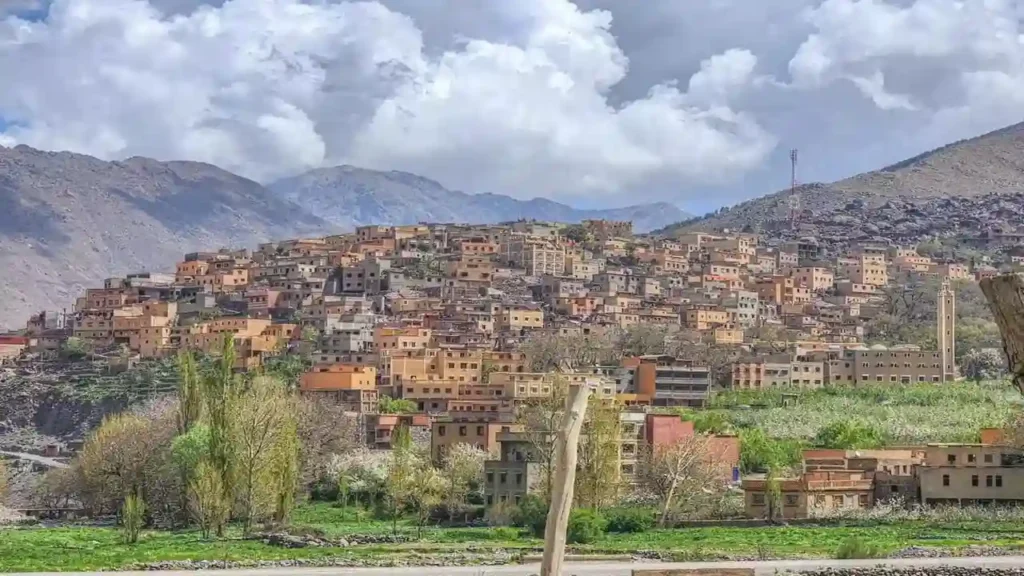
Imlil village Morocco is where every Mount Toubkal trek begins and ends – a small, mountain-focused Berber community at 1,740 meters elevation in the Mizane Valley , surrounded by terraced almond and walnut orchards, stone houses, and the steadily rising High Atlas peaks that dominate the horizon in every direction. Imlil is not a tourist resort – it is a genuinely functioning mountain village that has adapted its infrastructure to serve trekkers while maintaining its character as a working Berber community. The village supports a cluster of trekking offices, licensed guide associations, mule hire services, and basic guesthouses and riads, giving it everything required to organize a full Toubkal ascent from scratch on the day of arrival, though pre-booking guides and accommodation, particularly in peak spring and autumn season, is strongly recommended.
How to Get to Imlil from Marrakech
How to get to Imlil from Marrakech is straightforward: the village sits approximately 63 kilometers south of Marrakech on a well-maintained road, with the drive taking roughly 90 minutes by private transfer or taxi. The most reliable option for travelers already booked with Over Morocco Tours is a private transfer from your Marrakech riad or hotel directly to Imlil, arranged as part of a Toubkal package. Independent travelers can take a shared taxi (grand taxi) from Marrakech’s Bab Rob taxi station to Asni , then connect via a second shared taxi to Imlil. The combined journey by shared taxi takes roughly 2 hours including the connection, though the coordination adds a layer of complexity that many trekkers prefer to avoid at the start of a physically demanding multi-day excursion.
Mount Toubkal Trek Routes: 2-Day vs 3-Day Trek
Mount Toubkal 2-Day Trek: The Fast Ascent
The Mount Toubkal 2-day trek is the most commonly booked option, structuring the ascent into two consecutive days that together cover the full round trip from Imlil to the summit and back. On Day 1, trekkers depart Imlil in the morning and climb through the Mizane Valley , passing the shrine of Sidi Chamharouch at approximately 2,310 meters – a small, whitewashed religious site perched dramatically above the river crossing that attracts both tourists and local pilgrims, and serves as a natural rest and tea stop roughly halfway through the first day’s climb. From Sidi Chamharouch, the trail steepens considerably until reaching Refuge Les Mouflons at 3,207 meters – the standard overnight point and operational base camp for the summit attempt. The first day’s ascent from Imlil to the refuge covers approximately 9-10 kilometers and takes roughly 5-7 hours depending on pace and group fitness.
Day 2 begins very early – summit departures typically leave the refuge between 5:00 and 6:00 AM , both to catch the sunrise from the summit and to reach the top before afternoon cloud and wind commonly develop at high altitude . The final ascent involves a steep scree field – loose rock that most guides and experienced trekkers cite as the technically most demanding section of the entire route – before cresting the main ridgeline and making the final walk to the summit pyramid. The summit is reached in approximately 3-4 hours from the refuge , with the descent back to Imlil taking a further 5-7 hours for a total second-day walking time of 8-10 hours including summit time.
Mount Toubkal 3 Day Trek: The Recommended Option
The Mount Toubkal trek 3 day adds either an acclimatization day or an alternative return route – most commonly through the Azzaden Valley or via the Tizi M’zik Pass (2,664 meters) – that meaningfully improves both the summit success rate and the overall experience quality. The 3-day structure is the option most frequently recommended by experienced Atlas Mountain guides for trekkers without significant prior high-altitude experience. An extended 3-day Toubkal trek via Tamsoult adds a full-day acclimatization circuit on Day 1, climbing to Tizi M’zik Pass through juniper forests and almond groves before descending to the Tamsoult Cascade – a refreshing natural pool stop – and returning to Imlil. This gives the body a full night at altitude before the Imlil-to-refuge climb on Day 2 and the summit push on Day 3.
Sidi Chamharouch: The Sacred Shrine at 2,310 Meters
Sidi Chamharouch Morocco is one of the most culturally significant and visually striking waypoints on the entire Atlas Mountains trekking Morocco experience. The shrine – a whitewashed mausoleum built directly into the rock face above the Mizane River crossing – is dedicated to a local saint revered in both Berber animist tradition and Islamic practice, drawing a steady stream of pilgrims from surrounding communities throughout the year alongside trekkers. The contrast between the sacred, white-walled shrine and the increasingly raw, treeless mountain environment above it marks a genuine cultural and geographical transition point on the trail. The small cluster of tea stalls and rest spots at Sidi Chamharouch make it the natural refreshment stop on the first day’s climb, and most guided groups spend 20-30 minutes here before continuing upward.
Do I Need a Guide for Mount Toubkal?
Do I need a guide for Mount Toubkal is one of the most frequently asked practical questions. Moroccan law requires a licensed guide for the Toubkal summit route, and this requirement was strengthened following a 2018 incident in which two foreign tourists were attacked and killed in the High Atlas. Beyond the legal requirement, the practical safety case for hiring one is equally compelling: High Atlas weather changes rapidly without warning, the scree descent from the summit is genuinely disorienting in reduced visibility, and altitude sickness above 3,000 meters requires immediate, knowledgeable decision-making. Licensed Toubkal guides are certified through Morocco’s CFAMM (Centre de Formation aux Métiers de la Montagne) , know every variation of the route in every season, and carry the experience to adjust pace, timing, and route decisions based on real-time conditions. Booking through a reputable operator rather than directly with an individual at the trailhead ensures accountability and consistent quality.
Toubkal Refuge: Life at 3,207 Meters
Toubkal refuge altitude of 3,207 meters at Refuge Les Mouflons is the standard overnight stop for virtually all summit attempts. The refuge provides dormitory accommodation (private rooms available at a premium, book well in advance during peak season), basic meals, and sleeping bag rental. Temperatures at the refuge drop significantly after sunset throughout the year – summer nights reach 0degC to -5degC , and winter nights fall well below -10degC . Experienced Toubkal trekkers consistently recommend earplugs and a sleep mask, since dormitories on busy nights can hold 20 or more trekkers at various stages of preparation, with summit-departure alarms beginning as early as 4:30 AM .
Mount Toubkal Best Time to Visit
Mount Toubkal best time to visit for optimal conditions is late spring (April-May) and autumn (September-October) – stable weather at high altitude, comfortable temperatures for the long summit day, and, in spring, the visual reward of remaining snow combined with wildflowers and blossoming orchards on the lower valley approach. Summer (June-August) is the most popular and technically accessible window, with snow-free trails and no crampons required, though the heat on exposed lower sections and intense UV at altitude makes it more physically draining. Winter (December-March) transforms Toubkal into a technically demanding objective: significant snow and ice above the refuge requires crampons, ice axes , and cold-weather experience – winter Toubkal is not suitable for casual hikers and should only be attempted with a winter-certified guide.
Mount Toubkal Packing List: What to Bring
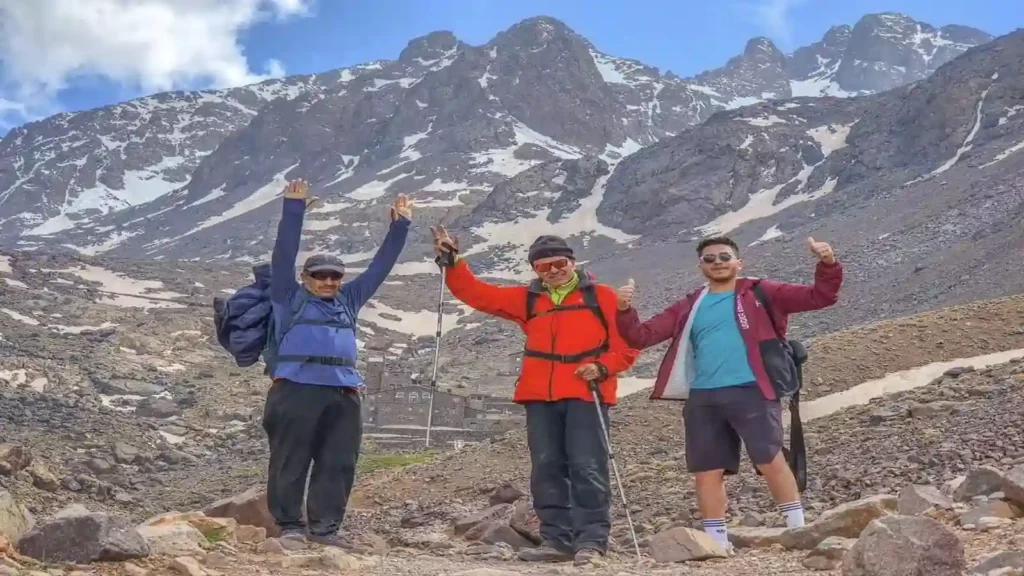
Mount Toubkal packing list requirements differ fundamentally from desert or city packing – the challenges are cold, altitude, and terrain rather than heat and sand. Critical items:
Footwear: Stiff-soled, waterproof hiking boots with solid ankle support are non-negotiable. Trail runners are inadequate for the scree field and a consistently cited cause of ankle injuries and turnarounds.
Layering system: Moisture-wicking base layer, insulating mid-layer (fleece or light down), and a waterproof windproof outer shell. Summit mornings involve wind at altitude regardless of season, with temperatures 15-20degC colder than at refuge level.
- Sleeping equipment: A 3-season sleeping bag rated to at least -5degC for all seasons except high summer; winter trekkers need -15degC or lower rating.
- Headlamp with fresh batteries: Summit departures before dawn are standard – do not rely on a phone torch.
- Sun protection: SPF 50+ sunscreen, UV-protective sunglasses, and a sun hat are essential. Snow reflection in spring and winter multiplies UV exposure significantly.
- Hydration: Minimum 2 liter water capacity with purification tablets as backup for stream refills.
- Winter additions: Crampons and trekking poles – both available for hire in Imlil – are required for safe winter summit attempts.
Mount Toubkal Cost: What to Budget
Mount Toubkal Trek cost for a self-arranged 2 day trek breaks down approximately as: licensed guide fee of 800-1,200 MAD (EUR75-110) per day , refuge accommodation at 150-300 MAD (EUR14-28) per night , refuge meals at roughly 100-200 MAD (EUR9-18) per meal , private transfer from Marrakech to Imlil and return at approximately 400-600 MAD (EUR37-55) each way , and Toubkal National Park entrance fee of approximately 20 MAD (EUR2) per person . A full 2-day independently arranged trek from Marrakech therefore runs approximately EUR200-300 per person all-in for a party of two. A fully packaged Atlas Mountains trekking Morocco tour from Marrakech – including private transfer, licensed guide, refuge accommodation, full-board meals on the mountain, and National Park fees – typically runs EUR250-400 per person for 2 days or EUR350-500 per person for 3 days . Mule hire for carrying luggage costs approximately 250-350 MAD (EUR23-32) per mule per day and is strongly recommended for multi-day trekkers wanting to ascend with a lighter daypack.
Combining Toubkal with a Morocco Desert Tour
The Mount Toubkal trek pairs naturally with a Marrakech city stay as a 2-3 day extension before or after a Sahara desert circuit. A practical combined itinerary that Over Morocco Tours structures for guests moves from Marrakech city (2 days) to Imlil for the Mount Toubkal trek (2-3 days), returning to Marrakech before departing south through Aït Benhaddou, the Dades Valley, and the Todra Gorge to Merzouga and the Erg Chebbi dunes – covering North Africa’s highest peak and its greatest sand sea in a single coherent trip.
Important Tip from Our Guide Team: The Mistake That Costs People the Summit
“The single most common reason people don’t make it to the summit is not fitness – it’s pace. We see strong, fit trekkers push too hard on Day 1 because they feel good at low altitude, then wake up at the refuge with a headache and nausea that stops them before they’ve left the door on summit morning. The mountain doesn’t reward speed the way people expect. The trekkers who summit most consistently are the ones who walk slowly, eat and drink before they’re hungry or thirsty, and sleep as well as the refuge allows.
The other thing worth saying honestly: the scree field below the summit is harder than most people expect from the description. ‘Loose rock’ in a guidebook doesn’t prepare you for what it feels like to climb steeply on shifting ground at 3,800 meters when your legs are already tired. This is not a reason not to go – it is a reason to hire a guide who will set the pace correctly and keep you moving continuously through that section without stopping, which is actually what makes it harder, not easier.”
Over Morocco Tours Guide Team
Frequently Asked Questions: Mount Toubkal Trek
How high is Mount Toubkal Trek?
Mount Toubkal stands at 4,167 meters (13,671 feet) above sea level, making it the highest peak in North Africa, the highest in the Arab world, and the dominant summit of Morocco’s High Atlas Mountains.
How long does the Mount Toubkal trek take?
The standard trek takes 2 days (1 overnight at the refuge at 3,207m), covering the full round trip from Imlil to the summit and back. A 3-day version adds an acclimatization day or scenic return route and is recommended for trekkers without prior high-altitude experience.
Is Mount Toubkal Trek difficult?
Moderate to challenging. No technical climbing skills are required in summer or autumn – the route is a strenuous hike on rocky and scree terrain at high altitude. The main challenges are sustained elevation gain of approximately 2,300-2,400 meters from Imlil to summit, the steep scree field below the summit, and altitude effects above 3,000 meters.
Do I need a guide for Mount Toubkal?
Yes. A licensed guide is legally required by Moroccan law for the Toubkal summit route, and the practical safety case is equally strong given the unpredictable High Atlas weather and the real risks of altitude sickness above 3,000 meters.
How far is Mount Toubkal from Marrakech?
Toubkal is approximately 63-65 km south of Marrakech. The gateway village of Imlil is reached in roughly 90 minutes by private transfer or approximately 2 hours by shared taxi via Asni.
What is the best time to trek Mount Toubkal?
Spring (April-May) and autumn (September-October) offer the best conditions. Summer (June-August) is accessible but hot and UV-intense at altitude. Winter (December-March) requires crampons, ice axes, and cold-weather experience.
Can I combine the Mount Toubkal trek with a Morocco desert tour?
Yes a combined Marrakech, Toubkal trek, and Sahara desert circuit is a natural and increasingly popular itinerary structure. Over Morocco Tours arranges the full combined trip.
Plan Your Mount Toubkal Trek
Over Morocco Tours arranges fully guided Mount Toubkal treks from Marrakech, with licensed certified Atlas Mountain guides, private transfers to and from Imlil, refuge accommodation, and the option to combine the trek with a Sahara desert circuit. Contact our team today to start planning your High Atlas itinerary.
Written by the Over Morocco Tours team, Morocco. All altitude figures, distances, and trek timings reflect consistent data across multiple independent trekking sources current as of 2026.
TOUR LOCATION