Morocco Visa Requirements 2026: Do You Need a Visa? Full Guide by Nationality
Table of Contents
Morocco Visa Requirements 2026: The Short Answer First
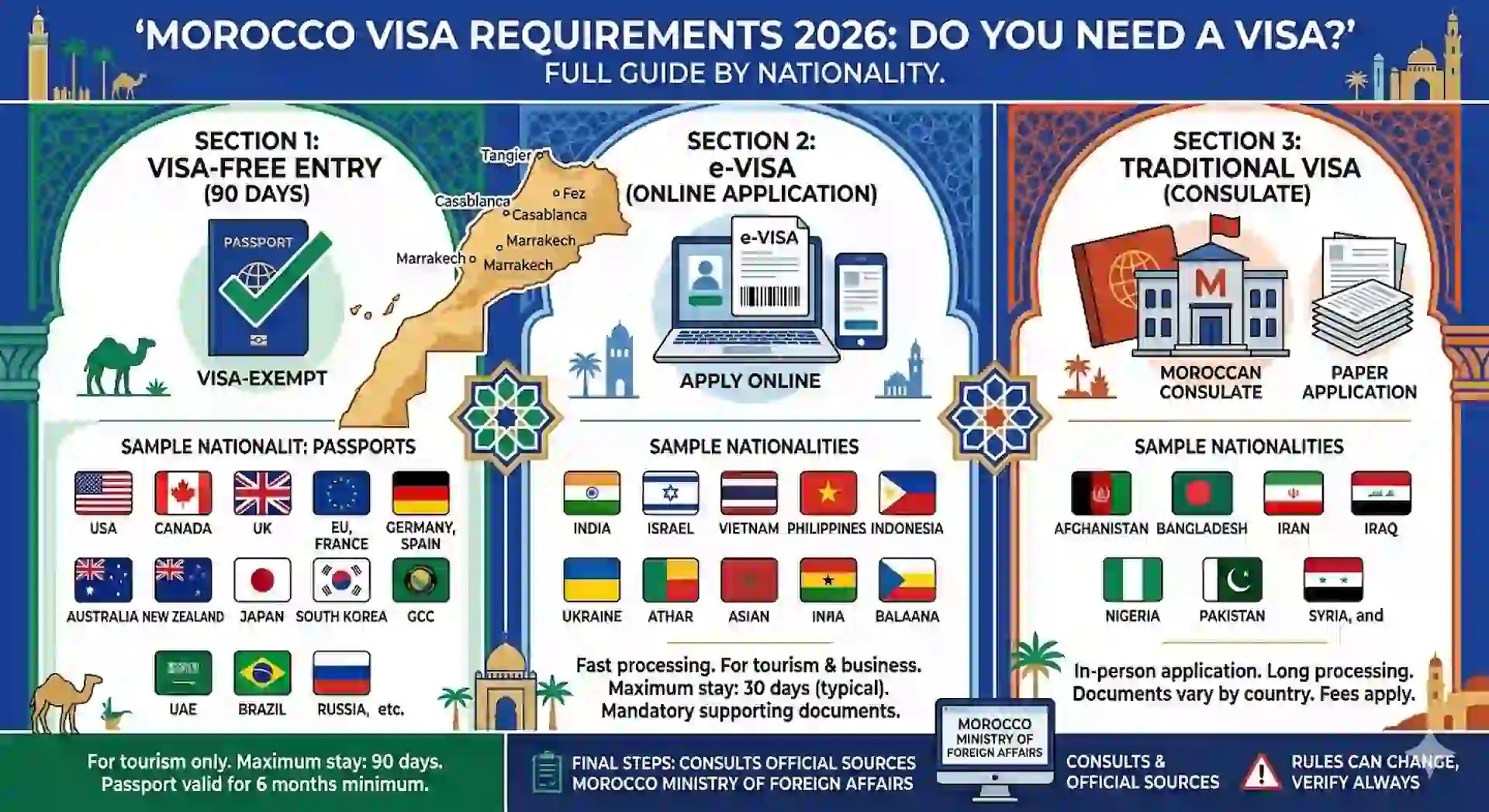
For the vast majority of travelers seeking Morocco visa requirements, the answer is reassuringly simple: you do not need a visa . Citizens of the US, UK, EU countries, Canada, Australia, and many other nationalities receive 90 days visa-free on arrival as of 2026, with no pre-arranged visa required — travelers simply receive a stamp at the port of entry. This makes Morocco one of the most accessible North African and Middle Eastern destinations for Western travelers, and it is one of the major reasons the country has become such a popular gateway into Saharan and Islamic-world travel for first-time visitors. At Over Morocco Tours, we are asked about visa requirements by nearly every international guest planning a Sahara desert tour, and the honest, practical answer for most of them is: pack your passport, check its validity date, and nothing else is required before arrival.
That said, Morocco entry requirements vary by nationality, and a smaller number of travelers do need to arrange a visa in advance, either through an embassy visit or, for some nationalities, an online e-visa system. This guide covers exactly who needs what, how the 90-day visa-free system actually works in practice, what documents border officials check, and the practical realities of customs, extensions, and re-entry that most generic visa guides skip entirely.
Do I Need a Visa for Morocco? Visa-Free Countries List
Morocco Visa Free Countries: Who Qualifies for 90 Days On Arrival
Citizens of around 60+ countries receive automatic visa-free entry to Morocco for 90 days, granted as a stamp at any official port of entry whether an international airport, land border crossing, or sea port. The Morocco visa free countries list is broad and includes the nationalities that make up the overwhelming majority of Over Morocco Tours guests:
North America: United States, Canada, Mexico
European Union & Schengen Area: most Schengen-area countries are included this covers France, Germany, Spain, Italy, the Netherlands, Belgium, Portugal, Austria, and the majority of EU member states
United Kingdom & Ireland: Both UK and Irish passport holders qualify for the 90-day visa-free entry
Oceania: Australia and New Zealand
Other major visa-free nationalities: Switzerland, Norway, Japan, South Korea, Singapore, Brazil, Argentina, and most Gulf Cooperation Council (GCC) countries
If your nationality is not listed above and you are uncertain, the safest approach is to check directly with the nearest Moroccan consulate or embassy before booking flights — visa policy can change, and Over Morocco Tours always recommends confirming current requirements 4-6 weeks before departure rather than relying solely on any single online source, including this one.
Morocco Visa on Arrival: How the Stamp Process Actually Works
For eligible nationalities, Morocco visa on arrival is not technically a “visa” in the bureaucratic sense it is an entry stamp issued automatically at passport control with no separate application, fee, or form beyond the standard immigration card. Travelers fill out a brief landing card (distributed on incoming flights or available at the border) with basic information: passport details, purpose of visit, and accommodation address in Morocco (your first riad, hotel, or our team’s contact details if you are unsure of your full itinerary). The immigration officer reviews the passport, asks the purpose of the visit (a one-word answer of “tourism” or “vacation” is standard), and stamps the passport for a 90-day stay . The entire process at major airports such as Marrakech Menara or Casablanca Mohammed V typically takes 2-5 minutes per traveler outside of peak arrival periods.
How Long Can I Stay in Morocco Without a Visa?
How long can I stay in Morocco without a visa is one of the most frequently misunderstood aspects of Moroccan entry policy. The standard answer is 90 days within a single stay , beginning from the date of entry stamped in your passport. This is distinct from the EU’s Schengen 90/180 rule Morocco’s 90-day allowance is not tied to a rolling 180-day window in the same way, though regulations are subject to change and travelers planning extended or repeated visits should verify current policy directly with Moroccan immigration authorities or their home country’s foreign affairs department before travel.
For travelers on a standard 1-3 week Morocco desert tour which describes the vast majority of Over Morocco Tours guests the 90-day allowance is far more than sufficient, and visa duration is rarely a practical concern. The relevant exception is digital nomads, long-stay travelers, or those combining Morocco with extended regional travel through North or West Africa, for whom the 90-day limit and renewal process deserve careful advance planning (covered below under visa extensions).
Morocco Passport Validity Requirements: The Rule Most Travelers Miss
Your passport must be valid for at least 6 months beyond your intended stay in Morocco. This Morocco passport validity requirement is the single most common reason travelers are denied boarding by airlines before they even reach Morocco airline check-in staff are required to enforce destination countries’ passport validity rules, and a passport expiring within 6 months of your travel dates can result in being turned away at check-in, regardless of how minor the remaining gap appears.
The practical advice from our team: check your passport expires date the moment you book flights to Morocco, not the week before departure. Passport renewal processing times vary significantly by country US passport renewals can take 6-8 weeks for standard processing (or 2-3 weeks expedited), UK passports typically 3 weeks for standard online renewal, and EU national ID cards or passports vary by member state. If your passport expires within 8 months of your planned Morocco departure date, begin the renewal process immediately rather than risking a denied boarding at the airport.
Morocco Tourist Visa 2026: For Nationalities That Require One
Who Needs to Apply for a Morocco Tourist Visa
Travelers from nationalities not on the visa-free list must apply for a Morocco tourist visa 2026 in advance, typically through the nearest Moroccan consulate or embassy in their country of residence. This category includes a number of nationalities across Africa, Asia, and parts of the Middle East. The standard required documents for a Morocco tourist visa application are: a valid passport with at least 6 months’ remaining validity and at least 2 blank pages, two recent passport-sized photographs, a completed visa application form (available from the consulate or its website), proof of accommodation in Morocco (hotel booking confirmation or, for Over Morocco Tours guests, a confirmation letter from our team), proof of sufficient funds for the stay (bank statements covering the prior 1-3 months are standard), a return or onward flight ticket, and the visa application fee, which varies by consulate and nationality.
Processing times for Moroccan tourist visas from an embassy typically range from 5 to 15 working days , though this varies considerably by consulate location and season. Applicants from nationalities requiring a visa should apply at least 4-6 weeks before their planned travel date to allow for processing delays and any requests for additional documentation.
Morocco E-Visa Application: Streamlined Options for Eligible Nationalities
A Morocco e-visa application process exists for certain nationalities as an alternative to the traditional embassy visit, allowing travelers to apply online and receive an electronic visa approval before travel rather than attending an in-person consular appointment. Eligibility for the e-visa system depends on nationality and is subject to periodic updates by Moroccan immigration authorities, so travelers should verify current e-visa eligibility directly through Morocco’s official consular or immigration channels rather than third-party visa-processing websites, some of which charge significant service fees for information that is freely available through official sources.
Documents Needed to Enter Morocco: The Complete Checklist Morocco visa Requirements
Regardless of whether your nationality requires an advance visa, every traveler should arrive prepared with the following documents needed to enter Morocco :
Always required:
- Valid passport with minimum 6 months’ validity beyond your stay, with at least 1-2 blank visa pages
- Completed immigration/landing card (provided on incoming flights or at land borders)
- Return or onward travel ticket (occasionally requested by immigration officers, though rarely checked in practice for visa-exempt nationalities)
Recommended to carry (not always checked, but useful):
- Proof of accommodation for at least your first night (hotel confirmation, riad booking, or tour confirmation)
- Travel insurance documentation
- A printed or downloaded copy of your Over Morocco Tours booking confirmation, if traveling with us, as proof of onward arrangements
For visa-required nationalities specifically:
- Approved visa or e-visa confirmation printed and ready to present
- All supporting documents originally submitted with the visa application, in case of secondary screening
Morocco Border Crossing Requirements: Airports, Land Borders, and Ferries
Morocco border crossing requirements apply consistently whether you arrive by air, land, or sea, though the practical experience differs by entry point. The vast majority of international tourists arrive via Marrakech Menara Airport (RAK) , Casablanca Mohammed V Airport (CMN) , or Fes-Saïss Airport (FEZ) , all of which have dedicated international arrivals processing with multilingual signage and generally efficient passport control, though queues can extend during peak season (October-November and March-April) or peak arrival banks.
Travelers arriving by ferry from Spain (Algeciras to Tangier or Tarifa to Tangier) pass through Moroccan immigration either onboard the ferry itself or upon disembarkation at the port, depending on the operator. Land border crossings exist with Ceuta and Melilla (Spanish autonomous cities on the Moroccan coast), though these crossings have specific and occasionally restrictive entry conditions and are less commonly used by standard tourists than air arrival. Morocco’s land border with Algeria has been closed since 1994 and remains closed to all cross-border travel, including tourism — travelers should not plan any itinerary assuming overland Morocco-Algeria crossing is possible.
Morocco Visa Extension: What to Do If You Want to Stay Longer Morocco visa requirements:
Morocco visa extension options are notably limited compared to many other countries, and this is one of the most important practical realities for travelers planning an extended stay. There is no straightforward tourist visa extension process in Morocco. The available options are to leave the country and re-enter, which resets the 90-day clock, though this is subject to border officer discretion, and pattern-use (frequent, repeated border runs) raises questions from immigration authorities.
For travelers who know in advance they want to stay in Morocco longer than 90 days for an extended cultural immersion, remote work stay, or multi-month travel itinerary — the more reliable approach is to apply for a Carte de Séjour (residence permit) through Moroccan immigration authorities before the 90-day period expires, a process that requires documentation including proof of accommodation, financial means, and purpose of extended stay, and should be initiated well before the visa-free period runs out. Travelers considering this route should consult directly with Moroccan immigration authorities (the Bureau des Étrangers at regional police prefectures) or a Moroccan immigration lawyer, as requirements and processing vary and change periodically.
Morocco Customs Rules for Tourists: What You Can and Cannot Bring
Morocco customs rules tourists should be aware of before arrival cover both standard international travel restrictions and a small number of Morocco-specific regulations. Standard prohibited or restricted items include narcotics and controlled substances (Morocco has strict penalties for drug possession, including for cannabis despite its cultivation in parts of the Rif region for non-personal-use purposes), firearms and ammunition without prior authorization, and counterfeit goods.
Currency declaration: travelers carrying more than 100,000 MAD (approximately €9,000) in cash, or equivalent foreign currency, are required to declare it on arrival. Duty-free allowances for personal goods follow standard international norms: travelers over 18 may bring in limited quantities of alcohol and tobacco for personal use (typically up to 1 liter of spirits or 2 liters of wine, and up to 200 cigarettes, though exact thresholds are periodically updated by Moroccan customs authorities and should be confirmed before travel if relevant to your trip). Drone equipment requires advance permitting through Morocco’s ANAC (Agence Nationale de l’Aviation Civile) flying a drone without authorization is illegal and can result in confiscation. Travelers wishing to bring professional camera equipment, drones, or significant quantities of electronics for non-personal use should research specific customs declarations in advance.
Important Tip from Our Booking Team: What We Tell Every Guest Before Arrival
“The number one mistake we see is travelers checking their passport expired date the week before their flight, not when they book. We had a guest two years ago who arrived at check-in in their home country and was denied boarding because their passport expired 4 months and 3 weeks after their return date from Morocco just one week short of the 6-month rule. It cost them their entire trip and the flights had to be rebooked. Check this the day you book your Morocco tour, not later.
The second thing we always mention: the immigration landing card asks for an accommodation address in Morocco. If you’re joining one of our desert tours and haven’t finalized every night’s accommodation yet, just write the address of your first hotel or riad, or use our office address in Merzouga we are always happy to confirm this for guests in advance by email so there’s no hesitation at the border.
And finally the passport stamp process is genuinely fast and relaxed for the vast majority of our guests. People sometimes arrive nervous about Moroccan border control because they’ve read older or inaccurate information online. In our experience, the immigration officers at Marrakech and Casablanca airports process Western tourists efficiently and professionally, and the most common interaction is simply confirming your name matches your booking and stamping you through.”
Over Morocco Tours Booking Team , Merzouga, Morocco
Frequently Asked Questions: Morocco Visa Requirements
Do US citizens need a visa for Morocco?
No. US citizens receive 90 days visa-free entry to Morocco, granted as a passport stamp on arrival with no advance application required. The US passport must be valid for at least 6 months beyond the intended stay.
Morocco visa for UK citizens?
No. UK citizens receive 90 days visa-free entry to Morocco on arrival. As with all visa-exempt nationalities, the UK passport must have at least 6 months’ validity remaining beyond the travel dates.
How long can I stay in Morocco without a visa?
Visa-exempt nationalities, including the US, UK, EU countries, Canada, and Australia, receive 90 days on entry. This is granted as a stamp at the port of entry with no separate application process required.
What documents do I need to enter Morocco?
A valid passport with at least 6 months’ remaining validity, a completed immigration landing card (provided on the flight or at the border), and ideally proof of accommodation for your first night. Visa-required nationalities must additionally present an approved visa or e-visa confirmation.
Can I extend my tourist stay in Morocco beyond 90 days?
Morocco does not have a straightforward tourist visa extension process. Options include leaving and re-entering the country (which resets the 90-day period, though this is at border officer discretion) or applying for a Carte de Séjour residence permit through Moroccan immigration authorities for longer planned stays.
Is Morocco visa-free for EU citizens?
Yes. Citizens of most Schengen-area and EU countries receive 90 days visa-free entry to Morocco on arrival, with the standard 6-month passport validity requirement applying as for all visa-exempt nationalities.
What happens if my passport expires soon after my Morocco trip?
If your passport expires within 6 months of your return date from Morocco, you may be denied boarding by the airline before departure, as airlines are required to enforce destination countries’ passport validity rules. Renew your passport well in advance if it falls within this window.
Plan Your Morocco Trip With Our Morocco Visa Requirements:
Now that your Morocco visa requirements are clear, the only thing left to plan is the trip itself. Over Morocco Tours has been guiding international travelers from first-time visa-free visitors to long-stay return guests through the Sahara desert, the imperial cities, and the Atlas Mountains since 2012. Our team is always available to confirm accommodation details for your immigration landing card or answer any entry-related questions before you book. Contact us today to start planning your Morocco desert tour.
Written by the Over Morocco Tours team, Merzouga, Morocco. This guide reflects entry requirements as understood at the time of publication in 2026; visa policy can change, and travelers should always verify current requirements directly with the nearest Moroccan consulate or official government sources before booking travel.