Majorelle Garden Marrakech: Complete Visitor Guide 2026
Table of Contents
The Majorelle Garden Marrakech is the most visited site in Morocco after Djemaa el Fna and the only place in the country where you can say with absolute certainty that the photographs you have seen before visiting do not do it justice. The particular blue Majorelle Blue, a cobalt so saturated and so accurately calibrated that it seems to give off its own light against the green of bamboo groves and the gold of desert sun, is actually more impressive in person than in any photograph, since photographs cannot capture the way this colour changes through the day: electric and aggressive in the full light of midday, luminous and complex in the gentle hours of the morning, almost violet in the hour before closing when the sun drops behind the palm trees to the west.
The Jardin Majorelle, in French, is a 2.5-acre plot of what was an empty stretch of land in 1923 on the edge of the Guéliz neighbourhood. It was purchased by the French painter Jacques Majorelle, who built a house and studio on it and then spent the next 40 years filling it with plants from five continents, painting his buildings in the blue that would later bear his name and creating a private world that he opened to the public in 1947 for a small admission fee to help cover maintenance costs. The garden was neglected after he died in 1962. By 1980, it was slated for demolition for a hotel development. Then came two men who would change its story entirely. Yves Saint Laurent and Pierre Bergé.
Ibrahim was born in Marrakech and has worked with Over Morocco Tours since 2012. He wrote this guide to give you the most practically useful and culturally honest account of Majorelle Garden Marrakech available: its history, what to see, exactly when to arrive, what the tickets actually cost, what the Berber Museum contains, how to photograph it and the five things about it that most visitors miss entirely.
Jardin Majorelle guide 2026 — ESSENTIAL FACTS (2026)
The History of Majorelle Garden Marrakech: From Empty Plot to Global Icon
Jacques Majorelle: The Man Who Created Majorelle Blue (1886–1962)
Born in 1886 in Nancy, France, Jacques Majorelle was the son of Louis Majorelle, one of the most accomplished furniture designers of the Art Nouveau movement whose workshop made the sinuous, plant-inspired pieces that defined the Nancy school at the dawn of the 20th century. Jacques inherited his father’s remarkable eye for colour and form but not his medium. Instead of becoming a craftsman, Jacques became a painter, studying at the École des Beaux-Arts in Paris, until tuberculosis forced him to seek a drier climate for his health.
Majorelle arrived in Marrakech in 1917 to convalesce, as so many European artists would in the decades to come – seduced by the extraordinary quality of the light in North Africa, the density and drama of the colour palette, and the sense of coming to a visual world that painting had not yet properly explored. Hooked. Instant. Forever. By 1923 he had given up any idea of returning to France. He bought a plot of land in the Guéliz neighbourhood, at that time at the western edge of the city, now well within the modern city, and began building:
What he created in the next four decades was not just a garden but an artistic manifesto in living material. Majorelle collected plants from five continents with the systematic obsession of a botanist: bamboos from Asia, cacti from Mexico and the American Southwest, water lilies and lotus flowers, bougainvillea from South America, date palms from the Moroccan Sahara and rare succulents from around the world. When the garden reached maturity, it contained more than 135 species. Today it numbers over 350, following restorations and extensions by Yves Saint Laurent and Pierre Bergé.
In 1937 the colour that would come to define the garden – and eventually bear his name – arrived when Majorelle painted his villa and Art Deco studio in an extraordinary intense cobalt blue. The particular pigment he had chosen was not the usual decorator’s blue, but a preparation of ultramarine – the same lapis lazuli pigment seen in Vermeer’s interiors and the tilework of Islamic architecture throughout Morocco. The effect was immediate and overpowering against the green foliage of the garden and the terracotta pots dotted around everywhere: the blue seemed to glow. The colour has since been officially registered and trademarked as Majorelle Blue – the only colour in the world with a Moroccan garden name.
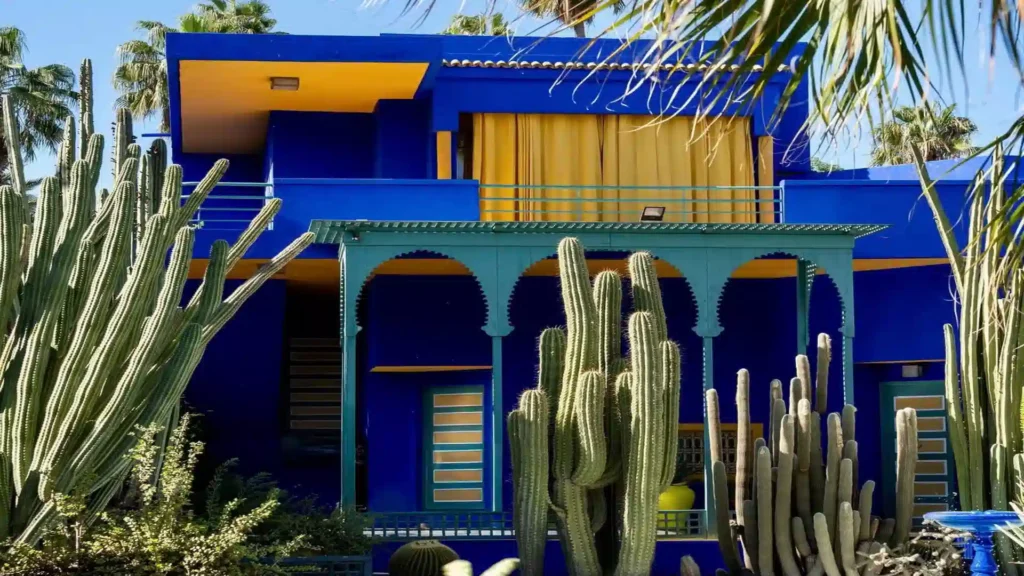
Majorelle Garden Marrakech — the iconic Majorelle Blue villa reflected in the lily pond at opening time, Jardin Majorelle 2026
The Opening, the Divorce, and the Decline (1947–1980)
In 1947 Majorelle opened the garden to the public for a small entrance fee, to help pay the increasing cost of keeping over 135 varieties of plants in a semi-arid climate needing constant irrigation. The garden soon became one of the most visited attractions in Marrakech – remarkable, given that the city was not yet a major tourist destination. Majorelle continued to paint, to expand the garden, to live in his villa (which he called Villa Bou Saf Saf — “the house of the poplar tree”) until his marriage to Andrée Longueville ended in divorce in 1950.
The divorce changed everything. As part of the settlement Majorelle was forced to sell the estate which had been the work of his life. He stayed on in Marrakech, and continued to paint, but the garden was sold to new owners who did not possess his botanical knowledge, or his obsessive commitment to keeping it up. By the late 1970s the planting was in a bad way, the irrigation systems were failing and there was serious discussion of demolishing the whole site to build a hotel – which would have been, as one travel writer later observed, an act of spectacular cultural stupidity.
Majorelle himself never witnessed the garden’s final decay.In 1962 he was involved in a serious road accident in Marrakech which required medical treatment that he was unable to find in Morocco. He was evacuated to Paris, where he died in that year, at the age of 75, after spending the better part of four decades building and losing and watching deteriorate the most beautiful thing he ever made.
Yves Saint Laurent and Pierre Bergé: The Rescue (1980–2008)
Yves Saint Laurent had first come to Marrakech in 1966 with his partner Pierre Bergé, and immediately the city had entered his creative bloodstream, as it does for certain temperaments – totally and permanently. He returned again and again, even buying a house in the medina, and it was on one of these visits that he and Bergé stumbled upon the crumbling Majorelle Garden. They bought the property in 1980 and started to restore it.
What they did was not to preserve what Majorelle had left but to expand his vision. Bergé hired the Moroccan perfumer Abdel Razzaq Bin Shaaban to classify and restore the collection of plants. Eventually the number of species more than doubled to over 350, specimens were brought in from all over the world. All irrigation systems have been reconstructed. The specific cobalt colour Majorelle Blue was repainted on every surface it appeared on and then extended to other elements: ceramic pots, archways, fountains and garden structures that Majorelle himself had never painted blue. The garden that visitors see today is Majorelle’s vision interpreted and amplified by the sensibility of one of the 20th century’s greatest creative minds.
Yves Saint Laurent died in Paris in June 2008. He had asked that his ashes be scattered in the rose garden of the Villa Oasis, the private garden next to the main Jardin Majorelle where he and Bergé had lived during their years in Marrakech. His ashes were scattered in a small memorial bust by the sculptor Jaume Plensa. In this last act the garden became more than a botanical collection; it was a resting place, the last destination of a man who found in Morocco the colour and intensity his creative life demanded.
Pierre Bergé on what Marrakech and the garden gave Saint Laurent:
“Marrakech taught Yves the importance of colour. Before Morocco, his palette was Parisian — refined, restrained, sophisticated. After Morocco, everything changed. The blue that Majorelle had put on those walls entered his collections. The saffron yellow of the medina walls appeared in his dresses. The garden made him see colour as something alive rather than something applied.” — Pierre Bergé, recorded in a 2012 interview about the Fondation Pierre Bergé–Yves Saint Laurent
What to See at Majorelle Garden: A Zone-by-Zone Guide
EXPLORING THE ZONES Of Majorelle Garden
The Jardin Majorelle is compact — 2.5 acres in total — but its layout is deliberately designed to prevent any single view from revealing the whole garden at once. Paths curve and bamboo groves screen, so that each turn produces a new framing of the Majorelle Blue against different foliage. Here is what to look for in each zone.
The Majorelle Blue Villa & Studio
The garden’s architectural centrepiece – the Art Deco studio Majorelle built in 1931, subsequently painted in his signature cobalt blue in 1937 and repainted to the same exact specification by Bergé’s restoration team. It now houses the Pierre Berge Museum of Berber Arts. The exterior walls, the ceramic tile accents, the arched windows and the pergola over the main entrance are the most-photographed elements in the entire garden. The blue changes with every light condition. Look how it goes from electric cobalt at noon to deep indigo-violet in the late afternoon shade.
The Lily Pond & Water Garden
The central reflecting pond, lined with papyrus, water hyacinth and lotus, is the place most iconic Majorelle Garden photographs are taken – the blue villa reflected in still water, surrounded by the green of papyrus stems. The pond also supports a healthy population of frogs whose croaks lend the garden soundscape a certain tropical quality that surprises most visitors. For the least-choppy water and most mirror-like reflections, arrive at opening time (8 a.m.). By 10 a.m., foot traffic from visitors circling the pond disrupts the surface.
The Cactus Garden
One of the largest private cactus collections in Africa—hundreds of specimen cacti from Mexico, the American Southwest and the Canary Islands, some more than a century old, their scale and architectural forms utterly unlike anything in the botanical gardens of Europe. The oldest of the Mexican columnar cacti are as thick as a human torso and can reach a height of 6–8 metres. At dawn, the cactus garden is at its most dramatic, with the light from a low angle casting long shadows that emphasize the geometric forms of the plants.
The Bamboo Grove
A dense planting of giant bamboo creates a unique sound environment unlike anywhere else in the Majorelle Garden – the dry clicking of bamboo stems in a slight breeze and total visual blocking from the rest of the garden, creating a sense of green enclosure more akin to a Southeast Asian forest than a Moroccan garden. The bamboo grove is also the coolest part of the garden in summer, with the canopy providing real shade and temperatures 3–5°C lower than the open areas.
The Bougainvillea Terraces
The south-facing wall of the garden is lined with mature bougainvillea plantings in six colours: deep magenta, pale pink, white, orange, coral and a rare yellow variety. Bougainvillea blooms riotously in spring (March–May) and the wall is one of the most colour-saturated visual experiences in Marrakech. The magenta bougainvillea against the Majorelle Blue of the neighbouring buildings creates a colour combination of almost aggressive beauty.
The YSL Memorial & Rose Garden
Next to the main garden is the Villa Oasis private garden (open except Wednesdays) with the rose garden where the ashes of Yves Saint Laurent were scattered in 2008, marked by a small memorial sculpture. The private garden has a different, quieter character to the main Jardin Majorelle – less dramatic, more intimate, with the particular quality of a place that was really lived in, rather than designed for public viewing.
The Pierre Bergé Museum of Berber Arts: Why It Matters
The Pierre Bergé Museum of Berber Arts located in Majorelle’s original studio building is the most underrated cultural experience in the entire Majorelle Garden Marrakech complex, and the one most visitors rush through. Entry costs an additional 60 MAD (or the combo ticket), but the collection inside is one of the best groupings of Amazigh (Berber) cultural objects in Morocco outside of the national museums in Rabat.
The permanent collection is devoted to three types of Berber material culture:Jewellery – traditional silver pieces from the Atlas Mountains, the pre-Saharan south and the Atlantic plain, many incorporating coral, amber and enamel in the distinctive regional styles of the Ait Atta, the Ait Khabbash and the Tuareg traditions.Textiles: Woven carpets, shawls, and ceremonial garments in the geometric traditions of various Berber groups from the Atlas Mountains, including context on their regional origins and the specific symbolic content of their patterns. And costumes, including complete traditional dress from various Berber cultural groups across Morocco, with labels detailing the occasion for which each type of dress was worn.
The Berber Museum in the Jardin Majorelle is exceptional not only for the quality of the objects but also for the quality of their presentation. The museum’s installation was financed and overseen by Pierre Bergé, who applied the same curatorial intelligence to the Berber collection as he did to the design of Saint Laurent’s fashion collections: each object shown for maximum visual impact, each grouping of objects placed in deliberate relationships to its neighbours, each label written to provide true cultural context, not simply catalogue descriptions. The museum is, in addition to other things, a tribute to Bergé’s true love and understanding of the Amazigh culture that surrounds the garden.
The Musée Yves Saint Laurent Marrakech: Fashion, Colour & Morocco
The Musée Yves Saint Laurent Marrakech (MYSLM) opened in October 2017 in a new building adjacent to the Jardin Majorelle. The design by Paris-based studio Studio KO features a terracotta-coloured concrete exterior, with a facade that evokes traditional Moroccan woven textile motifs at a scale of architecture. It is among the most architecturally significant buildings erected in Morocco in the 21st century.
The permanent collection contains around 50 of Saint Laurent’s most iconic creations, arranged thematically around the recurring obsessions of his creative life. The sections of the exhibition are: Black, Africa and Morocco – the sub-Saharan and North African influences that ran through his work from the early 60s onwards; Gardens and Art – the direct influence of the Majorelle Garden itself on his colour palette and textile choices; The Boundaries of Gender – his groundbreaking work in women’s suiting and the Le Smoking tuxedo; and Imaginary Voyages – the Russian, Chinese and African collections that brought ethnographic visual culture into haute couture.
There’s also a research library, an archive of sketches and preparatory drawings, a cinema screening a 16-minute film about Saint Laurent’s relationship with Morocco, and a bookstore with the best selection of Morocco-related design, art and photography books anywhere in Marrakech.
YSL Museum Opening Hours (July 2026)
The Musée Yves Saint Laurent Marrakech is open daily except Wednesday, from 10:00am to 6:00pm, with last admission at 5:30pm.
The Wednesday closure applies to both the YSL Museum and the Villa Oasis private garden. The main Jardin Majorelle and the Pierre Bergé Museum of Berber Arts are open every day. If visiting on a Wednesday, you can still see the garden and the Berber Museum — just not the YSL Museum or Villa Oasis.
Majorelle Garden Tickets and Prices (2026): Complete Guide
Visiting Jardin Majorelle & Yves Saint Laurent Museum
Critical booking alerts, ticket package breakdowns, and an optimized morning itinerary curated by Over Morocco Tours.
Official Booking Warning: Protect Against Fraudulent Tickets
The only official website for Majorelle Garden tickets is tickets.jardinmajorelle.com. Multiple fraudulent websites sell invalid tickets—if you purchase from an unauthorized third-party site, you risk arriving at the gate with a ticket that will be rejected.
Ready to Book?Secure your timed entry tickets directly via the official platform.
The Plants of Majorelle Garden: 350 Species from 5 Continents
The botanical collection at Jardin Majorelle guide 2026 is not incidental decoration — it is the primary reason the garden exists. Jacques Majorelle was a passionate and systematic botanist who sourced plants from across the world, and Yves Saint Laurent and Pierre Bergé continued this collecting mission, eventually more than doubling the species count to over 350. Here are the plants most worth specifically seeking out during your visit.
KEY PLANT SPECIES OF JARDIN MAJORELLE
Home to over 350 plant species from five continents, the garden is a living botanical tapestry. Here are the most significant species to look out for during your walk through the estate.
Date Palms
Many of the oldest specimens are over a century old. Morocco’s varieties of Phoenix dactylifera produce the Medjool dates that are Morocco’s finest agricultural export.
Giant Mexican Cacti
Columnar cacti (Carnegiea gigantea and relatives) reaching 6–8 metres, some over 100 years old. The most architecturally striking plants in the garden — especially in morning shadow light.
Bougainvillea
Six colour varieties of Bougainvillea glabra and spectabilis trained against the southern walls. Peak bloom: March–May. The magenta variety against Majorelle Blue is the garden’s signature colour combination.
Bamboo (Phyllostachys)
Giant bamboo creates the most acoustic and visually immersive section of the garden — a grove dense enough to completely screen the surrounding city and create its own cool microclimate.
Water Lilies & Lotus
The lily pond hosts Nymphaea and Nelumbo varieties. Water lilies bloom in summer; lotus flowers in late summer through autumn. Both attract dragonflies in extraordinary numbers on warm mornings.
Cycads
Among the oldest plant genera on earth — relatives of species that existed 200 million years ago. Several specimens in the garden are more than 150 years old. Identified by their palm-like appearance and distinctive cone structures.
Agave & Aloe
Large agave and aloe specimens from Mexico, the Canary Islands, and South Africa — their architectural rosette forms creating geometric contrast with the more fluid bamboo and palm planting nearby.
Papyrus
Cyperus papyrus — the ancient Egyptian paper plant — grows in dense clumps at the pond’s edge, its umbrella-like seed heads reaching 2–3 metres above the water surface and creating the distinctive framed view of the Majorelle Blue villa that appears in most garden photographs.
Argan Tree
Argania spinosa — Morocco’s most economically significant tree, the source of argan oil. Several specimens grow in the garden’s southern section. The twisted grey trunks and small oval leaves look nothing like the landscape paintings of argan forests in the Souss Valley — worth seeking out for comparison.
Best Time to Visit Majorelle Garden opening Hours: Honest 2026 Crowd Guide
Majorelle Garden Marrakech receives over 700,000 visitors annually — more than 1,900 per day on average, with peak days in spring and autumn exceeding 3,000. The garden is small — 2.5 acres — and at peak visitor density it becomes genuinely crowded, which fundamentally changes the experience. The honest advice is: timing your visit correctly is the single most important decision you can make about how to spend your time here. Here is the complete, unvarnished crowd guide.
BEST TIME TO VISIT JARDIN MAJORELLE
Timing your visit makes a dramatic difference in crowd levels, lighting, and overall experience. Here is a breakdown of the daily time slots and weekly trends.
⭐ The Best Window — Arrive at Opening
The garden opens at 8:00am daily. The first 90 minutes after opening are the only time when the famous lily pond reflection shot is achievable without other visitors in the frame, the bamboo grove is genuinely tranquil, and the Majorelle Blue villa can be photographed without a queue. The morning light is soft and diffused, perfect for the blue architecture. The frogs are most vocal and the garden smells of wet earth and night-blooming jasmine. Book the first entry slot online.
Good — Still Manageable
Visitor numbers increase steadily but the garden remains navigable. The light becomes harder and more contrasty — less ideal for photography of the blue architecture but revealing the cactus garden’s forms more dramatically. The Berber Museum in this window is at its most comfortable.
⚠ Avoid — Peak Crowd Period
This is when the garden is most crowded, hottest, and least pleasant. Tour groups arrive in volume and the lily pond has a de facto queue for photographs. The direct overhead sun eliminates the soft light that makes the colours pop. If this is your only window, manage expectations around solitude and photography.
🌟 Golden Hour — Best for Photography
The second-best window and the absolute best for photography. The sun moves low, casting a warm amber light that shifts Majorelle Blue into a deeper, richer indigo tone. Bougainvillea on the south wall is lit directly, and crowds thin after 5:00pm. Note: booking the 6:00pm slot gives you 30 minutes before closing at 6:30pm.
Weekday vs. Weekend Trends
Monday through Thursday mornings are consistently the quietest visiting days. Friday afternoons and weekends (Saturday/Sunday) draw both local visitors and tourists. Peak holiday periods — such as Easter week, May half-term, and October half-term — remain busy regardless of day or hour.
How to Photograph Majorelle Garden: The Definitive 2026 Guide
Jardin Majorelle is the most photographed single site in Morocco after the Erg Chebbi dunes and the Fes tanneries. Here are the specific shots worth planning for, and the exact conditions that produce them.
BEST PHOTOGRAPHY SPOTS & COMPOSITIONS
To capture the vivid colors and architectural geometry of Jardin Majorelle, timing and framing are everything. Here are the top shots to aim for and the best times to capture them.
The Classic Lily Pond Reflection
⏱ 8:00 – 8:45 AM
Stand at the pond’s northern edge and frame the Majorelle Blue villa with the papyrus stems on both sides. At 8am the water is absolutely still and the reflection is mirror-perfect. Use the widest lens you have and include the blue ceramic pots in the foreground. Arrive right at opening — by 9:30am foot traffic disrupts the surface.
The Blue Archway with Bougainvillea
⏱ 8:00 – 10:00 AM
The arched pergola on the garden’s south side, painted Majorelle Blue and framed with magenta bougainvillea (best March–May), is the most colour-saturated single composition in the garden. Morning light from the east hits the blue directly. Stand 3 metres back for the full arch frame.
The Giant Cactus Silhouettes
⏱ ANY MORNING
The columnar cacti in the cactus garden create extraordinary architectural silhouettes against the blue sky in any morning light. Get very close and shoot upward at 45 degrees to exaggerate the height. These photographs look unlike any other Morocco image — more Mexican desert than North Africa, which is historically accurate.
Golden Hour Blue on the Villa Facade
⏱ 4:30 – 6:00 PM
The west-facing facade of the Majorelle villa catches warm golden light from approximately 4:30pm. The blue shifts toward a complex warm-cool contrast that simply does not exist at any other time of day. This is the shot that professional photographers specifically book late-afternoon entry for. Use a telephoto lens (85–135mm equivalent) to compress the facade against the garden behind.
The Ceramic Pot Details
⏱ ANY TIME
The Majorelle Blue ceramic pots — in multiple sizes, stacked and arranged throughout the garden — are among the most graphically striking compositional elements in the complex. Macro or close-focus shots of the pot surfaces, glaze texture, and blue-on-blue layering create abstract images that read as Morocco instantly without any obvious landmark.
The Bamboo Grove Interior
⏱ MORNING LIGHT ONLY
Inside the bamboo grove, shafts of morning light filter through the canopy and create a green-gold dappled light that is entirely unlike anything else in the garden. Shoot toward the light source, slightly underexposed, to capture the atmospheric quality. This is one of the most atmospheric shots in the garden and rarely appears in other visitor guides.
PHOTOGRAPHY RULES AT MAJORELLE GARDEN
Jardin Majorelle is one of the few major Moroccan cultural sites that explicitly invites visitors to take photographs. Please keep the following guidelines in mind during your visit:
✅
Personal Photography Encouraged
Photography is actively encouraged for personal use. Enjoy capturing the iconic architecture and botanical collection!
🚫
No Flash Photography
Flash photography is strictly prohibited, as it disturbs the tranquility of the space and can damage sensitive plant specimens.
📐
Tripods Require Permission
Using tripods or professional stabilization gear requires advance written permission from garden management.
🛸
No Drones & Respect Privacy
No drone photography is permitted above the garden complex. Please avoid photographing other visitors without their explicit consent.
🎬
Commercial & Film Permits
Commercial photography (for advertising, magazine publication, or film) requires a formal permit application to the Fondation Pierre Bergé–YSL.
Majorelle Blue: The Science and Story of the World’s Most Famous Garden Colour
Majorelle Blue is the specific cobalt blue used throughout the Jardin Majorelle, first applied by Jacques Majorelle to his studio villa in 1937 and now so closely associated with the garden that it has been legally registered and trademarked as a colour in its own right. It is one of the very few colours in the world to be named for a specific artist and location, and the only colour in the world named for a Moroccan garden.
What Makes This Blue Different
What makes Majorelle Blue different from other cobalts is the particular quality of Moroccan light that it interacts with. Marrakech is located at an altitude of about 460 m in a semi-arid interior climate with more than 300 days of sunshine a year. The light in Marrakech, particularly in the spring and fall months when the Saharan dust that filters it in summer is absent, is extraordinarily clean and direct and high in ultraviolet content. From this perspective, the ultramarine pigment that makes Majorelle Blue so intense takes on an almost luminous quality: it appears to emit light rather than just reflect it. That is why visitors are always commenting on the garden being more vibrant in reality than in photographs.
Majorelle didn’t invent the color. Ultramarine and cobalt blue pigments have been part of Moroccan architecture, tilework (zellij) and calligraphy for centuries. What Majorelle did was to take this traditional pigment and apply it to an architectural surface in a scale, in a context (surrounded by lush tropical greenery rather than the terracotta and ochre of the surrounding city) and in a concentration never tried before. The result was a colour that was entirely traditional Moroccan and entirely new in application. When Yves Saint Laurent repainted the garden to the same specification, in 1980, he described the colour as “the blue that I always hear when I think of Morocco” — a synesthetic description that, for anyone who has stood in the garden, makes perfect sense.
The trademarking of Majorelle Blue as a colour was completed by the Foundation Pierre Bergé–YSL after Saint Laurent died. The Pantone equivalent is PMS 661 C, but the paint used at the garden is a custom blend of pigment that differs slightly from the commercial Pantone version. The colour has been commercially replicated on thousands of products – ceramics, textiles, stationery, paint lines – and become one of the defining visual exports of Moroccan design on the international stage.
Five Things About Majorelle Garden Marrakech That Most Visitors Miss
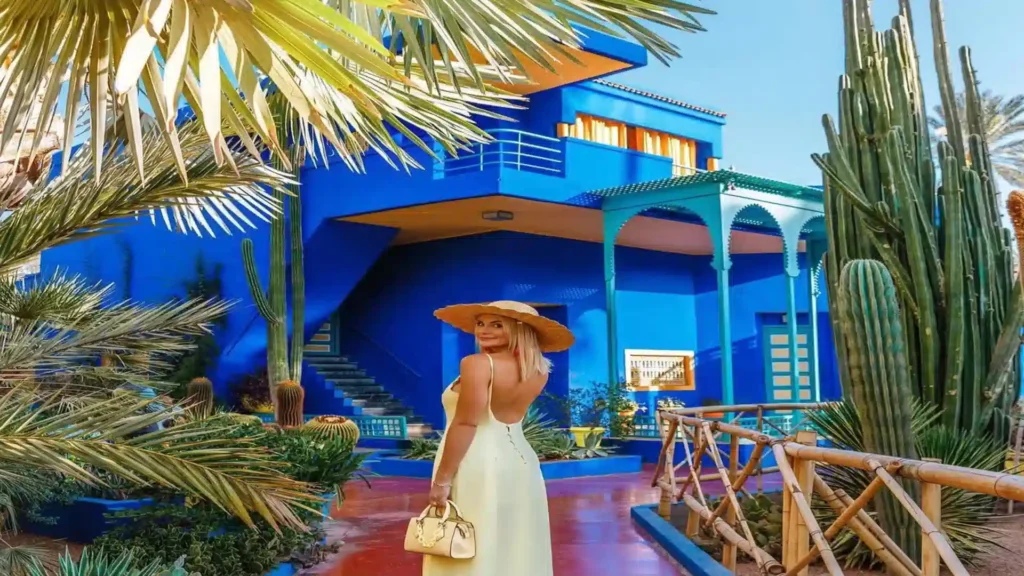
Majorelle Garden Marrakech – Favorite place for pictures
1. The Garden Was Nearly Demolished Twice — and Both Times Was Saved by French Designers
The Majorelle Garden Marrakech has been slated for demolition twice and saved twice. The first threat to the garden was when Jacques Majorelle divorced in 1950, and the property was sold. If the new owners had decided to develop it for commercial purposes (as many of the surrounding properties were at the time in the post-war period), the garden would have disappeared. The second most serious threat occurred in 1979-1980 when serious plans were drawn up to demolish the garden and replace it with a hotel. Yves Saint Laurent and Pierre Bergé’s 1980 purchase was not the casual acquisition of affluent collectors – it was an emergency rescue with a week or two to spare. This context gives the garden a certain quality, for those who know. It is not just beautiful, but contingently beautiful, a beauty that almost didn’t come to be, and that must be actively maintained and protected if it is to continue to be.
2. The Specific Blue Was Inspired by Moroccan Islamic Tile Tradition, Not by European Painting
Most descriptions of Majorelle Blue present it as Majorelle’s own artistic invention, a colour created by a European painter in North Africa. It ignores the cultural inheritance that the color draws on. The specific cobalt blue selected for the garden has direct precedents in the tilework tradition of Islamic Morocco: the deep cobalt glazes used in the zellige (mosaic tile) work of the Medersa Ben Youssef in Fes, the fountain tiles of the Saadian Tombs in Marrakech, and the portal ceramics of the Hassan II Mosque in Casablanca all use cobalt pigments in the same blue family. Majorelle didn’t invent this blue, he took it from a thousand years of Moroccan decorative tradition and applied it to his garden. And that is why the colour appears simultaneously alien and Moroccan to any visitor who sees it.
3. Yves Saint Laurent’s Ashes Are in the Garden
This fact is known to those who research before visiting but surprises a significant proportion of visitors who encounter the memorial in the Villa Oasis garden without expecting it. Yves Saint Laurent’s ashes were scattered in the rose garden of the Villa Oasis — the private garden adjacent to the main Jardin Majorelle — in June 2008, following his death in Paris. A small memorial sculpture by Jaume Plensa, featuring a Moroccan geometric tile pattern, marks the general location. The Villa Oasis private garden (open except Wednesdays, included in the main garden ticket) is a quieter, more intimate space than the main Jardin Majorelle — worth visiting specifically to understand why Saint Laurent loved Morocco, through the evidence of how he chose to spend the rest of eternity here.
4. The Century-Old Palms Predate the Garden
The date palms that are oldest in Majorelle Garden Marrakech predate the garden by a long shot. When Jacques Majorelle bought the land in 1923 it was not entirely empty – there were several established date palms growing there, indicating that the land had been cultivated (or at least used for water access) for at least a century before he bought it. These palms, now huge, with trunks of 3 ft circumference and canopies of 15–20 metres above the garden floor, are the oldest living elements of the site. They are at least 50 years older than Majorelle Blue, and they will almost certainly survive whatever follows the stewardship of the Foundation Pierre Bergé–YSL.
5. The Garden Has Its Own Water Source — a Roman-Era Underground Canal
The extraordinary plant diversity of the Jardin Majorelle in a semi-arid climate (Marrakech receives less than 250 mm of rain annually) could only be achieved through a khettara: an ancient underground irrigation canal, part of the system that has provided the groundwater for Marrakech since the time of the Almoravids and that, in turn, is based on even older irrigation infrastructure, dating to Roman-era settlements in the region. The garden’s khettara taps the same underground water table that feeds the Agdal Gardens and the Menara olive groves—a hydraulic infrastructure more than 1,000 years old. And that is the reason why the lily pond does not dry up in summer; why the bamboo grove does not turn yellow in drought years; why century-old palms continue to produce dates in what is technically a desert climate. The beauty of the garden is not despite its location — it is because of an ancient human engineering solution to the fundamental problem of water in a dry land.
Practical Tips for Visiting Majorelle Garden Marrakech (2026)
How to Get There
- From Djemaa el Fna: 10–15 minutes by petit taxi (15–25 MAD) or 30 minutes on foot via Rue Bab Doukkala and Rue Yves Saint Laurent. Walking is pleasant in the cooler morning hours.
- From Guéliz hotels: 10 minutes on foot from the Avenue Mohammed V to the garden entrance on Rue Yves Saint Laurent.
- By taxi: Tell the driver “Jardin Majorelle” or “Musée YSL” — both are universally known to Marrakech taxi drivers. Insist on the meter or agree a fixed price of 20–30 MAD from the medina before departure.
What to Bring
- Your booking confirmation — QR code on your phone or printed. Save it offline before leaving your hotel as garden WiFi may be limited at peak times.
- Sunscreen and a hat — the cactus garden and the main garden paths are exposed to direct sunlight. The Moroccan sun is stronger than it appears.
- A charged phone — you will photograph more than you expect.
- Cash — the garden café accepts cards, but nearby street vendors and taxis require cash.
On-Site Facilities
- Café Majorelle — the on-site café serves drinks, light lunches, and pastries in a shaded courtyard setting. Good mint tea, reasonable prices by Marrakech standards (30–60 MAD for drinks and snacks). Quality of food is adequate rather than exceptional.
- The Majorelle Shop — sells Majorelle Blue–themed ceramics, textiles, books, and artisan products. The ceramics (bowls, plates, and tiles in the Majorelle Blue glaze) are genuinely beautiful and make some of the best design-quality souvenirs available in Marrakech. Prices are higher than the medina but reflect genuine quality and authenticity.
- Luggage storage — a storage area near the entrance accepts backpacks and small bags. Large suitcases may not be accommodated.
- Toilets — available at the garden entrance and near the Berber Museum. Clean and maintained.
- Wheelchair accessibility — the garden paths are mostly paved and navigable by wheelchair. The Berber Museum interior is accessible. Some garden sections with gravel paths are more difficult.
Visit Majorelle Garden as Part of Your Marrakech Tour
Over Morocco Tours includes a guided Majorelle Garden visit — with our English-speaking Marrakech guide providing cultural context on Berber art, the YSL legacy, and the garden’s botanical significance — as an optional add-on to any desert circuit starting in Marrakech.
We book timed entry slots on your behalf and seamlessly coordinate the visit with your overall tour schedule.
+212 673 952 695
Overmoroccotrip@gmail.com
FREQUENTLY ASKED QUESTIONS: MAJORELLE GARDEN MARRAKECH
Everything you need to know about planning your visit, tickets, timing, and history. Click any question below to expand the answer.
Is Majorelle Garden worth visiting in 2026?
+
Yes, Majorelle Garden Marrakech is absolutely worth visiting in 2026 — with one important qualification about timing. If you visit between 11am and 3pm on a peak day, the garden is genuinely crowded and the experience is significantly diminished. If you visit at opening time (8:00am) or in the late afternoon (4:30–6:00pm), the garden rewards you with one of the most visually extraordinary experiences available in Morocco. The combination of Majorelle Blue architecture, 350+ plant species from 5 continents, a world-class Berber art museum, and the YSL legacy is genuinely unique. Arrive at 8:00am with a timed entry booking and you will leave having seen one of the finest gardens in Africa.
How much does Majorelle Garden cost to enter in 2026?
+
Majorelle Garden entry costs 170 MAD (approximately £13.50 / $17) for tourist adults as of July 2026. The Pierre Bergé Museum of Berber Arts inside the garden costs an additional 60 MAD. The Musée Yves Saint Laurent (adjacent, separate building) costs 140 MAD. A combination ticket covering the garden, Berber Museum, and YSL Museum costs 290 MAD (approximately £23 / $29) and represents the best value for a full visit. Children under 10 are admitted free. Moroccan citizens pay 75 MAD. International students with valid ID pay 95 MAD. Book all tickets in advance at the official website tickets.jardinmajorelle.com — do not purchase from third-party sites as fraudulent tickets are widely sold.
What time does Majorelle Garden open?
+
Majorelle Garden Marrakech opens daily at 8:00am, with last entry at 6:00pm and closing at 6:30pm. The Pierre Bergé Museum of Berber Arts opens at 8:30am daily. The Musée Yves Saint Laurent Marrakech opens at 10:00am daily except Wednesday (closed Wednesdays), with last admission at 5:30pm. The Villa Oasis private garden is open daily except Wednesday, from 8:00am to 5:30pm. Hours may vary slightly during Ramadan and major Moroccan public holidays — always check the official website before visiting.
Who created Majorelle Garden?
+
Majorelle Garden was created by French painter Jacques Majorelle (1886–1962), who bought the land in 1923 and spent 40 years developing it into a botanical garden with 135+ plant species from 5 continents. He painted the studio and villa in his signature cobalt blue — now internationally known as Majorelle Blue — in 1937. After his death in 1962, the garden deteriorated. In 1980, fashion designer Yves Saint Laurent and his partner Pierre Bergé purchased the property and undertook a complete restoration, eventually more than doubling the plant collection to 350+ species. Saint Laurent’s ashes were scattered in the adjacent Villa Oasis rose garden after his death in 2008. The garden is now owned and operated by the Foundation Pierre Bergé–Yves Saint Laurent.
Do I need to book Majorelle Garden tickets in advance?
+
Yes — booking in advance is strongly recommended and on peak days (weekends in spring and autumn, school holiday weeks) is effectively essential. Majorelle Garden issues timed entry slots and operates strict daily visitor capacity limits. On peak days, morning slots sell out online the evening before. The official booking website is tickets.jardinmajorelle.com — this is the only valid booking source. Third-party websites selling Majorelle Garden tickets are frequently fraudulent and will not be accepted at the gate. Book at least 2–3 days ahead in spring and autumn; 1–2 weeks ahead during Easter week and summer holidays.
What is Majorelle Blue?
+
Majorelle Blue is the specific cobalt blue paint colour that French painter Jacques Majorelle first applied to his studio villa at the Jardin Majorelle in Marrakech in 1937. The colour is an intense, vivid cobalt — derived from ultramarine pigment in the same tradition as the cobalt glazes used in Moroccan zellige (mosaic tile) work for centuries. What distinguishes it visually is how it responds to Moroccan sunlight: it appears to emit its own light rather than merely reflecting it, particularly in the clear, high-UV light of Marrakech. The colour has been legally registered as a trademark by the Foundation Pierre Bergé–YSL and is one of the few colours in the world named for a specific artist and place. The approximate Pantone equivalent is PMS 661 C, though the garden’s own paint formulation differs slightly from this commercial standard.
What is the best time to photograph Majorelle Garden?
+
The best time to photograph Majorelle Garden is at opening (8:00am) for the classic lily pond reflection shot with still water and soft morning light, and between 4:30pm and 6:00pm for golden hour photography of the Majorelle Blue villa facade. The midday period (11am–3pm) produces the harshest light and the most crowded conditions — the least favourable for photography. The three shots most worth planning for: the lily pond reflection (requires 8am arrival, still water, papyrus framing), the blue archway with magenta bougainvillea (best March–May bloom, morning light from the east), and the columnar cacti silhouettes against the blue sky (any morning, underexposed for drama).
How long does it take to visit Majorelle Garden?
+
The Jardin Majorelle can be walked in 45–60 minutes at a comfortable pace. However, most visitors who are genuinely engaged with what they are seeing — photographing, sitting by the pond, reading labels in the cactus garden — spend closer to 75–90 minutes in the garden itself. Adding the Pierre Bergé Museum of Berber Arts extends the visit by 30–45 minutes. Adding the Musée Yves Saint Laurent Marrakech extends it by another 60–75 minutes. A complete visit to garden + Berber Museum + YSL Museum + on-site café stop requires 2.5–3 hours. Plan accordingly when booking your entry slot time.
Majorelle Garden Marrakech: Final Thoughts from Our Guides
There is a specific quality that the finest gardens in the world share: they make you forget, briefly and completely, where you are. The bamboo groves of Jardin Majorelle make you forget you are in a city of a million people. The lily pond in the early morning makes you forget you are in Africa in any metropolitan sense. The Majorelle Blue, seen for the first time in the specific quality of Moroccan morning light, makes you forget you have a flight to catch, a schedule to keep, a world outside the garden walls.
This capacity for transport — for temporarily relocating the person who stands in it — is what Jacques Majorelle spent 40 years building, what Yves Saint Laurent spent 28 years protecting, and what the Foundation Pierre Bergé–YSL is committed to maintaining for the travelers who will come here long after all of them are gone. It is, in the end, the reason a 2.5-acre garden in Marrakech has become one of the most significant cultural destinations in Africa — not because of what it is, but because of what it briefly makes you.
Book the 8am slot. Bring your best camera or just your phone. Stand at the lily pond at 8:15am before anyone else arrives. Give yourself five minutes of silence. The rest will take care of itself.
🔗 Related Guides & Tours — Over Morocco Tours
- Things to Do in Marrakech: 25 Best Attractions & Activities (2026)
- Djemaa el Fna Marrakech: Complete Visitor Guide 2026
- The Hand of Fatima: Berber Culture & Meaning in Morocco
- Morocco Cooking Class: Learn to Cook Moroccan Food in Marrakech
- 3 Days Tour from Marrakech to the Sahara Desert
- Stargazing in Morocco: From the Majorelle Garden to the Sahara Sky
- Morocco in December: Is Marrakech Worth Visiting in Winter?