Stargazing in Morocco: Best Spots & Sahara Desert Sky Guide (2026)
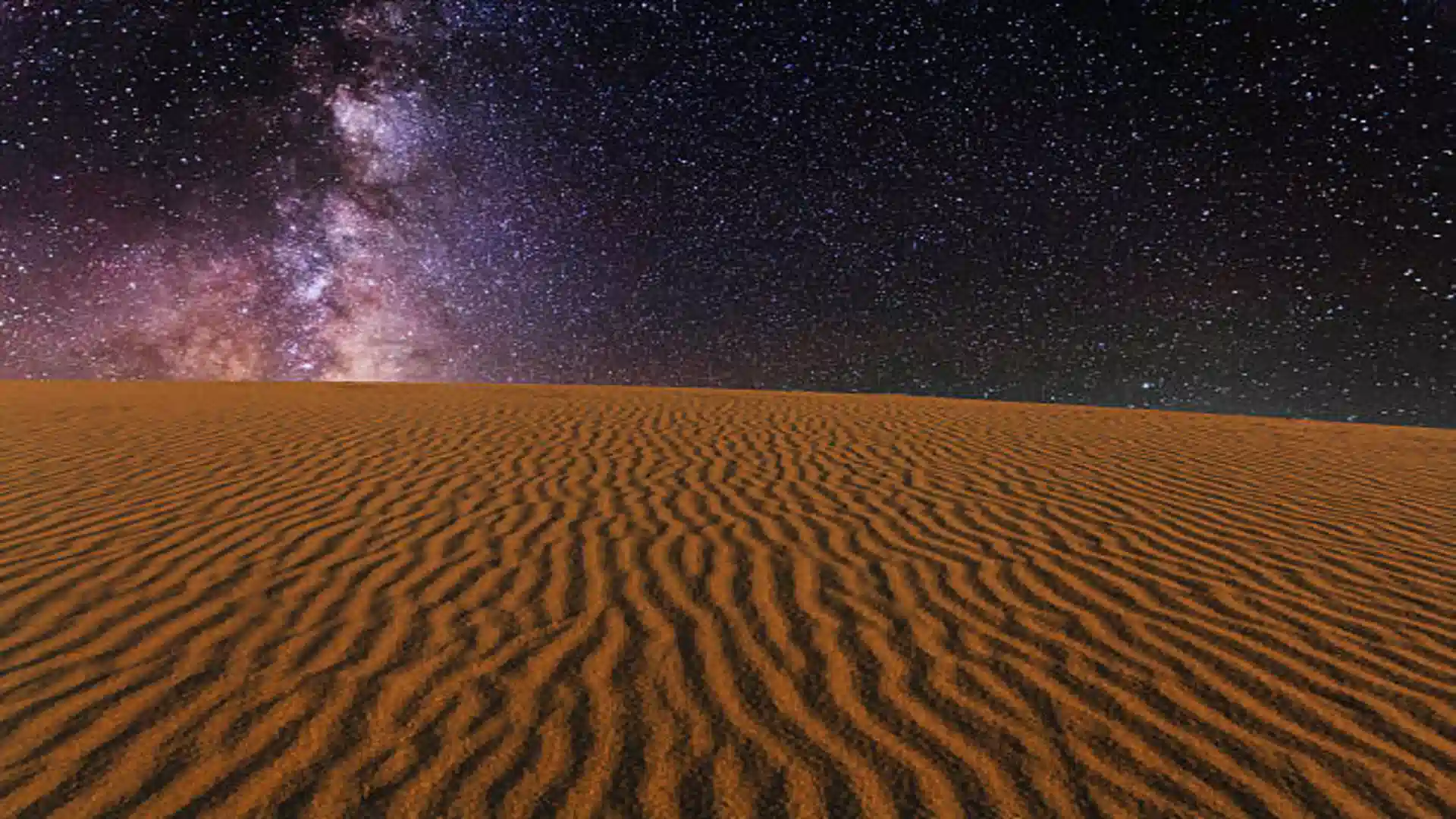
Stargazing in Morocco is the single most visually overwhelming moment for most travelers who experience it, and for many, of their entire lives. The reason is simple and quantifiable: the Sahara Desert above Erg Chebbi is rated a 2 on the Bortle Scale, making it one of the darkest skies on Earth. At this level of darkness the Milky Way is not the faint smear seen from rural countryside; It is a thick three-dimensional pattern of light, a bright band of billions of individual stars from horizon to horizon, wide enough to cast a faint shadow on the sand below. The Andromeda Galaxy, 2.5 million light years away, the farthest object visible to the human eye, appears as a small but definite oval of diffuse light about three times the width of the full moon. The Large Magellanic Cloud can be seen above the southern horizon on the clearest nights from October to March.
Over Morocco Tours has been taking guests to the Erg Chebbi stargazing in Morocco experience since 2012. Our desert camp is around 7 km from the nearest road lighting; our guides Lhcen, one of them, has been navigating these dunes by starlight for more than 14 years, combining the practical knowledge of professional desert operators with a deep personal relationship with the Sahara night sky. This guide will provide you with everything you need to plan the best stargazing Morocco experience in 2026. The science behind why Morocco’s sky is so extraordinary. How to choose the best dates. What to expect during an overnight camp and how to photograph the Milky Way above the Erg Chebbi dunes.
Erg Chebbi dunes, Merzouga — 7 km from nearest road lighting
New moon ±3 days for darkest sky; full moon for dune photography
Class 2 — Truly dark sky, among the darkest in Africa
11 pm – 4 am — peak darkness after moon sets
4,000–4,500 individual stars with naked eye on best nights
7–14°C at peak stargazing hours in spring; 0–4°C in winter
Visible year-round, best June–August (galactic core), Nov–Mar (winter arm)
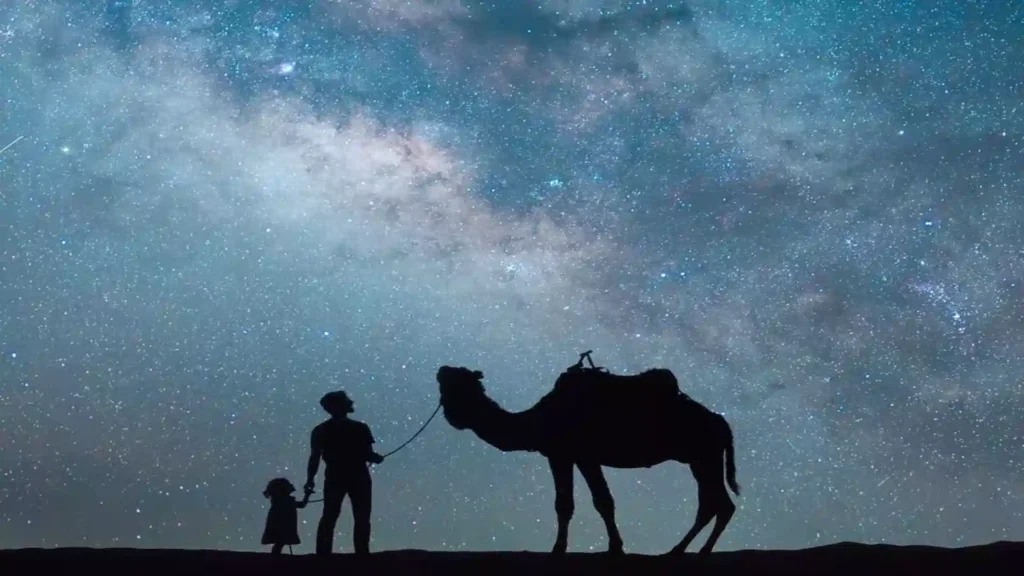
Overnight camel trek to Erg Chebbi desert camp — Over Morocco Tours
Table of Contents
Why Stargazing in Morocco’s Sahara Is Unlike Anywhere Else
Stargazing in Morocco at Erg Chebbi is extraordinary for four specific, measurable reasons that distinguish it from stargazing anywhere in Europe, North America, or most of the rest of Africa.. Learning these reasons helps you to understand what you are really seeing—and why it consistently produces the emotional response it does in travelers who have never seen a truly dark sky before.
1. The Bortle Scale: What Class 2 Actually Means
The Bortle Dark-Sky Scale, created in 2001 by amateur astronomer John E. Bortle, rates the darkness of the night sky from Class 1 (the absolute darkest skies on earth, found only in the most remote deserts and high-altitude locations) to Class 9 (the inner city, where only a handful of the very brightest stars are visible through light pollution). Most suburban places in Europe and North America score Class 6-8. Class 4–5 is typically the rural countryside. The Erg Chebbi dunes above our Morocco stargazing tour camp are consistently rated Class 2 on the Bortle Scale—a level at which the Zodiacal light (sunlight reflected by dust in the plane of the solar system) is visible as a distinct cone rising from the horizon, the airglow of the upper atmosphere is perceptible as a faint uniform luminosity across the entire sky, and the Milky Way casts a measurable shadow on pale ground surfaces including sand.
Understand sky darkness and star visibility levels around the world.
OUR CAMP ★
2. Zero Humidity and Minimal Atmospheric Dust
The clarity of the sky above the Sahara Desert is not just about the absence of electric light — it is about the extraordinary optical quality of the air itself. The Erg Chebbi region receives less than 20 mm of rainfall annually, resulting in near-zero atmospheric humidity for the majority of the year. Humidity is the primary source of atmospheric scintillation (the “twinkling” effect) and diffuse sky glow that degrades astronomical observation from humid locations like coastal Europe or Southeast Asia. Above the Sahara on a calm, clear night, stars near the horizon show minimal twinkling compared to the same stars seen from a European observatory. The transparency of the air is exceptional enough that experienced astronomers consistently note that objects appear at a higher magnitude (fainter, more distant objects become visible) from Erg Chebbi than from certified International Dark-Sky Association reserves in Europe at comparable altitudes.
3. The Sahara’s Specific Latitude
Merzouga sits at approximately 31° North latitude — a position that provides access to a uniquely broad slice of the celestial sphere. From this latitude, you can observe the entire northern sky including Polaris (the North Star), the Big Dipper, Cassiopeia, and Perseus, while also seeing deep into the southern sky: Scorpius rises high above the horizon in summer, the Centaurus constellation (home to Alpha Centauri, the closest star system to our own) is visible low in the south, and on the clearest nights between October and March, the Large Magellanic Cloud — a satellite galaxy of the Milky Way, visible only from approximately 20°N latitude and southward — appears as a faint but distinct patch of diffuse light above the southern horizon. This southern reach, combined with full northern hemisphere sky visibility, makes Merzouga stargazing astronomically richer than comparable dark sky locations in northern Europe or Canada.
4. The Physical Environment of Observation
Stargazing in the Sahara Desert Morocco benefits from the specific physical environment in a way that no observatory or dark-sky park can fully replicate. You are lying on warm sand that has absorbed 10–12 hours of sunlight, on a dune crest with a 360° unobstructed horizon, in absolute silence, in air that is clean and dry and slightly cool. The dunes themselves block any residual light from the distant village of Merzouga on the western horizon. The physical experience of looking up from this position — lying back on the sand, the vast bowl of the sky overhead, the Milky Way directly above — is qualitatively different from observatory stargazing through a telescope, and most travelers find it more emotionally overwhelming rather than less, despite the absence of magnification.
Stargazing in Morocco — Milky Way above Erg Chebbi glamping camp tents at 2am, Merzouga Sahara Desert, Over Morocco Tours 2026
When Is the Best Time for Stargazing in Morocco? Moon Phase and Season Guide
Timing is the single most important factor in planning a Morocco stargazing experience. Two variables determine sky quality more than any other: the phase of the moon and the season.
The moon is by far the most important source of “light pollution” at a Class 2 dark sky site like Erg Chebbi. The full moon shines so brightly that even the dimmest stars, nebulae and galaxies are hidden, cutting the number of visible stars from 4,500 to about 1,200. For the best Erg Chebbi stargazing, try to be here for the new moon phase. The three days before and after new moon are the darkest. The sky is fully dark during the prime stargazing hours of 11pm-4am, which means the moon is either very thin or below the horizon, setting by 9-10pm. This window
When contacting Over Morocco Tours to book your Morocco stargazing desert camp experience, tell us you want to time your visit around the new moon. We can immediately tell you which dates in your travel window fall within the optimal dark moon period.
27 April
27 May
25 September
25 October
24 November
Season: When the Sky Is at Its Best
Summer (June–August): Galactic Core Season
The Milky Way is best positioned for viewing in Morocco during the summer months. The galactic core, the bright, dense part of the Milky Way around the constellation Sagittarius, rises high above the southern horizon between June and August, and is ideally placed for viewing between 10pm and 2am. This is the Milky Way as seen in the most iconic astrophotography images of the Sahara Desert: a sweeping, complex arc of dense star clouds overhead, with the dust lanes and star forming regions of the galactic bulge visible to the naked eye. The downside of summer stargazing is the heat – daytime temperatures in Erg Chebbi reach 40-44°C, although nights cool quickly after dark to 20-24°C, so the actual stargazing hours are comfortable.
Autumn (September–November): Best All-Round Season
October is our guides’ favourite month for Morocco stargazing tours. In the early evening before setting, the galactic core can still be seen partially in the western sky. The summer heat has gone, the desert night temperatures are comfortable (10–16 °C at midnight) and the autumn sky is bringing the great winter constellations – Orion, Taurus with the Pleiades cluster, Perseus – rising in the east as the night goes on. October is also the time of the peak Orionid meteor shower (around October 21st each year) which produces 15-25 meteors per hour at maximum from a Class 2 dark sky location.
Winter (December–February): Clearest Skies of the Year
The winter months at Erg Chebbi stargazing produce the most atmospheric transparency of the year. Humidity is very low and there is no summer dust haze, allowing faint objects to be seen with unusual clarity. Orion rules the winter sky at a splendid altitude, the Pleiades cluster (the Seven Sisters) is at its greatest altitude and detail and experienced astronomers coming to our camp in January and February invariably report the highest object magnitudes of any season. The big downside? By 3am winter desert nights drop to 0-4C, so serious warm clothing is needed for extended outdoor observing. “That’s why we’ve got an electric blanket in our luxury glamping tent.
Spring (March–May): Most Popular for Stargazing Travelers
Spring is the most popular season for Sahara desert stars Morocco among our guests, as it offers the most comfortable combination of good dark skies, moderate night temperatures (7-14°C at the peak observation hours), and the visual beauty of the spring dune landscape. In April the core of the Milky Way rises in the southeast around 3-4am, giving early risers the chance to see the galactic core in the pre-dawn sky before sunrise. Spring is also the time for the year’s biggest meteor shower, the Eta Aquariids (peak around May 5-6 each year), which produces 50-60 meteors per hour at its peak from the southern sky position of Erg Chebbi.
What Can You See Best Stargazing Merzouga the Sahara Desert Of Morocco?
The following is an honest, specific guide to what is visible during a Erg Chebbi stargazing night in Morocco— not a generic list of “thousands of stars,” but the specific objects, constellations, and phenomena that our guests most frequently photograph, ask about, and describe as the highlight of their desert night.
The Milky Way — Our Galaxy from the Inside
The Milky Way is the disc of our own galaxy seen from inside, a roughly 200–400 billion stars condensed into a band of light by the geometry of our position inside the spiral arm. As a Class 2 site, such as Erg Chebbi, the Milky Way is visible all year round and has interesting internal structure: the dark dust lanes crossing the galactic plane are visible as non-luminous gaps against the background of the stars; the central bulge of the galaxy (in Sagittarius, best seen June–August) looks like a widening, brighter segment of the band; individual star-forming nebulae such as the Lagoon Nebula (M8) and the Omega Nebula (M17) are visible as slightly brighter patches within the band of the Milky Way. This is shown by our guides to all the groups.
The Andromeda Galaxy (M31)
The Andromeda Galaxy is the most distant object visible to the naked eye at some 2.537 million light years. From a Class 2 site it looks like an oval smear of diffuse light – about 3× the apparent diameter of the full moon. It is in the constellation Andromeda and is best seen from September through November as it passes high overhead. For many of our guests it’s a special knowledge that the light that they are looking at with their naked eye left its source before modern humans were on earth.
See Planets With Morocco Stargazing Tour
The four Galilean moons of Jupiter (Io, Europa, Ganymede & Callisto) are seen as a straight line of tiny points flanking the planet through standard 8×42 binoculars which we have at our desert camp for guest use..
Meteor Showers
Several of the year’s major meteor showers produce spectacular displays from Erg Chebbi. The Perseids (peak August 12–13) produce 80–100 meteors per hour at maximum from a dark site — the most impressive single-night meteor display of the year. The Geminids (peak December 13–14) produce 120+ meteors per hour, making them technically the most prolific shower of the year, though the winter cold requires determination. The Leonids (peak November 17–18) and Orionids (peak October 21) both provide reliable 20–40 meteors per hour from Erg Chebbi.
What to look out for in the night sky over Erg Chebbi across the seasons.
Winter / Spring
The most recognisable constellation in the sky — three-star belt, the red giant Betelgeuse, the blue supergiant Rigel. From Erg Chebbi in winter, Orion transits directly overhead, giving maximum clarity. The Orion Nebula (M42) is visible as a distinct fuzzy patch below the belt.
Summer
The great summer constellation — its distinctive curved tail and the red supergiant Antares at its heart. Scorpius rises high from Erg Chebbi’s southern latitude in summer, giving European travelers their finest view of this constellation, which never rises above the horizon from northern UK or Scandinavia.
September – April
The most beautiful naked-eye star cluster in the sky. From a Class 2 site like Erg Chebbi, experienced observers can count 9–11 individual stars rather than the 6–7 visible from suburban locations. Exceptional through 8×42 binoculars.
Autumn / Winter
The W-shaped constellation of Cassiopeia and the adjacent Perseus constellation contain some of the richest star fields visible from Erg Chebbi — including the famous Double Cluster (NGC 869 / NGC 884), two open clusters visible to the naked eye as a double patch of light between the two constellations.
How to Photograph the Milky Way Above Erg Chebbi: Complete Guide
Milky Way photography Morocco is one of the most searched topics among travelers planning a Sahara desert camp night. The combination of Class 2 dark skies, clean dry air, photogenic dunes, and Berber camp tents creates conditions for extraordinary astrophotography. Here is the complete technical guide for photographing the night sky above Erg Chebbi.
| Setting | Recommended Value | Reason |
|---|---|---|
| Aperture | f/2.8 or wider (f/1.8, f/2.0) | Maximum light collection. Wider aperture = brighter stars in shorter exposure |
| ISO | ISO 1600–6400 | Start at ISO 3200. Modern mirrorless cameras handle ISO 6400 cleanly |
| Shutter Speed | 15–25 seconds | Use the 500 Rule: 500 ÷ focal length = max seconds before star trails appear |
| Focus | Manual focus — set to infinity | Autofocus fails in darkness. Use live view, zoom to brightest star, focus manually |
| White Balance | 3500–4000K (Tungsten) | Reduces orange light pollution cast; gives natural blue-to-green Milky Way tones |
| Format | RAW (not JPEG) | Essential for desert astrophotography — allows noise reduction and sky enhancement in post |
| Lens | 14–24mm wide angle preferred | Captures maximum sky area; fits entire Milky Way arc in single frame |
| Tripod | Mandatory | Any camera movement during a 20-second exposure blurs every star |
| Remote shutter | Strongly recommended | Pressing the shutter button causes vibration. Use a remote or 2-second timer |
The Best Composition at Erg Chebbi
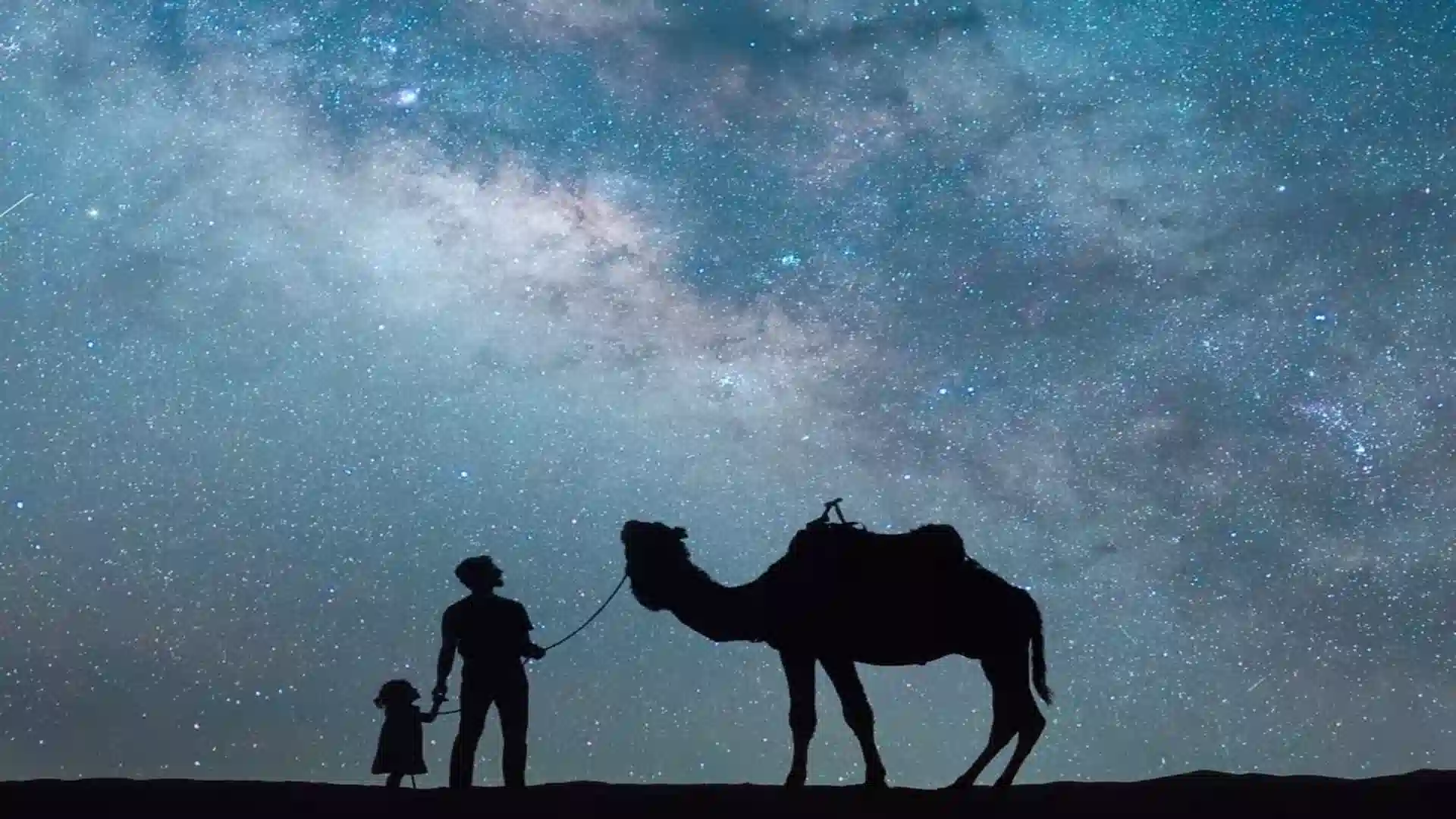
The most powerful Milky Way compositions at Erg Chebbi use the desert camp’s tents or the camel silhouettes as foreground elements against the star-filled sky. Our guides position your tent on arrival specifically so that the tent entrance faces east — toward the rising Milky Way galactic core from June through October. For the classic Sahara astrophotography shot: set your camera on a tripod approximately 5 metres in front of your lit tent (a candle or headlamp inside the tent creates the warm glow that makes the composition work), aim toward the darkest part of the sky, include one or two dune ridges as foreground interest, and expose as above.
PHONE PHOTOGRAPHY FOR STARGAZING MOROCCO
Capturing the Erg Chebbi night sky with modern smartphones.
Modern smartphones — particularly the iPhone 15 Pro/16 series and Samsung Galaxy S24/S25 series — are now capable of producing excellent Milky Way photographs in their “Night Mode” or “Astrophoto” modes.
Use a Phone Tripod: A Joby GorillaPod works perfectly on the sand dunes to maintain absolute stability.
Maximize Exposure: Enable the longest available Night Mode or Astrophoto exposure setting.
Avoid Overexposure: Point toward the darkest part of the sky rather than directly at the bright galactic core.
The results will not match a dedicated camera with a fast wide-angle lens, but are extraordinary by smartphone standards — and more than sufficient to produce a stunning Milky Way image for social media.
Best Stargazing Locations in Morocco Beyond Erg Chebbi
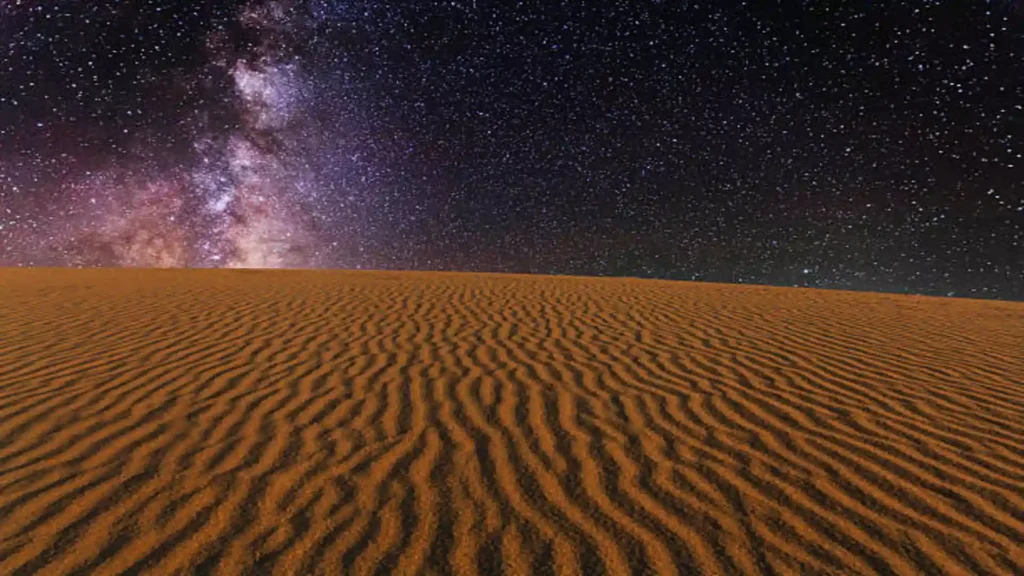
Stargazing in Morocco – beautiful milky way over the Erg Chebbi Dunes of Merzouga
While Erg Chebbi is the finest Morocco stargazing destination and the site of our overnight desert camp, several other locations in Morocco provide excellent dark sky experiences for travelers who are exploring different parts of the country.
Erg Chigaga — Western Sahara (Alternative to Erg Chebbi)
Erg Chigaga, located near the town of M’Hamid in the southwest of Morocco, is the country’s other significant dune field and offers comparable stargazing conditions to Erg Chebbi — Class 2–3 darkness, minimal light pollution from surrounding villages. However, Erg Chigaga is harder to reach (4–5 hours by 4×4 from Ouarzazate) and has fewer developed camp facilities. For travelers specifically prioritizing Sahara stargazing Morocco, Erg Chebbi remains the superior choice for accessibility, camp quality, and guide expertise.
Jebel Saghro — Anti-Atlas Dark Skies
The Jebel Saghro volcanic massif south of Ouarzazate offers excellent dark sky conditions at altitudes of 1,600–2,000 metres, with the additional visual drama of dramatic rocky desert terrain. The high altitude improves atmospheric transparency further and the volcanic landscape creates extraordinary foreground subjects for astrophotography. This is the choice for travelers who want dark sky experience combined with High Atlas Mountain hiking rather than Sahara dune camping.
High Atlas Mountains — Toubkal Area
The High Atlas mountains above Imlil and the Toubkal base camp (3,200 metres) offer Class 3–4 dark skies that, while not matching the Sahara’s darkness, provide altitude-enhanced transparency and extraordinary mountain foregrounds for astrophotography. Orion above the snow-capped Toubkal massif in winter is one of the finest landscape astrophotography compositions available in Morocco.
Why Erg Chebbi Remains the Best
None of the above alternatives match Erg Chebbi for the combination of sky darkness, physical comfort of observation (lying on warm sand rather than cold rock), the complete absence of wind-break obstacles allowing a full 360° horizon, the cultural depth of the overnight Berber camp experience, and the extraordinary aesthetics of the dune landscape at night. Stargazing in Morocco at Erg Chebbi is not just astronomical observation — it is a complete sensory and cultural experience that no other Morocco location can replicate.
Practical Guide to Stargazing in Morocco: What to Bring and Expect
What to Wear for Desert Stargazing
The primary practical challenge of stargazing in the Sahara Desert Morocco is temperature. Desert nights cool rapidly after sunset and reach their coldest point between 2am and 4am — precisely the prime observation window. In spring (March–May), peak stargazing temperatures at Erg Chebbi range from 7–12°C. In winter (December–February), they drop to 0–4°C. In summer (June–August), nights remain comfortable at 18–24°C. The standard layering recommendation: a long-sleeve base layer, a fleece mid-layer, a down jacket or puffer outer layer, and warm socks. Your wool blanket from the desert tent is invaluable for lying on the dune during extended observation sessions — bring it outside with you after midnight.
Equipment Our Camp Provides
- 8×42 binoculars — available for guest use at all overnight camps. Excellent for the Pleiades, Jupiter’s moons, the Andromeda Galaxy, and the Double Cluster in Perseus
- Red headlamp — provided to each guest. Red light preserves night vision (white light destroys dark adaptation in seconds); essential for moving around camp without ruining your stargazing
- Star map — printed seasonal star chart provided in Arabic, English, and French
- Guide interpretation — Lhcen and our desert guides have navigated by stars for over a decade and know the major constellations, planets, and seasonal patterns by name in Berber, Arabic, and English
Apps for Morocco Stargazing
- Stellarium Mobile — best free planetarium app, works offline after initial download, shows exactly what is overhead in real time
- Sky Map (Google) — point your phone at the sky and see constellation overlays in real time
- PhotoPills — the essential tool for planning Milky Way photography, shows exact galactic core position and rise time for any date and location including Merzouga coordinates
- Clear Outside — cloud cover and atmospheric transparency forecast, useful for selecting the clearest night during a multi-day stay
DOWNLOAD BEFORE YOU GO
Prepare your mobile apps before venturing into the desert.
All stargazing apps should be downloaded and set up before you leave your home country. Mobile data coverage at Erg Chebbi is minimal (7 km deep from the nearest road), and the desert camp has no Wi-Fi.
★ FREQUENTLY ASKED QUESTIONS: STARGAZING IN MOROCCO
Click on any question below to expand the full details.
Book Your Erg Chebbi Stargazing Night In Morocco 2026/2027
Stargazing in Morocco at our Erg Chebbi desert camp is not simply an observation session it is a complete reorientation of scale. You arrive via camelback at sunset, eat dinner under the first stars of the evening, watch the Milky Way emerge and strengthen as the sky darkens, and then lie on warm Sahara sand at 1am with 4,500 individual stars overhead and the complete silence of one of the world’s most extraordinary environments surrounding you. It is the experience that our guests most consistently describe — not the camel trek, not the dunes, not the food, though all of those are extraordinary as the moment their Morocco trip became something different from travel. Something closer to perspective.
Over Morocco Tours has been guiding guests to this sky since 2012. Our camp sits 7 km deep in the Erg Chebbi dune field, at a Class 2 Bortle Scale dark sky rating, with native Berber guides who know the constellations by their traditional Arabic names. We can plan your visit around the new moon for maximum sky darkness, provide binoculars and star maps, and help you capture the Milky Way on camera. Contact us today for your 2026 Morocco stargazing tour dates.
★ RESERVE YOUR SAHARA STARGAZING NIGHT — 2026
Bortle Scale 2 dark skies • Milky Way visible year-round • Overnight desert camp 7 km deep in Erg Chebbi • Native Berber guides • New moon dates on request • Private and group packages available.
Related Guides and Experiences — Over Morocco Tours
- What Is It Like to Sleep in the Sahara Desert? — Full Experience Guide
- Camel Trekking in Merzouga: Complete 2026 Guide
- 3 Days Tour Marrakech to Merzouga — Book Now
- 5 Days Marrakech to Merzouga and Fes — Full Circuit
- Morocco Tours from the USA
- Morocco Tours from the UK
Amateur Astronomer
Milky Way Photographer
Ibrahim has taken hundreds of photos of the Milky Way over Erg Chebbi in 14 years, and has guided travelers through the stargazing experience at our desert camp in every season. His professional knowledge of photography, expertise in astronomy and deep familiarity with the sky of Erg Chebbi make him the definitive guide to stargazing experiences in Morocco.