What Is It Like to Sleep in the Sahara Desert? A Night in Erg Chebbi Glamping Camp (2026)
What Is It Like to Sleep in the Sahara Desert? A Night in Erg Chebbi Glamping Camp (2026)
An honest, hour-by-hour account of what really happens when you spend a night inside the Erg Chebbi dunes — written by the people who live there.
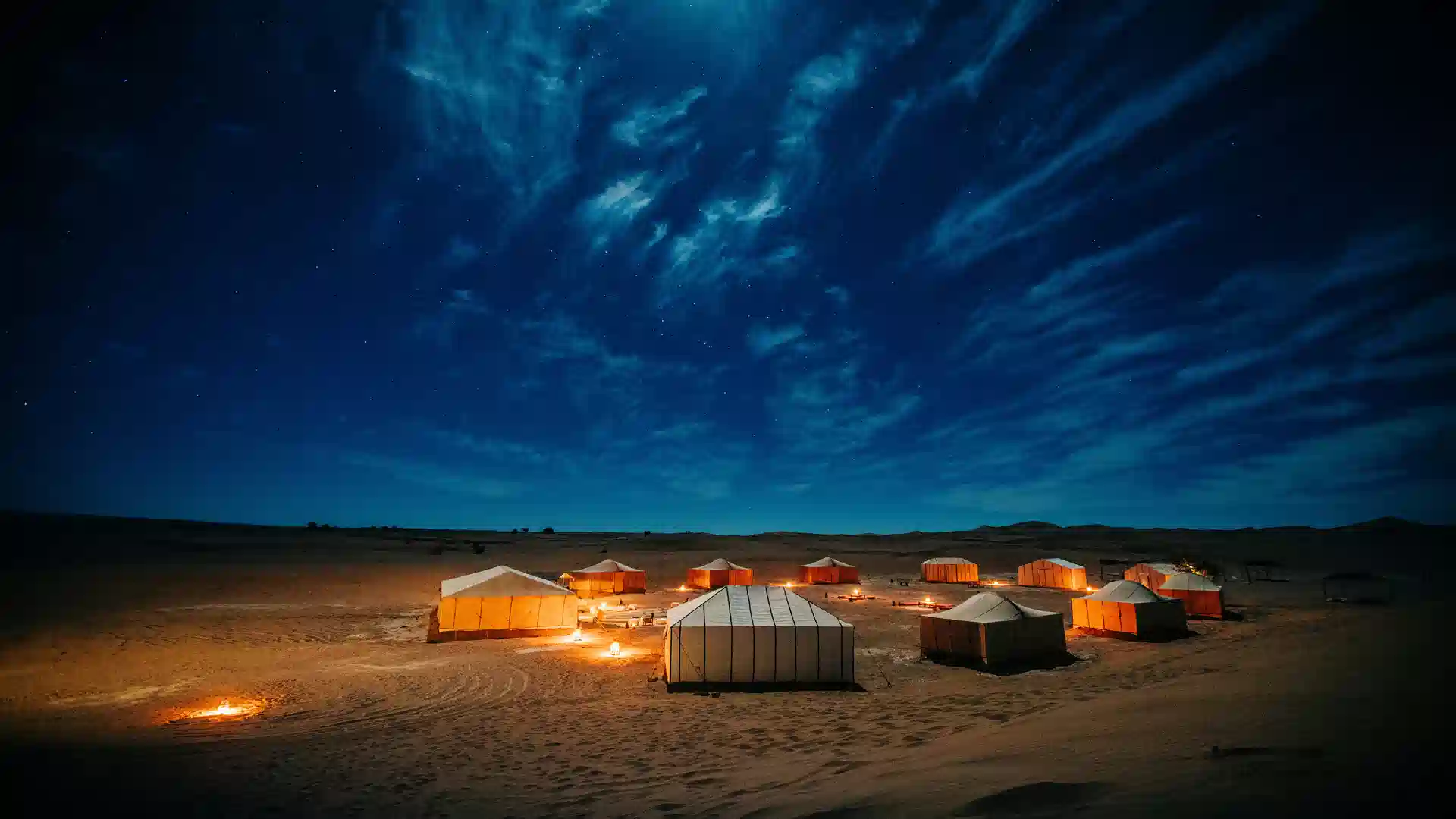
Sleeping in the Sahara Desert is the kind of experience people describe years later with the same precision they use for the most significant moments of their lives. Not because anything dramatic happens — no adventures, no dangers, no extraordinary plot twists. But because the Sahara at night is one of the very few places left on earth where the world around you becomes completely, impossibly still. No traffic. No screens. No artificial light of any kind. Just 150-metre dunes glowing faintly silver under a sky so dense with stars it appears three-dimensional.
At Over Morocco Tours, we have been guiding travelers to our Erg Chebbi glamping camp deep in the dune heart since 2012. We hear the same thing from guests every single morning at sunrise: “I had no idea it would feel like this.” This guide exists because the question “what is it like to sleep in the Sahara Desert?” deserves a real, detailed, honest answer — not a brochure. We will walk you through every hour, every sensation, every practical question, and every decision you need to make before your night in our luxury desert camp Morocco.
Whether you are considering a Merzouga overnight experience for the first time or upgrading from a basic shared camp to a luxury desert camp in Erg Chebbi, everything you need is here.
- The SoundComplete silence — the deepest silence most travelers have ever experienced. Occasional soft wind over the dune crests after midnight.
- The TemperatureWarm at dusk (25–30°C in spring), cooling rapidly after 10pm, cold by 3am (8–12°C in spring; near 0°C in winter). Always bring layers.
- The SkyZero light pollution. The Milky Way is visible to the naked eye with striking clarity. Between 3,000 and 4,500 individual stars visible without a telescope.
- The TentStandard: shared Berber tent, foam mattress, wool blankets. Luxury glamping: private en-suite tent, king-size bed, proper bedding, private bathroom.
- The SleepLighter than at home — the unfamiliar silence and cool air mean most guests sleep in shorter cycles, waking naturally 2–3 times to look at the stars.
- The MorningThe most extraordinary hour. Pre-dawn blue light, sunrise over the dunes, and a breakfast of mint tea, amlou, bread, and eggs around the campfire.
- Overall VerdictConsistently rated by our guests as the single most memorable night of their entire Morocco trip and for many, of their lives.
Table of Contents
Sleeping in the Sahara Desert: What Nobody Tells You Before You Go
Every travel blog about sleeping in the Sahara Desert shows you the same two photographs: a camel silhouette at sunset and a tent under the stars. What they rarely tell you is what the experience actually feels like from the inside the specific textures, sounds, temperatures, and emotional shifts that make a night in the Erg Chebbi glamping camp something genuinely different from every other travel experience on earth.
The first thing that surprises almost every traveler is the silence. The Sahara Desert is one of the least acoustically polluted environments remaining on the planet. There are no roads within 6–8 kilometres of our luxury desert camp Morocco. There are no towns, no airports, no power lines, no dogs. The dunes themselves absorb sound rather than reflecting it. When the wind drops after midnight — which it almost always does — the silence becomes something you can almost physically feel. Guests who live in cities often describe a mild disorientation in the first hour, as though something is wrong because nothing can be heard.
The second surprise is the cold. The Sahara has an extreme diurnal temperature range — the difference between its daytime and nighttime temperatures is among the largest of any environment on earth. In spring (March–May), daytime temperatures at Erg Chebbi regularly reach 28–34°C. By 11pm, that same air has dropped to 12–15°C. By 3am, it frequently sits at 7–10°C. In winter, sub-zero temperatures at the dune surface are recorded several times each season. Every guest who has ever said “I won’t need a jacket — it’s the desert” has been wrong, and our guides now include this warning in every pre-departure briefing.
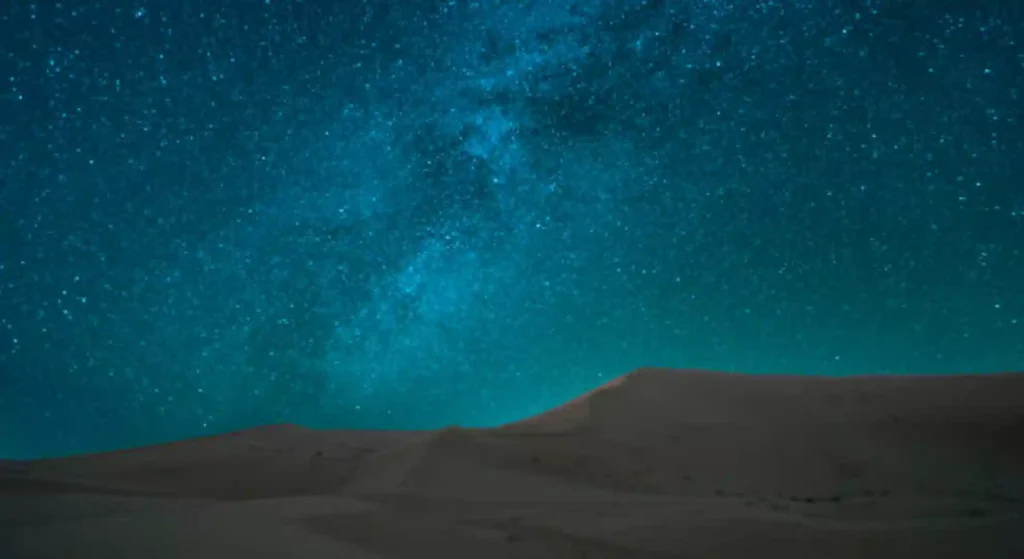
The third surprise — a genuinely pleasant one — is the quality of the darkness. Our Sahara desert camp Morocco sits roughly 7 km from the nearest road lighting, and Merzouga village itself produces minimal light pollution by global standards. The result is a night sky of a quality that the vast majority of travelers from Europe, North America, or urban Morocco have never seen. The Milky Way is not a faint smear — it is a structural feature of the sky, dense enough to cast a faint shadow. The stars do not twinkle so much as vibrate. Experienced astronomers who visit our desert camp Erg Chebbi consistently report Bortle Scale ratings of 2 or lower — among the darkest skies achievable anywhere.
Standard Desert Camp vs Erg Chebbi Glamping Camp: Know the Difference
Not all Sahara desert camp Morocco experiences are the same — and the difference between a basic shared camp and a true luxury desert camp Morocco is significant enough to be worth understanding before you book. Over Morocco Tours operates at the glamping end of this spectrum, but we are transparent about what all options involve.
| Feature | Budget Shared Camp | Standard Camp | Luxury Glamping (Over Morocco) |
|---|---|---|---|
| Tent type | Large shared canvas, 6–10 guests | Individual Berber tent, shared spaces | Private en-suite tent, separate from others |
| Bed | Thin foam mat on ground | Foam mattress, raised base | King-size bed with proper mattress & pillows |
| Bathroom | Shared basic toilet, no shower | Shared facilities, basic shower | Private en-suite with flush toilet & shower |
| Dinner | Simple communal tagine | Traditional Moroccan 3 courses | Gourmet Moroccan multi-course, private table |
| Privacy | None — group setting throughout | Partial | Complete — private guide, private camp |
| Music / Atmosphere | Group campfire, variable quality | Berber musicians at communal fire | Private Gnawa session, personal musician |
| Electricity | None | Solar lantern only | Solar USB charging, bedside lamp |
| Location in dunes | Near dune edge, sometimes road visible | 2–3 km into dunes | 6–8 km in — complete 360° dune horizon |
| Price per person | €25–45 | €60–90 | €120–220 |
Experience the Erg Chebbi Glamping Camp in 2026
Private en-suite tent, king-size bed, gourmet Moroccan dinner, and a native Berber guide — all positioned 7 km deep in the Erg Chebbi dunes. Available year-round with flexible dates.
Book Your Glamping Night Now
+212 673 952 695 · 💬 WhatsApp · ✉ Overmoroccotrip@gmail.com
Hour by Hour: A Complete Night in the Erg Chebbi Glamping Camp
This is the most detailed account of a Merzouga overnight experience available anywhere online. It is written from direct experience — our team sleeps in the dunes regularly, not just to guide guests, but because the Sahara at night is simply where they choose to be. Every time listed below is approximate and adjusts seasonally; your guide will calibrate the schedule to sunset and sunrise times for your specific travel dates.
Departure from Merzouga — Meeting the Camels
Your guide collects you from your riad or hotel in the village and drives 5–10 minutes to the dune edge. The camels are waiting, already saddled. You mount (the guide assists the kneeling-and-rising motion surprises first-timers every time), and the caravan moves into the dunes in single file. The village disappears behind you within the first 15 minutes.
Crossing the Dune Heart — The World Shifts
At approximately the 30-minute mark, a specific psychological shift happens that nearly every guest notices: the last traces of the road, the village rooftops, any mobile signal — all gone. The dunes fill the entire 360° horizon. The silence, which was partial near the village edge, becomes complete. This is the moment most people take their first truly deep breath of the trip.
Arrival at the Erg Chebbi Glamping Camp — Mint Tea Welcome
Your private luxury desert camp Morocco appears seemingly from nowhere — a cluster of dark Berber tents low against the dune face, completely invisible from any road. A staff member greets you with a tray of sweet mint tea and a plate of Ziz Valley dates — the traditional Berber welcome. You are shown to your private tent, given a few minutes to settle, and the evening begins.
Sunset Over Erg Chebbi — The Golden Hour
Your guide leads you on foot to the crest of the nearest high dune — a 10-minute climb in soft, warm sand. From the top, the entire Erg Chebbi dune field is visible: 22 km of orange-red sand rolling to the south, the Atlas Mountains faintly outlined on the western horizon, and the sun descending in a sky that turns amber, then flame-red, then deep violet. The temperature, which was 28°C at the dune base, drops noticeably at the crest as the first cool night air rises from the desert floor below.
Dinner at the Desert Camp — Three Courses Under the Stars
Dinner at our Erg Chebbi glamping camp is a gourmet Moroccan multi-course meal served at a private table set on a sand-floor terrace outside your tent. The sequence: harira soup with fresh bread and olive oil; a slow-cooked lamb or vegetable tagine with preserved lemon and olives, served with hand-rolled couscous; a dessert of fresh fruit, honey, and pastilla au lait (a Moroccan cream pastry). The entire meal is cooked on traditional clay braziers by our camp cook using produce sourced from Rissani market and the Ziz Valley date growers. Candles in carved brass lanterns provide the only light. The stars, visible from the first moment of true darkness around 8:30pm, begin appearing one by one above the dune rim.
Gnawa Music Around the Campfire
After dinner, your Berber guide and a musician sit around a small campfire between the tents and play guembri — the three-string bass lute central to Gnawa music — and bendir hand drum. Gnawa is a West African-rooted musical tradition brought to Morocco by sub-Saharan traders and enslaved peoples centuries ago along the same trans-Saharan caravan routes your camels traversed this afternoon. The rhythms are hypnotic, repetitive, and specifically designed for late-night desert listening. Most guests sit for 45–90 minutes before the cold and the silence draw them toward the tent.
Stargazing — The Milky Way at Full Strength
By 11pm, the sky above our desert camp Erg Chebbi has reached maximum darkness. This is the moment for serious stargazing. The Milky Way — the galactic arm of our galaxy, containing between 100 and 400 billion stars — is visible as a dense, three-dimensional structure stretching from one horizon to the other. Your guide can point out Orion’s Belt, the Pleiades star cluster, the planet Jupiter (visible to the naked eye as a steady non-twinkling point), and, on clear nights, the Andromeda Galaxy — the most distant object visible to the human eye at 2.5 million light years. If you are visiting near a new moon (we recommend this), the sky is at its most extraordinary. If visiting on a full moon, the dunes glow silver-white in a completely different kind of beauty.
Inside the Tent — What Sleeping in the Sahara Actually Feels Like
The luxury tent at our Erg Chebbi glamping camp is approximately 4 metres by 3.5 metres, with a ceiling height of 2.2 metres at the apex. The walls are hand-woven Berber wool over a wooden frame — the same construction method used in this region for at least 400 years, refined today with modern insulation lining. Inside: a king-size bed with a proper sprung mattress, high-thread cotton sheets, and three layers of wool blankets. A private bathroom annex contains a flush toilet and a hot shower (solar-heated water, genuinely warm until approximately 10pm; warm rather than hot after midnight). A small brass lantern on the bedside table provides soft light. There is no Wi-Fi, no television, and intentionally no phone signal. The effect is immediate and complete — sleeping in the Sahara Desert forces a total digital detox that no city retreat can fully replicate.
The Deep Hours — The Coldest, Quietest, Most Extraordinary Part
Most guests wake once or twice between 2am and 4am — not from discomfort, but from the instinctive sense that something remarkable is happening outside. Stepping out of the tent at 3am for a few minutes is an experience that guests consistently describe as the most profound of the entire Merzouga overnight experience. The cold is real (8–12°C in spring, colder in winter — your wool blanket from inside is recommended), and the sky at this hour is at its absolute peak depth. The Sahara in the deep night hours is also where you may hear the desert’s only sound: a very faint, very low whisper of wind crossing the highest dune crests — a sound described by Tuareg people as the voice of the desert itself.
The Guide Wakes You for Sunrise
A quiet knock on the tent frame, 45 minutes before sunrise. Your guide carries a small thermos of mint tea. You climb a dune in the cool pre-dawn dark — in silence, in single file, with only a small headlamp on the guide’s head for orientation. The eastern sky begins its shift around 5:45am: first a pale grey lightening, then deep indigo, then a thin line of gold at the dune horizon.
Sunrise Over the Sahara — The Reason You Came
When the sun clears the dune horizon, the entire Erg Chebbi changes colour in under three minutes. The silver-blue pre-dawn dunes become copper, then flame-orange, then the deep terracotta that appears in every photograph of Morocco’s desert you have ever seen. The long morning shadows running west across the dune faces create a topographic map of perfect geometric beauty. The air temperature rises approximately 4–6°C in the first 20 minutes after sunrise. At this moment — cold-cheeked, dune-crested, watching light remake the Sahara — virtually every guest understands why sleeping in the Sahara Desert is not a single event but an accumulated 14-hour experience of which the sunrise is the magnificent payoff.
Breakfast at Camp — The Perfect Final Hour
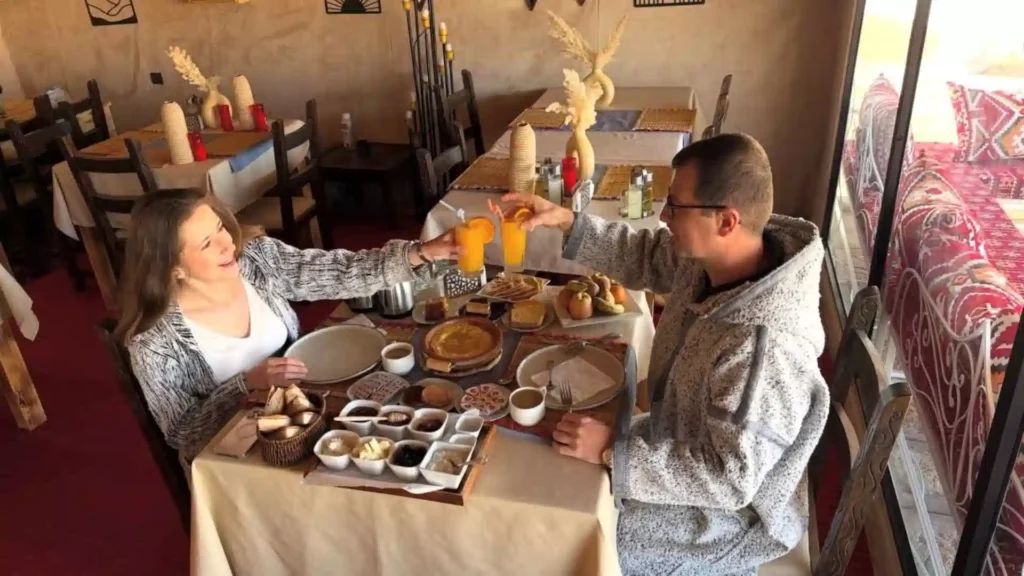
Breakfast at our luxury desert camp Morocco is served at the same outdoor table as the previous night’s dinner, now in full golden morning light. The spread: a large pot of fresh mint tea, a smaller pot of Moroccan coffee (spiced with cinnamon and cardamom), warm Msemen flatbread, fresh baguette, amlou (the Berber paste of ground almonds, argan oil, and honey — extraordinary), olive oil with za’atar, fresh-squeezed orange juice, and eggs cooked to order on the camp brazier. Most guests spend 45–60 minutes here, unwilling to leave. The camel trek back begins when you are ready.
What Does Sleeping in the Sahara Desert Feel Like? A Sensory Guide
The most common question we receive from travelers planning a Merzouga overnight experience is not logistical — it is sensory. “What will I actually feel, hear, smell, and see?” Here is the honest, specific answer that most travel descriptions omit.
What You See
By day: burnt orange and terracotta dunes with knife-sharp shadow lines. By night: a sky so dense with stars it has structural depth. The Milky Way is not a smear — it is a three-dimensional architecture stretching horizon to horizon. Pre-dawn: silver and steel-blue dunes under starlight. Sunrise: copper becoming flame in three minutes.
What You Hear
Almost nothing. The rarest acoustic experience available to modern travelers: true silence, consistently below 10 decibels. After midnight, an occasional whisper of wind over the highest dune crests. Before dawn, the call to prayer from Merzouga village drifts faintly across 7 km of open desert — one of the most haunting sounds any traveler can encounter.
What You Smell
Clean, mineral desert air with no identifiable scent. After dinner: woodsmoke from the campfire and the specific sweetness of Moroccan mint tea. In the cold deep-night hours: a faint mineral sharpness — the smell of warm sand releasing the day’s stored heat into cold air. At breakfast: coffee spiced with cinnamon, fresh bread warming on the brazier.
What You Touch
Fine, warm sand between your fingers at dusk — surprisingly smooth, not gritty. Cool wool blankets in the tent. The dry cold of the air on your face at 3am outside the tent. The warming sun on your face from the first minute of sunrise onward. The rough, warm neck of the dromedary on the morning return ride.
What You Taste
Mint tea sweetened with three teaspoons of Moroccan sugar — served at welcome, again after dinner, and again at breakfast. Amlou at breakfast: the unmistakable combination of toasted almond, raw argan oil, and pure honey. Slow-cooked lamb tagine with preserved lemon. Dates from the Ziz Valley oasis, harvested in autumn, kept in clay pots through winter.
What You Feel Emotionally
A progressive deepening of calm that most guests notice by the second hour and cannot fully explain afterward. Travelers consistently use the same vocabulary: “reset,” “perspective,” “stillness,” “belonging.” The Sahara has been described by philosophers, poets, and scientists as one of the few environments that reliably induces what psychologists call “the overview effect” — a shift in self-perception produced by scale. Standing at the top of a 150-metre dune at 3am changes something in most people, at least temporarily.
What Is Inside the Erg Chebbi Luxury Glamping Tent? A Full Description
The Erg Chebbi glamping camp offered by Over Morocco Tours is our flagship overnight product — built for travelers who want the full Sahara experience without sacrificing sleep quality or privacy. Here is a complete, honest description of exactly what you will find inside and around the luxury tent at our desert camp Erg Chebbi.
The Tent Structure
Each luxury tent is a traditional Berber khaima — a large, low-profile structure of hand-woven goat-hair and camel-wool fabric stretched over a frame of acacia wood poles. The khaima design has been used across North Africa and the Sahara for at least 2,000 years, and its engineering is genuinely sophisticated: the loose weave allows air circulation in high heat while the wool fibres swell and tighten when wet (during rare desert rain events), creating a waterproof barrier. Our luxury versions are double-lined with a modern cotton interior for added insulation — critical for comfortable sleeping in the Sahara Desert on cold winter nights. Tent footprint: approximately 14 square metres of interior space, plus a private sand-floor terrace of 6 square metres in front.
The Bed and Bedding
The bed at our luxury desert camp Morocco is a king-size (180cm x 200cm) frame with a proper sprung mattress — not a ground-level foam pad, which is what most “luxury” desert camps in the region still use. The bedding layers: a high-thread cotton fitted sheet, a flat sheet, a medium-weight duvet, and two heavy Berber wool blankets folded at the foot. By midnight in spring, you will likely use the duvet and at least one wool blanket. By 3am, both wool blankets. In winter, we provide an additional electric blanket powered by our solar battery system. Four pillows are standard; additional pillow types available on request.
The Private Bathroom
The en-suite bathroom is the single feature that most distinguishes our Erg Chebbi glamping camp from every competitor in the same price range. It is a separate canvas annex attached directly to the sleeping tent via a covered walkway (no need to go outside in the cold at 3am). Inside: a flush toilet connected to a sealed composting system designed to leave zero impact on the desert environment; a hot shower with 30-litre solar-heated water tank (genuinely hot until approximately 9:30pm; warm by midnight; cool by 3am — plan your shower before dinner); a wooden vanity with a ceramic basin and mirror; biodegradable organic Argan soap and shampoo provided. A small battery-powered USB light remains on all night in the bathroom.
Technology and Power
Our desert camp Erg Chebbi runs entirely on solar power — no generator noise, no carbon emissions, no fuel logistics. Two 200-watt solar panels charge a lithium battery bank during daylight hours, providing enough power for tent lighting, bathroom lights, USB device charging (one 5W USB port per tent — sufficient for phone charging, not for laptops), and the small audio system used for music at the campfire. There is intentionally no Wi-Fi and no mobile signal at the camp location. This is not an oversight — it is a deliberate design choice. The reason travelers seek the experience of sleeping in the Sahara Desert is specifically because it offers a complete break from connectivity. We find that guests who are initially frustrated by the lack of signal consistently cite it as one of their favorite aspects of the experience by morning.
“The moment you arrive at the camp, the desert night begins. First, a member of our staff will give you a cup of whiskey (mint tea) as a greeting and show you to your luxury tent. You will have some time to enjoy yourself with the view of the Sahara desert.”
This reflects exactly what every guest experiences in the first 30 minutes at camp — a transition from traveler to inhabitant of the desert. The luxury tent makes this transition feel permanent rather than temporary.
The Food at Our Sahara Desert Camp: What You Will Eat and Drink
Food is one of the most underrated aspects of a Merzouga overnight experience — and one of the areas where the difference between a basic camp and our luxury desert camp Morocco is most dramatically visible. At Over Morocco Tours, the food served at our Sahara desert camp Morocco is prepared by a dedicated camp cook who sources ingredients from Rissani market and the Ziz Valley oasis growers on the morning of each camp night.
Welcome: Mint Tea and Ziz Valley Dates
The Moroccan welcome — a glass of heavily sweetened mint tea — is not optional, not abbreviated, and not served in paper cups. At our desert camp Erg Chebbi, the welcome tea is poured from a traditional silver teapot into small decorated glasses from a height of approximately 40 cm — a technique that aerates the tea, cools it slightly, and creates the characteristic froth on top that indicates a properly poured Moroccan tea. The dates accompanying it are Medjool variety from Rissani, one of Morocco’s finest date-producing regions. This is the first food moment of your desert night, and it sets the tone for everything that follows.
Dinner: Three Courses at the Sand-Floor Table
Course one: harira soup — the classic Moroccan tomato, lentil, and chickpea soup thickened with flour and finished with a squeeze of lemon, served with sfenj (Moroccan ring doughnuts) or warm crusty bread. Course two: the main event — a slow-cooked tagine. At our Erg Chebbi glamping camp, the tagine is prepared over a charcoal brazier for 3–4 hours before you arrive, using either lamb shoulder with preserved lemon, green olives, and herb chermoula; or a vegetable version with root vegetables, chickpeas, and a Ras el Hanout spice blend sourced from the Rissani souk. Served alongside: a large dish of hand-rolled couscous with steamed vegetables and a separate bowl of harissa for heat. Course three: a dessert plate of fresh seasonal fruit, a small piece of pastilla au lait, and Moroccan honey from High Atlas beehives.
Midnight: The Campfire Tea
Around 10–11pm, as the campfire music winds down, your guide brings a second round of mint tea — this time slightly lighter and less sweet than the welcome version, specifically designed to be calming rather than stimulating. This tea moment, around a fire that has burned down to warm coals under the full night sky, is the emotional center of the sleeping in the Sahara Desert experience for many guests.
Breakfast: The Morning After the Stars
Breakfast at our luxury desert camp Morocco is served outdoors in the first morning light. The spread is generous and unhurried: Moroccan mint tea and spiced coffee; fresh-squeezed orange juice from Ouarzazate valley oranges; Msemen (layered pan-fried flatbread), baguette, and Khobz (round Moroccan loaf); amlou paste (ground almonds, argan oil, and honey — the single most asked-about food item by guests); olive oil with dried herbs; a selection of Moroccan jams including fig and rose; and eggs cooked over the brazier. There is no fixed end time for breakfast — you eat, watch the morning light move across the dunes, and leave when you are genuinely ready.
Sleeping in the Sahara Desert: Practical Information for 2026
Beyond the poetic, there are practical realities to understand about sleeping in the Sahara Desert before you go. These are the details that our guests most frequently wish they had known in advance.
What to Bring for Your Night at the Erg Chebbi Glamping Camp
- Warm layers: A fleece or light down jacket, a second long-sleeve layer, and thick socks — essential for 2am temperatures even in spring and autumn. The desert camp Erg Chebbi provides wool blankets, but your own warm clothing gives you freedom to sit outside the tent for midnight stargazing without discomfort.
- Headlamp or small torch: The camp runs on soft solar lighting, beautiful but not bright. A headlamp is invaluable for navigating to the bathroom at 3am or climbing a dune for pre-dawn stargazing.
- Camera with fully charged battery: Cold temperatures at night drain camera batteries faster than normal. Bring at least one fully charged spare. The Sahara desert camp Morocco has USB charging but this is slow (5W) — don’t rely on it as your primary charging method for camera batteries.
- Portable power bank: Fully charged before departure. Our solar USB port provides trickle charging, not fast charging.
- Earplugs (optional): The desert is silent, but other guests at nearby camps (if any) can occasionally be heard. Luxury private camps are positioned to minimize this, but earplugs are a sensible precaution for light sleepers.
- Any prescription medications: There are no pharmacies, no shops, and no road access within 6–8 km of our Erg Chebbi glamping camp. Bring everything you need for 24 hours.
- A journal: This sounds like a cliché recommendation. It is not. The specific combination of silence, darkness, and removal from daily routine that characterizes sleeping in the Sahara Desert reliably produces the urge to write. Several of our guests have told us that the hour between midnight and 1am, by the fading campfire, was when they wrote the most honest thing they had written in years.
What NOT to Bring to the Desert Camp
- Full-size suitcases: You cannot carry a hard-shell case on a camel. Bring a single daypack (30L maximum) for the overnight. Leave all other luggage securely at your hotel in Merzouga.
- Laptop computers: No power, no Wi-Fi, no flat surface, and fine Sahara sand that infiltrates every gap in a laptop casing within hours. Leave it in the hotel room.
- Single-use plastics: Our Sahara desert camp Morocco operates under a strict Leave No Trace policy. All waste is packed out. We ask all guests to bring reusable water bottles rather than single-use plastic.
- Perfume or heavy cologne: The desert at night has no scent of its own — a profound rarity that deserves to be experienced without interference. Strong fragrances also attract insects in the brief warm hours after sunset.
How Cold Does It Get? Temperature Guide by Season
- Spring (March–May): Sunset 22–26°C → Midnight 10–14°C → Pre-dawn 7–11°C. The most comfortable season for sleeping in the Sahara Desert.
- Summer (June–August): Sunset 35–40°C → Midnight 22–26°C → Pre-dawn 20–24°C. Genuinely warm overnight — no heavy layers needed, but a light long-sleeve for the camel trek back in morning breeze.
- Autumn (September–November): Sunset 28–34°C → Midnight 14–18°C → Pre-dawn 10–14°C. Similar to spring. October is regarded as the single best month by our guides.
- Winter (December–February): Sunset 18–22°C → Midnight 4–8°C → Pre-dawn 0–4°C. Frost on the sand surface is possible. The electric blanket in our luxury tent is particularly appreciated. The winter sky is the most extraordinary of any season due to low atmospheric humidity.
How Much Does It Cost to Sleep in the Sahara Desert at Erg Chebbi? (2026 Prices)
The cost of sleeping in the Sahara Desert at our Erg Chebbi glamping camp depends on the level of experience you choose, whether you are travelling as a couple, family, or solo traveler, and whether you are booking the camp as a standalone experience or as part of a multi-day Morocco desert tour. Here are our 2026 prices with full transparency.
- Individual Berber tent
- Shared bathroom block
- Traditional 3-course dinner
- Gnawa music at communal fire
- Breakfast included
- Camel trek both ways
- Private en-suite luxury tent
- King-size bed with proper mattress
- Private bathroom with hot shower
- Gourmet Moroccan multi-course dinner
- Private Berber guide & musician
- Camel trek both ways + sunrise dune walk
- Everything in Luxury Glamping
- Dedicated camp photographer
- Rose petal and candle tent setup
- Champagne on arrival
- Private 4×4 transfer to/from camp
- Late checkout — leave at 9:30am
Reserve Your Night Under the Sahara Stars
Standard, luxury glamping, and honeymoon packages available year-round. Dates fill quickly from March through May and September through November — book early for 2026.
Book Your Desert Night Now
📞 +212 673 952 695 · 💬 WhatsApp · ✉ Overmoroccotrip@gmail.com
Centre of Merzouga, N13, Morocco · Operating since 2012
Sleeping in the Sahara Desert with Over Morocco Tours: Why We Are Different
There are many operators offering Sahara desert camp Morocco experiences. Here is what specifically distinguishes the Merzouga overnight experience offered by Over Morocco Tours — not as a marketing claim, but as a structural fact about how we operate.
Our Camp Is 7 km Deep in the Erg Chebbi Dunes
Many camps marketed as “deep in the desert” sit at the dune edge, 1–2 km from the village road, where the lights of Merzouga are visible and the sounds of vehicles carry on still nights. Our luxury desert camp Morocco is positioned approximately 7 km from the nearest road — a distance that guarantees a 360-degree dune horizon with no artificial light visible from any direction. This is not a minor difference. The psychological impact of being truly surrounded by desert, versus being adjacent to it, is the entire point of the sleeping in the Sahara Desert experience.
All Our Guides Are Native to the Region
Our team at Over Morocco Tours includes guides born and raised within the Merzouga area — including Lhcen, a former camel guide who has navigated the Erg Chebbi dunes for decades and now leads our overnight camp treks, and Ibrahim, our lead operations specialist, originally from Marrakech, who documents every camp experience as a photographer and narrative writer. When you experience a night at our desert camp Erg Chebbi, you are guided by people who have slept in this specific landscape their entire lives. The difference in the quality of their storytelling, their knowledge of the stars, and their awareness of the desert’s subtle behaviours throughout the night is not replicable by any training programme.
Sustainability Is Structural, Not Marketing
Our Sahara desert camp Morocco generates no waste in the desert. All food waste is composted and removed by camel to a composting facility in Merzouga. All non-organic waste is packed in sealed bags and transported back to the village for proper disposal. We use no single-use plastics at camp — water is provided in reusable ceramic carafes. Our toilet system is sealed composting (zero ground contamination). The solar power system produces no emissions. We partner exclusively with Rissani market suppliers and Ziz Valley producers rather than importing food from outside the region. This is what responsible desert camp operation looks like in practice.
“Visiting Morocco with Mohammed and Said was an amazing experience. Their warmth and hospitality made the trip enjoyable and interesting. Seeing an oasis, the river that gives it life, and tasting the dates and olives harvested there — the music and landscapes of Morocco are mesmerizing.”
— Angillika R., TripAdvisor Verified Review“Communication with Hassan was always excellent, even before we started our tour. He responded to all queries and was very flexible. As the owner of the company, he understands customer care.”
— Des1963, TripAdvisor, after a 10-day tour including the Erg Chebbi overnight camp
Frequently Asked Questions: Sleeping in the Sahara Desert at Erg Chebbi
Sleep Under the Stars: Book Your Night at the Erg Chebbi Glamping Camp with Over Morocco Tours
Sleeping in the Sahara Desert is one of those experiences that travelers categorize differently from other travel moments — not as “a nice thing I did on holiday” but as “one of the nights I will not forget.” The specific combination of complete silence, extraordinary starlight, Berber hospitality, extraordinary food, and the profound physical reality of being 7 km deep in the world’s largest desert, with 150-metre dunes in every direction and the Milky Way overhead, produces something that the word “memorable” is too small to describe.
At Over Morocco Tours, we have been creating this experience since 2012. Our Erg Chebbi glamping camp — with its private en-suite luxury tents, gourmet Moroccan dinners, native Berber guides, and position deep in the dune heart — is built to deliver the full emotional weight of what sleeping in the Sahara Desert is capable of. Not a simulation. Not a tourist approximation. The real thing, with every comfort that makes it possible to be fully present for it.
Whether you are arriving via our Merzouga overnight experience as a standalone desert night or building it into a longer Morocco desert tour from Marrakech or Fes, we are ready to plan it with you. No hidden fees. No overcrowded camps. No compromises on what makes the luxury desert camp Morocco experience worth having.
Book Your Night in the Sahara Desert — 2026
Erg Chebbi luxury glamping, standard desert camp, and honeymoon packages available year-round. Private camel treks, gourmet meals, native Berber guides. TripAdvisor 10.0 Superb rated. No hidden fees.
Book Your Erg Chebbi Glamping Night
📞 +212 673 952 695 · 💬 WhatsApp · ✉ Overmoroccotrip@gmail.com
Centre of Merzouga, N13, Morocco