List Of Cities in Morocco: Complete Travel Guide to 15+ Top Cities
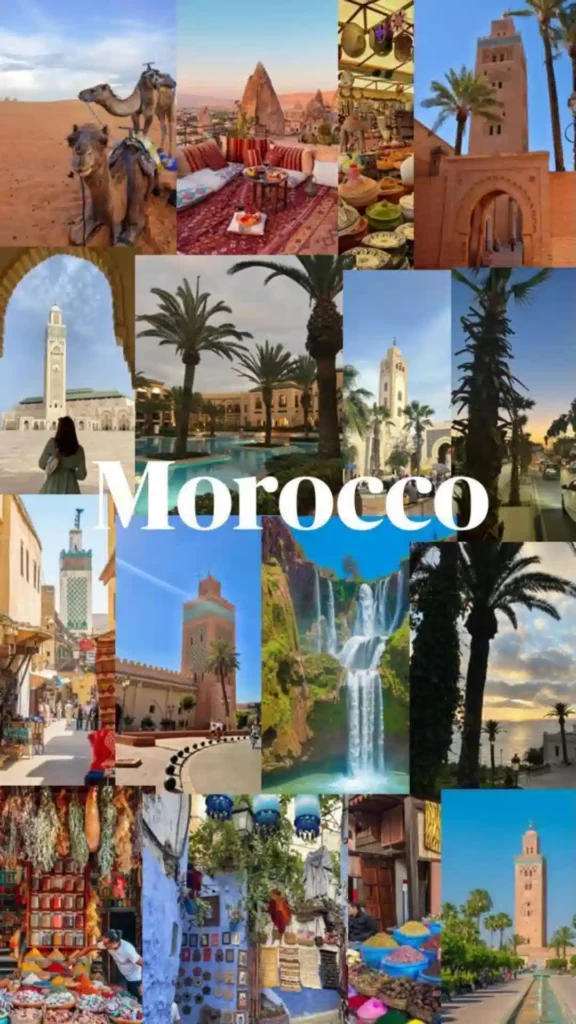
Exploring the diverse culture, coastal beauty, and vibrant landscapes across top cities in Morocco.
Ask ten travelers to name some cities in Morocco, and you’ll get the same four or five answers: Marrakesh, Fes, Casablanca, and maybe Chefchaouen if they’ve done their homework. But the full list of Moroccan cities runs to dozens of places that are worth knowing about, each one a different combination of history, geography, and purpose: imperial capitals built by sultans, Atlantic ports built by Portuguese traders, and desert towns built around caravan routes that are still, in a sense, in use today.This guide will take you through the major cities in Morocco by region, not just a flat, undifferentiated list of them. Here are the four imperial cities of Morocco that were successive capitals of the kingdom: the Mediterranean and Rif cities shaped by centuries of contact with Spain, the Atlantic coast’s mix of resort towns and working ports, and the desert gateway cities that most travelers only ever pass through on the way to the Sahara but which deserve a closer look in their own right.
We’ll look at detailed populations, historical backgrounds, neighborhood breakdowns, local food, transport connections, and more useful information on which cities in Morocco are the best cities to visit in Morocco to build a trip around and which cities are better as stops on the way to somewhere else.
Quick Answer: Major Cities in Morocco & Best-Known Highlights
- Biggest city in Morocco: Casablanca, Morocco’s commercial and economic capital with over 3.4 million residents.
- Political capital: Rabat is home to the royal palace, government ministries, foreign embassies, and green boulevards.
- Most-visited city: Marrakech, the country’s main tourism gateway, famous for its bustling medina and Jemaa el-Fnaa square.
- Oldest continuously inhabited imperial city: Fes, founded in the late 8th century, home to the world’s oldest university.
- Most photographed city: Chefchaouen, the iconic blue-washed town nestled high in the Rif Mountains.
- Closest city to Europe: Tangier, a historic port city sitting just across the Strait of Gibraltar from Spain.
How to Think About the Cities in Morocco
Morocco doesn’t really have one “capital” like most Western countries do. But its urban fabric is a living testament to successive dynasties, colonial influences, and geographic trade axes. It includes four historic imperial cities of Morocco Fes, Marrakech, Meknes, and Rabat, which have each ruled the kingdom at various times over the past thousand years. Each imperial capital was fortified by the ruling sultans and still bears the grand architectural masterworks, extensive madrasas, defensive ramparts, and sprawling royal palace complexes as evidence of its former glory. Rabat is the current official political capital, but Marrakech is the de facto tourism capital, while Casablanca is the largest city in Morocco in terms of economy and industry. The rest of this list of cities in Morocco falls into place effortlessly, knowing that Morocco’s urban centers are divided naturally by function political, economic, spiritual, coastal, and desert trade hubs.
Besides the four historic imperial capitals, it’s useful to group the rest of major cities in Morocco by geography and culture: the Mediterranean and Rif cities in the far north, the long line of Atlantic coast cities stretching from Tangier down to Agadir and into the southern territories, and the desert gateway towns along the pre-Saharan oases. Each region has its own dialect, influences in architecture, regional food, and local tempo. We will look at each group in detail below to help you plan your perfect itinerary.
The Four Imperial Cities of Morocco
These four imperial cities of Morocco have each served as the seat of Moroccan power at key moments across medieval and modern history. Together, they safeguard the country’s most significant cultural heritage, grandest mosques, historic universities, and UNESCO-protected car-free medinas.
Discover Marrakech, the Red City, with Cities in Morocco. Blog post:
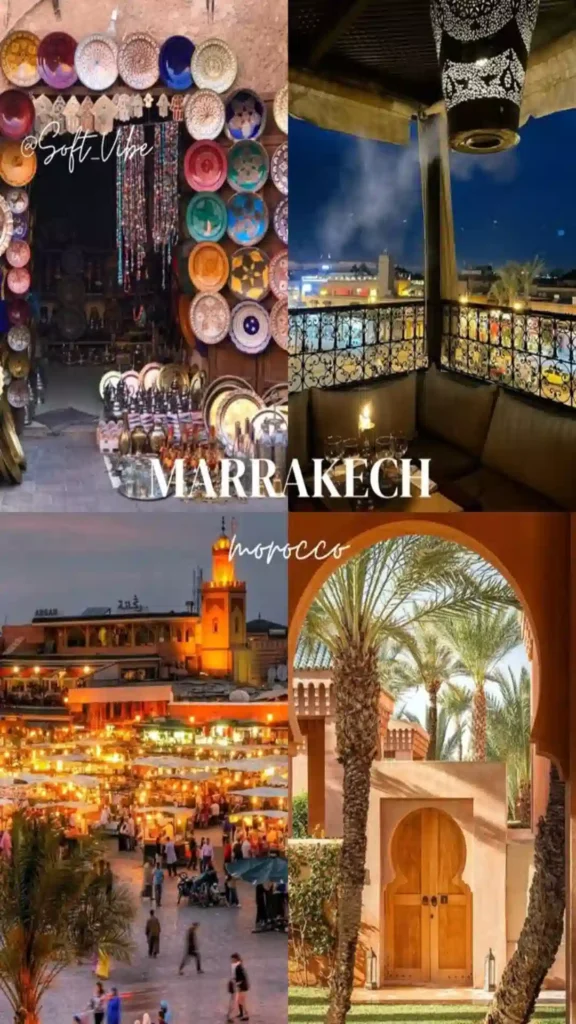
Experiencing the electric energy, historic riads, and bustling markets of Marrakech when visiting cities in Morocco.
For most visitors, the mental image of Morocco begins in Marrakech: the famed terracotta-and-pink rammed-earth walls, the sensory intensity of Jemaa el-Fnaa square at dusk, snake charmers, storytellers, fresh orange juice stalls, and the majestic minaret of the 12th-century Koutoubia Mosque soaring over the flat rooftops. Founded in 1070 by the Almoravid dynasty under Abu Bakr ibn Umar, Marrakech soon became the political, cultural, and economic center of the western Maghreb and Andalusian territories. Later, under the Almohad and Saadian dynasties, the city was enriched by breathtaking monuments, including the Saadian Tombs, the El Badi Palace, and the Ben Youssef Madrasa.
Today, Marrakech is recognized as one of the best cities to visit in Morocco. It is the country’s main tourism hub, with Menara International Airport, world-class luxury riads, vibrant nightlife, and vast artisan souks organized by trade (leather, metalwork, carpets, spices, and woodwork). Just beyond the historic medina are the French-built districts of Gueliz and Hivernage, with wide tree-lined avenues, contemporary art galleries, high-end dining, and tranquil botanical gardens such as the famous Jardin Majorelle and Yves Saint Laurent Museum. It is also the main base for day trips into the High Atlas Mountains (Imlil, Ourika Valley) and multi-day desert overland trips across the Tizi n’Tichka pass toward the Sahara.
Population: roughly 930,000 (metro area exceeds 1.3 million). Region: Marrakech-Safi. Best Time to Visit: March to May and September to November (avoiding intense summer heat). Known for: Jemaa el-Fnaa square, Bahia Palace, Ben Youssef Madrasa, Jardin Majorelle, luxury riads, and vibrant artisan souks.
Visit one of the Imperial Cities of Morocco, “Fes,” the Cultural & Spiritual Heart
Fes is nearly two centuries older than Marrakech. Founded in 789 AD by Idris I and greatly expanded by his son Idris II in 809 AD, Fes is considered by Moroccans to be the country’s spiritual, intellectual, and culinary heart. The city is divided into three distinct sectors: Fes el-Bali (the 9th-century ancient walled medina), Fes el-Jdid (the 13th-century Marinid district including the Royal Palace and Mellah Jewish quarter), and the Ville Nouvelle (the modern French-designed neighborhood established during the Protectorate era).
Fes el-Bali is the world’s largest contiguous car-free urban zone, home to over 9,000 narrow alleys, dead-end lanes, and bustling thoroughfares where donkeys and handcarts remain the primary modes of transport. Within these walls lies the University of Al-Qarawiyyin, founded in 859 AD by Fatima al-Fihri recognized by UNESCO and the Guinness World Records as the oldest continuously operating institution of higher learning on earth. Visitors flock to Fes to witness ancient craftsmanship preserved in real time, most famously at the Chouara Tanneries, where artisan dyers work in stone vats filled with natural dyes using methods unchanged since medieval times. Compared to Marrakech, Fes retains a deeper, raw historical weight and feels less commercialized, offering an unparalleled glimpse into classical Islamic architecture, zellige tilework, and intricate cedar wood carving.
Population: roughly 1.1 million. Region: Fès-Meknès. Best Time to Visit: Spring (April–May) and Autumn (September–October). Known for: Chouara Tanneries, Al-Qarawiyyin University, Bab Bou Jeloud (Blue Gate), Bou Inania Madrasa, and traditional crafts.
Meknes The Imperial Versailles of Morocco
Often overshadowed by neighboring Fes just 45 minutes away, Meknes is a remarkably tranquil imperial capital that offers immense architectural grandeur without heavy tourist crowds. Meknes rose to supreme prominence in the 17th century under the rule of Sultan Moulay Ismail (1672–1727), the powerful Alaouite ruler who transformed a small village into a monumental fortified capital designed to rival the court of King Louis XIV of France. Moulay Ismail constructed over 45 kilometers of massive defensive walls, grand gates, giant granaries, stabling for over 12,000 royal horses, and expansive palace compounds.
The highlight of Meknes is Bab Mansour, widely considered one of the grandest and most intricately decorated ceremonial gates in all of North Africa, featuring marble pillars salvaged from the nearby ancient Roman ruins of Volubilis. Other striking sites include the Mausoleum of Moulay Ismail, the subterranean royal prison (Habs Qara), and the vast Heri es-Souani grain storage complexes and water basins. Meknes serves as an ideal, quiet cultural stop and an easy base for visiting the UNESCO World Heritage Roman ruins of Volubilis and the holy hilltop town of Moulay Idriss Zerhoun.
Population: roughly 630,000. Region: Fès-Meknès. Best Time to Visit: Year-round, particularly spring and autumn. Known for: Bab Mansour gate, Heri es-Souani granaries, Mausoleum of Moulay Ismail, and proximity to Volubilis.
See Rabat The Coastal Political Capital with our major cities in Morocco
Rabat is a sharp, refreshing contrast to the other imperial cities of Morocco. Rabat, on the Atlantic coast at the mouth of the Bou Regreg River, was chosen as the political capital of Morocco by the French administration in 1912, replacing Fes; it remained the capital after independence in 1956. It is still the seat of government today with the Parliament, foreign diplomatic embassies, government ministries, and the official primary residence of King Mohammed VI (Dar al-Makhzen).
Rabat combines its extensive history with contemporary urbanism. The Kasbah of the Udayas reveals its ancient history as a dramatic 12th-century Almohad fortress overlooking the ocean on cliffs and populated with peaceful blue-and-white residential alleys and Andalusian gardens. The Hassan Tower, the iconic unfinished minaret of an ambitious 12th-century mosque project, stands nearby, beside the magnificent marble Mausoleum of Mohammed V. Rabat’s modern identity is highlighted by clean streets, efficient tram systems, palm-lined boulevards, public parks, and cutting-edge architectural landmarks like the Grand Theater of Rabat, designed by Zaha Hadid. The relaxed, sophisticated atmosphere makes it a great stop for travelers looking for culture without aggressive touts or crowded souks.
Population: roughly 580,000 (metro area exceeding 1.9 million, including Salé). Region: Rabat-Salé-Kénitra. Best Time to Visit: May to October (pleasant coastal climate). Known for: Kasbah of the Udayas, Hassan Tower, Mausoleum of Mohammed V, Chellah Necropolis, and political institutions.
Northern Morocco: Mediterranean & Rif Cities
Northern Morocco has a unique cultural identity distinct from the central plains and southern desert oases. Heavily influenced by geographical proximity to Europe, centuries of Mediterranean maritime trade, and Spanish colonial administration during the Protectorate period (1912–1956), Spanish is widely spoken alongside Darija (Moroccan Arabic), and Andalusian-Moorish heritage is reflected across local architecture, music, and food.
Tangier: The Gateway to Africa
Tangier is located at the northernmost tip of Morocco, where the Mediterranean Sea meets the Atlantic Ocean, just 14 kilometers across the Strait of Gibraltar from the Spanish coast. For decades in the mid-20th century (1923–1956), Tangier was an international zone, administered by a coalition of foreign powers. Its special political status attracted international spies, colorful aristocrats, smugglers, and renowned writers and artists of the Beat Generation, like William S. Burroughs, Paul Bowles, Henri Matisse, and Jack Kerouac.
Recently, Tangier has been transformed into a clean, modern maritime hub with massive infrastructure investments, including high-speed bullet train (Al Boraq) links to Casablanca, expanded cruise terminals, and a world-class marina (Tanger Marina Bay). But it still retains its old-world charm. Visitors can discover the hilltop Kasbah with its views across to Europe, sip mint tea in historic haunts like Café Hafa, or stroll the breezy seaside promenade (Corniche). Explore the legendary Caves of Hercules, or visit Cap Spartel, where the ocean meets the sea. Tangier is dynamic, salty, literary, and vibrantly undeniable. Learn more about things to do in Tangier.
Population: roughly 950,000 (expanding rapidly). Region: Tanger-Tétouan-Al Hoceïma. Best Time to Visit: April to October. Known for: Strait of Gibraltar views, Kasbah Museum, Café Hafa, Caves of Hercules, Cap Spartel, and literary history.
Tetouan, the White Dove, is one of the best cities to visit in Morocco
Nestled along the Martil Valley at the foot of the Rif Mountains, Tetouan is nicknamed “The White Dove” (El Hamama El Beida) due to its whitewashed buildings and serene mountain setting. Tetouan holds an exceptionally pure Andalusian lineage. Following the fall of Granada during the Reconquista in 1492, thousands of Moorish and Jewish refugees fled southern Spain and settled in Tetouan, rebuilding the city and leaving a lasting imprint on its urban planning, tile craftsmanship, embroidery, and culinary traditions.
Tetouan’s ancient medina is recognized as a UNESCO World Heritage site and is widely considered one of the best-preserved medinas in Morocco, remaining almost completely unmarred by modern commercialization and heavy tourist development. Adjoining the medina is the Ensanche district, built during the Spanish Protectorate era, featuring elegant Spanish-colonial architecture, wrought-iron balconies, and wide pedestrian plazas. Tetouan is ideal for culture lovers, art enthusiasts, and travelers looking for an authentic northern experience away from large tourist groups.
Population: roughly 470,000. Region: Tanger-Tétouan-Al Hoceïma. Best Time to Visit: Spring and early autumn. Known for: UNESCO-listed medina, Spanish Ensanche architecture, School of Fine Arts, and authentic artisan guilds.
Chefchaouen, The Blue Pearl
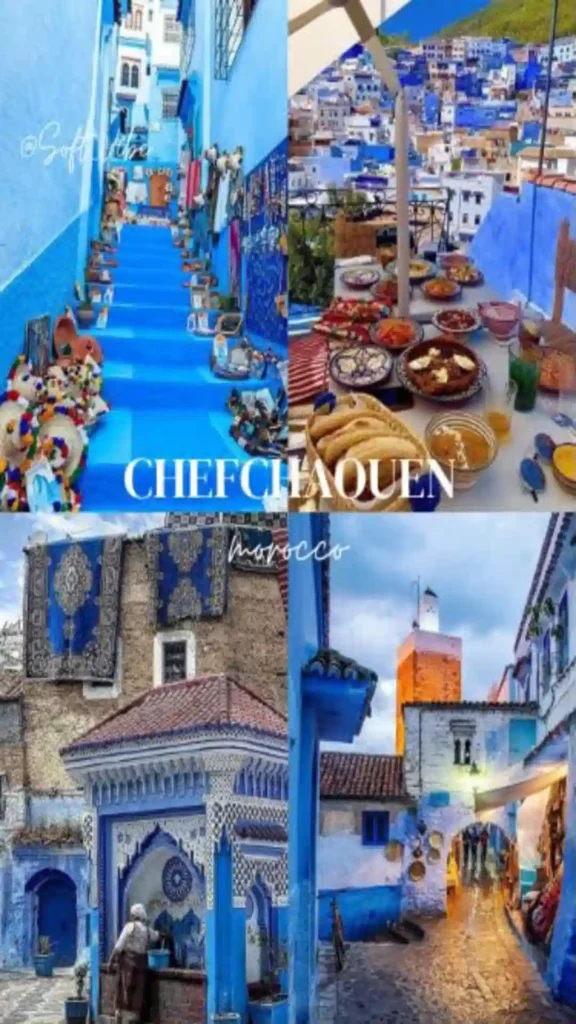
Immersing in the tranquil blue streets and rich artisan traditions of Chefchaouen among the top cities in Morocco.
Perched dramatically between two peaks of the Rif Mountains, Chefchaouen, or “Chaouen,” as the locals call it, means “look at the horns” in Berber. Established in 1471 as a small fortress to defend against Portuguese invasions, the town grew as Sephardic Jewish and Moorish refugees settled here. Chefchaouen is internationally recognized for its vibrant blue-washed buildings, cobalt alleyways, powder-blue staircases, and colorful wrought-iron portals.
There are many theories as to why the city is painted blue, from Jewish spiritual traditions that symbolize sky and heaven to practical reasons such as repelling mosquitos or keeping homes cool. But its appeal is unquestionable. Chefchaouen is one of the best cities in Morocco to visit for relaxation, mountain trekking, and photography. The city is walkable, compact, and centered around the 15th-century Kasbah fortress and outdoor cafes of the Outa el-Hammam plaza. Visitors will spend their days wandering along quiet lanes, shopping for local woolwear and woven blankets, trekking to the Spanish Mosque for panoramic sunset views, or heading to nearby natural waterfalls at Akchour.
Population: roughly 45,000. Region: Tanger-Tétouan-Al Hoceïma. Best Time to Visit: March to May and September to November. Known for: Blue-painted streets, Plaza Outa el-Hammam, Spanish Mosque view, Rif mountain hiking, and Akchour Waterfalls.
Al Hoceima, the Mediterranean Coastal Gem
Al Hoceima lies on the eastern edge of the Rif region on dramatic coastal cliffs overlooking pristine Mediterranean coves, clear turquoise waters, and pine-forested slopes. Less hectic than Atlantic coast resort towns, Al Hoceima remains pretty much under the international tourist radar, making it a summer vacation magnet for Moroccan domestic tourists and returning European diaspora families.
The city boasts beautiful urban beaches such as Quemado Beach, lively seafood restaurants serving fresh catches daily, and easy access to Al Hoceima National Park, a protected ecological reserve that features both land-based coastal forests and marine habitats that are home to wild dolphins and fish species. A prime stop-off for travelers driving down the northern Mediterranean coast who want stunning sea views, quiet coves, and fresh seafood, far from the crowded tour itineraries.
Population: roughly 65,000. Region: Tanger-Tétouan-Al Hoceïma. Best Time to Visit: June to September (ideal beach weather). Known for: Quemado Beach, Mediterranean seafood, dramatic cliffs, and Al Hoceima National Park.
Morocco’s Atlantic Coast Cities in Morocco
Morocco’s Atlantic coast is hundreds of kilometers long, with bustling industrial ports, historic Portuguese fortified outposts, artistic beach towns, and modern surf capitals. Unlike inland destinations such as Marrakech or Ouarzazate, the ocean breeze cools them in summer.
Explore Casablanca, the economic powerhouse, with the best cities to visit in Morocco
The capital of the classic 1942 Hollywood film, Casablanca, is the largest city in Morocco and serves as the country’s economic, commercial, and industrial center. With a metro area of over 4 million people, “Casa,” as the locals call it, is a sprawling and fast-paced modern city of glass skyscrapers, traffic, corporate headquarters, international banks, and hip shopping malls such as Morocco Mall.
Casablanca may lack the fairy-tale medina charm of Marrakech or Fes, but it has architectural gems of its own, especially in the central business district, with a mix of French Colonial planning, Art Deco, and Neo-Moorish (Mauresque) architecture from the 1920s and 1930s. The crown jewel of the city is the magnificent Hassan II Mosque, completed in 1993, it sits dramatically on a rocky outcrop overlooking the Atlantic Ocean. The mosque, one of the tallest in the world with a 210-meter minaret, can host 105,000 worshipers and has handcrafted zellige, carved plaster, and titanium doors. It is among the only active mosques in Morocco open to non-Muslim visitors through guided tours. Casablanca also boasts Mohammed V Square, the oceanfront Corniche promenade in Ain Diab, and a bustling contemporary food and nightlife scene.
Population: roughly 3.4 million (metro area ~4.3 million). Region: Casablanca-Settat. Best Time to Visit: Spring and Autumn. Known for: Hassan II Mosque, Art Deco architecture, central business district, Ain Diab Corniche, and corporate commerce.
Essaouira The Wind City of Africa
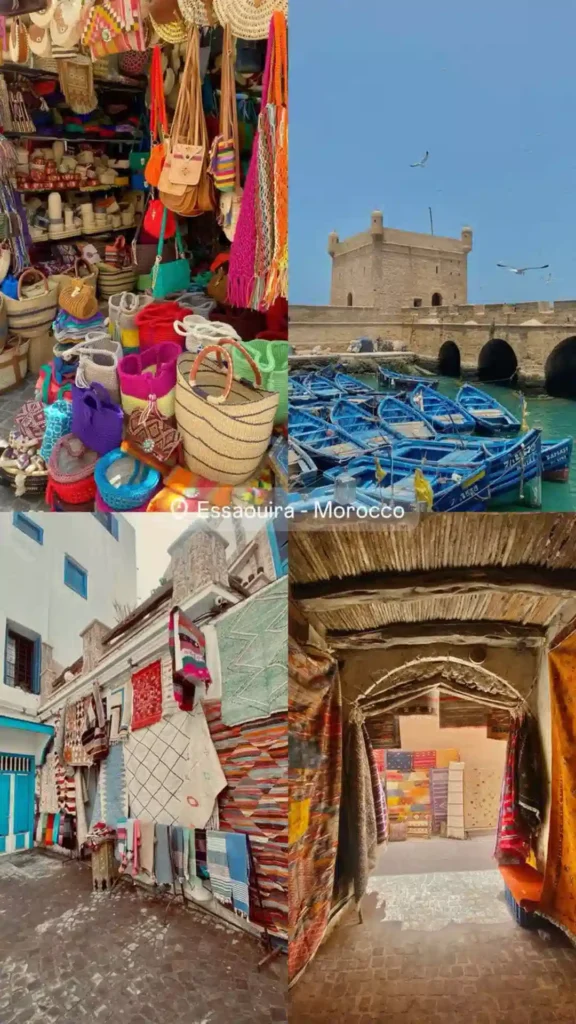
Discovering Atlantic ocean breezes, blue fishing boats, and artisan alleyways in coastal cities in Morocco like Essaouira.
Situated about three hours west of Marrakech, Essaouira (known as Mogador under the Portuguese) is a delightful coastal town with 18th-century stone ramparts overlooking the Atlantic Ocean. The city’s medina, redesigned in 1760 by French military architect Théodore Cornut for Sultan Mohammed ben Abdallah, is a uniquely grid-like, walkable maze of whitewashed buildings, blue shutters, art galleries, craft workshops, and spice shops.
For decades musicians, artists, and surfers have been drawn to Essaouira’s laid-back atmosphere, cool sea breezes, and bohemian creative vibe (notably Jimmy Hendrix visited in 1969). The city has an active fishing port, where electric blue wooden trawlers unload fresh catches every day, ready to be grilled on the spot. The crescent bay is buffeted by strong trade winds (the Alizé), and this makes Essaouira one of Africa’s best spots for windsurfing and kitesurfing. The city is also home to the internationally known Gnaoua World Music Festival, which is held each summer to celebrate traditional African spiritual music and global fusions.
Population: roughly 80,000. Region: Marrakech-Safi. Best Time to Visit: May to October (warm weather, ideal for watersports). Known for: Skala de la Ville ramparts, fishing harbor, Thuya wood carving, windsurfing/kitesurfing, and Gnaoua Music Festival.
Agadir, The Sun & Beach Resort Capital
Agadir, in the Souss-Massa region of southwestern Morocco, is the country’s premier beach resort destination. On February 29, 1960, a devastating earthquake struck Agadir, destroying most of the historic city in less than 15 seconds. After the disaster, King Mohammed V promised to rebuild the city, making Agadir a modern, European-style resort city with wide grid streets, landscaped palm avenues, modern residential complexes, and luxury oceanfront hotels.
Agadir’s 10-kilometer length of gold sand lines a sheltered bay with 300-plus days of sunshine a year. Sunbathing, watersports, golf, spa wellness resorts, and family beach holidays offer the main attractions for visitors. Highlights are walks along the modern marina, exploring the huge Souk El Had (one of North Africa’s largest covered markets with over 6,000 stalls), visiting the Agadir Oufella Kasbah ruins on the hilltop for panoramic views of the bay, or day trips to nearby surf spots like Taghazout and the lush paradise valley in the High Atlas foothills.
Population: roughly 505,000 (metro area ~900,000). Region: Souss-Massa. Best Time to Visit: Year-round (mild winters, warm sunny summers). Known for: Golden beach, year-round sunshine, Souk El Had, Agadir Marina, golf courses, and proximity to Taghazout.
El Jadida The Fortified Portuguese Enclave
El Jadida is a peaceful coastal city located about 100 kilometers south of Casablanca on the Atlantic coast, famous for its extensive maritime colonial history. Originally founded by the Portuguese in 1502 as a fortified trading post, Mazagan remained in their hands until 1769, when it was ceded to Sultan Mohammed ben Abdallah. The old fortified quarter, called the Cité Portugaise, is now a UNESCO World Heritage site.
El Jadida’s main attraction is the amazing Portuguese Cistern, an underground hall built in 1514 with stone vaults, 25 stone columns, and a central inlaid floor that reflects the light streaming down through a circular opening in the roof (famously featured in Orson Welles’s movie Othello). Visitors can walk along the thick sea ramparts with their old bronze cannons, eat fresh ocean seafood, and see a real Moroccan town, largely untouched by mass tourism.
Population: roughly 250,000. Region: Casablanca-Settat. Best Time to Visit: May to September. Known for: Cité Portugaise, Manueline architecture, Portuguese cisterns, sea ramparts, and quiet beaches.
Safi, The Pottery & Ceramic Capital and one of the Major cities in Morocco:
Safi is an old port city situated between El Jadida and Essaouira. The city of Safi was first settled by the Carthaginians and Romans and later became a major industrial port city for sardine fishing and phosphate processing due to the presence of Portuguese traders who built the 16th-century Ksar el Bahr sea fortress. But its real cultural legacy is in its world-famous pottery and ceramics skills.
The city has a special hill district, Colline des Potiers (Potters’ Hill), where hundreds of master artisans make, paint, glaze, and fire traditional clay pottery, pots, tagines, and decorative tiles in clay kilns fired by wood and olive pits. Safi is the best place to buy authentic, high-quality Moroccan pottery from the craftsmen themselves at unbeatable local prices. It also has a historic medina, ocean cliffs with panoramic views, and great nearby surf breaks like Ras al Lafa.
Population: roughly 310,000. Region: Marrakech-Safi. Best Time to Visit: Spring and Summer. Known for: Traditional pottery and ceramics, Potters’ Hill, Ksar el Bahr fortress, sardine fishing, and surfing spots.
Desert Gateway Cities: The Towns That Lead to the Sahara
To the south and east, beyond the high passes of the Atlas Mountains, are dry, sun-baked river valleys, palm oases, earth-brick kasbahs, and vast desert frontiers. These towns sprang up along ancient trans-Saharan trade routes where camel caravans piled high with gold, salt, spices, and textiles would stop for a breather after weeks of hard trekking across the desert. Today they are the gateway hubs for desert excursions into the dunes of the Sahara.
Ouarzazate The Hollywood of Morocco
Ouarzazate (pronounced War-zazat) sits at a strategic altitude of 1,160 meters south of the High Atlas Range. Known as “The Door to the Desert,” Ouarzazate was historically a military garrison town expanded during the French Protectorate. Today, it is world-famous as North Africa’s film production hub, home to massive movie facilities like Atlas Studios and CLA Studios. The surrounding dramatic desert landscapes, red earth valleys, and fortified mudbrick kasbahs have served as filming backdrops for epic productions including Gladiator, Lawrence of Arabia, Kingdom of Heaven, The Mummy, and Game of Thrones.
Within the town sits the impressive Taourirt Kasbah, a 19th-century fortress that belonged to the powerful Thami El Glaoui family. Just 30 kilometers northwest of Ouarzazate lies Ksar Ait Benhaddou, a magnificent UNESCO World Heritage earthen fortress complex that stands as one of the finest surviving examples of southern Moroccan clay architecture. Ouarzazate is also a major solar energy leader, hosting the Noor Ouarzazate Solar Complex, one of the largest concentrated solar power plants in the world.
Population: roughly 71,000. Region: Drâa-Tafilalet. Best Time to Visit: October to April (avoiding extreme summer heat). Known for: Film studios, Ait Benhaddou ksar, Taourirt Kasbah, and desert tour routes.
Merzouga, at the Foot of Erg Chebbi Dunes
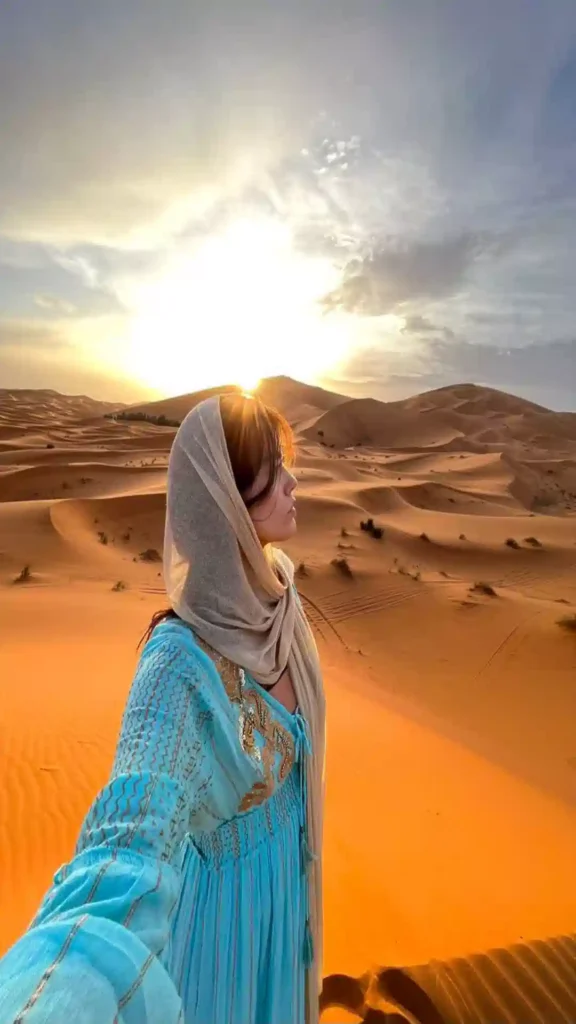
Experiencing magical golden hour views over the Erg Chebbi dunes during a luxury Sahara Desert tour in Morocco.
Merzouga is a small desert village located in southeastern Morocco, sitting right at the base of the Erg Chebbi dune field, a vast sea of wind-blown orange dunes reaching heights of up to 150 meters. While not a large city in terms of infrastructure, Merzouga is world-renowned as the ultimate destination for authentic Sahara Desert experiences in Morocco.
Travelers travel to Merzouga to ride camels across golden dunes at sunset, sleep in luxury desert camps under starry skies, listen to traditional Gnawa music played by local musicians in nearby Khamlia village, and go on thrilling 4×4 off-road sand tours or quad biking excursions. Despite its remote location, Merzouga features comfortable desert hotels, swimming pools, and glamping sites, making it accessible for travelers seeking comfort alongside raw desert beauty.
Population: ~5,000 (part of Errachidia province). Region: Drâa-Tafilalet. Best Time to Visit: October to May (cool desert nights, warm sunny days). Known for: Erg Chebbi sand dunes, camel treks, desert luxury camps, Khamlia Gnawa village, and stargazing.
Errachidia The Oasis Administrative Capital
Errachidia (formerly known as Ksar es-Souk) serves as the regional administrative capital of the vast Drâa-Tafilalet province. While it lacks the tourist draw of Merzouga or the cinematic renown of Ouarzazate, Errachidia is an essential regional transport hub equipped with an international airport (Moulay Ali Cherif Airport), hospitals, regional government offices, and major road junctions connecting northern Morocco to the Sahara.
Errachidia is surrounded by striking natural landscapes, most notably the lush Ziz Valley, a long oasis corridor packed with millions of date palms running alongside carved red limestone canyons. It serves as a practical stop for travelers flying directly into the region or driving south from Fes toward the desert dunes.
Population: roughly 92,000. Region: Drâa-Tafilalet. Best Time to Visit: Autumn and Spring. Known for: Ziz Valley palm groves, regional airport access, Hassan Addakhil Dam, and administrative services.
Zagora Gateway to Erg Chigaga
Located in the far south along the Draa River valley, Zagora is framed by dark palm groves and flat-topped mountain ridges. Historically, Zagora was a major staging post for trans-Saharan trading expeditions. The city is renowned for its iconic, painted road sign at the edge of town reading “Tombouctou 52 jours” (“Timbuktu 52 days,” referring to the travel time on foot and by camel caravan across the desert).
Zagora acts as the primary starting hub for trips toward Erg Chigaga, the largest and most wild, undisturbed dune field in Morocco, located roughly 90 kilometers further off-road near M’Hamid El Ghizlane. Erg Chigaga is much larger and more remote than Erg Chebbi, making Zagora the preferred base for adventurous travelers seeking a quieter, less-developed desert experience far away from tourist buses.
Population: roughly 40,000. Region: Drâa-Tafilalet. Best Time to Visit: October to March. Known for: Draa Valley palm oases, the “Timbuktu 52 Days” sign, Tamegroute pottery, and Erg Chigaga desert access.
Taroudant, the Walled Jewel of the Souss
Located in the heart of the fertile Souss Valley between the High Atlas and Anti-Atlas mountain ranges, Taroudant is often affectionately nicknamed “Little Marrakech.” In the 16th century, under the Saadian dynasty, Taroudant briefly served as the capital of Morocco before power shifted to Marrakech. The city retained its magnificent 6-kilometer ring of orange-red rammed-earth ramparts, complete with 13 fortified gates and defensive bastions.
Despite its impressive history, Taroudant feels like a genuine, working Moroccan town rather than a tourist destination. It features two bustling medina souks, the Arab Market and the Berber Market, where locals trade silver jewelry, carpets, argan oil, leather goods, and fresh agricultural produce. Taroudant is ideal for travelers seeking the historic architecture of Marrakech in a much calmer setting.
Population: roughly 80,000. Region: Souss-Massa. Best Time to Visit: October to April. Known for: Intact 16th-century ramparts, silver souks, argan oil production, and authentic Souss cultural heritage.
List of Cities in Morocco: Other Major Hubs Worth Knowing About
Beyond the places most travelers actively plan around, several other major cities in Morocco matter for size, economy, border transport, or regional importance, even if they rarely appear on a typical two-week tourist itinerary.
| City | Region | Why It Matters |
|---|---|---|
| Salé | Rabat-Salé-Kénitra | Rabat’s historic twin city across the Bou Regreg river; famous for its 17th-century corsair pirates (Republic of Salé), magnificent Great Mosque, and traditional pottery workshops. |
| Oujda | Oriental | The largest city in eastern Morocco near the Algerian border, an important rail terminus, university town, and cultural capital for Raï music and eastern trading markets. |
| Kenitra | Rabat-Salé-Kénitra | A rapidly expanding industrial, agricultural, and automotive manufacturing hub north of Rabat, connected via the high-speed Al Boraq train line with easy access to Mehdia beach. |
| Tiznit | Souss-Massa | A historic walled town in the south famous for handcrafted Berber silver jewelry, filigree craftsmanship, red earth walls, and proximity to Mirleft coastal surf beaches. |
| Guelmim | Guelmim-Oued Noun | Known as the “Gateway to the Sahara”; famous for holding one of North Africa’s largest weekly camel markets (Souk Achema) and rich Sahrawi cultural traditions. |
| Nador | Oriental | A thriving northeastern Mediterranean port city situated on the Marchica Lagoon, serving as a key trade hub near the Spanish enclave of Melilla. |
| Ifrane | Fès-Meknès | Nicknamed “The Switzerland of Morocco”; a alpine hill town in the Middle Atlas with pitched roofs, clean parks, ski slopes (Michlifen), and Al Akhawayn University. |
| Larache | Tanger-Tétouan-Al Hoceïma | A laid-back Atlantic port town featuring Andalusian architecture, pine forests, fresh seafood markets, and close proximity to the ancient Phoenician/Roman ruins of Lixus. |
Morocco’s Major Cities by Population
For a quick reference, here’s how the major cities in Morocco stack up by population, based on recent census figures and metropolitan estimates.
| Rank | City | Approx. Population | Region |
|---|---|---|---|
| 1 | Casablanca | ~3.4 million (Metro: ~4.3M) | Casablanca-Settat |
| 2 | Fes | ~1.1 million | Fès-Meknès |
| 3 | Tangier | ~950,000 | Tanger-Tétouan-Al Hoceïma |
| 4 | Marrakech | ~930,000 (Metro: ~1.3M) | Marrakech-Safi |
| 5 | Salé | ~890,000 | Rabat-Salé-Kénitra |
| 6 | Meknes | ~630,000 | Fès-Meknès |
| 7 | Rabat | ~580,000 (Metro: ~1.9M) | Rabat-Salé-Kénitra |
| 8 | Agadir | ~505,000 | Souss-Massa |
| 9 | Oujda | ~495,000 | Oriental |
| 10 | Tétouan | ~470,000 | Tanger-Tétouan-Al Hoceïma |
Note that population size and travel appeal don’t always line up Chefchaouen has fewer than 50,000 residents but draws an outsized share of Morocco’s international tourism, while the biggest city in Morocco, Casablanca, offers a fast-paced commercial experience rather than ancient medina charms, and a city like Salé barely registers on most tourist itineraries because it functions primarily as Rabat’s residential twin across the river.
Best Cities to Visit in Morocco: Which Ones Should You Choose?
When reviewing a comprehensive list of cities in Morocco, the honest answer is that most travelers only need four or five destinations, carefully chosen for contrast and geography rather than trying to see everything in one go. Morocco is a large country with varied terrain; trying to cover too much distance results in spending your vacation inside a minibus or train car. Here’s how to structure your route depending on your travel timeframe and personal interests.
| If You Have… | Prioritize These Best Cities to Visit in Morocco |
|---|---|
| 3–4 days (Long Weekend) | Focus on Marrakech: Explore the medina, palaces, and souks, paired with a day trip to coastal Essaouira or the High Atlas foothills (Ourika Valley). Alternatively, take a city break to Tangier or Fes. |
| 6–7 days (one week) | Southern Desert Route: Fly into Marrakech (2 days), cross the High Atlas via Ait Benhaddou to Ouarzazate (1 day), continue to Merzouga for a Sahara desert camp (2 days), and return to Marrakech or end in Fes. |
| 10 days (Standard Trip) | The Imperial & Desert Highlights: Start in Casablanca/Rabat, travel to Fes (2 days), drive through the Ziz Valley to the Merzouga desert (2 days), travel via Ouarzazate to Marrakech (2 days), and finish with a day trip to Essaouira. |
| 14 days (Full Grand Tour) | The Grand Moroccan Circuit: Cover all four imperial cities of Morocco (Rabat, Meknes, Fes, and Marrakech), Northern highlights (Tangier and blue Chefchaouen), the complete Sahara desert loop (Merzouga/Ouarzazate), and the Atlantic coast (Essaouira). |
| Repeat Visit or Off-the-Beaten-Path | Hidden Regional Gems: Explore Tetouan, Safi, Taroudant, Tiznit, or Al Hoceima for an authentic, unhurried experience with virtually no tourist crowds. |
Essential Travel & Transport Logistics Between Moroccan Cities
Getting between major cities in Morocco is surprisingly straightforward thanks to modern infrastructure:
- High-Speed Train (Al Boraq): Connects Tangier to Kenitra, Rabat, and Casablanca in just over 2 hours at speeds up to 320 km/h.
- Standard Rail Network (ONCF): Comfortable mainline trains link Casablanca, Rabat, Meknes, Fes, Marrakech, and Oujda.
- Long-Distance Buses (CTM & Supratours): Clean, punctual air-conditioned buses connect major cities to destinations without train stations, such as Chefchaouen, Essaouira, Agadir, Ouarzazate, and Merzouga.
- Private Drivers & Guided Tours: The ideal option for crossing the High Atlas Mountains and navigating desert loops where public transport schedules can be limited.
If this is your first trip and you’re still mapping out the wider route, our complete guide on planning a Moroccan itinerary can help you tie these destinations together seamlessly into an unforgettable journey.
Frequently Asked Questions About Cities in Morocco
What is the single best city to visit in Morocco for first-timers?
Marrakech is generally considered the best starting city for first-time visitors due to its international flight connections, wide array of accommodation options (from budget hostels to world-class luxury riads), rich historic architecture, and convenient access to High Atlas day trips and Sahara desert tours.
What are the four imperial cities of Morocco?
The four historic imperial cities are Marrakech, Fes, Meknes, and Rabat. Each served as the capital of Morocco under various ruling Islamic dynasties over the last millennium and features grand royal palaces, ancient medinas, and fortified city walls.
What is the biggest city in Morocco?
Casablanca is the biggest city in Morocco by population and economic size, with approximately 3.4 million residents (and over 4.3 million in its surrounding metropolitan area).
How do I travel between cities in Morocco?
Morocco has an excellent public transportation network. Major northern and coastal cities (Tangier, Rabat, Casablanca, Fes, Marrakech) are linked by the modern ONCF train network and the high-speed Al Boraq bullet train. Destinations off the rail line (like Chefchaouen, Essaouira, or Sahara gateways) are easily reached via comfort buses (CTM and Supratours), private drivers, or organized tour circuits.
Is Chefchaouen worth visiting even though it’s small?
Yes! Despite its small population (under 50,000 residents), Chefchaouen offers a uniquely relaxed atmosphere, breathtaking mountain scenery, and photogenic blue-washed streets that provide a pleasant contrast to the fast pace of larger cities like Fes or Marrakech.
Ready to Explore the Imperial & Coastal Cities in Morocco?
Whether you want to get lost in Fes’s ancient medina, trek the blue streets of Chefchaouen, watch the sunset over Sahara dunes, or unwind along Essaouira’s ocean ramparts, we craft tailor-made Moroccan journeys customized to your schedule and budget.
100% Private Transfers • Local Expert Guides • Handpicked Luxury & Boutique Riads