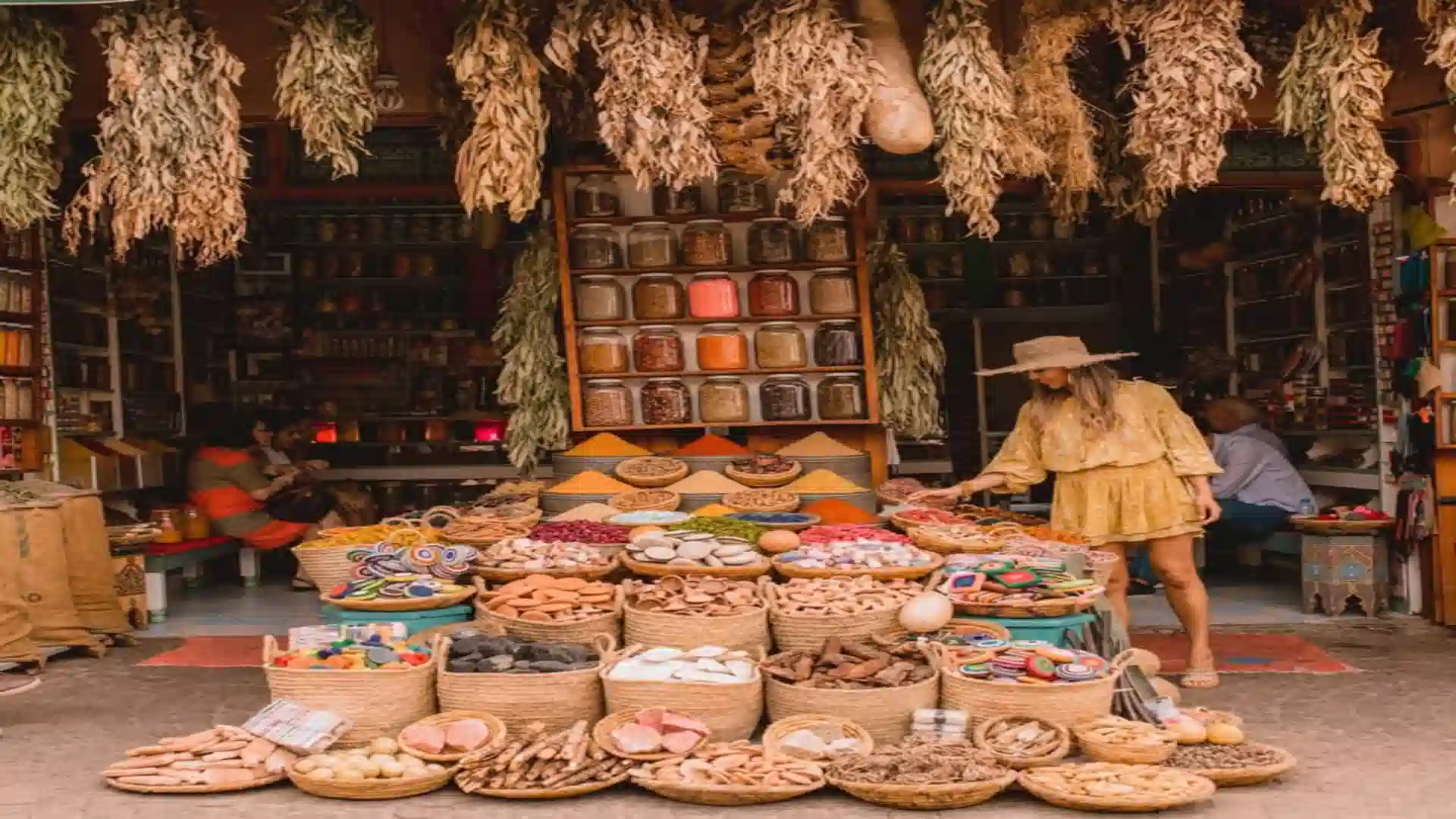

Fes Morocco The Ultimate Visitor Guide 2026 (Medina, Tanneries & Insider Tips)
Fes Morocco is the city most travelers are not prepared for. They come expecting something on the order of Marrakech, the chaos, the souks, the Djemaa el Fna, and they find something older, quieter, more profound, and more itself than almost any other inhabited medieval city on earth. Fes el-Bali’s medina, founded by the Idrisid dynasty in 789 CE and continuously inhabited for over 1,200 years, is not a heritage district created for tourism. It is a working city, of some 156,000 inhabitants who live, work, pray, eat, argue and raise children on the same streets walked by Marinid scholars in the 13th century, in alleys too narrow for any motorized vehicle, in a sonic environment dominated by the calls of artisans and the five daily prayers from the hundreds of mosque minarets that rise above the rooftop landscape.
Fes is Morocco’s oldest imperial city and spiritual capital, home to the world’s oldest continuously operating university (Al-Qarawiyyin, founded 859 CE) and the most intact medieval urban landscape in the entire Islamic world. It was added to the UNESCO list in 1981. Its Chouara tannery has dyed leather using the same techniques since the 11th century. In its Bou Inania Madrasa, there is carved plaster and cedarwood of a quality that no contemporary craftsman can match. All 9,400 of them, in fact, are medina alleyways that form a navigational labyrinth that has left visitors disoriented since the first foreign travelers described it in the medieval period.
Fes is always on the itinerary of all the great circuits we do at Over Morocco Tours, either as a starting point from the north or as an arrival point from the south via the Sahara. Our guides, such as Mohammed (who has been driving and guiding the Fes circuit for 14 years) and Tim (our lead itinerary designer who has spent more time in the Fes medina than in any European city), know this city with a familiarity that has come from repeated visits rather than studied research. This guide is written with that knowledge in mind.
Table of Contents
Fes Morocco Guide: Essential Facts & Cultural Overview (2026)
789 CE
By Idris I (Wadi Fes)
1,256,172
3rd largest in Morocco
280 Hectares
Largest car-free urban area
Founded 859 CE
Oldest active university
- 1. Fes el-Bali: The original 9th-century old medina featuring over 9,400 winding car-free alleyways.
- 2. Fes el-Jdid: The “new medina” founded in 1276 by the Marinid dynasty, housing the Royal Palace and historic Jewish Mellah.
- 3. Ville Nouvelle: The modern French colonial quarter laid out in 1912 with wide palm-lined avenues and modern commerce.
Connecting Marrakech to Fes (~540 km)
~5.5 hrs by car
~3.5 hrs express link
1-hr Royal Air Maroc flight
Tip: Over Morocco Tours custom desert itineraries regularly link Marrakech to Fes via the High Atlas, Ait Ben Haddou, and Erg Chebbi dunes.
Fes Morocco: Chronology of the Imperial Capital
Understanding Fes is not merely context—it is the code that unlocks what you see in the medina today. Every alleyway, craft quarter, and madrasa courtyard carries twelve centuries of living history.
The Idrisid Foundation
Idris I Founds Madinat Fas on the East Bank
Idris I—a descendant of the Prophet Muhammad fleeing Abbasid persecution—founded Madinat Fas on the eastern bank of the Wadi Fes. In 809 CE, his son Idris II extended the settlement to the western bank (naming it al-‘Aliya) and declared it the capital of the first Moroccan state.
The Great Migrations
Two Refugee Waves Create a Cosmopolitan Capital
Approximately 8,000 Arab families expelled from Córdoba (Al-Andalus) settled the eastern bank, forming the Andalusian Quarter (Adwat al-Andalus). Shortly after, 2,000 families from Qairouan (Tunisia) settled the western bank, creating the Qairouan Quarter (Adwat al-Qarawiyin) and bringing unmatched commercial and scholarly sophistication.
Guinness World Record
Fatima al-Fihri Founds Al-Qarawiyyin
Fatima al-Fihri, a wealthy Qairouan refugee, devoted her entire inheritance to construct a mosque and university. Recognized as the world’s oldest continuously operating university, Al-Qarawiyyin predates Bologna (1088) by 229 years and Oxford by over two centuries.
Almoravid Dynasty
Unification of the Two Banks
The Almoravids conquered Fes and unified the two separate walled quarters into a single fortified city. This unified entity became Fes el-Bali—the historic core that retains its medieval layout to this day.
Marinid Golden Age
Capital of a Moroccan Empire
The Marinids built Fes el-Jdid (1276) alongside architectural masterpieces like the Bou Inania and Attarine Madrasas. Scholars like Ibn Khaldun and Ibn Battuta studied here during this intellectual apex.
Colonial Preservation
Treaty of Fes & Creation of Ville Nouvelle
The Treaty of Fes established the French Protectorate. Capital status was moved to Rabat, and French urban policy built a separate European-style Ville Nouvelle. This separation inadvertently preserved Fes el-Bali in its intact medieval form.
UNESCO Designation
UNESCO World Heritage Designation
The Medina of Fes was inscribed as a UNESCO World Heritage Site, cited as “a nearly perfect example of an 11th-century Arab Muslim town.” Today, Fes el-Bali remains the world’s largest car-free urban zone.
Experience Fes el-Bali on a Private Desert Tour
Our official local guides connect the historic milestones above directly to your walking itinerary through the medina. Reach out to design your Marrakech-to-Fes desert transition.
The Three Cities of Fes: An Honest Traveler’s Guide With Things To Do In Fes Morocco:
Fes is not one city, but three each built in a different century, with its own distinct layout and character. Most travelers focus entirely on Fes el-Bali and miss the specific highlights of the other two districts.
UNESCO World Heritage
Fes el-Bali
The Historic Old Medina
A 280-hectare medieval core home to 156,000 residents and 9,400+ winding alleyways with zero motor vehicles. Contains key cultural landmarks including Al-Qarawiyyin, Chouara Tannery, Bou Inania Madrasa, and Bab Boujloud.
Marinid Royal Hub
Fes el-Jdid
The New Medina & Mellah
Founded by Marinid Sultan Abu Yusuf Yaqub as an administrative center. Features the Royal Palace (Dar el-Makhzen) with its handcrafted brass doors, the historic Jewish Mellah, and quieter, authentic local markets.
Ville Nouvelle
Modern Town & Transit Hub
Laid out under Marshal Lyautey’s Protectorate plan. Characterized by wide palm-lined boulevards, sidewalk cafes, the main train station (ONCF), and top restaurants. Serves as a practical logistics base.
Need Help Planning Your Fes Morocco Guide?
Our team seamlessly weaves all three districts into customized multi-day circuits across Morocco, with private transport and licensed local guides.
Top Sights & Architectural Wonders in Fes Morocco
From the world’s oldest continuously operating university to centuries-old dye tanneries and delicate Marinid tilework, here is the quick-reference guide to Fes’s defining landmarks.
Founded 859 CE
Al-Qarawiyyin Mosque & University
The world’s oldest continuously operating university, founded by Fatima al-Fihri. The complex covers 3 hectares with 21 doorways and holds ~4,000 ancient Islamic manuscripts restored in 2016 by architect Aziza Chaouni.
Chouara Tannery
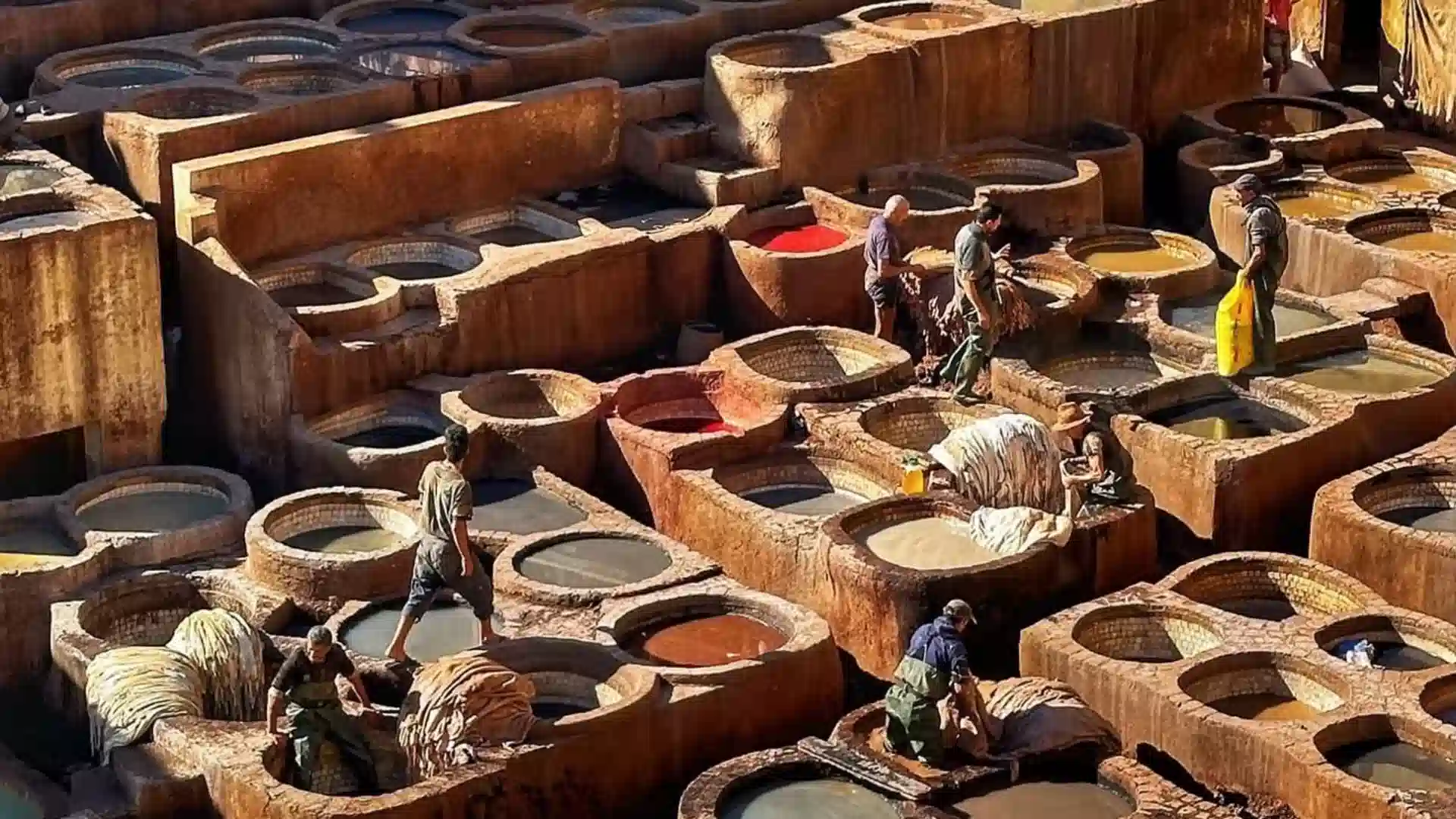
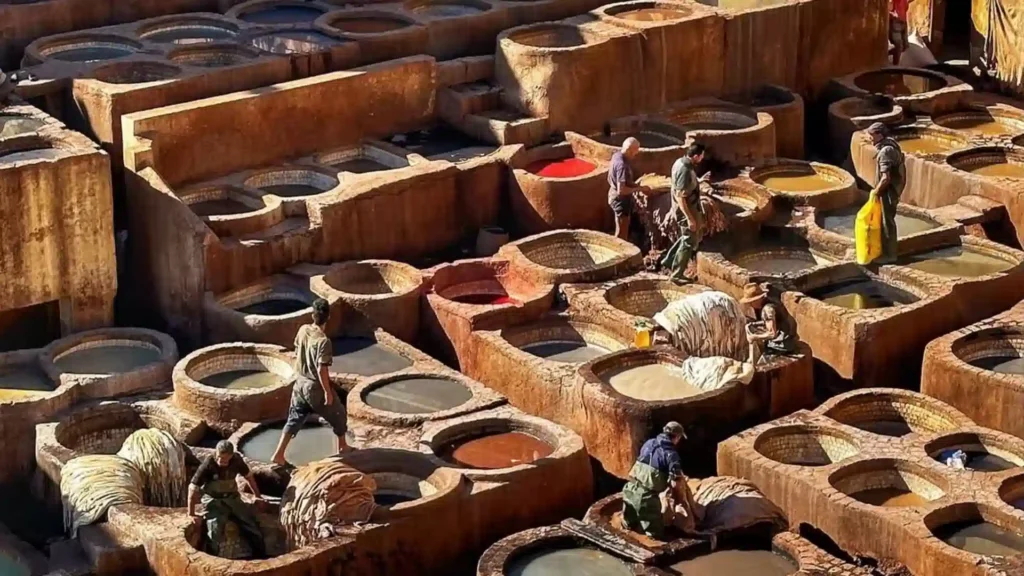
Iconic stone dye vats arrayed across the medina floor. Hides are softened using traditional pigeon droppings and lime solutions, then hand-dyed with natural indigo, saffron, and poppy red.
Built 1350–1355
Bou Inania Madrasa
Marinid architectural masterpiece blending carved cedarwood, zellige tilework, and intricately cut stucco plaster. Functions as both a school and a mosque with a distinctive minaret.
Built 1913
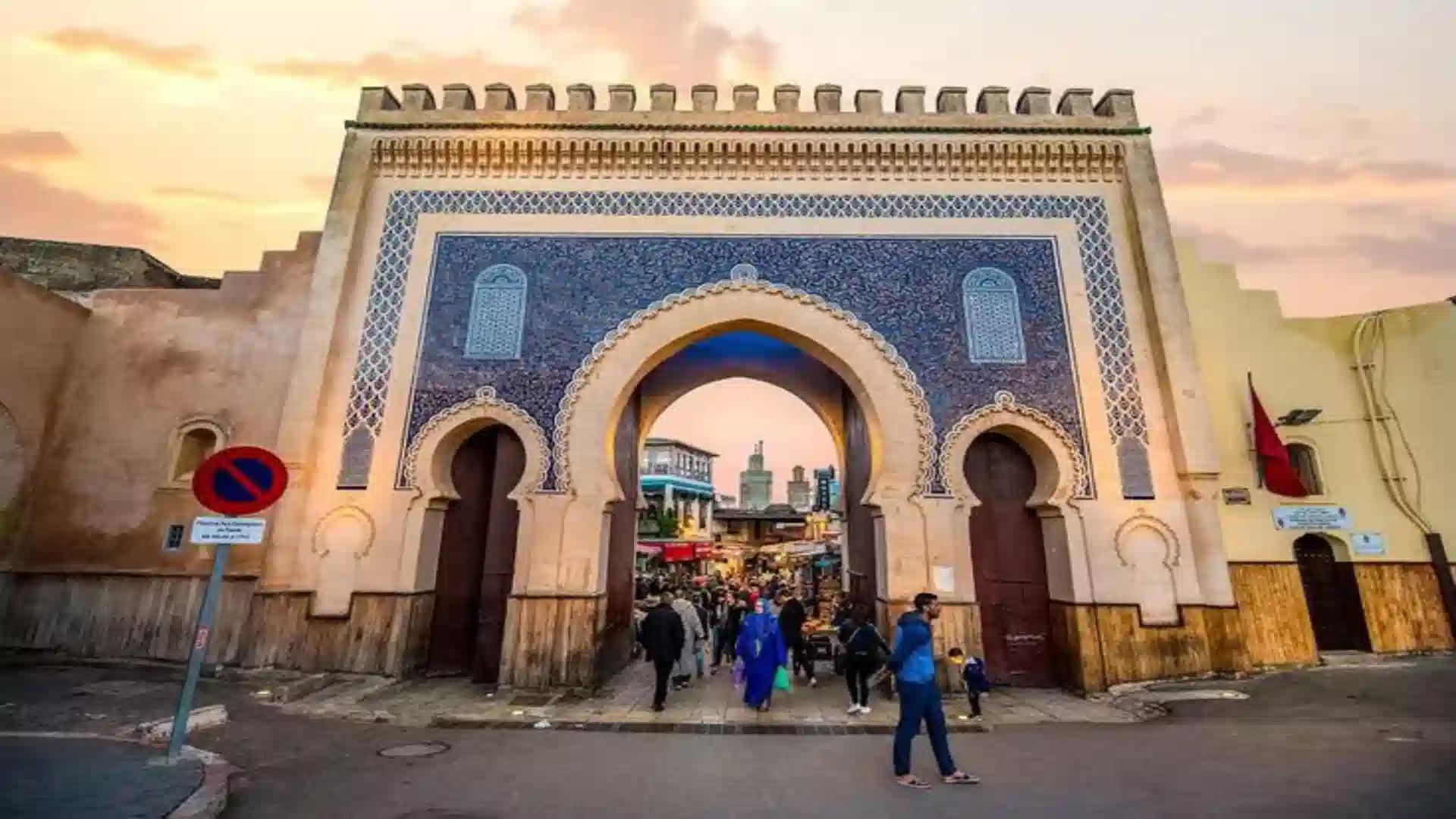
Bab Boujloud (The Blue Gate)
Primary ceremonial gate into Fes el-Bali. Famous for its dual-color tilework: Majorelle Blue on the exterior side and Islamic Green on the medina side.
Fes el-Jdid
Royal Palace Gates (Dar el-Makhzen)
Seven monumental brass doors covered in complex geometric relief work. Weighing several tonnes each, they represent Moroccan artisan metalwork at its pinnacle.
Built 1325 CE
Attarine Medersa
Located in the spice quarter (Souk el-Attarine) next to Al-Qarawiyyin. Features exquisite zellige tilework, a upper cedarwood gallery, and a central marble basin.
Nejjarine Museum of Wooden Arts
Housed in a restored 18th-century fondouk featuring traditional woodworking tools, carved panels, and a rooftop café with views over the medina.
20 MAD entry • In a restored Caravanserai
The Mellah (Jewish Quarter)
Established ~1438 in Fes el-Jdid. Home to the 17th-century Ibn Danan and Al-Fassiyin synagogues alongside the historic white-plastered Jewish cemetery.
Free to explore • Fes el-Jdid district
Experience these sights with an official licensed Fes guide
Al-Qarawiyyin: The World’s Oldest University and the Woman Who Founded It
Al-Qarawiyyin University in Fes is the most historically significant educational institution in Africa and one of the most important in the Islamic world — and its founder, Fatima al-Fihri, is one of the most remarkable women in medieval history whose story most people have never heard. Understanding the full story of Al-Qarawiyyin gives the traveler who visits Fes a context that transforms what would otherwise be an architectural appreciation into something much closer to a genuine encounter with history.
Fatima al-Fihri: The Woman Who Built a University in 859 CE
Fatima al-Fihri was born in Qairouan (present-day Tunisia) to a wealthy merchant family. In the early 9th century her father, Muhammad al-Fihri, moved the family to Fes with the wave of emigrants from Qairouan who established themselves in the city. Her father and then her husband died in rapid succession, leaving Fatima and her sister Mariam considerable wealth. In 859 CE Fatima pledged all her inheritance for the construction of a mosque and school for the burgeoning Muslim community of Fes She is said to have fasted during the construction period, which took several years, and to have only broken her fast when the building was finished. Within a century of its founding, the institution she created, Al-Qarawiyyin (named after the Qairouan community she originated from), became the intellectual heart of the Islamic world.
The scholars who taught and studied at Al-Qarawiyyin Fes in the ensuing centuries include: Ibn Khaldun (1332–1406), whose Muqaddimah is considered the founding text of sociology and historiography; Ibn Battuta (1304–1368/9), the greatest traveler of the pre-modern world, who studied in Fes; Leo Africanus (1488–1554), the Moorish diplomat and geographer whose Description of Africa was the primary European source on sub-Saharan Africa for over a century; and Gerbert of Aurillac, the French monk who later became Pope Sylvester II (999–1003 CE), who may have studied mathematics and astronomy under scholars connected to the Qarawiyyin intellectual tradition — bringing the Hindu-Arabic numeral system (including the concept of zero) to Europe.
Navigating Fes el-Bali Medina: The Honest Practical Guide
The Fes medina is not difficult once you understand its logic — which is that it has no grid, no main street, and no universal landmark visible from all points. It was built for people who knew it from childhood, and its 9,400+ alleyways (derbs) branch and reconnect and dead-end in patterns that defy any cartographic intuition shaped by European or American urban experience. Here is what actually helps.
Navigating the Medina: What Works
- Download Google Maps offline before entering. Google Maps has surprisingly good coverage of Fes el-Bali’s interior — better than any other offline mapping app. Download the offline map for “Fes, Morocco” before you enter the medina, where data coverage can be intermittent. Following GPS navigation rather than instinct is the single most effective navigation tool available.
- Use the main arteries. Despite the labyrinth, two main commercial streets run roughly through the medina: Tala’a Kebira (the “big slope”) runs from Bab Boujloud (the Blue Gate) south through the commercial heart toward Al-Qarawiyyin; Tala’a Sghira (the “small slope”) runs parallel. If lost, ask for either of these streets or for Bab Boujloud — almost any local can point you.
- Hire a licensed guide for the first day. A licensed medina guide (available through your hotel or by hiring from the official Fes tourist office at Bab Boujloud) provides not only navigation but the cultural context that transforms the medina from a confusing labyrinth into a comprehensible cityscape. Over Morocco Tours provides a licensed Fes medina guide for all circuit guests who request one.
- Watch for donkeys and bicycles. The two forms of transport in the car-free medina. When you hear a bell or a shout of “Balek!” (“Make way!” in Darija Arabic), step immediately to the wall — a loaded donkey or a cargo bicycle needs the full width of the alley.
Avoid Unofficial Medina Guides
Near Bab Boujloud and at major medina entry points, unofficial “guides” often offer quick directions or spontaneous tours. These encounters typically end at partner shops where prices are inflated to cover heavy guide commissions.
Need Medina Assistance? →
Directory of Historic Fes Medina Souks
Navigating Fes el-Bali is much easier if you know which craft quarter you’re in. Here’s the rundown of the most legendary market streets and what makes each one special.
| Souk Name | Location | What Is Sold | Notable For |
|---|---|---|---|
| Souk el-Attarine Spice Market |
Adjacent to Al-Qarawiyyin | Spices, perfumes, argan oil, rose water | Most beautiful souk in Fes — arched wooden balconies overhead, open spice sacks below. |
| Souk el-Henna Natural Cosmetics |
Near Moulay Idriss II Mausoleum | Henna paste, kohl, natural cosmetics | Small square shaded by mulberry trees — arguably the most intimate souk in the medina. |
| Souk el-Nejjarine Woodworking |
Nejjarine Square | Traditional woodwork, carved cedar | Located directly adjacent to the historic Nejjarine Museum fondouk. |
| Souk el-Dabbaghin Leather Goods |
Chouara Tannery area | Finished leather goods — bags, belts, babouche slippers | Leather bought at the source — prices are typically lower than Marrakech for comparable quality. |
| Souk el-Sebbaghine Dyers’ Quarter |
Near Chouara Tannery | Dyed wools and silks, raw materials | The Dyers’ Souk — famous for hanging skeins of vibrant yarn and active artisans at work. |
| Souk el-Ktebiyin Books & Paper |
Near Al-Qarawiyyin | Books, manuscripts, traditional paper | Historic book market positioned right beside the world’s oldest university. |
Want a private guided tour through the craft quarters?
The Chouara Tannery Fes: How Leather Has Been Made in Fes Since the 11th Century
The Chouara Tannery is the most viscerally memorable experience in Fes Morocco a landscape so visually extraordinary and so profoundly unchanged from the medieval period that most visitors stand on the viewing terrace for significantly longer than they planned to. Understanding exactly what you are watching makes the experience far richer than simply observing coloured vats from above.
The Seven-Stage Leather Process
The complete leather preparation and dyeing process at Chouara Tannery Fes takes approximately one month from raw hide to finished leather. Every stage is done by hand, using techniques that have remained essentially unchanged since the tannery was established in the 11th century.
- Soaking in the hair removal vat — Raw hides (from cows, sheep, goats, and camels) are soaked in a solution of water, quicklime, and plant ash for 2–3 days to remove hair and soften the skin. The vats used for this stage are white with lime residue — the white vats visible from the viewing terraces.
- Scraping — Workers standing in the vats up to their knees manually scrape the hair from the softened hides using curved iron blades. This is physically demanding and constant work.
- Birdcage washing — The scraped hides are loaded into large rotating wooden drums (resembling birdcages) filled with water to wash out the lime. The drums visible turning slowly at the tannery’s edge are part of this process — one of the few mechanized elements in an otherwise entirely hand-operated system.
- Tanning in pigeon dung — The hides are soaked in a solution of water, pigeon droppings, and salt. This is the source of the tannery’s distinctive smell. The pigeon dung provides ammonia, which further softens the leather and prepares it to absorb dye. The pigeon dung is sourced from pigeon houses (colombiers) maintained specifically for this purpose in the surrounding neighbourhood.
- Dyeing — The softened hides are worked by hand into the circular stone dye vats, each containing a different natural dye. Traditional dyes include: saffron (yellow), pomegranate skin (red-orange), indigo (blue), poppy flower (red), henna (orange-brown), and cedar bark (dark brown). Some tanneries now use synthetic dyes — Chouara still predominantly uses natural dye preparations for the finest quality leather.
- Drying — Dyed hides are spread across the tannery rooftops and surrounding walls to dry in the Moroccan sun. The drying hides visible above the vat level, in various colours and at various stages of drying, are part of the upper visual layer of the Chouara view from the terraces.
- Softening and finishing — Dried leather is worked by hand or by foot to soften it to the required pliability, then cut and shaped by leather workers in the surrounding shops into the finished products: babouche slippers, bags, belts, wallets, and jackets.
🌿 What to Know About the Chouara Tannery Fes Smell
The iconic dye vats of Chouara are an unforgettable sight, but the smell—driven by traditional organic processing is genuinely intense. Here is how to prepare for your visit.
The distinctive odor is produced by ammonia from pigeon dung baths (used to soften the raw hides) alongside natural organic compounds released during the lime-soaking and vegetable-dyeing process. While strong, understanding its authentic 11th-century origin makes it much more manageable for most visitors.
Fresh Mint Sprigs
Leather shop hosts provide fresh mint to hold under your nose while on the terrace viewing platforms, which masks the odor remarkably well.
Arrive in the Morning
Visiting during cooler morning hours significantly reduces the warmth-driven intensity of the organic vapors before peak afternoon sun.
Sensitive Alternative
If you are highly sensitive to strong odors, the smaller Sidi Moussa Tannery offers a similar visual experience in a much milder setting.
Planning a visit to Chouara or Sidi Moussa Tannery?
Marrakech vs. Fes: Our Honest Recommendation
The most popular planning question for first time travelers to Morocco is whether to pick Fes or Marrakech as the home base or main city. The honest answer is both cities are extraordinary and the perfect Morocco trip is both. But if you only have time to see one, or you are trying to understand the difference, here is the comparison our guides give to travelers.
Visit Both on Your Desert Circuit
Every Over Morocco Tours desert circuit seamlessly links both imperial capitals starting in Marrakech and ending in Fes (or vice versa) as you cross the High Atlas Mountains and Sahara dunes. We recommend allocating a minimum of 2 nights in each city.
Best for First-Timers
Marrakech
Vibrant, energetic, and highly sensory. Perfect for travelers seeking legendary rooftop dining, world-class luxury riads, buzzing night markets (Jemaa el-Fnaa), and modern boutique shopping.
Best for Cultural Depth
Fes Morocco
An unpolished, living medieval museum. Essential for travelers wanting authentic Islamic architecture, centuries-old artisan guilds, car-free medina immersion, and deep historical preservation.
Over Morocco Tours • Custom Itineraries
Combine Marrakech, the Sahara, and Fes into one circuit
How to Get to Fes: Information for Visiting Fes Morocco (2026)
Whether arriving from Marrakech, the Sahara Desert, Casablanca, or flying domestically, here is the complete guide to routes, durations, and costs for reaching Fes.
Desert Route
Merzouga (Sahara) → Fes
Scenic high-mountain traverse via the stunning Ziz Valley palm groves and the Middle Atlas cedar forests near Azrou.
$ Cost: Circuit Package
Imperial Route
Marrakech → Fes
Direct transit via motorways or scenic detour through Beni Mellal or Midelt, customizable depending on your schedule.
$ Cost: Circuit Package
| From | Method | Duration | Est. Cost | Route Notes |
|---|---|---|---|---|
| Marrakech | ONCF Train (via Casablanca) |
~5.5 hrs total | ~190 MAD (2nd class) | Most comfortable rail option; book in advance at oncf.ma. |
| Casablanca | ONCF Train (Direct) |
~3.5 hrs | ~120 MAD (2nd class) | Frequent daily departures; most reliable direct public transit option. |
| Any Major City | Domestic Flight (Royal Air Maroc) |
~1 hr flight | From ~350 MAD (early booking) | Fes-Saïss Airport (FEZ) — connections from Casablanca, Marrakech, Agadir. |
Where to Stay in Fes (2026)
Fes accommodation divides clearly between medina riads and Ville Nouvelle hotels. For the full Fes experience, a riad in Fes el-Bali is strongly recommended — the specific combination of waking inside the medina, having breakfast in a traditional courtyard, and stepping directly into the old city from your front door cannot be replicated from a Ville Nouvelle hotel. Budget for the riad premium (typically 200–400 MAD more per night than a comparable Ville Nouvelle hotel) as a worthwhile investment in the overall experience.
- Budget riads (300–500 MAD/night): Several genuine family-run riads within the medina offer clean, comfortable rooms with traditional architecture at accessible prices. Often the most authentic accommodation choice.
- Mid-range riads (600–1,200 MAD/night): Well-restored riads with en-suite bathrooms, reliable hot water, and quality Moroccan breakfast included. The standard Over Morocco Tours recommendation for circuit guests.
- Luxury riads (1,500–4,000 MAD/night): Fully restored historic riads with rooftop terraces, swimming pools, spa services, and restaurant-quality dining. Riad Fes, Palais Amani, and Dar Bensouda are consistently rated among the finest boutique hotels in Morocco.
Best Time to Visit Fes Morocco
The best times to visit Fes Morocco are the spring season (March-May) and the autumn season (September-November). Spring is the most comfortable time to walk the medina alleyways for long periods. The temperatures are mild for walking around the medina (18–26°C) and there are occasional wildflower blooms on the hills surrounding the medina. October is the best month overall: clear light, moderate crowds, comfortable all-day temperatures, and the particular atmospheric quality of the medina in autumn morning light that most travel photographers hold above any other Fes season.
Summer (June-August) in the Fes medina is hot – temperatures often go above 38°C inside the enclosed alleyways making long medina walks unpleasant and exhausting. Start very early (7am) and be finished by noon. Winter (December–February) the medina is cold and sometimes rainy but extraordinary atmospheric – fewer tourists and the specific quality of winter light on the carved plasterwork of the madrasas are genuinely beautiful.
Best Day Trips from Fes Morocco (2026/2027)
Expand your journey beyond the medina walls. From ancient Roman capitals and sacred pilgrimage hills to alpine cedar forests and hidden artisan towns, these are the finest day excursions around Fes.
60 km • 1 hr
Meknes & Volubilis Roman Ruins
Meknes—the 17th-century imperial city built by Sultan Moulay Ismail—pairs with the adjacent 1st-century CE Roman ruins of Volubilis to create Morocco’s finest historical day trip. Discover remarkable mosaic floors, triumphal arches, and forum ruins that highlight the country’s deep pre-Islamic heritage.
65 km • 1 hr
Ifrane & Middle Atlas Cedar Forest
Known as the “Switzerland of Morocco” for its alpine architecture and winter snows, Ifrane sits high at 1,665 meters in the Middle Atlas. The nearby Cèdraie d’Azrou cedar forest is home to Morocco’s last wild Barbary macaques, offering an astounding contrast just an hour from medieval Fes.
65 km • 1 hr
Moulay Idriss & Sacred Town
Cascading across twin hills overlooking the Volubilis plain, Morocco’s holiest pilgrimage site centers on the tomb of Idris I, founder of Fes. Closed to non-Muslims until 2005, its whitewashed hillside architecture creates one of the most striking visual panoramas in the kingdom.
28 km • 30 min
Sefrou & Cherry Festival
Located just 28 km south of Fes, Sefrou features an exceptionally preserved medina and historic Jewish Mellah. Free from heavy tourism, walking its quiet alleyways feels like stepping back through time to an earlier, unhurried era.
Five Things About Fes That Most Visitors and Travel Guides Miss
1. The Fes Medina Has More Functioning Hammams Than Any City in the World
Fes el-Bali has around 120 working neighbourhood hammams (public baths) — more than any other similar urban area in the world. Density is a function of both Islamic tradition (ritual bathing before prayer) and medieval urban planning that placed hammams within walking distance of every mosque. Many of the medina’s hammams are 11th–13th century Marinid buildings that have been functioning nonstop since they were built. A visit to a neighbourhood hammam in Fes costs 10-15 MAD — about £1 — it’s the most authentic cultural immersion experience you can have in the city for this price.
2. Fassi Cuisine Is Considered Morocco’s Most Sophisticated — and It Differs Significantly from What Is Served in Marrakech
The cooking tradition of the Fes medina – Fassi cuisine – is widely considered to be the most technically sophisticated and culturally developed of Morocco’s regional culinary traditions. It differs from Marrakech’s cuisine in a few specific ways: more use of preserved and fermented ingredients; more complex layering of spices (15–20 spices in a single dish compared to Marrakech’s 8–12); the Fes sweet-savoury combination (a pastilla filled with pigeon, almond and powdered sugar is a Fes original, not a Marrakech dish); and the tradition of the diffa (formal feast) in which a multi-course sequence of salads, briwats (fried pastry triangles), tagines, couscous and pastilla are served in a specific ceremonial order. The best Fassi food can be found in homes within the medina and in riad restaurants, not in places catering to tourists, a distinction that needs local guidance to navigate.
3. The Water Clock Across from Bou Inania Madrasa Is One of the Most Extraordinary Medieval Scientific Instruments Still Standing
The Dar al-Magana (House of the Clock) – the water clock constructed in 1357 directly across the main street from the Bou Inania Madrasa – is one of the most overlooked medieval scientific monuments in the world. It was constructed to indicate the five daily prayer times with a hydraulic mechanism of 12 or 13 brass bowls and wooden doors that opened and spilled water at designated intervals. Never has the mechanism been fully reverse-engineered by modern scholars – a hydraulic clock complex enough from the 14th century that modern-day engineering historians can’t agree on its exact operating principles, working from the street in the middle of the world’s oldest Islamic medina, seen by thousands of visitors each day without most of them knowing what they are looking at.
4. Leo Africanus — the Man Who Gave Europe Its Primary Knowledge of Africa — Studied in Fes
Leo Africanus (Arabic name: al-Hasan ibn Muhammad al-Wazzan al-Fasi, surname al-Fasi means “from Fes”) was born in Granada around 1488, he came to Fes as a child when his family was expelled from Spain after the fall of Granada in 1492. He studied at Al-Qarawiyyin, travelled widely across North Africa and sub-Saharan Africa as a diplomat, was captured by Spanish pirates in 1518, and ended up at the court of Pope Leo X in Rome, where he converted to Christianity (taking the name Johannes Leo de Medici — “Leo Africanus”) and wrote his Description of Africa (Descrittione dell’Africa). It was published in 1526 and was the main source of knowledge about sub-Saharan Africa in Europe for more than a century. The man who defined European perceptions of Africa for 150 years, Leo Africanus studied in the same classrooms, still in use, at Al-Qarawiyyin in Fes el-Bali.
5. The Fes Medina’s Street Layout Has Been Largely Unchanged Since the 13th Century
Comparative studies of historical Islamic maps of Fes el-Bali and current GPS mapping show that the basic street plan of the medina, the course of the main arteries, the position of the major mosques and madrasas, and the layout of the souk quarters by craft type, for example, have not changed fundamentally since the Marinid period of the 13th–14th centuries. This makes Fes el-Bali the most accurately preserved medieval Islamic urban environment anywhere in the world. When you walk Tala’a Kebira from Bab Boujloud towards Al-Qarawiyyin, you are following the same route, through the same spatial sequence, past the same fundamental spatial relationships between buildings, that a medieval Fassi student walked on his way to study in the 13th century. No other European medieval city has preserved its physical fabric to this extent and with this degree of accuracy.
Fes, Morocco: Frequently Asked Questions
Click any question below to reveal detailed answers, historical context, and local recommendations for your trip.
What is Fes, Morocco famous for?
Fes Morocco is famous primarily for five historical and cultural pillars:
Who founded Fes Morocco and when?
Fes Morocco was founded in 789 CE by Idris I — a descendant of the Prophet Muhammad through his grandson Hasan, who fled Abbasid persecution after the Massacre of Fakh in 786 and established the Idrisid dynasty in Morocco. Idris I founded the settlement of Madinat Fas on the eastern bank of the Wadi Fes river. His son Idris II extended the city to the western bank in 809 CE.
Is Fes better than Marrakech to visit?
Fes and Marrakech offer fundamentally different experiences — neither is objectively better; they are complementary:
Marrakech
More immediately dramatic, accessible for first-timers, connected by low-cost European flights, and the natural start/end point for Sahara desert tours.
Fes
Older (founded 789 CE vs Marrakech 1070 CE), larger, better-preserved medieval medina, world’s oldest university, and rewards travelers seeking deep cultural immersion.
How many days do you need in Fes Morocco?
Two full days (2 nights minimum) is the minimum for a thorough experience of the essential sights:
- Day 1: Fes el-Bali: Bou Inania Madrasa, Al-Qarawiyyin area, craft souks (Souk el-Attarine, Souk el-Henna), and Chouara Tannery.
- Day 2: Attarine Medersa, Nejjarine Museum, and Fes el-Jdid (Royal Palace Gates, Jewish Mellah).
- Day 3 (Optional): A deep medina wander without an agenda — or a day trip to Meknes and Volubilis.
Do you need a guide in Fes medina?
A licensed guide is strongly recommended for your first day in the Fes medina — not because the medina is unsafe, but because it is genuinely complex and the historical context transforms what you see. Without a guide, first-time visitors typically spend significant time disoriented, miss the most historically significant sites, and lack context for what they find.
What is the best time to visit Fes Morocco?
The best times to visit Fes Morocco are spring (March to May) and autumn (September to November).
Mild temperatures (18–26°C), comfortable walking conditions, pleasant overall climate.
October is the finest month—clear light, moderate crowds, and beautiful autumn light in alleyways.
Enclosed alleys reach 38°C+; requires early morning starts and midday rest.
Cold (8–15°C) but atmospheric, fewest tourists, and extraordinary light quality.
Note on Ramadan: Creates a unique atmosphere—restaurants close during daylight hours, but the city comes alive spectacularly at sunset iftar.
What is Al-Qarawiyyin University and why is it significant?
Al-Qarawiyyin (Al-Quaraouiyine) is a mosque and educational institution in Fes el-Bali, founded in 859 CE by Fatima al-Fihri — a wealthy Tunisian-Moroccan woman who used her inheritance to build it for the community. Recognized by Guinness World Records as the world’s oldest continuously operating educational institution, it predates the University of Bologna (1088 CE) by 229 years.
At its medieval peak, it attracted world-class scholars including Ibn Khaldun (founding father of sociology), Ibn Battuta (medieval traveler), and Leo Africanus.
How do I get from Marrakech to Fes?
The best ways to travel from Marrakech to Fes in 2026 are:
Include Fes on Your Morocco Desert Circuit
Over Morocco Tours circuits from Marrakech to the Sahara and onward to Fes are our most popular itineraries — combining the camel trek at Erg Chebbi, the Dades and Todra gorges, the Ziz Valley date palm forests, and a full guided day in the Fes medina. Private tours, English-speaking guides throughout, no hidden fees. TripAdvisor 10.0 Superb.
Plan Your Morocco Circuit💬 WhatsApp: +212 673 952 695 · ✉ [email protected]
🔗 Related Guides & Tours — Over Morocco Tours
- 5 Days Tour Marrakech to Merzouga and Fes — Book Now
- 7 Days Casablanca Grand Circuit via Sahara and Fes
- Things to Do in Marrakech: Complete 2026 Guide
- Djemaa el Fna Marrakech: Complete Visitor Guide 2026
- Camel Trekking in Merzouga: Complete 2026 Guide
- Berber People: The Complete Guide to Amazigh Culture in Morocco

Verified Guide
Article Author & Local Expert
Mohammed
•
Fes Circuit Specialist
Mohammed has driven the Marrakech to Fes circuit via the Sahara hundreds of times over 14 years, overnighting in Fes more times than he can count. His knowledge of the medina — which guesthouse terrace has the best view of the Chouara tannery, which souk sells genuine artisan leather rather than tourist-grade imports, and which rooftop has the finest Al-Qarawiyyin minaret framing at golden hour — is specific, practical, and unmatched.