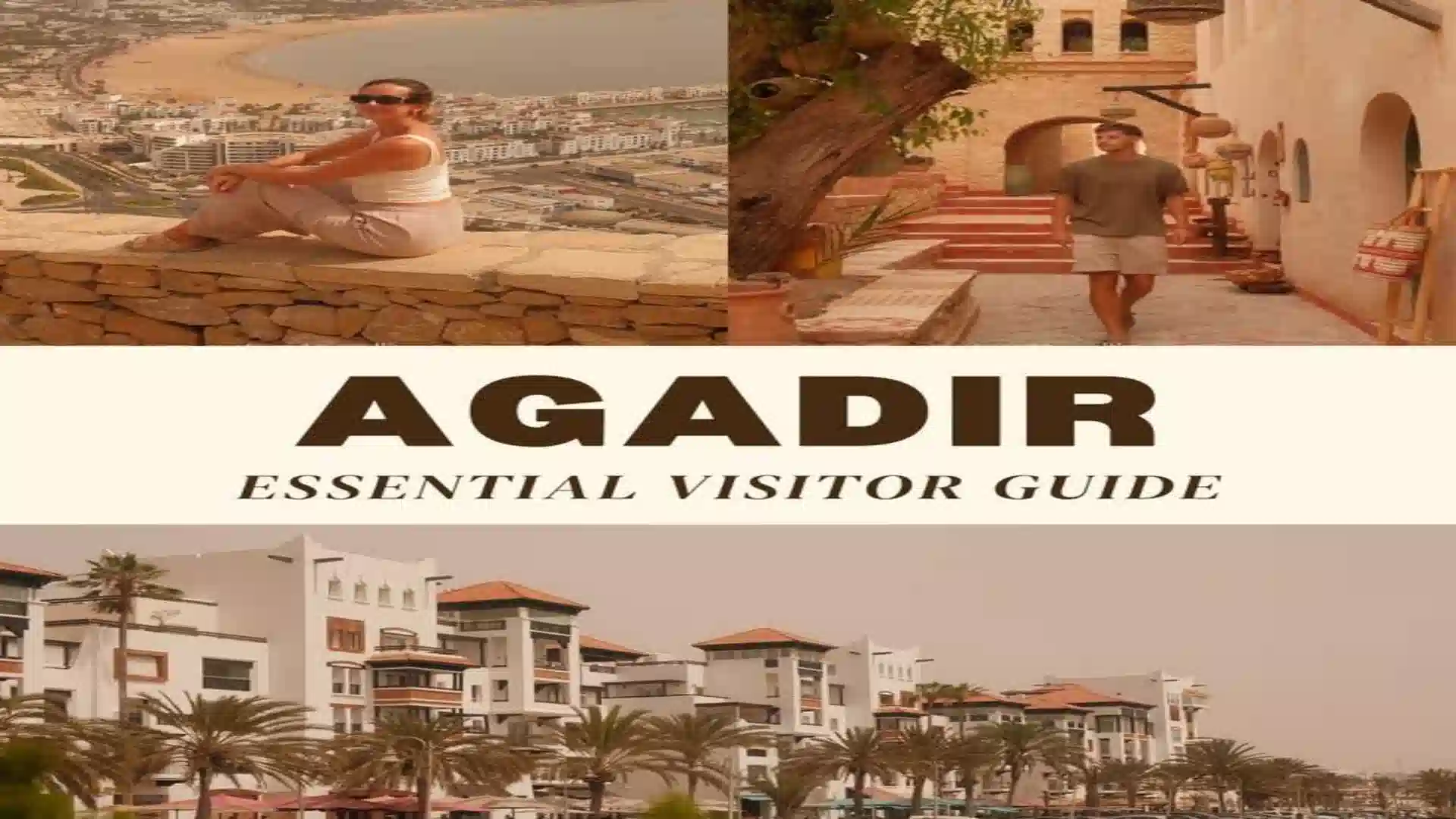
20 Best Things to Do in Agadir in 2026: The Complete Local Guide
This guide covers all the Agadir attractions worth your time, with real prices in MAD, opening hours, beach and surf conditions by month, day trip logistics, and the insider details that will distinguish a truly rewarding Agadir visit from a week spent entirely on a sun lounger.
Quick Reference: Best Things to Do in Agadir Morocco
| # | Attraction / Activity | Type | Time Needed | Price (MAD) |
|---|---|---|---|---|
| 1 | Agadir Beach and Promenade | Beach / seafront | Half day–full day | Free (beach clubs 100–300) |
| 2 | Agadir Oufella Cable Car and Kasbah | History / views | 1.5–2 hrs | 80 (round trip) |
| 3 | Souk El Had Market | Culture / shopping | 2–3 hrs | Free |
| 4 | Medina d’Agadir (Medina Polizzi) | Culture / crafts | 1–1.5 hrs | Free |
| 5 | Agadir Marina | Leisure / food | 1–2 hrs | Free (restaurants 150–400) |
| 6 | Amazigh Heritage Museum | Museum | 45 min | 20 |
| 7 | Crocoparc | Family / nature | 1.5–2 hrs | 100 (adult) / 70 (child) |
| 8 | Agadir Fishing Port | Culture / food | 1 hr | Free |
| 9 | Watersports on Agadir Beach | Adventure | 1–3 hrs | 150–500 |
| 10 | Camel Ride on the Beach | Experience | 1 hr | 200–350 |
| 11 | Day Trip to Taghazout | Surf / village | Half–full day | 150–250 return taxi |
| 12 | Paradise Valley Day Trip | Nature | Full day | 200–400 (guided) |
| 13 | Souss-Massa National Park | Wildlife / nature | Half–full day | 50 |
| 14 | Day Trip to Taroudant | Culture / history | Full day | 200–400 return |
| 15 | Day Trip to Essaouira | Coast / art | Full day | 250–450 return |
| 16 | Sunset Boat Trip from Marina | Experience | 2–3 hrs | 250–500 |
| 17 | Hammam in Agadir | Wellness | 1.5 hrs | 80–400 |
| 18 | DaniaLand Waterpark | Family | Half day | 250 (adult) |
| 19 | Hot Air Balloon near Agadir | Adventure | 4–5 hrs | 1,500–2,000 |
| 20 | Day Trip to Marrakech | Culture | Full day | 500–700 return |
What to Do In Agadir Morocco’s Most Accessible City
Agadir is unlike any other major Moroccan city; it has no ancient medina, no UNESCO-listed labyrinthine souk, and no 700-year-old mosque dominating the skyline because almost everything in the city was built after 1960, when a catastrophic earthquake (magnitude 5.7, lasting just 15 seconds) killed between 12,000 and 15,000 people and destroyed 70% of the original city. Agadir was destroyed by an earthquake in 1960 and rebuilt, transforming from a traditional Moroccan town to a more modern and vibrant destination.
That rebuilt character-wide boulevards, modern hotels, an ordered seafront, and rational urban planning are not a historical loss to mourn but the very quality that makes Agadir work so well for its core audience. It’s one of the few Moroccan cities where a family with small children, a couple on a beach holiday, and an adventure-hungry surfer can all have a fantastic time from the same base.
Agadir is laid back, beachy, and designed for comfort. Agadir is generally a better choice for families, sun-seekers, and those interested in watersports and convenient access to the Atlas and Sahara. For culture, history, and the classic Morocco experience, Marrakech is the winner. Both statements are true; neither is a criticism, but rather a description of two cities that serve different travel needs.
1. Agadir What to Do in Beach and Promenade: The Heart of the City
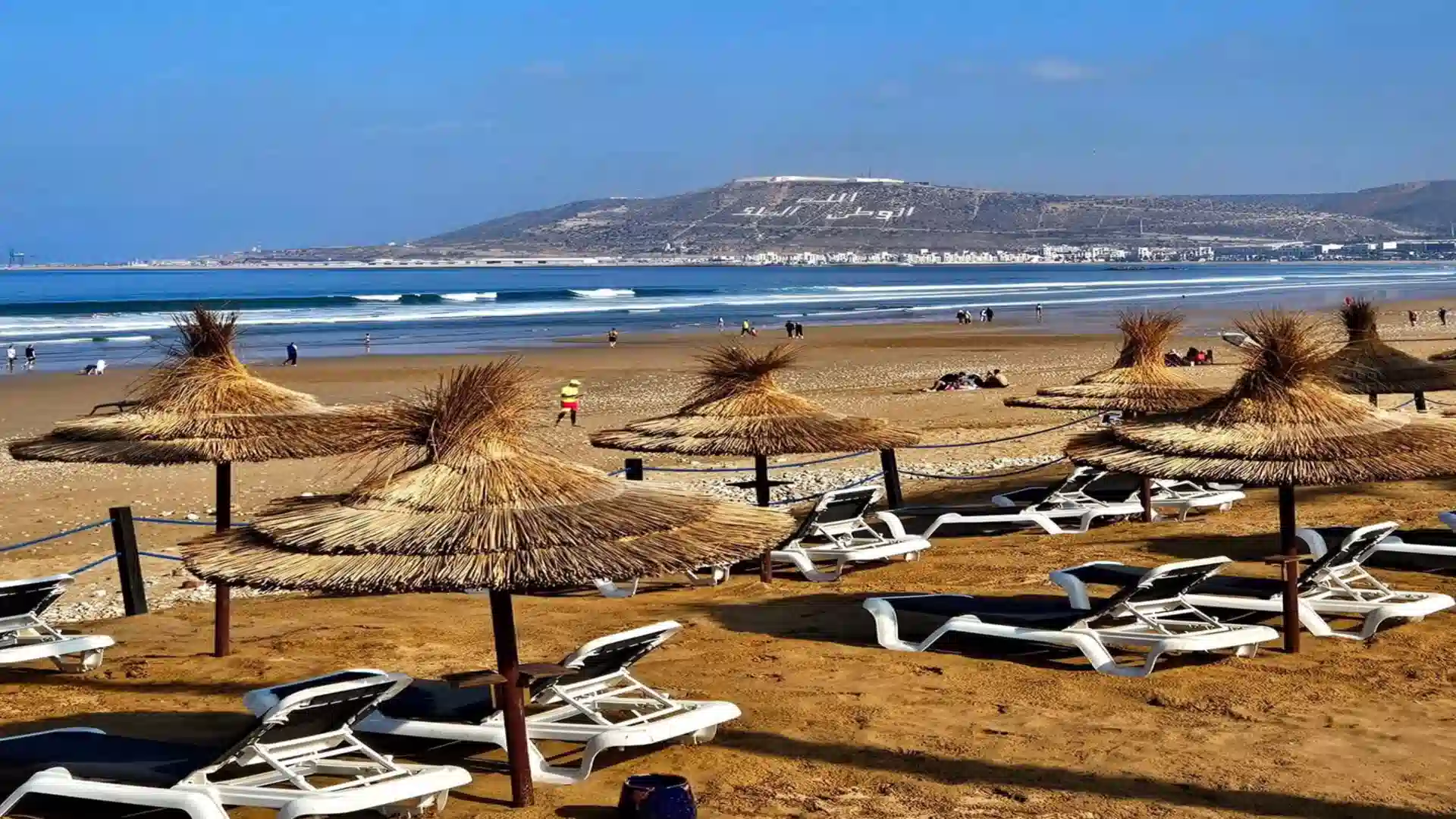
Agadir Beach is the main attraction of the city, 10 km of wide, golden Atlantic sand with lifeguards on duty year-round, calm water in the protected curve of the bay, reliable sunshine, and a palm-lined promenade the entire length that is the city’s social spine from morning walks to midnight strolls. Agadir’s beach, 10 km of fine sand, is patrolled year round by lifeguards.
One of the most common things to do in Agadir is to explore Agadir Beach. The promenade is undoubtedly Agadir’s biggest attraction, with the beach lined with restaurants and bars.
What makes Agadir Beach exceptional:
- Scale: 10 km of uninterrupted sand large enough that even in peak July and August, the beach never feels overcrowded across its full length.
- Safety: The bay’s natural curve protects swimmers from the strongest Atlantic swells; designated swimming zones with lifeguards operate year-round.
- Facilities: Beach clubs with sun loungers and umbrellas (100–300 MAD per day), parasols for hire independently, beach volleyball courts, and watersports stations at regular intervals.
- The promenade: A wide, palm-lined seafront walkway runs the full length of the beach, and the evening passeggiata here, particularly from 6 to 9 PM, is one of Agadir’s most genuinely pleasant experiences.
Surfing on Agadir Beach: Surfing is excellent at the southern end of the beach and at the Taghazout beaches 20 kilometers away, which is Morocco’s best surf spot and one of the best in Africa. The southern end of Agadir Bay generates consistent, manageable beach breaks better for beginners and intermediate surfers than the powerful point breaks of Taghazout. Several surf schools operate directly from the beach at the southern end, offering 2-hour lessons for 250–400 MAD, including board and wetsuit.
Best times:
- Swimming: April–October (water temperature 18–22°C)
- Beach walking: Year-round, even in January, it is mild (16–18°C and sunny)
- Surfing: October–April for the best Atlantic swells; summer sees smaller, more inconsistent waves
2. Things to do in Agadir Oufella Cable Car and Kasbah Ruins: The Best View in the City

Taking in the iconic panoramic view of Agadir bay and city from the Kasbah hill.
One of the best things to do in Agadir Morocco Lately, opened in 2018, Morocco’s first cable car runs 1,700 meters in about 5 minutes from the marina base to the 236-meter-high Kasbah ruins. This is the best panoramic view of Agadir, the Atlantic Bay, and the Anti-Atlas foothills that you can get from anywhere in the city, especially at dusk, when the entire bay turns amber. The Agadir cable car is one of the most fun and modern things to do in Morocco. It links the city with the Oufella ruins in only 5 minutes, soaring above palm-lined streets and coastline.
The cable car connects the city to the historic Casbah of Agadir Oufella, a historical fortress perched on top of a 236-meter mountain with the whole bay stretching out beneath you as you rise from the base all the way up to the kasbah.
What’s at the top:
- The Agadir Oufella Kasbah ruins all that remained after the 1960 earthquake, preserved as a memorial to the original city.
- The Arabic inscription “God, Homeland, King” is visible on the hillside below, lit at night and seen from anywhere on the bay.
- A panoramic café and viewing terrace with 360° views over the city, beach, ocean, and Atlas foothills.
- A small cultural museum documenting the history of the original city and the earthquake.
Practical details:
- Cable car price: 80 MAD round trip
- Operating hours: Check locally; the cable car closes periodically for maintenance; mornings and late afternoons are most reliable.
- Alternative: Taxi or walk (steep, 30–45 minute climb) to the kasbah if the cable car is closed.
- Best time: One hour before sunset, ride up, watch the light change on the bay, and ride down as the city lights activate.
3. Visit Souk El Had: Morocco’s Largest Market With Agadir What To Do
Souk El Had is the biggest walled market in Morocco. Over 6,000 stalls covering 16 hectares, laid out by product zone (spices, argan oil, clothing, leather, ceramics, fresh produce, electronics, and traditional crafts), and open every day of the week, with the busiest and most atmospheric sessions on Sunday (El Had means ‘Sunday’ in Moroccan Arabic). Go hungry, and return with things you didn’t know you needed. Bargaining is expected, so start at half the advertised price.
What to buy at Souk El Had:
- Argan oil: Agadir sits in the heart of Morocco’s argan country; the Anti-Atlas foothills surrounding the city are covered in argan trees found nowhere else on earth. Buy culinary argan oil (golden, for cooking) or cosmetic argan oil (darker, for skin and hair) directly from producers at the souk rather than tourist-facing boutiques.
- Spices: Ras el hanout (Morocco’s complex spice blend), cumin, saffron (check authenticity; real saffron is expensive), paprika, and dried herbs at a fraction of tourist zone prices.
- Leather goods: Babouche slippers, belts, and bags have less tourist pressure than in Marrakech’s souks.
- Fresh produce: The finest seasonal fruits from the Souss Valley date from the Draa Valley, clementines from the Agadir plain, and seasonal vegetables at local prices.
The real Souss starts at Souk El Had, continues along the argan route toward Essaouira, and is completed at Paradise Valley. Spend at least 2 hours here it takes 30 minutes just to orient yourself.
4. Medina d’Agadir (Medina Polizzi): The Reconstructed Traditional Quarter
Since 1992, Italian architect Coco Polizzi has been creating a deliberate facsimile of a traditional Moroccan medina, the Medina d’Agadir. Built from materials salvaged from around Morocco and with artisans moved from other areas of the country to work there, this was a working crafts quarter with real artisan production, not a theme park recreation. Enjoy mint tea and shop Moroccan treasures at the open-air Medina d’Agadir.
This is not the organic, centuries-old Medina of Fes or Marrakech, and it doesn’t pretend to be that. What it offers is a more relaxed, more structured introduction to Moroccan crafts for visitors overwhelmed by the Marrakech souk system, with artisans visible at their work, prices somewhat higher than authentic Medina equivalents but considerably lower than tourist boutiques, and no commission-shop pressure.
What’s here:
- Pottery, ceramics, and zellige tilework workshops.
- Weavers producing Moroccan carpets and kilims.
- Leather workers making babouche slippers and bags.
- Woodcarving and marquetry workshops.
- Cafés serving mint tea in a medina atmosphere.
5. Things To Do In Agadir Marina: The Modern Waterfront

Strolling along the waterfront promenade and yachts at the Agadir Marina.
Agadir Marina, Morocco’s most established leisure marina, with several hundred berths for private and charter vessels, surrounded by a crescent of international restaurants, cafes, boutique shops, and a sunset boat-trip departure point is the city’s most modern and European-feeling public space and genuinely pleasant for an evening of dining and people-watching.
What to do at the Marina:
- Evening walk along the pontoons as sailing boats and fishing charter vessels sit in the amber light.
- Fresh seafood dinner at one of the marina-facing restaurants: Atlantic sea bass (loup), grilled sole, and fresh prawns are the specialties.
- Sunset boat trip departure: All sunset cruises depart from the marina’s main pier.
- Watersport rental: Sea kayaks, paddleboards, and glass-bottom boat trips available directly from the marina.
6. Amazigh Heritage Museum: What To Do In Agadir Morocco Most Important Museum
The only museum in Morocco entirely dedicated to Amazigh (Berber) culture is the Amazigh Heritage Museum (Musée du Patrimoine Amazigh) in central Agadir. Exhibits include Berber jewelry, traditional looms, Anti-Atlas ceramics, and documentation of the different Tamazight dialects spoken by the country’s indigenous communities. Small, honest, and entirely overlooked by tour packages.
Because Agadir is in the heart of Tashelhit-speaking Berber territory (the Souss Valley is the largest Tashelhit-speaking area in Morocco), this museum provides context that makes every subsequent experience in the region a whole lot richer: the argan oil, the craft traditions, the mountain villages, and the Berber guides who operate most desert tours through the south.
7. Visit Crocoparc: Most Unusual Agadir Attraction
Just southeast of Agadir city center, Crocoparc, a 2.5-hectare botanical garden and wildlife park, is home to more than 300 Nile crocodiles, exotic birds, iguanas, chameleons, tortoises, and tropical plant species, making it Agadir’s most surprising and most family-friendly indoor-outdoor attraction.
The crocodile feeding sessions (usually 11 a.m. and 3 p.m.) are the most popular events, and it’s quite dramatic to watch handlers feeding 300 Nile crocodiles at once.
8. Agadir Fishing Port: Where the Real Agadir Operates
Just north of the marina, Agadir’s fishing port is one of the most photogenic and authentic experiences the city offers, running from before dawn to mid-morning: trawlers unloading Atlantic catch directly onto the quay, seagulls massing over the boats and adjacent restaurants serving the morning’s fish grilled to order within meters of where it was landed.
Agadir is Morocco’s main Atlantic fishing port; the volume of fish processed here each year makes it one of the largest fish landing centers in Africa. The morning port scene is totally separate from the resort-hotel world of the beach and marina and completely free to watch.
9. Watersports on Agadir Beach: The Full Activity Menu
Agadir Beach offers the widest selection of Atlantic watersports of any beach in Morocco, from beginner surf lessons and paddleboarding to jet skiing, parasailing, banana boat rides, and sea kayaking, all organized by licensed operators working directly on the beach.
| Watersport | Provider Location | Price (MAD) | Best Level |
|---|---|---|---|
| Surf lesson (2 hrs, incl. board + wetsuit) | South end of beach | 250–400 | Beginner–intermediate |
| Paddleboarding (1 hr) | Central Beach | 150–200 | All levels |
| Sea kayaking (1 hr) | Marina or central beach | 150–250 | All levels |
| Jet skiing (20 min) | Central Beach | 300–450 | Adults only |
| Parasailing | Central Beach | 400–600 | All levels (tandem) |
| Banana boat ride | Central Beach | 100–150 per person | Families, groups |
| Glass-bottom boat trip | Marina | 150–250 | All levels |
10. Camel Ride on Agadir Beach: Things To Do In Agadir Morocco
One of the most atmospheric beach activities Morocco has to offer, combining the golden Atlantic light, the full length of the beach, and the Sahara camel experience to be had in the desert, all accessible directly from the city, is a camel ride along Agadir Beach, usually 45-60 minutes along the shoreline at sunrise or sunset.
Price: 200–350 MAD for a 45–60 minute guided beach camel ride.
Best time: Sunset (5–7 PM depending on season). The light on the ocean is exceptional.
11. Things To Do In Agadir And Taghazout: Morocco’s Surf Capital, 20 km North
20 kilometers (about 30 minutes) north of Agadir, Taghazout is Morocco’s undisputed surf capital and one of Africa’s premier surfing destinations, with consistent right-hand point breaks that attract surfers from across Europe and beyond between October and April. Taghazout Bay has become a global hub for surfers and digital nomads.
| Break | Type | Level | Best Season |
|---|---|---|---|
| Anchor Point | Right-hand point break | Intermediate–advanced | October–March |
| Hash Point | Right-hand point break | Intermediate | October–March |
| Killers | Right-hand point break | Advanced | October–March |
| Panoramas | Beach break | Beginner–intermediate | Year-round |
| Tamraght (4 km south) | Beach break | Beginner | Year-round |
Even non-surfers find a week here easy. Tamraght is 4 km south, quieter, greener, and popular with people who find Taghazout too busy.
12. Visit Paradise Valley: The Day Trip That Surprises Everyone With Agadir What To Do
Paradise Valley (Vallée du Paradis) is the one-day trip from Agadir that everyone keeps mentioning: a palm-lined river gorge in the Ida Outanane foothills, about 60 km northeast of Agadir. A winding drive through argan tree forests, Berber villages, and dry riverbed valleys leads to a green oasis of natural rock pools fed by waterfalls, all free to swim in and definitely not what you see from Agadir’s beach.
What to expect at Paradise Valley:
- The approach: 60 km of increasingly dramatic mountain road passing through Argan Forest and small Berber villages the drive itself is part of the experience.
- The pools: Natural rock pools of varying depth, cold and clear, ideal for swimming in warm months and photographically extraordinary year-round.
- The palms: Ancient Saharan-edge palm groves that give the valley its name and its specific microclimate.
- Rope swings: Local entrepreneurs have set up rope swings over the deepest pools for 5–10 MAD per session.
13. Souss-Massa National Park: Birdwatching and Atlantic Wilderness
Souss-Massa National Park, located 80 km south of Agadir along the Atlantic coast, protects a 33,800-hectare area of coastal wetland, dune systems, arganeraie forest, and Atlantic shoreline. It hosts one of the most important populations of the critically endangered Northern Bald Ibis in Africa, the only remaining wild Atlantic population of this bird species in Morocco.
In addition to the bald ibis, the park is visited by flamingos, ospreys, raptors, and a wide range of migratory birds, which use Morocco’s Atlantic coast as a migration corridor between Europe and sub-Saharan Africa.
14. Day Trip to Taroudant: Visit the Walled City With Things to Do In Agadir Morocco
Taroudant is a walled medieval town in the Souss Valley, 80km east of Agadir, frequently dubbed ‘Little Marrakech’ for its intact red pisé ramparts and traditional souk atmosphere. It offers a compact, authentic medina experience that’s an easy day trip from Agadir’s beach.
Taroudant’s medieval ramparts, 7 km of original earthen walls built in the 16th century, surround a medina with two main souks, a traditional tannery, and a kasbah district that feels much less touristy than Marrakech equivalents, with far fewer crowds.
15. Day Trip to Essaouira from Agadir
Essaouira is Morocco’s most charming coastal town and is on the UNESCO list. It’s on the Atlantic coast road, 175 km north of Agadir. Essaouira has a whitewashed-and-blue medina, 16th-century Portuguese fortification walls, a working fishing port, and a cultural atmosphere shaped by Gnawa music and a thriving contemporary arts scene.
Combination tip: Essaouira is also a good intermediate stopover if you’re traveling between Agadir and Marrakech 2.5 hours south of Marrakech, 3 hours north of Agadir, and a natural lunch and half-day stopover on any coastal route.
16. Sunset Boat Trip from Agadir Marina: One of the Best Things to Do In Agadir Morocco
A very romantic and scenic thing to do in Agadir is a sunset boat trip from Agadir Marina. It usually lasts 2-3 hours and takes you along the coastline past the bay’s golden cliffs and out to see if, you’re lucky, you might even spot some dolphins under the right sea conditions. You’ll get back to port just in time for the Agadir Oufella Kasbah to light up on the hillside.
Several operators run sunset cruises from the Marina pier on a variety of boats, from open-deck boats to larger catamarans, serving mint tea and Moroccan pastries on board.
17. Hammam in Agadir: Traditional Moroccan Bathing
Agadir has neighborhood public hammams (15-30 MAD entry) and hotel spa hammams (200-500 MAD for a full ritual). The most authentic experience can be had in the public hammams in the residential neighborhoods of the city, whereas the most comfortable setting can be found in the hotel hammams.
Best hammam areas in Agadir:
- Neighbourhood public hammams near the Souk El Had area (most authentic, least tourist-oriented).
- Hotel spa hammams in the beach hotel zone (most comfortable, English-speaking staff).
Agadir vs Marrakech vs Casablanca: Where Does It Fit?
Agadir is not like the rest of Morocco’s urban landscape. It is Morocco’s beach destination and capital of outdoor activities. It lacks the historic medina architecture of Marrakech or the Art Deco sophistication of Casablanca, but it has a special blend of Atlantic coast, adventure sports, and resort comfort that neither of these cities can match.
| Factor | Agadir Attractions | Marrakech Attractions | Casablanca Attractions |
|---|---|---|---|
| Beach | 10 km, world-class | No beach | Atlantic Corniche (urban) |
| Surf | Taghazout (world-class) | None | Limited |
| Historic Medina | Rebuilt post-earthquake | UNESCO, 700+ years | Functional only |
| Sahara access | Via Marrakech or a longer circuit | Best departure point | Via Marrakech |
| Family-friendly | Most family-friendly in Morocco | Intense Medina | Urban, manageable |
| Nightlife | Best beach resort nightlife | Strong in Gueliz | Best overall |
| Climate | Mildest year-round | Very hot July–Aug | Atlantic-moderated |
Best Time to Visit Agadir Morocco
Agadir has the most temperate climate of any of the main cities in Morocco; year-round the Atlantic trade wind (alizé) keeps summer temperatures at a maximum of 28–32°C, while Marrakech is hitting 42°C, and winter temperatures rarely fall below 16°C – so it’s really comfortable at all times of year. Agadir is a bustling port and resort on the south-western coast of Morocco. Agadir boasts more than 300 days of sunshine a year and a consistently temperate climate.
| Month | Temp Range | Sea Temp | Surf | Crowds | Notes |
|---|---|---|---|---|---|
| Jan–Feb | 18–22°C | 17°C | Good | Low | Excellent winter sun escape, lowest prices |
| Mar–May | 22–26°C | 18–19°C | Good | Medium | Best overall warm, uncrowded |
| Jun–Aug | 26–30°C | 20–22°C | Moderate | High | Peak beach season; warm sea swimming |
| Sep–Oct | 26–30°C | 22–23°C | Excellent | Medium | Best surf; warm water; post-summer quiet |
| Nov–Dec | 18–22°C | 19°C | Good | Low | Excellent value; mild and sunny |
Practical Tips for Visiting Agadir Attractions
How to Get to Agadir:
- Al Massira Airport (AGA): 35 km from the city center, Morocco’s second-busiest airport with direct charter and scheduled flights from across Europe.
- Airport taxi to beach hotel zone: 250–300 MAD (negotiate before entering).
- CTM bus from Marrakech: 4.5 hours, ~100 MAD.
- Private transfer from Marrakech: 3 hours, 400–600 MAD per vehicle.
Getting around Agadir:
- Petit taxi: 20–40 MAD for most city journeys; insist on the meter or agree to the price.
- Bicycle rental: 100–150 MAD per day. The flat city and beach promenade make cycling excellent.
- Walking: The beach, promenade, marina, and Medina d’Agadir are all walkable from the hotel zone.
Where to stay:
- Beach hotel zone: The main resort strip along the seafront with a full range of 3–5 star hotels, the easiest for beach access.
- Talborjt district: More authentic residential neighborhood north of the tourist zone, cheaper guesthouses, closer to Souk El Had.
- Marina area: Best for dining and evening atmosphere, slightly further from the main beach.
Full 3 Day Itinerary: Best Things to Do in Agadir Morocco
Day 1) Beach, Cable Car, and Market:
- Morning: Agadir Beach swim and promenade walk.
- Late morning: Agadir Oufella Cable Car arrives 30 minutes before sunset if timing allows, or go early for clear Atlas Mountain views.
- Afternoon: Spend 2–3 hours exploring the market zones at Souk El Had.
- Evening: Marina dinner and sunset boat trip.
Day 2) Day Trip to Paradise Valley and Taghazout:
- Morning: Private transfer to Paradise Valley (1 hour) swimming in natural pools, Berber village lunch.
- Afternoon: Continue to Taghazout (30 minutes from Valley) to explore the village, watch the surf at Anchor Point, late afternoon coffee with ocean views.
- Evening: Return to Agadir dinner at the fishing port restaurants.
Day 3) Culture and Wellness:
- Morning: Amazigh Heritage Museum → Medina d’Agadir → Crocoparc.
- Afternoon: Traditional hammam near Souk El Had.
- Evening: Camel ride along the beach at sunset → final dinner at a marina restaurant.
Note: We have customized different categories for travelers that want to spend more times visiting our desert tours from Agadir and book your tour for multiple days or contact us if you have your own itinerary.
Frequently Asked Questions: Things to Do in Agadir Morocco
What is Agadir most famous for?
Agadir is most famous for its 10-kilometer Atlantic beach, one of the finest in North Africa alongside the Souk El Had market (Morocco’s largest, over 6,000 stalls), the Agadir Oufella cable car and Kasbah ruins viewpoint, and Taghazout surf beach 20 km north, which is Morocco’s premier surfing destination.
How many days do you need in Agadir?
Three to four days is enough to comfortably cover all the main Agadir attractions. Extend to a week if you plan to surf at Taghazout, combine multiple day trips (Paradise Valley, Taroudant, and Essaouira), or want a genuinely relaxed beach holiday without a packed schedule.
Is Agadir better than Marrakech?
They serve different purposes. Agadir is better for beach holidays, families, watersports, and travelers who want Morocco’s warmth and culture without the intensity of a historic medina city. Marrakech is better for cultural immersion, architecture, souks, and as a base for Sahara desert tours. Many Morocco trips combine both.
Is Taghazout in Agadir?
No, Taghazout is a separate fishing village approximately 20 km (30 minutes) north of Agadir. It is the closest world-class surf destination to Agadir and is reached by local bus (10–20 MAD) or taxi (150–250 MAD).
What is the best beach in Agadir?
Agadir Beach itself, 10 km of Atlantic sand directly in front of the hotel zone, is the main beach and the best organized for facilities, safety, and watersports. The southern end generates the best surf breaks. Taghazout’s beaches 20 km north offer better waves for intermediate and advanced surfers.
Is Agadir safe for tourists?
Yes, Agadir is one of Morocco’s safest and most tourist-oriented cities, with a dedicated resort infrastructure, well-patrolled beach areas, and significantly less medina-style souk pressure than Marrakech or Fes.
What day is the Souk El Had market in Agadir?
Despite “El Had” meaning Sunday in Arabic (the original market day), Souk El Had now operates every day of the week. Sunday remains the busiest and most atmospheric day.
Plan Your Things to Do in Agadir and South Morocco Tour
Pin this travel guide for top things to do and day trips in Agadir, Morocco.
Agadir is the natural starting point for a tour of southern Morocco combining the Atlantic coast with the Anti-Atlas Mountains, argan country, and eventually the Sahara desert along the Marrakech–Ouarzazate–Zagora route.
At Your Magic Camp, we run private desert tours connecting Agadir with Marrakech and the Sahara, including pickup from your Agadir hotel and drop-off at Marrakech airport at the end of the circuit, giving you the beach holiday in Agadir and the desert experience in Merzouga or Zagora in one connected itinerary.
Our most popular Agadir-connected tours:
- Agadir → Taroudant → Taliouine (saffron country) → Draa Valley → Zagora → Marrakech (5 days)
- Agadir → Marrakech → Ait Ben Haddou → Merzouga Sahara → Fes (7–8 days)
- Custom southern circuits built around your Agadir arrival and Marrakech or Casablanca departure
Private tours with licensed guides — from Agadir to the Sahara and back. No hidden fees.