Merzouga Morocco: The Complete 2026 Desert Guide
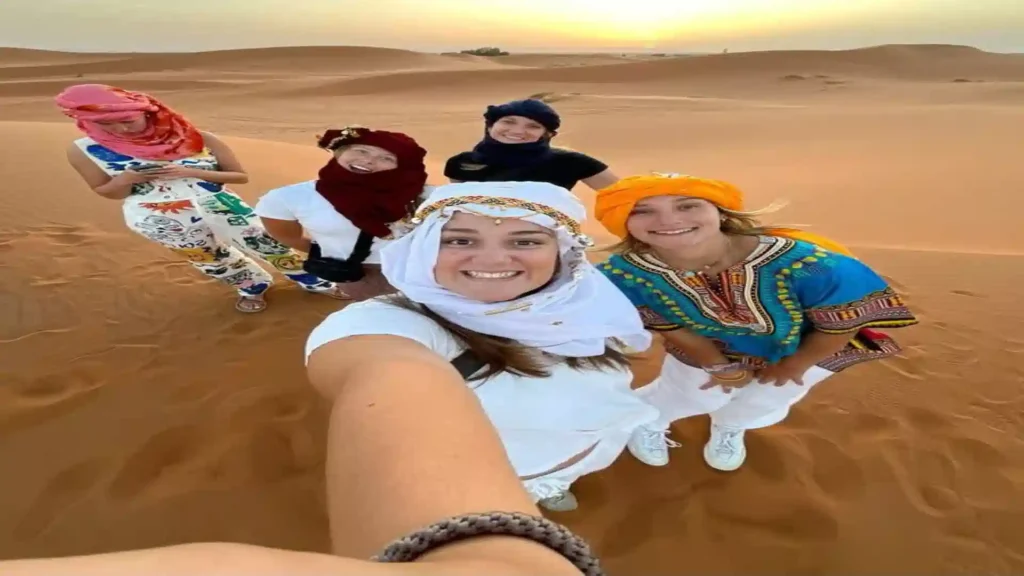
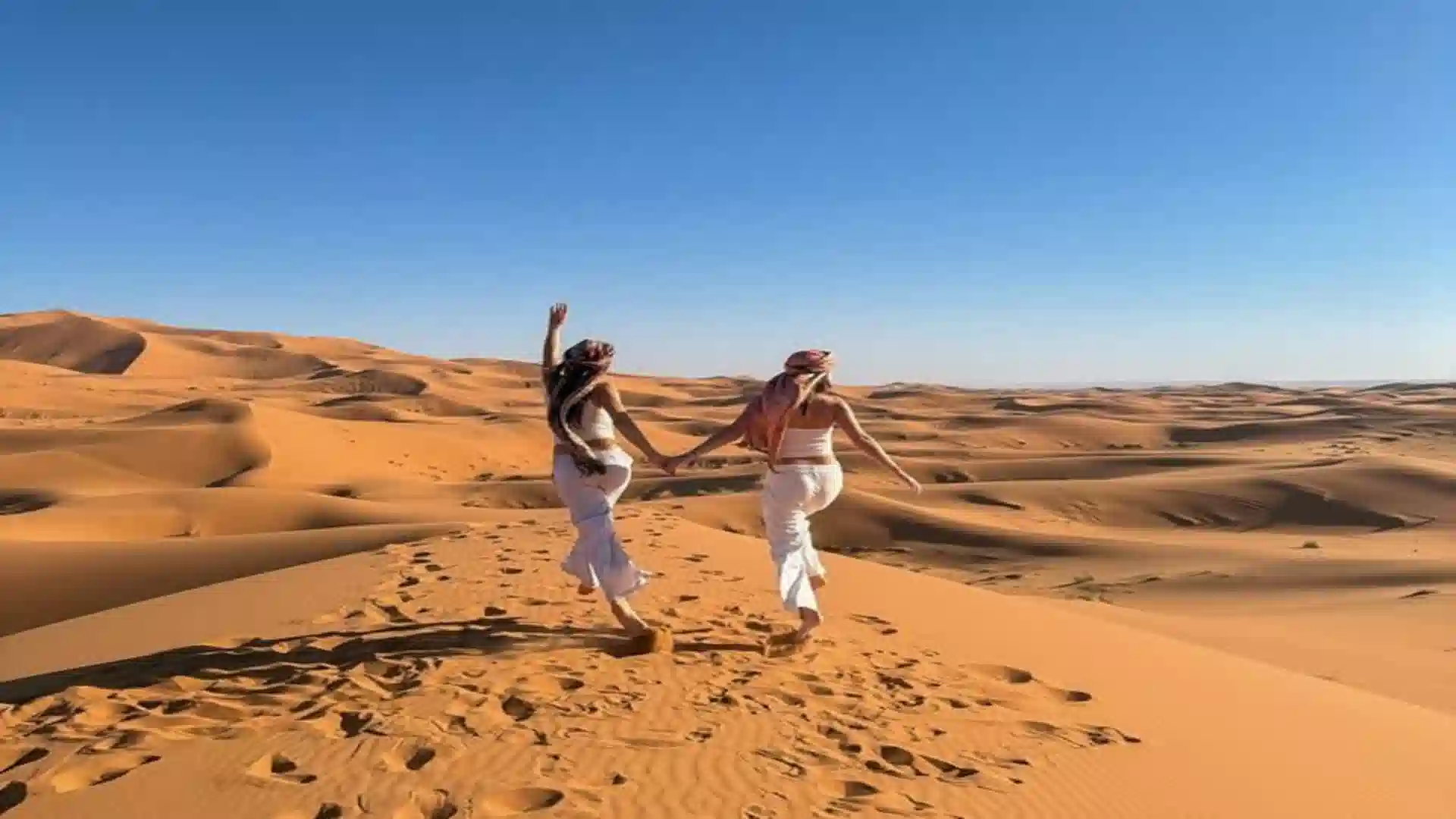
Capturing memories with friends while wearing traditional headscarves during a Sahara Desert excursion in Merzouga.
Merzouga Morocco: Essential Facts at a Glance
| Fact | Detail |
|---|---|
| Location | Southeastern Morocco, Drâa-Tafilalet region |
| Province | Errachidia Province |
| Coordinates | 31.1°N, 4.0°W |
| Altitude | 900 meters above sea level |
| Population | ~3,000 residents (Merzouga village) |
| Distance from Marrakech | ~560 km, 9–10 hours by road |
| Distance from Fes | ~550 km, 7–8 hours by road |
| Distance from Casablanca | ~700 km, 10–11 hours by road |
| Distance from the Algerian border | ~50 km |
| Distance from Rissani | ~35 km |
| Distance from Erfoud | ~50 km |
| Erg Chebbi dune height | Up to 150 meters |
| Erg Chebbi dimensions | 22–28 km long, 5–7 km wide |
| Best time to visit | October–April |
| Peak season | March–May, September–November |
| Summer temperatures | 44–46°C (June–August) |
| Language spoken | Tamazight (Berber), Darija (Arabic), French |
Where Is Merzouga Morocco?
Merzouga Morocco is located in the southeastern corner of the country, in the Drâa-Tafilalet administrative region, approximately 560 km from Marrakech, 550 km from Fes, and 50 km from the Algerian border, a position at the very edge of Morocco where the High Atlas Mountains, the Ziz Valley palm oasis, and the Saharan erg system all converge. Merzouga is only 31 miles (50 km) from the border with Algeria, in eastern Morocco, not very far away from Erfoud and Rissani. The nearest large city is Errachidia, the capital of the province.
Understanding Merzouga’s geography explains everything about what makes it special:
- It sits at a geological boundary: East of the village, the flat hammada (rocky desert plateau) stretches toward Algeria. West of the village, the great Erg Chebbi dune field rises from that same hammada floor, a product of thousands of years of wind accumulation. The dune field simply appears, dramatically and without transition, at the village’s edge.
- It is at the southern end of the Ziz Valley: The route from Fes to Merzouga follows the spectacular Ziz Valley, a 300-km ribbon of palm oasis carved through the desert before arriving at the dunes. This valley was historically the main trans-Saharan trade route connecting Morocco to sub-Saharan Africa.
- It is close to the Tafilalet region: The land around Merzouga was once a lush, tropical jungle, and as the landscape was swallowed up by the world’s largest desert, it became home to some of the most impressive sand dunes in the world. The fossils found throughout the region marine creatures, trilobites, ammonites are evidence of this ancient landscape transformation.
What Is Erg Chebbi? Merzouga’s Desert Explained
Erg Chebbi dunes is Morocco’s biggest and most dramatic dune field, a sea of wind-driven golden sand 22–28 km long and 5–7 km wide with peaks as high as 150 meters. It is one of only two true ergs in Morocco, the other being Erg Chigaga near Zagora. When most visitors say they want to “see the Sahara” in Morocco, this is the place they are referring to. Here the dunes reach a height of 150 m at their highest point and extend for some 22 km from north to south and are about 5 km wide. As the shadows lengthen and the silence deepens into something almost gravitational, the sand changes color in the late afternoon light from gold to copper to deep amber.
What makes Erg Chebbi different from other Moroccan desert landscapes:
- True dune formation: Unlike the rocky Agafay Desert near Marrakech or the stony hammada that dominates much of Morocco’s southeast, Erg Chebbi is a genuine erg, a large area of dunes formed by wind-blown sand accumulation over millennia. Standing on its highest dune crest, you see nothing but sand in every direction.
- Color variability: In late afternoon light, the sand shifts from gold to copper to deep amber as the shadows lengthen. At sunrise, the same dunes glow in pale pink and orange; at midday (outside the summer months), they read as near-white in direct light; at sunset, the deep amber of the shadows creates the most dramatic photography conditions of any time of day.
- The silence: Erg Chebbi’s size means that within 30 minutes of walking from the dune’s base, the sounds of the village and the road disappear entirely. The silence at the dune’s crest, broken only by wind and the occasional creak of camel leather, is one of the most frequently mentioned experiences in every traveler account of the Merzouga desert.
- The scale: Nothing in photographs, however good, prepares visitors for the actual scale of Erg Chebbi. The dunes are significantly larger in person than they appear in images, a combination of their height (up to 150 meters), width (5–7 km), and the flatness of the surrounding hammada that provides no visual reference point.
Erg Chebbi vs Erg Chigaga: The Quick Comparison
| Factor | Erg Chebbi (Merzouga) | Erg Chigaga (Zagora/M’Hamid) |
|---|---|---|
| Size | 22–28 km long, 5–7 km wide | ~40 km long, 15 km wide |
| Dune height | Up to 150 m | Lower on average |
| Road access | Fully paved to village edge | Unpaved 4×4 track from M’Hamid |
| Crowd level | The most popular route | Lower, more remote |
| From Marrakech | ~560 km, 9–10 hrs | ~440 km + 2–3 hrs off-road |
| Best for | First-timers, accessibility | Solitude, photographers |
Things to Do in Merzouga Desert: The Complete Activity Guide
There is much more to the Merzouga desert than just one camel trek! You can do the classic sunset camel trek into Erg Chebbi and overnight desert camp, sandboarding, quad biking, 4×4 desert excursions to nomadic camps, Gnawa music performances in Khamlia village, flamingo birdwatching at Dayet Srji lake, and fossil hunting near Erfoud. Based on our experience organizing activities for clients in the Merzouga desert all year round, the full menu is
1. Camel Trek into Erg Chebbi Dunes: The Essential Merzouga Experience
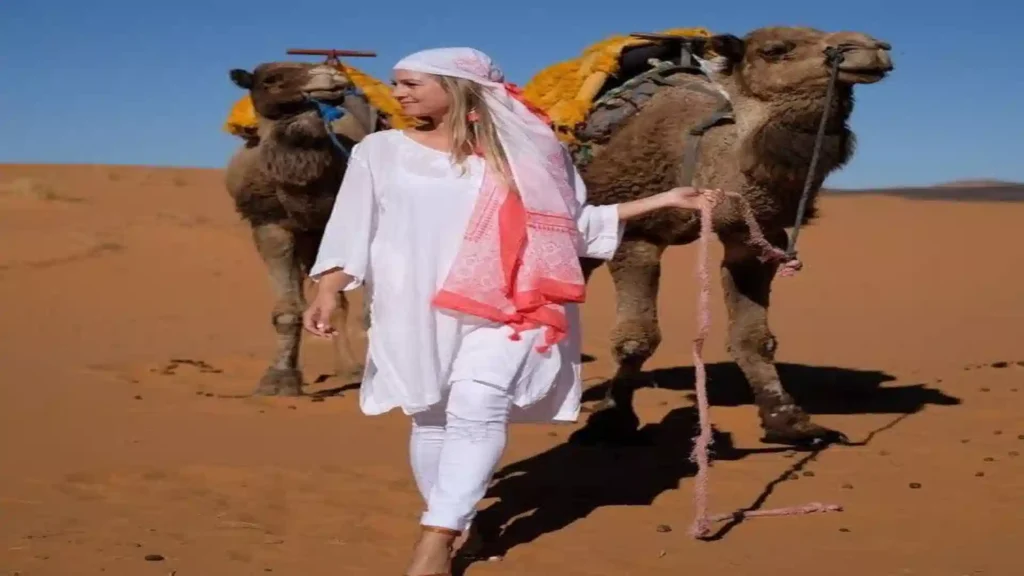
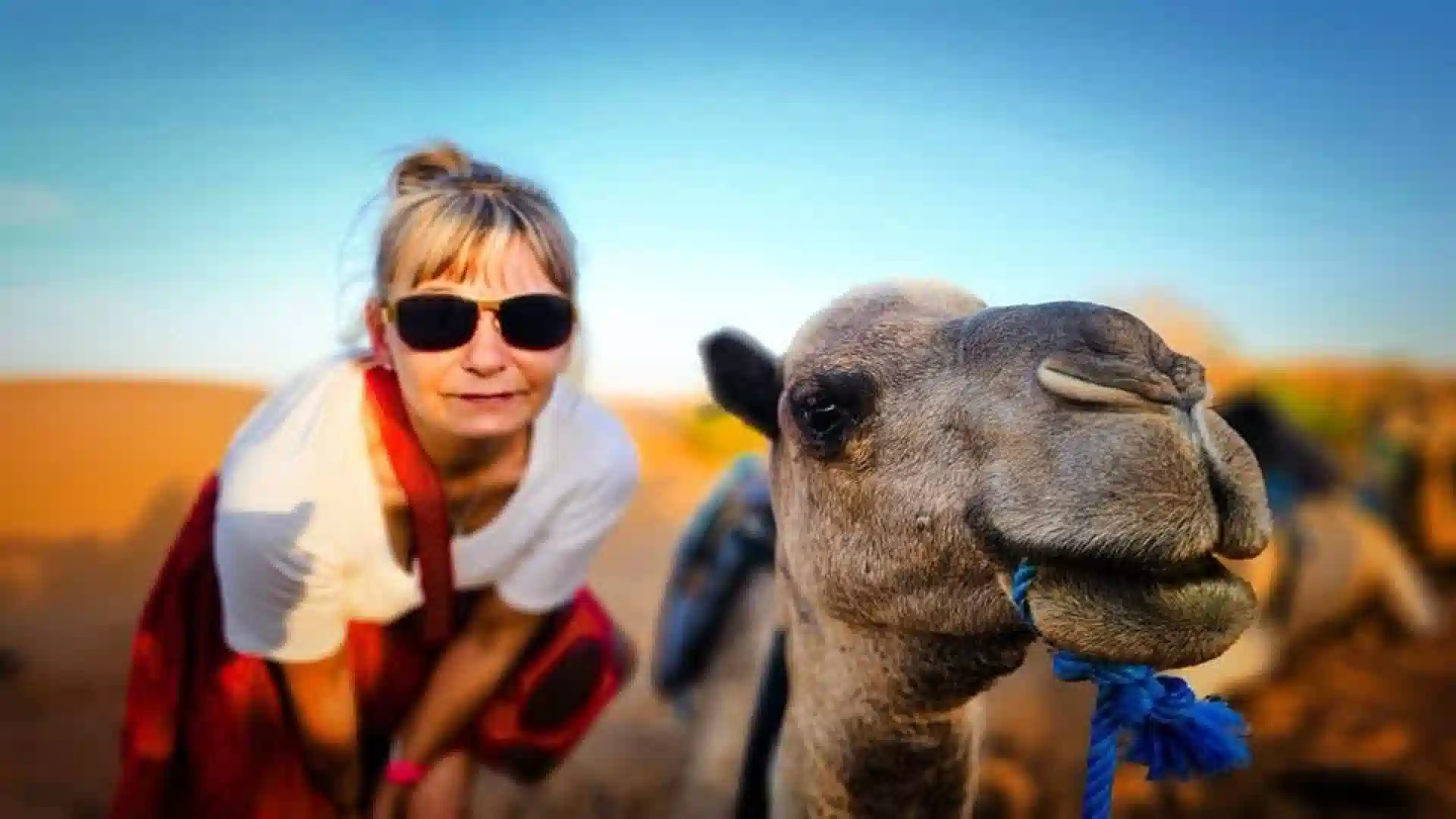
Walking through the golden sand dunes of Erg Chebbi alongside camels on a Merzouga desert tour.
The quintessential Merzouga desert experience and the activity that brings most visitors to this corner of the Sahara is a sunset camel trek from the edge of the village of Merzouga into Erg Chebbi. Ride a Merzouga camel (dromedary, single-humped) for 45 to 60 minutes across the hammada and into the dune field as the sun falls toward the western horizon. Camel: The traditional entry into the dunes. A sunset camel ride from the outskirts of the village to a desert camp takes 45 minutes to 1 hour. Camels are good for short rides, but not more than 2 hours for the ones not used to them.
What the camel trek experience actually involves:
- Meeting your camel at the dune edge (most camps or hotels arrange pickup from the accommodation)
- Mounting: via a kneeling position, the camel stands up rear-first, then front, creating a lurching double movement that surprises most first-timers
- 45–60 minutes of riding across the hammada transition zone and into the first dune ridges
- Arriving at desert camp as the sun reaches the horizon and the dunes turn deep amber
- The return option: most guests return from camp by 4×4 in the morning rather than the camel, which is faster and less demanding before the day’s drive
Price: 200–350 MAD per person for the camel trek alone; included in most desert tour packages
2. Overnight Desert Camp in the Merzouga Sahara
The Merzouga desert experience that every traveler describes first when they return from Morocco is eating dinner by firelight, listening to Berber drums in the dark, sleeping in a canvas tent, and waking before dawn to climb the nearest dune for sunrise. Spending a night in an Erg Chebbi desert camp is the Merzouga experience that every traveler describes first when they return from Morocco. Sleeping in the desert is more than an adventure; it’s a spiritual experience. The sky is full of stars, away from the city lights.
Desert camp options in Merzouga range from the very basic to the genuinely luxurious:
| Camp Tier | What’s Included | Price Range (per person) |
|---|---|---|
| Basic Berber camp | Shared canvas tent, communal bathroom, dinner, breakfast, camel trek | 300–500 MAD |
| Standard camp | Semi-private tent, better meals, fire, music | 500–900 MAD |
| Comfort camp | Private tent, en-suite bathroom, upgraded meals, electricity | 900–1,500 MAD |
| Luxury glamping | Private tent with pool view, gourmet meals, private guide | 1,500–3,000+ MAD |
In our experience coordinating camp bookings for clients across every tier, the standard and comfort tiers deliver the best overall value for private or semi-private tents, better meal quality, and the essential campfire and music experience without the budget camp’s shared bathroom limitation or the luxury tier’s price premium. Check out our full guide of standard or luxury desert camp.
The camp evening sequence:
- Arrive by camel at sunset (5:30–6:30 PM depending on season)
- Unpack, explore the camp, and the nearest dune crest on foot
- Dinner: communal or table-based, traditional tagine and salad spread, mint tea
- Campfire and Berber drumming session (most camps include this; some basic camps do not)
- Star viewing: at this distance from any city, the Milky Way is clearly visible with the naked eye on a clear night from October through April
- 5:30 AM: alarm for sunrise (worth it every single time the dunes in pre-dawn light are unlike anything at other hours)
3. Sunrise Over Erg Chebbi Dunes: The Most Memorable Moment in Merzouga
The Erg Chebbi dunes sunrise is universally agreed to be the most memorable single moment of any Morocco trip, with travelers describing waking before dawn, climbing the nearest dune crest in the cold darkness, and watching the first light turn the eastern horizon pale orange before the full sun appears over Algeria and floods the dune field in rapidly shifting pinks, reds, and golds. The dunes rise up to 150 meters high and offer spectacular views of the sunrise and sunset, as well as the opportunity to sandboard, take pictures, or just enjoy the peace of the desert.
The practical sequence:
- Wake at 5:30 AM (your camp host will call you or set an alarm)
- 15–20 minute climb to a dune crest above camp in the cold pre-dawn air (desert temperatures in winter can approach 0°C before sunrise)
- The eastern horizon lightens from black to deep blue to pale grey to orange in roughly 20 minutes
- The sun breaks the Algerian horizon, and the dune field below transforms almost instantly; shadows lengthen, colors shift, and the sand appears to be illuminated from within
- Return to camp for breakfast before departing
4. Sandboarding on Erg Chebbi Dunes
Sandboarding, sliding down the steep side of Erg Chebbi’s dunes on a waxed board, is one of the most adrenaline-inducing activities available in the Merzouga desert. It’s best to attempt it on the steeper north-facing dune slopes, where the accumulation of sand creates near-vertical faces. Sandboard: Available for rent from camp operators in Merzouga.
- Price: 50–100 MAD for board rental
- Technique: Sit facing downward on the board (standing snowboard-style is technically possible but requires practice); the sand provides significant deceleration friction, making sandboarding more approachable for beginners than snowboarding
- Best conditions: Dry sand following several days without wind; boards require regular waxing (camp operators provide this)
5. Quad Biking in the Merzouga Desert
Quad biking in the Merzouga desert, hiring an ATV from operators on the main village road, and riding across the hammada and around the outer edges of Erg Chebbi is the fastest and most independent way to explore the desert terrain beyond the immediate dune edge, covering ground in 2–3 hours that would take a full day on foot or camel. Quad bike: Operators along the main road of the village provide rentals. 300-400 MAD/hour depending on the size of the bike. The most liberating way to explore the outer edges of the dune field is on your own.
- Price: 200–400 MAD per hour
- Route options: Hammada circuit around Erg Chebbi’s northern edge (2 hours), sunset route to the western face for photography, Khamlia village loop combined with cultural visit
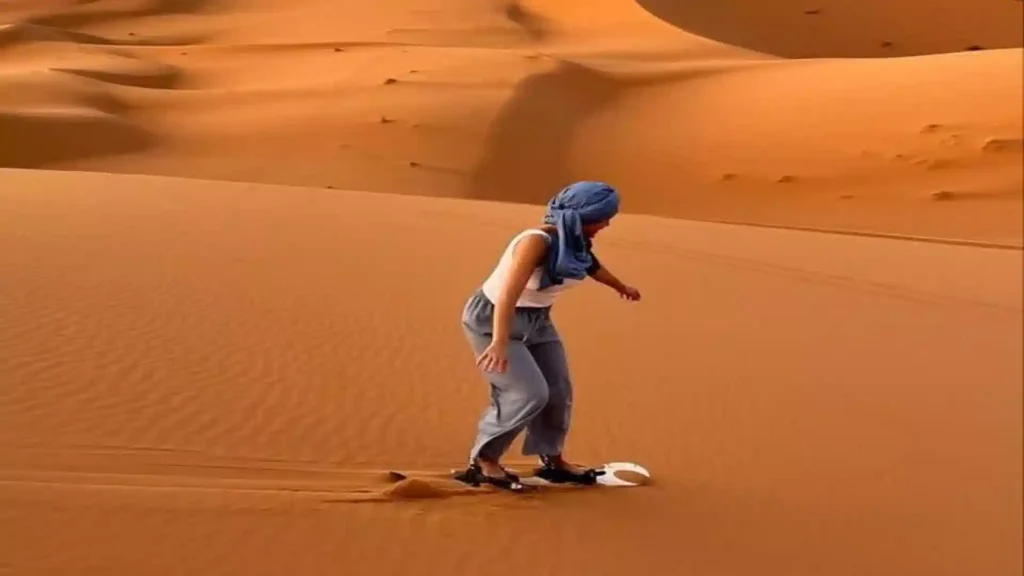
Gliding down the steep slopes of Erg Chebbi on a sandboard in Merzouga, Morocco.
6. 4×4 Desert Excursion: The Full Merzouga Experience
A guided 4×4 trip from the Merzouga desert (half to full day) takes you to places inaccessible by camel or quad bike: nomadic family camps where animals are still herded across the desert, fossil sites in the hammada, the Gnawa village of Khamlia, Dayet Srji lake, and the black volcanic rock formations of the outer desert. 4×4 desert excursions: nomad camps, fossil sites, the Gnawa village of Khamlia, and old mining areas.
A typical 4×4 half-day circuit from Merzouga:
- Khamlia village (7 km from Merzouga): Gnawa music performance and tea with local hosts
- Dayet Srji Lake (3 km west of Merzouga): Birdwatching at the seasonal salt lake
- Nomadic camp visit: Meeting a family of Berber nomads living in traditional black goat-hair tents
- Fossil site: Hammada areas where trilobites, ammonites, and ancient marine fossils protrude from the desert floor
Price: 300–600 MAD per person for a guided half-day 4×4 excursion
7. Khamlia Village: Gnawa Music in the Desert
One of the most culturally extraordinary stops in the Merzouga desert is Khamlia, a small village 7 km from Merzouga that is home to Morocco’s Gnawa community of sub-Saharan descent. A visit to a local home or cooperative for mint tea and a live Gnawa music performance connects travelers with a musical tradition that mixes West African rhythmic heritage with Moroccan desert life. During your Morocco desert tour, you’ll be able to visit Khamlia, meet the locals, and get lost in the live performances of Gnawa music in their houses.
The Gnawa were slaves brought to Northern Africa in desert caravans from Central and Southern Africa. Now they comprise a large proportion of the population of the town of Khamlia, a mere 3 miles (7 km) from the town of Merzouga. Khamlia is a small village near Merzouga, known for Gnawa music, with steady percussion and call-and-response singing that will get stuck in your head for the rest of the day. Visits tend to be an hour or so, and it’s a fairly short drive generally. The vibe is low-key; usually tea first, then a short set. Bring small cash for a donation, and ask before shooting audio/video. It’s not a theme show; it’s people sharing a tradition, so a quiet, appreciative attitude goes a long way.
- Getting there: 7 km by 4×4, quad bike, or moto-taxi from Merzouga village
- Duration: 1 hour for tea and a performance
- Cost: Free (leaving a modest cash donation of 50–100 MAD for the group is appropriate)
8. Dayet Srji Lake: Flamingos in the Desert
Dayet Srji, a seasonal salt lake 3 km west of the village of Merzouga, fills with rainwater during the autumn and winter rains, becoming a temporary haven for migratory birds, including pink flamingos, creating one of Morocco’s most visually extraordinary contrasts: flamingos standing in shallow water against a backdrop of golden Erg Chebbi dunes. Dayet Srji can be dry in the summer, but in winter it is alive with migratory and desert birds, including the majestic flamingos. Nature lovers come from all over to see the seasonal transformation.
Dayet Srij is a seasonal lake, and that word is important. Some months it is there; some months it is more of a dry basin. Birds, sometimes including flamingos and other migratory species, can gather when the rain and conditions cooperate. Go early or late in the day, when the light is softer and the wildlife more active. “Keep your expectations wide open, because the lake changes from year to year.
- Best months: November–March, when rainfall fills the lake; the presence of flamingos depends on annual rainfall patterns
- Getting there: 45-minute walk west from Merzouga village, or 5–10 minutes by bicycle or moto-taxi
- Cost: Free, no entry fee
9. Stargazing in the Merzouga Desert
The Merzouga desert offers some of the best stargazing opportunities in North Africa at an altitude of 900 meters, with almost no light pollution in any direction and clear skies for most of the year. The Milky Way is clearly visible to the naked eye on clear nights between October and April. Merzouga is one of the best places in Morocco to watch the stars. In the heart of the Sahara, you can often see the Milky Way clearly, with little light pollution.
Most desert camps have informal stargazing sessions, a blanket outside the tent, mint tea, and a guide who can point out constellations and clarify the function that stars play in traditional Berber navigation. No equipment needed; the best stargazing is just looking up from the dune crest above camp, away from any camp lighting.
Best conditions: Moonless nights, October–April; avoid the week around the full moon for the darkest skies.
10. Fossil Hunting Near Merzouga: Erfoud and the Ancient Seabed
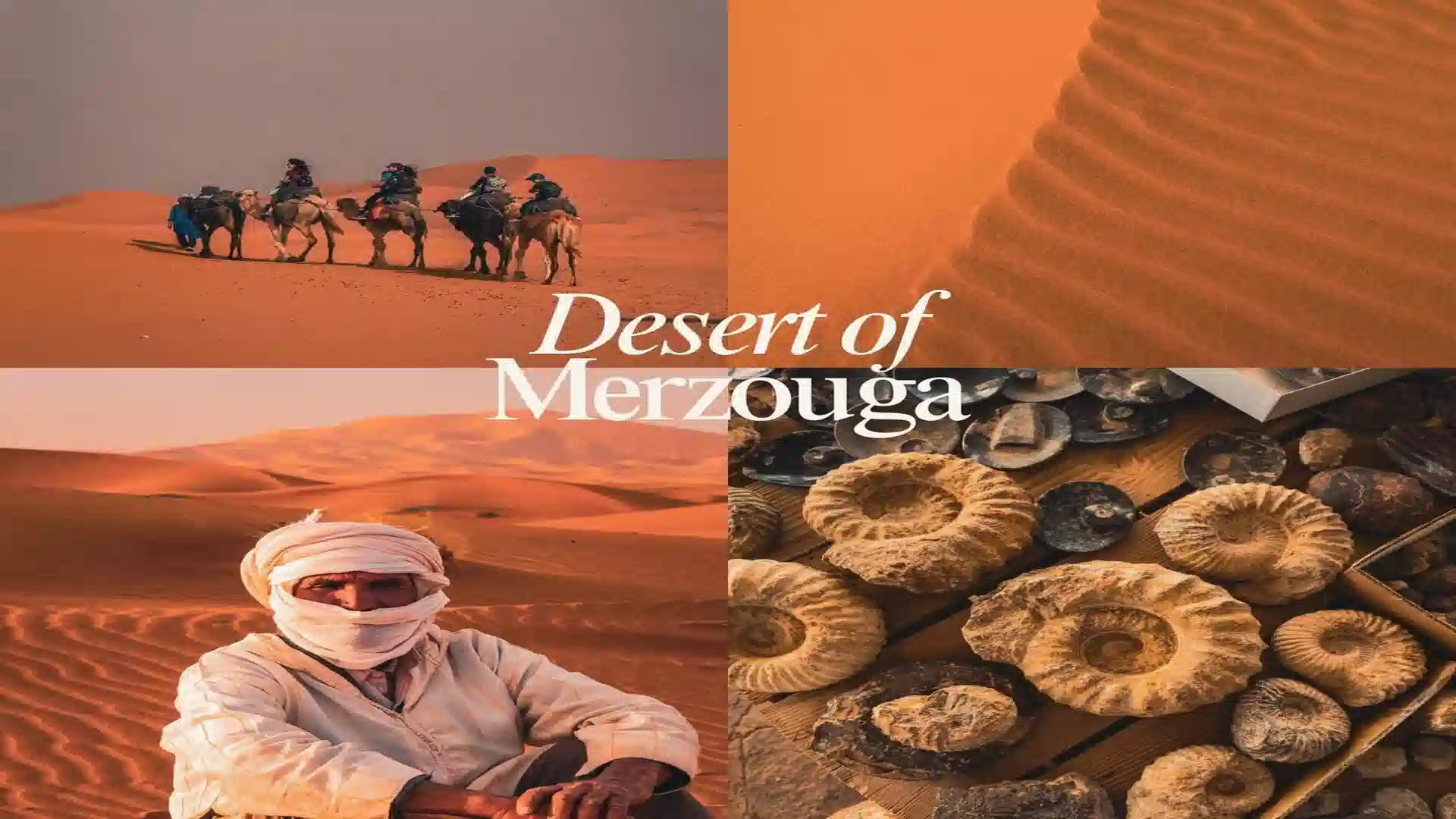
The desert surrounding Merzouga was once an ancient seabed 350 million years ago, and the fossils of that lost ocean (trilobites, ammonites, crinoids, and nautiloids) are exposed all over the floor of the hammada and are worked into jewelry and decorative objects sold all over Erfoud, just 50 km from Merzouga. The region around Merzouga, especially Erfoud, is known for its fossil quarries, dating back hundreds of millions of years, and for dinosaur bones.
Erfoud Fossil Workshops: Fossil purchases in Erfoud. Among the most commercially organized craft operations in southern Morocco are the fossil workshops of the town, where marble tables inlaid with trilobites, ammonite pendants, and slabs of orthoceras (straight nautiloid) are produced. Prices vary from 20 MAD for a small ammonite pendant to several thousand MAD for large marble slabs inlaid with multiple fossil specimens.
11. Rissani Market: The Desert’s Historic Trading Post
35 km from Merzouga, Rissani was the terminus of the trans-Saharan caravan trade and the home of the Alaoui dynasty, who still rule Morocco today. One of the most authentic traditional markets in southern Morocco takes place here on Tuesday, Thursday, and Sunday. There are livestock auctions, date merchants, spice sellers, and the ruins of the historic walled city of Sijilmassa nearby. It takes 40 minutes to drive from Merzouga to the village of Rissani. It is famous for its market with hundreds of stalls & shops. Unlike the souks, medinas, and other markets of the big cities of Morocco, the Rissani market sells livestock, food, spices, and other products.
The ruins of Sijilmassa near Rissani are among the most important historical and least visited archeological sites in Morocco. Sijilmassa was a medieval Islamic city that dominated the trans-Saharan gold and salt trade for several centuries before its decline in the 14th century.
- Market days: Tuesday, Thursday, Sunday
- Time needed: 2–3 hours, including Sijilmassa ruins
- Distance from Merzouga: 35 km (40–45 minute drive)
How to Get to Merzouga Morocco
By road Merzouga Morocco is 9–10 hours from Marrakech (560 km) and 7–8 hours from Fes (550 km); there are no direct trains. The easiest and most comfortable way to get there is by a private guided tour vehicle, which can negotiate the mountain passes and desert tracks and coordinate accommodation along the way. It is 8-10 hours from Marrakech (bus €15-25, private transfer €200-280) and 7-8 hours from Fes (bus €12-20, private transfer €180-240) from the major Moroccan cities.
| From | Distance | Time | Options |
|---|---|---|---|
| Marrakech | ~560 km | 9–10 hrs | Private tour (recommended), CTM bus (~10 hrs), shared taxi |
| Fes | ~550 km | 7–8 hrs | Private tour, CTM bus (~9 hrs), shared taxi |
| Casablanca | ~700 km | 10–11 hrs | Private tour, CTM bus (~11 hrs) |
| Ouarzazate | ~320 km | 4–5 hrs | Private vehicle, shared taxi |
| Erfoud | ~50 km | 45 min | Shared taxi (25–30 MAD per seat), rental car |
The Route from Marrakech to Merzouga Desert
The standard Marrakech to Merzouga route is not just a transfer it is itself one of the most scenically dramatic road journeys in Africa:
Day 1: Marrakech → Dades Gorge (~280 km)
- Tizi n’Tichka pass (2,260 m) through the High Atlas
- Ait Ben Haddou UNESCO Kasbah
- Ouarzazate Morocco’s film studio hub
- Overnight in Dades Gorge or Boumalne Dades
Day 2: Dades → Merzouga (~280 km)
- Todra Gorge 300 m walls narrowing to 10 meters
- Tinghir Palm Oasis
- Ziz Valley: 300 km of palm groves through the Saharan gateway
- Erfoud fossil capital, gateway to the Tafilalet
- Arrive in Merzouga by mid-afternoon sunset camel trek into Erg Chebbi
This two-day approach is the foundation of every 3 day Merzouga desert tour from Marrakech, and it is the route all of our private tours use, with our guides offering running commentary on the landscape, history, and culture of each region passed through.
Where to Stay in Merzouga Morocco
Accommodation in Merzouga Morocco comes in two forms: village guesthouses and hotels in Merzouga town proper and desert camps right on the edge of the Erg Chebbi dune. Most visitors book at least one night in a desert camp as the defining Merzouga experience. In Merzouga you have two main questions when choosing your accommodation: do you want to sleep in the village or out in the dunes, and how much comfort do you want?
| Type | Location | Price Range (per night) | Best For |
|---|---|---|---|
| Basic Auberge/Guesthouse | Merzouga village | 100–250 MAD | Budget travelers, multi-night stays |
| Mid-range hotel | Village or dune edge | 300–600 MAD | Comfortable base with private room |
| Standard desert camp | Erg Chebbi dune edge | 300–500 MAD per person | Authentic experience, shared facilities |
| Comfort desert camp | Erg Chebbi interior | 500–900 MAD per person | Private tent, better meals |
| Luxury glamping | Erg Chebbi | 1,500–3,000+ MAD per person | Honeymooners, high comfort requirement |
Our operational recommendation: Book one night in a desert camp (comfort tier or above for the best experience) and any additional nights in Merzouga in a mid-range village hotel with a pool. The combination gives you the essential desert camp experience without using your full accommodation budget on luxury tents.
Merzouga Desert Weather: When to Visit
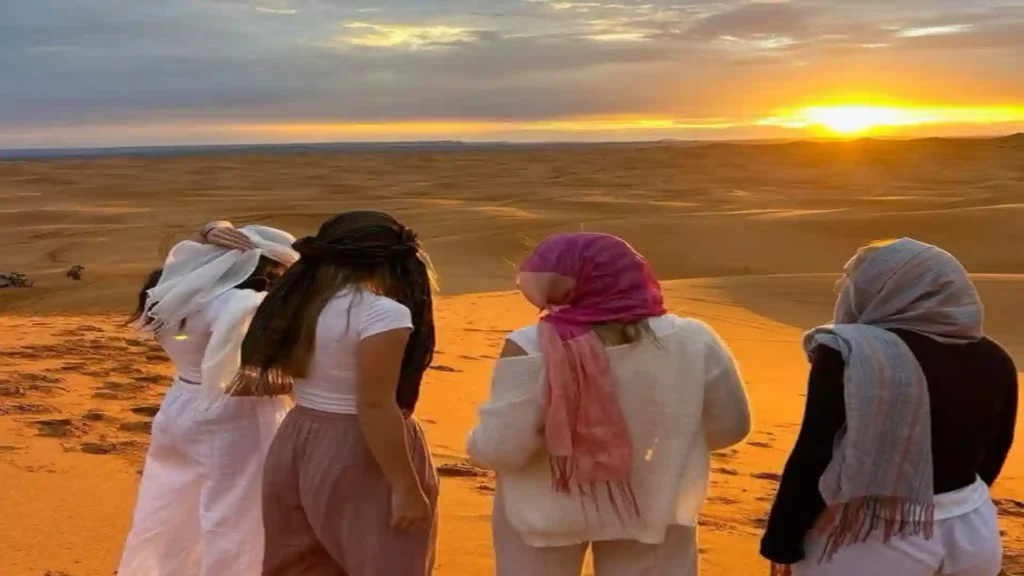
Watching the sunset cast golden light over the vast sand dunes of Erg Chebbi in Merzouga.
Best time to visit Merzouga Morocco is from October to April. October, November, March, and April offer the most comfortable best mix of daytime temperatures (20-30°C) and cool but not freezing nights (8-15°C). July and August are truly dangerous for outdoor desert activities with temperatures exceeding 44-46°C. The best time to visit Merzouga is in the spring (March to May) and fall (September to November) when the weather is nice with temperatures from 25°C to 30°C during the day but cooler at night.
| Month | Day Temp | Night Temp | Verdict |
|---|---|---|---|
| October | 28–32°C | 12–15°C | ⭐⭐⭐⭐⭐ Best warm days, comfortable nights |
| November | 22–26°C | 8–12°C | ⭐⭐⭐⭐ Very good pack warm camp layers. |
| December | 18–22°C | 2–6°C | ⭐⭐⭐ Good cold nights, very clear skies |
| January | 18–20°C | 0–4°C | ⭐⭐⭐ Good freezing is possible at night. |
| February | 20–24°C | 4–8°C | ⭐⭐⭐ Good warming, almond blossoms nearby |
| March | 25–28°C | 8–12°C | ⭐⭐⭐⭐⭐ perfect temperature range |
| April | 30–34°C | 12–16°C | ⭐⭐⭐⭐⭐ Best last comfortable month |
| May | 35–38°C | 17–20°C | ⭐⭐⭐ Acceptable early morning/evening only |
| June–September | 40–46°C | 22–28°C | ⭐ ⭐⭐⭐ Acceptable early morning/evening only |
What to Pack for the Merzouga Desert
Remember that it does get very hot in the desert. If you are traveling between October and April, you should bring protection from the sun during the day and thermal layers for the cold nights. Also, if there is a chance of sandstorms (more common in spring), pack a face covering and goggles or sunglasses. For the complete packing list, see our What to Pack for Merzouga Desert.
Essential Merzouga desert items:
- High-SPF sunscreen and UV-blocking sunglasses
- Lightweight, breathable, light-colored clothing covering shoulders and legs
- A warm fleece or light down jacket evenings and early mornings are significantly colder than midday
- Sleeping bag rated to 5°C for October–April desert camps (luxury camps provide bedding; basic camps may not)
- Headtorch/flashlight camps have limited lighting
- Face scarf or buff for dust and sandstorm conditions
- Sturdy, closed-toe shoes for camel mounting and dune climbing; sandals for camp use
- Power bank charging is limited at desert camps
Merzouga Morocco Travel Tips: What Our Guides Always Tell Clients
Based on our operational experience running desert tours to Merzouga year-round, these are the ten practical details that make the difference between a memorable desert experience and a stressful one:
- 1. Arrive at the dune edge before 4:30 PM The sunset camel trek needs to begin at least 45 minutes before the actual sunset to ensure arrival at camp in good light. Later departures often arrive in full dark.
- 2. Bring cash. Merzouga village has one ATM (at Café Yasmina, occasionally out of service). Carry all the cash you need from Erfoud or Rissani.
- 3. The camel has a name; ask your camel handler. This simple question reliably produces a conversation and a more personal desert experience than treating the camel as a prop.
- 4. Set your alarm for 5:30 AM for sunrise, not 6:30 AM. The critical light lasts approximately 20 minutes. Most travelers who sleep through it regret it immediately.
- 5. Walk the dunes alone for 30 minutes after dinner. The silence of Erg Chebbi at night, away from the camp’s firelight, is as defining an experience as any activity. The dunes at night under stars are not the same place as the dunes at sunset with 40 other people.
- 6. The sandboarding hill is not the highest dune; if you want to climb to the actual peak of Erg Chebbi’s main dune, ask your guide for the route. It takes 45–60 minutes and delivers a 360° view with no camp, no road, and no visible horizon except sand.
- 7. Khamlia village is worth the detour; many one-night Merzouga packages skip it. We don’t. An hour in Khamlia with genuine Gnawa music changes the entire desert experience from a landscape trip to a cultural one.
- 8. The hammada is as interesting as the dunes. The black volcanic rock desert between Merzouga and the dune field, the fossil floor, and the nomadic camps in the flat open desert none of this appears in photographs of Erg Chebbi, but all of it is part of the Merzouga desert experience.
- 9. Ask your camp host about the wells; many Merzouga camp sites sit above the most significant underground water system in Morocco. The invisible geology of the desert is extraordinary.
- 10 November to February is the best value, and it is one of the best experiences. The camps are emptier, the stars are clearer, and the cold nights are manageable with proper gear. This is when we run some of our most memorable tours.
Merzouga Morocco: Frequently Asked Questions
What is Merzouga Morocco famous for?
Merzouga Morocco is famous as the gateway to Erg Chebbi, Morocco’s most spectacular Sahara dune field, where golden dunes reach 150 metres high and stretch 22 km from north to south. It is the location of the most iconic images of the Moroccan Sahara and the departure point for camel treks, desert camp overnight stays, sandboarding, and 4×4 desert excursions.
How far is Merzouga from Marrakech?
Merzouga is approximately 560 km from Marrakech, taking 9–10 hours of driving time. The standard route crosses the High Atlas Mountains via the Tizi n’Tichka pass (2,260 m), passes through Ouarzazate and Ait Ben Haddou, continues through the Dades and Todra Gorges, and follows the Ziz Valley palm oasis south to Merzouga making the journey itself one of the most scenically rewarding road trips in Africa.
How many days do you need in Merzouga?
Plan to spend at least two days in Merzouga including an overnight stay at a desert camp, to experience the Sahara under a canopy of stars. Most travelers on a 3 days tour from Marrakech to Merzouga spend one night at a desert camp in the Merzouga desert, which covers the essential experiences. Two nights allows time for a full day of activities, including Khamlia, Dayet Srji, and a 4×4 excursion.
Is Merzouga or Zagora better for the Sahara desert?
Merzouga and Erg Chebbi deliver the most dramatic dune landscape in Morocco taller, more accessible, with more camp options. Zagora and Erg Chigaga offer a more remote, less crowded experience with a larger total dune area but require a longer drive on unpaved tracks. For first-timers, Merzouga is the stronger recommendation. For repeat visitors seeking solitude, Erg Chigaga wins. See our full Merzouga vs Zagora comparison guide for the detailed breakdown.
Is Merzouga desert safe to visit?
Yes, the Merzouga desert is safe for international tourists. The main safety considerations are heat (avoid outdoor activity between 11 AM and 4 PM in summer), proper hydration (desert air dehydrates significantly faster than humid climates), and ensuring your camp operator has functioning means of communication. All licensed camp operators maintain satellite or radio contact.
What is the best desert camp in Merzouga?
The best desert camp for most travelers sits in the comfort tier with a private tent with an en-suite or adjacent bathroom, good meals, a campfire and music included, and positioning inside the dune field rather than at its edge. Our team books clients into camps we have personally inspected; ask us directly for current recommendations for your budget and dates.
Can you visit Merzouga without a tour operator?
Yes, Merzouga village is reachable by CTM bus from Erfoud and by shared taxi, and the dunes are free to access independently. However, the most rewarding way to experience the Merzouga desert, the two-day drive from Marrakech through the Atlas Mountains and gorges, the camp coordination, and the cultural dimension of Khamlia and nomadic encounters is significantly better with a local guide who knows the routes, the camps, and the people.
Plan Your Merzouga Desert Tour with Over Morocco Tours
Merzouga Morocco and the Erg Chebbi dunes form the centrepiece of our most booked itinerary the 3 days tour from Marrakech to Merzouga that covers the Tizi n’Tichka pass, Ait Ben Haddou, the Dades and Todra Gorges, and one night in an Erg Chebbi desert camp before returning via Ouarzazate.
Our Merzouga desert tours:
- 3 Day Marrakech to Merzouga Desert Tour: The classic circuit is our most-booked route, covering every key landscape on the way to the dunes
- 5 Day Desert and Imperial Cities: Marrakech → Merzouga → Fes, or the reverse
- Custom private Merzouga itineraries: Built around your dates, group size, and comfort preferences
Every quote includes transport, accommodation, camel trek, and desert camp meals. No hidden fees once you’re on the road.
Book the 3-Day Merzouga Desert Tour →
Compare Merzouga vs Zagora Before You Choose →
Contact Us to Plan Your Custom Desert Tour →
*Based in Merzouga. Running private tours to Merzouga since 2012. Our guides were born in the desert communities our tours visit.*