Morocco Cooking Class: How to Make Tagine & Moroccan Food (Guide 2026)
Table of Contents
International tourists frequently consider Morocco cooking classes as the most culturally absorbing experience in the country, surpassing museum visits, guided medina tours, and even camel treks. The answer is simple: learning to create Moroccan food from a Moroccan cook in a Moroccan kitchen is not like seeing a culture from the outside. You are taking part in it at the most fundamental level when food becomes nutrition, spices become memory, and the daily routine of feeding people becomes an act of cultural transmission.
At Over Morocco Tours, a Moroccan cooking class in Marrakech is one of the most requested add-ons to our desert circuits, particularly for travelers arriving a day early or departing a day late from the city. This guide provides all the information you need to schedule and enjoy a cooking class in Morocco in 2026, including what you’ll learn, how much it costs, how to distinguish between authentic and tourist-oriented programs, and which recipes to master.
Morocco Cooking Class: At a Glance
600–1,200 MAD full day with guided souk shopping
Private (just your group) to Small Group (max 8–10 people)
Signature Dishes Covered in Our Morocco Cooking Class Experiences
The dishes taught in a Moroccan cooking class vary by school, instructor, and the length of your class. A standard half-day class typically covers two to three dishes. A full-day class with a souk market visit in the morning covers four to six dishes and produces a proper multi-course Moroccan lunch or dinner. Here are the most commonly taught dishes and what makes each one worth learning.
Chicken or Lamb Tagine
The staple of Moroccan cuisine. Tagine is a slow-cooked stew named for the conical ceramic pot in which it is stewed. The process involves stacking premium meat, preserved lemons, olives, and regional aromatics directly in the base before cooking at low heat, resulting in a rich, distinctive layer of taste.
Hand-Rolled Couscous
Couscous served at good Moroccan restaurants is precisely hand-rolled and steam-cooked three times. Learning to roll semolina between moistened palms to make exactly uniform, light grains is a very contemplative, traditional master talent that distinguishes true cooking from quick fixes.
Pastilla (B’stilla)
Morocco’s most technically complex dish is a multi-layered pie of paper-thin warqa pastry filled with delicately spiced chicken or pigeon, crushed almonds, and slow-cooked egg ribbon, coated with powdered sugar and fine cinnamon. It’s a magnificent meal fit for a celebration.
Harira Soup
Morocco’s most popular daily staple—a deep, substantial soup packed with fresh tomatoes, lentils, soft chickpeas, celery, and a generous amount of chopped coriander. This warm meal, topped with a fresh squeeze of lemon, symbolizes real Moroccan home cooking at its most nutritious.
Traditional Salad Array
An authentic Moroccan supper begins with a variety of cooked and raw cold mezze. You will learn the fundamental combinations of ground cumin, sweet paprika, garlic, and preserved lemon paste, which are the basic building blocks of the country’s vegetable dishes.
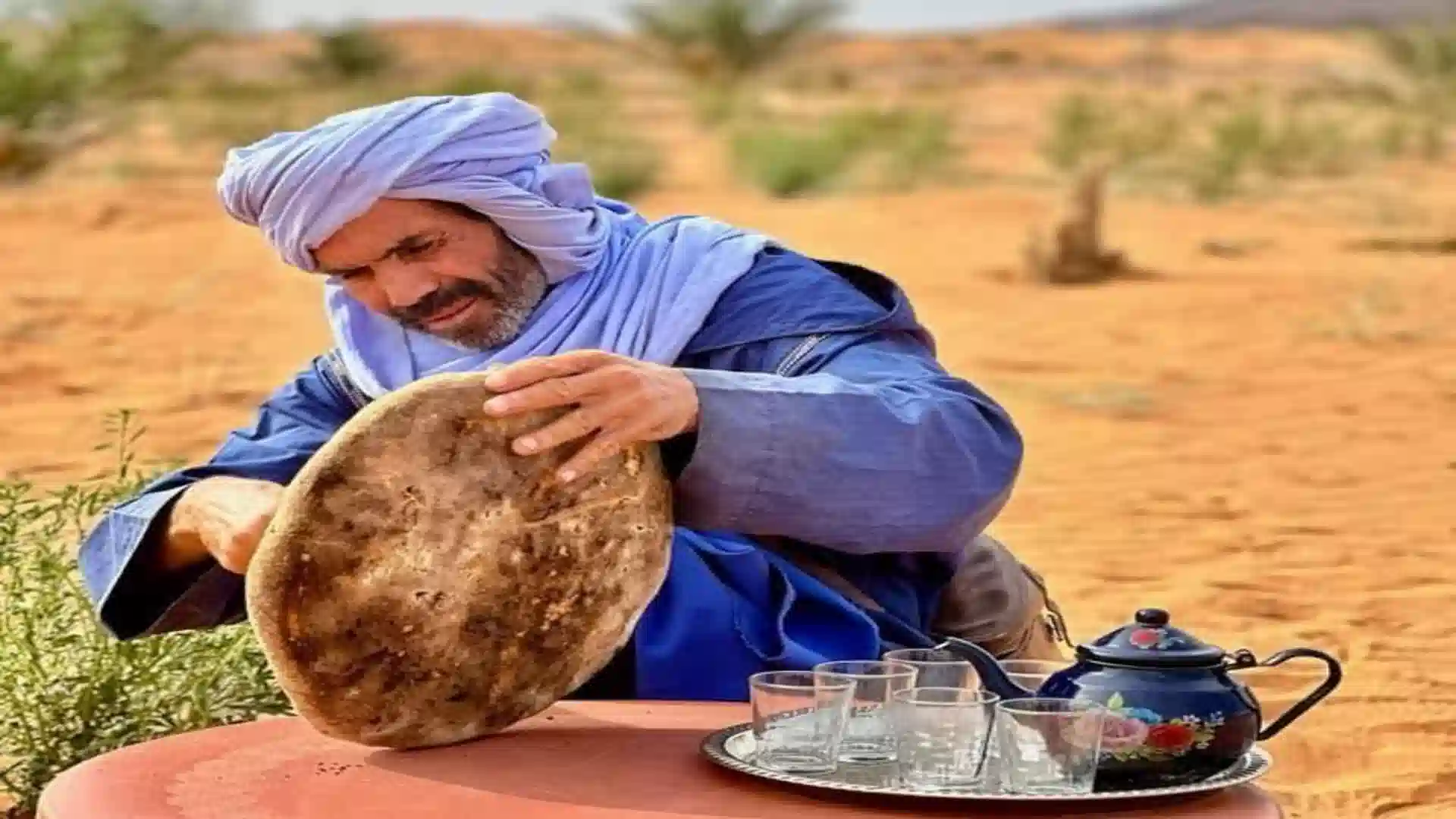
Moroccan Bread (Khobz)
The circular, thick, sesame-dusted crusty flatbread that serves as a universal tool at all meals. Learning the particular mechanics of kneading, proving, flattening into rounds, and baking on stone surfaces provides a readily transportable technique for recreating a traditional Moroccan meal arrangement anyplace.
Full-Day vs Half-Day Morocco Cooking Class: Which to Choose?
| Feature | Half-Day Class (3–4 hrs) | Full-Day Class (6–7 hrs) |
|---|---|---|
| Souk market visit | ✗ No | ✓ Yes — buy fresh ingredients at dawn market |
| Dishes covered | 2–3 dishes (tagine + 1–2 others) | 4–6 dishes (full multi-course meal) |
| Spice souk visit | ✗ No | ✓ Yes — learn to identify and buy spices from vendors |
| What you eat | What you cooked — light lunch | Full multi-course Moroccan lunch or dinner |
| Price (approx) | 350–800 MAD (~£28–64) | 600–1,200 MAD (~£48–96) |
| Best for | Travelers with limited time; those on a tight budget | Food enthusiasts; travelers with a free full day in Marrakech or Fes |
| Recipe card | ✓ Included at most schools | ✓ Included — full booklet at better schools |
Our Professional Recommendation
If you have a whole day available in Marrakech or Fes, the full-day session with the intensive morning souk sourcing tour is the clear option. Purchasing cumin and saffron directly from spice merchants, selecting preserved citrus fruits at neighborhood market stalls, and then entering a traditional riad kitchen to cook your haul alongside a professional Moroccan chef creates an educational arc—from source to table—that a brief half-day session cannot match.
Souk Sourcing Modules
Discover The Essential Spices & Sourcing Ingredients With Morocco Cooking Class:
When it comes to learning Moroccan cooking class, having a good grasp of Moroccan spices is essential. There is a large amount of time spent in the spice souk in every successful cooking session, and you will learn how to recognize and make use of at least six essential spices. This is the type of ingredient that may be found in virtually every cuisine.
Ras el Hanout
🌿
Morocco’s signature premium spice blend—featuring up to 30 individual raw spices freshly toasted and ground together. Every master souk vendor guards their own custom hereditary recipe closely.
Cumin (Kamoun)
🌶
The single most heavily utilized spice across the entire landscape of Moroccan home cooking. It appears consistently inside virtually every hot or cooked recipe on the menu.
Saffron (Zaafran)
🌿
Morocco proudly stands as one of the planet’s largest producers of genuine high-grade saffron, primarily harvested by hand within the remote, high-altitude Taliouine region.
Paprika (Felfa Hloua)
🌶
Both bright sweet and highly smoked forms of ground red pepper figure heavily inside the local spice cupboard, being used largely to anchor important sauces and color base.s.
Preserved Lemon (Hamd M’rakad)
🌿
Technically categorized as an artisanal curing procedure rather than a dried spice, this is undoubtedly the most distinctive Moroccan culinary component in existence. Whole lemons are cut and fermented securely in salt brine for at least 30 days.
Argan Oil (Zit Argan)
🌶
Widely known as Morocco’s liquid gold. This rare oil is painstakingly stone-pressed from the thick kernels of the indigenous argan tree, a protected species found only in the desert landscapes of southwestern Morocco.
Morocco Cooking Class Marrakech: What to Expect
Marrakech offers the most diverse range of Morocco cooking classes, including individual riad-based workshops for one or two people and bigger school-format sessions with demonstration kitchens. A typical Marrakech morning class structure is as follows: meet at 9:00 a.m. at the school or riad, walk together to the Djemaa el-Fna spice souk and fresh produce market (approximately 45 minutes), return to the kitchen to begin cooking by 10:30 a.m., eat what you’ve cooked for lunch at 1:00-1:30 p.m., receive recipe cards, and leave by 2:00 p.m.
The genuineness of the lesson is the most important factor distinguishing cooking class Marrakech from others. The finest lessons are taught by Moroccan women who make these foods on a daily basis for their families, and their approach contains generations of wisdom rather than a prescribed curriculum. Tourist-facing programs at bigger riads are frequently taught by hotel workers who are excellent in their abilities but have a professional rather than personal relationship to cuisine. When making a booking, inquire as to who the teacher is. Is this their family’s meal? The response tells you nearly everything.
Morocco Cooking Class Fes: The More Authentic Experience
While Marrakech offers more cooking class options, experienced tourists routinely evaluate Moroccan cooking classes in Fes as more genuine. Fes is Morocco’s gastronomic capital, a city whose food culture has been less influenced by tourists than Marrakech’s, and whose home cooking traditions have been more strongly preserved as a result. A cooking class Fes is usually held in a private home in the medina rather than a commercial riad kitchen, and the instructor is a local lady rather than a professional chef. The ingredients are sourced from the same local market booths that the family has utilized for generations. The dish feels like it was created for family rather than consumers, which it is.
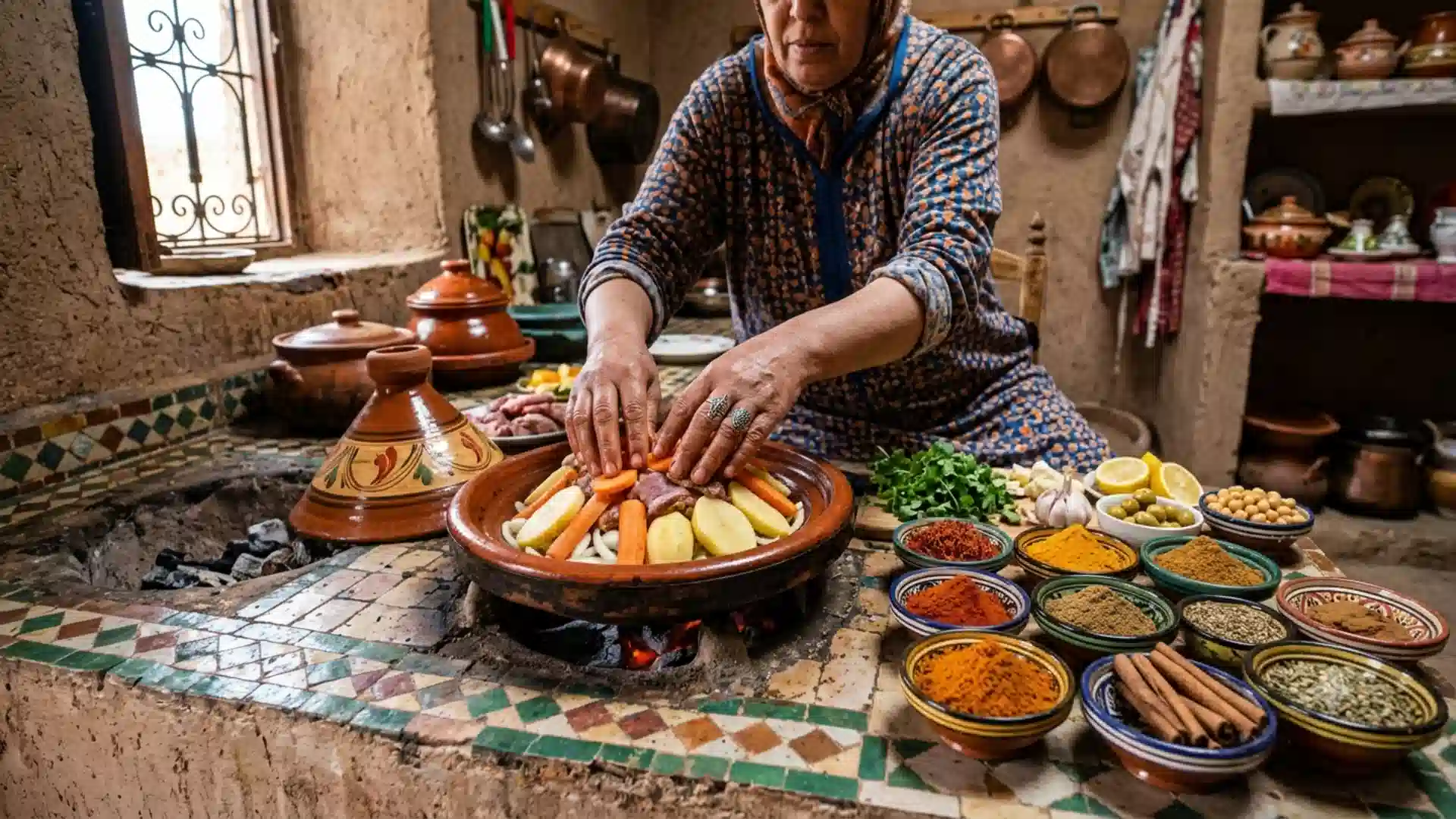
A Moroccan woman in traditional attire layering fresh vegetables and meat into a clay tagine pot on a mosaic tile stove surrounded by colorful spice bowls.
Learn to Cook Moroccan Food With Morocco Cooking Class Skills at Home
The best Moroccan cooking classes send you home with more than a recipe card. They send you home with the understanding of why Moroccan food tastes the way it does — the slow cooking, the layering of spice, the balance of sweet and savory, the patience that transforms simple ingredients into something extraordinary. Here are the items worth purchasing in the souk to bring home and recreate your class at home:
- A clay tagine pot — available at every souk from 80–300 MAD (~£6–24). Buy an unglazed clay one rather than a painted tourist version — the clay is what matters for cooking.
- Ras el Hanout from your class instructor’s preferred vendor — the specific blend your instructor uses. Ask them which stall, buy directly, bring home in a sealed jar.
- Saffron from Taliouine — sold vacuum-packed in the spice souk. Far cheaper and higher quality than anything available in European supermarkets.
- Preserved lemons — available in sealed jars at the souk and in most Moroccan airports duty-free.
- Argan oil — culinary grade (darker, more intense flavour) rather than cosmetic grade (lighter, used for skin). Buy from a certified women’s cooperative for guaranteed authenticity.
Culinary Knowledge Hub
Morocco Cooking Classes: Ultimate FAQ & Planning Guide
Do I need cooking experience to take a Morocco cooking class?
No cooking experience is required. All classes are deliberately structured to accommodate complete beginners. Instructors demonstrate each step before you try it, and recipes are built to be highly achievable in a single session. The core dishes (tagines, harira, salads) are fundamentally straightforward—the true magic lies in learning spice combinations and balancing traditional techniques, making it fully accessible even for children as young as 8.
How much does a Morocco cooking class cost?
A half-day session covering 2–3 dishes averages 350 to 800 MAD (approx. £28–64). A comprehensive full-day class—which includes a guided souk market sourcing trip and a complete multi-course banquet—runs between 600 and 1,200 MAD (approx. £48–96). While private bookings carry a premium for one-on-one attention, highly authentic family-home workshops often present incredible value at the lower end of the pricing spectrum.
Is Marrakech or Fes better for a Morocco cooking class?
Both offer distinct culinary memories. Marrakech boasts the widest selection of classes, modern high-end facilities, and streamlined bookings for busy travelers. Fes offers a raw, deeply traditional home-style alternative—often hosted by local home cooks inside historical medina houses using ingredients from neighborhood stalls. Choose Marrakech for smooth, professional setups, and Fes for an immersive slice of generational family life.
What dishes will I learn in a Morocco cooking class?
Standard half-day courses focus tightly on an iconic main tagine (typically classic lemon-olive chicken), an array of cooked salads (zaalouk, taktouka), and fresh hearth bread (khobz). Full-day variations branch into advanced hand-rolled couscous, celebratory pastilla pastry, and traditional pastries like honey-drenched chebakia or almond-based sellou. Fresh mint tea preparation is universally included.
Can I book a Morocco cooking class as part of a desert tour?
Yes, seamlessly. Over Morocco Tours routinely integrates curated culinary sessions directly into our desert itineraries. We can smoothly coordinate a morning class (9:00 AM – 1:00 PM) in Marrakech on your arrival day before launching into the Sahara, or save it for your departure day as a fantastic final memory before heading to the airport. Simply let us know your preferences (riad kitchen or private home) when planning your circuit.
Seamless Tour Integration
Add a Morocco Cooking Class to Your Desert Tour
Over Morocco Tours effortlessly combines genuine dining experiences in Marrakech and Fes with our unique desert circuits. With both flexible half-day and thorough full-day itineraries available, we strongly recommend individual training for a more customized experience. Simply contact our experts to incorporate a traditional culinary workshop into your forthcoming holiday plans.
Book Your Cooking Class Experience
🔗 Related Guides — Over Morocco Tours

Written by Ibrahim
|
Cultural Specialist & Operations Director, Over Morocco Tours
Generational Culinary Background
Industry Expert Since 2012
Ibrahim grew up enjoying authentic traditional harira, fresh stone-baked khobz, and slow-cooked tagines daily at his family table in Marrakech. His deep, technical insights into Moroccan cooking traditions are written entirely from firsthand personal experience rather than external research. The custom spice mixtures, ancestral kitchen techniques, and rich cultural context showcased throughout this guide represent the foundational culinary elements that defined his childhood in the red city.
+212 673 952 695