Moroccan Khobz: What It Is, How to Make It & Where to Find It (2026)
Table of Contents
Moroccan khobz (خبز, pronounced khobz — the “kh” is the guttural sound of the Arabic خ in Berber (Tamazight) AGHROM ) is the round, dome-shaped, sesame-dusted wheat bread that appears at every Moroccan table, at every meal, in every social class, in every region of the country. It is not one of Morocco’s foods. It is Morocco’s primary food — the carbohydrate foundation upon which every other dish rests, the utensil with which tagine is scooped, the vessel into which olive oil and harissa are dipped, the first thing placed on the table and the last thing removed from it.
It is common for tourists who are experiencing khobz Moroccan bread for the first time to be taken aback by how unlike it is to what they had envisioned “Moroccan bread” to be. In contrast to pita and lavash, this is not a flatbread in the modern sense. It is a true leavened bread, which means that it has been raised with yeast, has a solid texture, a golden crust, and a soft crumb, but it is made into round discs with a diameter of roughly 20–25 centimeters, rather than the loaf forms that are typical of bread traditions in Europe or the United States. The sesame seeds that are pressed into its surface before to baking give it a toasted and nutty quality that makes it truly one of the best breads that can be consumed daily anywhere in the globe you may be.
In this book, you will learn all you need to know about Moroccan khobz, including its history, its cultural significance, the variants you will come across throughout Morocco, how to recognize and purchase the finest kinds while you are there, and the recipe for making it at home after you get back from your trip.
Moroccan Khobz — At a Glance
What is it?
Leavened wheat bread formed into round discs, sesame-seeded, and baked in communal wood-fired ovens or home ovens throughout Morocco.
Name Origin
From the Arabic خبز (khubz) meaning “bread”—the exact same linguistic root utilized natively across the Arab world.
Shape & Size
Distinctly round and slightly domed. Measures roughly 20–25 cm in diameter and 3–4 cm thick when fully proofed and risen.
Seed Varieties
Sesame seeds are the most popular type of seed, however regional versions commonly include nigella seeds (also known as habba sawda) or anise seeds.
Where Made
Forming in the kitchens of homes and then being taken to the community wood-fired oven (ferran) in the neighborhood, or being purchased fresh from commercial bakeries in the neighborhood.
When Eaten
Present at each and every meal: at breakfast, it is served with olive oil and honey; during lunch, it is used to scoop up tagines; and during supper, it is coupled with a velvety harira soup.
Cultural Context & Significance
In Moroccan society, bread holds a sacred status. Khobz is deeply respected and is never carelessly thrown into the trash. Leftover or stale pieces are systematically collected to feed livestock or carefully placed aside in public areas for others to use, ensuring this vital source of life is never discarded.
What Is Khobz Moroccan Khobz? A Complete Description
Moroccan khobz is a circular flatbread prepared with wheat flour, water, salt, yeast, and sesame seeds. However, this definition fails to capture all that distinguishes it. Khobz Moroccan bread is unique due to a combination of factors, including the use of fine-ground Moroccan semolina mixed with white flour for a more substantial crumb, the traditional wood-fired communal oven (ferran) for baking, and the daily ritual.
Moroccans’ cultural affinity with their khobz extends beyond sustenance. In Morocco, bread is regarded sacrosanct, reflecting the Islamic tradition that regards food, particularly grain, as a direct gift from God. Throwing bread away is regarded extremely rude. Stale Moroccan bread is left on the street for birds and stray animals, given to neighbors, or fed to cattle, but not disposed of properly. Children are trained at a young age to pick up any piece of bread discovered on the ground and set it somewhere elevated rather than walking on it. This connection between Moroccans and their bread is one of the most direct and emotional cultural experiences offered to first-time visitors to the country.
The History of Khobz in Moroccan Culture
Bread has been made in North Africa from at least 6,000 BCE, according to archaeological evidence from ancient Berber villages in the Atlas foothills and Saharan pre-desert. The evidence includes grinding stones, storage jars, and hearths that are compatible with grain processing and bread baking at this time. Moroccan khobz is traditionally baked on flat stones or clay discs, resulting in naturally circular shapes as the dough is patted outward from a central point rather than molded into a loaf.
The term “khobz” originated in Arabic and was introduced to North Africa after the Arab conquest in the 7 th century CE. However, the Amazigh (Berber) peoples of Morocco had already been making circular Moroccan flatbreads for millennia before the Arabs arrived. Modern khobz combines Berber baking traditions, Arabic names, and wheat production practices from Islamic agriculture.
The community oven, known as the ferran, is a key social institution in Moroccan khobz. It is still used in medinas in Fes, Marrakech, and rural Morocco. Traditionally, families make their khobz dough at home, shape it into rounds, and transport it to the neighborhood ferran on a wooden board; the baker puts each family’s bread into the wood-fired oven with a long-handled peel, and the family gets it an hour later, still warm. Each household identifies its bread with a unique pattern pressed into the surface before baking – a practice that predates printed addresses as a form of identification.
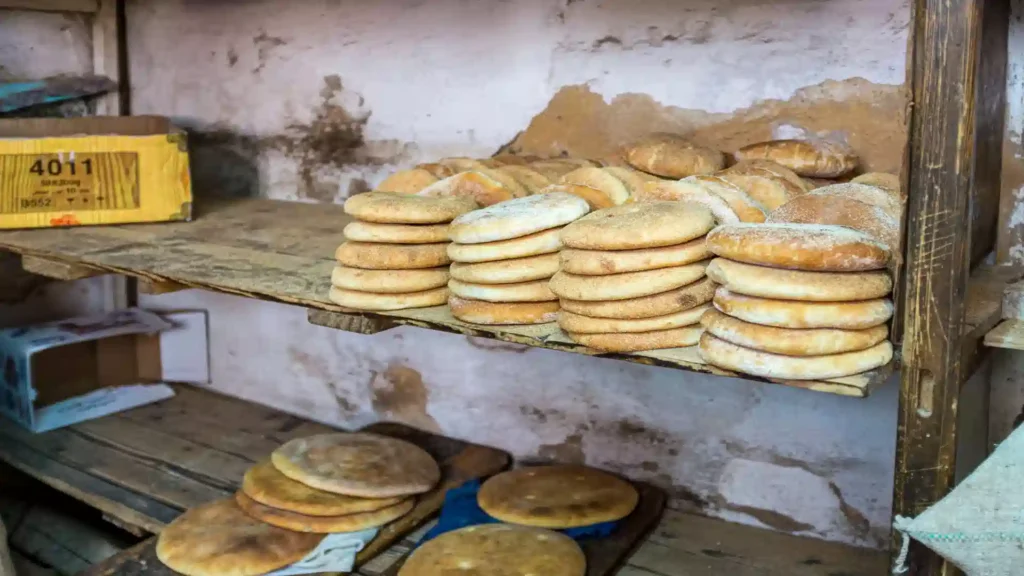
Stacks of fresh, round Moroccan Khobz await customers on rustic wooden shelves in a bustling local market bakery.
Culinary Field Guide
The Varieties of Moroccan Bread You Will Encounter
While classic khobz remains a mainstay on tables across the country, it is only the beginning of a rich baking history. Morocco has an exceptionally rich bread culture, full with different regional specialties and contextual variations that visitors will witness firsthand at various points during their personalized travel routes.
Khobz — The Classic
The bread that is consumed on a daily basis in Morocco. Before being placed on the stone platform, the leavened dough is shaped into a round shape and delicately covered with toasted sesame seeds.
Msemen
a pan-fried flatbread that is square, nicely stacked, and precisely produced by incorporating rich butter or oil straight into the dough that has been stretched.
Harcha
A rich and rustic semolina griddle cake that has a surface that is notably crisp and rough in texture, which is generated from coarse grains’ composition.
Beghrir
Popularly known as the “thousand-hole pancake.” This light, yeasted semolina crumpet is only griddled on one side.
Khobz Dar (Home Bread)
The personal, bespoke home-baked version of the regular commercial loaf, precisely tailored to family preferences.
Batbout
An airy pocket flatbread prepared directly on a hot cast-iron skillet rather than in a normal oven.
Traditional Moroccan Bread Recipe — Makes 2 Round Loaves
This recipe yields two 22 cm-diameter rounds of Moroccan bread recipe, ideal for a family table of four. The recipe was offered by our Morocco cooking class instructor in Marrakech and is a true home kitchen approach rather than a reduced copy.
Ingredient Checklist
Preparation Steps Learn How To Make Moroccan Bread:
1
Combine the bread flour (or semolina mix), salt, and sugar thoroughly in a large mixing bowl. Add your yeast and whisk lightly to distribute it evenly through the dry mix.
2
Pour in the olive oil, then begin gradually streaming in the warm water, mixing steadily with your hand until the ingredients cohere into a soft, shaggy dough mass.
3
Turn the dough onto a lightly floured surface. Knead vigorously and continuously for 10 full minutes until the structure turns perfectly smooth, supple, and elastic, bouncing back quickly when pressed firmly with a finger.
4
Divide your dough into 2 equal portions and shape each into a clean round ball. Using the flat palm of your hand, press outward from the center to flatten each ball into a neat disc roughly 22 cm in diameter and 2 cm thick. Do not use a rolling pin.
5
Transfer the shaped discs onto a flat baking tray generously dusted with semolina. Lightly brush or mist the upper surfaces with water and immediately scatter sesame and optional nigella seeds across, pressing down gently so they secure to the dough surface.
6
Drape a clean, dry kitchen towel over the tray and rest in a warm, draft-free spot for 45–60 minutes until the loaves look clearly expanded and slightly puffed up.
7
Preheat your oven to 220°C (200°C for convection/fan settings). Just before sliding the tray into the oven, pierce the top of each loaf 5 to 6 times using the tines of a fork—this traditional venting pattern stops vast internal air pockets from separating the crust.
8
Bake the loaves for 15–20 minutes until the crust turns an even, deep golden hue and the bottom crust rings with a distinct hollow thump sound when carefully tapped.
9
Cool on an elevated wire baking rack for at least 10 minutes prior to breaking into pieces. Authentic khobz is best enjoyed warm on the very day it is pulled from the hearth.
Key Technical Execution Note
The most important stage in making authentic Moroccan bread at home is the kneading process. Dedicating a full 10 minutes to rigorous, rhythmic physical stretching is essential for developing the gluten network that gives khobz its signature tender-yet-chewy texture. Under-kneading produces a thick, sticky interior profile. Stretch a little piece of dough to see how far you’ve come. If it tears right away, keep kneading; if it stretches flawlessly into a thin, transparent sheet without fracturing (the traditional windowpane test), it’s structurally ready for the baking tray.
How Moroccan Khobz Functions Across Moroccan Meals
Khobz is the universal complement to Moroccan cuisine, but examining its various pairings throughout the day exposes the full scope of its culinary role. It serves as a simple breakfast dip and the principal utensil at supper, establishing the daily rhythm of rural life.
🌒
Breakfast — Amlou Paste
Tearing warm khobz and dipping it into fresh amlou—a silky combination of powdered roasted almonds, pure argan oil, and mountain honey—is widely regarded as the best breakfast experience in Morocco. The creamy, nutty oil nicely permeates the loaf’s thick texture. For optimal results, serve it with a cool glass of freshly squeezed orange juice from a bustling Djemaa el-Fna market booth.
🍳
Lunch — The Tagine Utensil
When eating a classic tagine, khobz is used instead of metal utensils. Diners take a tiny, bite-sized slice and shape it cleanly with their thumb and fingers to scoop up the slow-cooked meats, soft veggies, and reduced sauces. It easily absorbs the various layers of spicy olive oil, preserved lemon brine, and deep fluids that accumulate at the clay foundation.
🌺
Olive Oil & Harissa
The Moroccan meal starts with a bowl of quality squeezed olive oil, a tiny dish of hot house-made harissa (spiced chile paste), and a loaf of khobz. This is the cultural counterpart of western bread and butter. Notably, the harissa at our luxury desert lodge in Erg Chebbi is hand-ground from wild desert peppers that survive only in that Saharan habitat.
🌟
Dinner — Harira Soup
A hot bowl of zesty harira soup, rich with aromatic tomatoes, earthy lentils, plump chickpeas, and comforting spices, served with a crust of crispy khobz, is the ultimate evening meal. Throughout the holy month of Ramadan, this precise, historical combination breaks the day-long fast at the exact moment of sunset (iftar) across the whole country.
☕
Mint Tea Accompaniment
During afternoon tea, the key social ritual that frames the Moroccan day, khobz is served alongside flaky msemen flatbreads, honey-drenched chebakia pastries, and sweet Tafilalet dates. Balancing rich, syrupy pastries with basic, substantial bread and hot mint tea creates the perfect communal gastronomic experience in local life.
🍀
Zaalouk & Mezze Salads
The first meal of every great, traditional Moroccan dinner includes a variety of seasonal prepared salads, such as smokey eggplant zaalouk, spicy tomato taktouka, and sweet cumin-scented carrots. These are scooped up with khobz, an organic spoon. This beginning meal at a traditional table is served without forks, in accordance with stringent local customs.
Where to Find the Best Morocca Khobz?
The Ferran — Communal Neighbourhood Oven
Moroccan khobz is best cooked in a wood-fired ferran, a communal oven found in most Moroccan medinas and rural settlements. The unique character of wood-fired khobz—the thin, crackling crust, the mild smokiness, and the uneven char lines on the underside—cannot be duplicated in a home oven. In the medinas of Fes and Marrakech, the ferran bakes from around 6:00 a.m. until all of the neighborhood’s bread is finished, which is usually around 9-10 a.m. Arriving at a ferran early in the morning and watching the baker manage 50 or more family loaves at once — sliding them in and out with a long-handled wooden peel, stacking them in their respective groups, calling out names as each family’s bread is ready — is one of the most authentic Moroccan experiences available to a traveler, and it is completely free.
Street Bakeries
Every Moroccan metropolitan area has a commercial bakery that sells khobz from 6am. Look for little establishments that have a pile of gold rounds visible through the window. Price: About 1-2 MAD each round (less than 20p). Purchasing and eating a warm khobz from a neighborhood bakery — not a tourist-oriented café, but a business where local families purchase their morning bread — is the most economical and real food experience Morocco provides.
The Desert Camp Experience
At Over Morocco Tours’ Erg Chebbi desert camp, khobz is baked fresh each morning on the camp brazier — a version of harcha (the semolina griddle bread) rather than oven-baked khobz, adapted for the camp cooking equipment. Served hot from the pan with butter and amlou paste at sunrise breakfast after the camel trek back from the dunes, it is consistently cited by guests as the most memorable bread they have ever eaten. Context, as always in Morocco, makes everything taste better.
|
🌿 Sustainable Riad Traditions
A Note on Stale Khobz: Honoring Morocco’s Sacred Loaf
If you buy fresh khobz in the morning and have a surplus by the evening, there is no need to worry about waste. Simply place the leftover pieces neatly on the outside windowsill of your riad or guesthouse. Within minutes, it will be securely collected by neighborhood birds, street cats, or a passing person who recognizes the bread and instantly collects it rather than allowing it to spoil.
This is not exceptional or isolated behavior in Morocco; it is a totally typical, lovely, and deeply ingrained cultural reaction to food management. In a world where daily bread is carefully guarded as a holy gift, this simple approach guarantees that excess food is smoothly redistributed back into nature or the community.
Riad Etiquette Tip: Never throw bread directly into a trash bin during your tour. If a windowsill isn’t available, ask your hosts or guide to help put it aside respectfully.
Moroccan Khobz — Frequently Asked Questions
What exactly is Moroccan khobz?
How does khobz differ structurally from other international flatbreads?
Can I replicate authentic Moroccan khobz successfully at home?
Is khobz fundamentally the same product as pita bread?
Why exactly is daily bread handled with sacred respect in Moroccan culture?
Experience Authentic Moroccan Bread Culture on Your Desert Tour
Enjoy fresh, rustic harcha griddle cakes at our luxury desert camp sunrise breakfast, warm Moroccan khobz pulled straight from a historic neighborhood wood-fired ferran in the Fes medina, and flaky afternoon msemen with organic almond amlou at your boutique Marrakech riad. At Over Morocco Tours, we weave these rich, local culinary legacies directly into every milestone of your private circuit.
Fully licensed transport company based natively in Marrakech. Tailor-made private circuits nationwide.
Related Guides — Over Morocco Tours

Editorial Contributor
•
Local Culinary Insight Verified
Written by Ibrahim
Cultural Specialist, Over Morocco Tours
🥖 Heritage Ferran Raised
🇲🇦 Food Culture Expert Since 2012
Ibrahim spent his childhood collecting fresh, hot khobz each morning directly from the traditional neighborhood communal oven (ferran) situated steps from his family home in the heart of Marrakech. He brings an authentic, deeply personal perspective to Moroccan gastronomy rather than an academic one, drawing on decades of lived household routines, local baking methods, and ancestral traditions.
+212 673 952 695