Morocco vs Egypt: Which Should You Visit in 2026? The Honest Comparison
Table of Contents
Morocco vs Egypt: Why This Is the Question So Many Travelers Ask
Morocco vs Egypt is one of the most common dilemmas facing anyone planning a first trip to North Africa, and for good reason: both countries deliver extraordinary, once-in-a-lifetime travel experiences; both are remarkably affordable compared to Europe or North America, and both have built reputations as two of the continent’s most rewarding destinations. Yet the two trips could hardly feel more different. Is Morocco better than Egypt? The honest answer, covered in full detail below, is that there is no universal winner; the right choice depends entirely on what kind of traveler you are and what kind of experience you are seeking. This guide, written by the Over Morocco Tours team, gives you a genuinely balanced, head-to-head comparison of cost, safety, food, landscapes, and travel style, so you can make a decision based on real information rather than marketing spin from either side.
Executive Summary: Morocco vs Egypt Guide
Morocco vs Egypt: What Each Country Actually Offers
The Fundamental Difference: Living Culture vs. Ancient Monuments
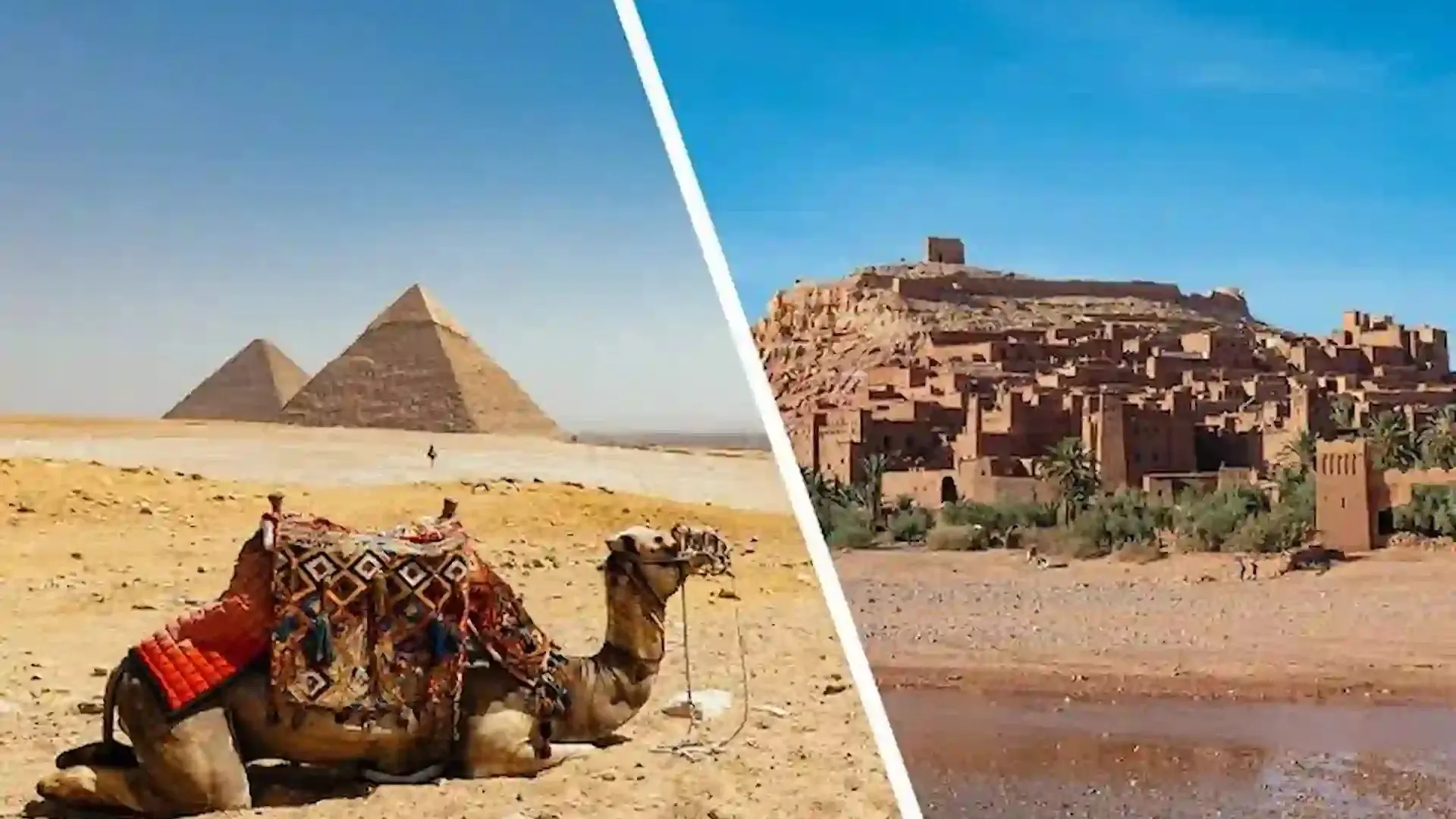
The clearest way to understand Morocco or Egypt which to visit is to recognize that the two countries are built around fundamentally different kinds of travel experience. Egypt’s appeal is concentrated, monumental, and historical; the Pyramids of Giza, the Sphinx, the Valley of the Kings, the temples of Luxor and Karnak, and Abu Simbel represent some of the oldest and most awe-inspiring human achievements on Earth, and a trip to Egypt is, in large part, a journey through the weight of pharaonic history along the Nile. Morocco’s appeal, by contrast, is diffuse, sensory, and rooted in living culture rather than ancient ruin Morocco’s history is layered through Berber, Arab, Andalusian, and French influence, and a Morocco trip moves continuously between dense medieval medinas, dramatic mountain passes, and the vast silence of the Sahara, with the Sahara desert vs Egypt pyramids comparison capturing the core distinction well: one experience is a multi-day immersion in nomadic culture and natural landscape, while the other is a single, concentrated encounter with monumental antiquity.
Neither approach is objectively superior they reward fundamentally different travel instincts. Travelers who describe their ideal trip in terms of “seeing” a specific, iconic wonder tend to gravitate toward Egypt. Travelers who describe their ideal trip in terms of “feeling” immersed in an unfolding, varied landscape and culture tend to gravitate toward Morocco.
Landscape Diversity: Where Morocco Pulls Ahead
In terms of sheer landscape variety within a single, compact country, Morocco vs Egypt landscapes is not a particularly close comparison. Morocco packs Atlantic coastline, the snow-capped High Atlas mountains, the rose-colored kasbahs of the pre-Saharan valleys, and the golden dunes of Erg Chebbi into a country that can be crossed by road in days rather than weeks. Egypt’s landscape, by contrast, is dominated by the Nile Valley and the surrounding desert, with the Red Sea coast (Hurghada, Sharm el-Sheikh) offering exceptional diving and snorkelling as a genuinely distinct complementary experience, while destinations such as the White Desert and Siwa Oasis exist but typically require considerably more time and logistical effort to reach than Morocco’s equivalent natural attractions. For travelers who prioritize diversity of scenery — coast, mountain, and desert within a single accessible itinerary — Morocco is generally considered the stronger choice.
Morocco vs Egypt Cost: What You’ll Actually Spend
Morocco vs Egypt cost comparisons vary somewhat between sources, reflecting genuine currency volatility and differing traveler budgets, but the consistent pattern across nearly every comparison is that Egypt tends to run somewhat cheaper than Morocco at the budget and street-food level, while the gap narrows or reverses at the mid-range and luxury level, where Morocco’s riad accommodations offer a category of experience with limited direct equivalent in Egypt. Budget daily costs are typically cited in the range of $30-60 per day in Egypt versus $40-80 per day in Morocco , with the most significant cost difference appearing in street food and basic local transport rather than in mid-range hotels or organized tours, where the two countries land much closer together. Egypt’s currency has also depreciated substantially against major Western currencies in recent years, which has made already-affordable day-to-day costs even lower in dollar or euro terms though this is a moving target worth checking against current exchange rates rather than relying on any fixed figure.
It is worth noting plainly that cost estimates across different travel sources vary meaningfully, sometimes by 30% or more for the same category, reflecting differences in travel style, season, and how “budget” is defined. The safest practical approach is to treat both countries as genuinely affordable relative to Western Europe or North America, while building in a realistic buffer for organized desert tours, Nile cruises, or guided archaeological site visits, which represent the largest single cost category in either country’s itinerary.
Morocco vs Egypt Safety: An Honest Assessment
Morocco vs Egypt safety comparisons consistently place Morocco in a marginally stronger position across most independent travel safety indices, though both countries are broadly considered safe for tourists at established destinations, with violent crime against visitors remaining rare in both. The most consistent theme across independent comparisons is that the primary safety concern in both countries is not violent crime but rather persistent touss, unofficial guides, and overly insistent vendors a category of nuisance rather than danger, but one that meaningfully affects the day-to-day feel of a trip, particularly around the most visited sites in each country (the souks of Marrakech in Morocco; the areas immediately surrounding the Pyramids and Luxor’s West Bank in Egypt).
Both countries advise standard precautions around specific border or interior regions Western Sahara border areas in Morocco’s case, and the Sinai interior and Libyan border in Egypt’s case — though these areas fall well outside any standard tourist itinerary in either country. Booking with a reputable, locally based tour operator rather than navigating independently is the single most consistently recommended strategy across both destinations for reducing friction with touts and unofficial guides, and is particularly valuable for first-time visitors unfamiliar with either country’s specific dynamics.
Morocco vs Egypt for Solo Female Travelers
Morocco vs Egypt for solo female travelers is one of the most frequently asked safety-adjacent questions, and the consistent finding across independent comparisons is that Morocco is generally reported as the somewhat more relaxed of the two destinations for women traveling alone, though both countries require genuine awareness and preparation. Persistent verbal attention and staring are commonly reported by solo female travelers in both countries, with several comparisons noting that the intensity around Egypt’s most visited monuments particularly Cairo and Luxor — can feel more pronounced than the equivalent experience in Morocco’s well-trafficked tourist cities such as Marrakech, Fes, Essaouira, and Chefchaouen. In both countries, modest dress (covering shoulders and knees) is consistently identified as meaningfully reducing unwanted attention, and joining an organized tour or working with a local guide is widely recommended as an effective way to reduce friction for solo travelers of any gender, though particularly for women. For a full breakdown of practical strategies specific to Morocco, see our dedicated solo female travel Morocco guide .
Morocco vs Egypt Food: Two Very Different Culinary Traditions
Morocco vs Egypt food represents one of the more genuinely decisive differentiators between the two destinations for travelers who prioritize cuisine as part of their trip. Moroccan food is widely respected internationally as one of the world’s great culinary traditions the slow-braised tagine, the ceremonial Friday couscous (recognized by UNESCO as Intangible Cultural Heritage in 2020), pastilla, harira soup, and an extensive, internationally celebrated pastry and sweets tradition combine to make food a genuine highlight of nearly any Morocco itinerary, supported by an active culture of riad dining, cooking classes, and rooftop restaurants in cities like Marrakech and Fes. Egyptian cuisine is hearty, flavorful, and built around staples such as koshari (a filling mix of rice, lentils, and pasta topped with a spiced tomato sauce), ful medames (slow-cooked fava beans), and grilled kofta, representing excellent, affordable, satisfying food — though it has not achieved the same level of international culinary celebrity or dedicated food-tourism infrastructure that Morocco has built around its cuisine. For travelers for whom food is a central trip priority, Morocco generally holds a meaningful edge.
Morocco vs Egypt Visa Requirements
Morocco vs Egypt visa requirements differ in a practically significant way for many Western travelers. Most major nationalities including the US, UK, EU countries, Canada, Australia, and New Zealand enter Morocco visa-free for up to 90 days , with no advance application required (see our full Morocco visa requirements guide for the complete breakdown by nationality). Egypt, by contrast, requires a tourist visa for most Western nationalities, though this is generally straightforward to obtain either on arrival at major airports for a modest fee, or in advance through Egypt’s e-Visa portal. Neither requirement represents a major obstacle for most travelers, but Morocco’s visa-free entry does offer a small practical advantage in trip-planning simplicity, particularly for travelers booking relatively last-minute.
Morocco vs Egypt for Families
For travelers planning with children, Morocco vs Egypt for families comparisons generally favor Morocco, for several converging reasons. Morocco’s shorter internal travel distances mean less time spent in transit between major sights, its climate is somewhat more moderate across more of the year (particularly outside peak Egyptian summer heat, which can be genuinely difficult for young children), and activities such as camel rides, desert camps, pottery and cooking workshops, and riad swimming pools tend to suit a wide age range without requiring extensive walking through large, exposed archaeological sites in high heat. Egypt remains an entirely viable and often deeply memorable family destination particularly for older children and teenagers with a genuine interest in ancient history but the logistics of a Nile cruise itinerary alongside extended time at sites like Giza and Luxor in full sun require more careful planning around heat and stamina for very young children specifically.
Best Time to Visit: Morocco vs Egypt Weather
Morocco vs Egypt weather best time considerations differ meaningfully between the two countries’ high seasons. Morocco’s most comfortable travel window falls in spring (March-May) and autumn (September-November) , when temperatures across the country’s varied regions coast, mountains, and desert are at their most moderate; visiting during these windows also coincides with seasonal highlights such as the Kelaat M’Gouna rose harvest in spring. Egypt’s most comfortable window for inland and Nile Valley travel falls similarly in the October to April period , since Egyptian summer heat away from the coast can become genuinely extreme; the Red Sea coast, however, remains a viable warm-weather destination through the summer months given its resort infrastructure and water-based activities. Both countries see their highest tourist volumes and prices during their respective comfortable seasons, meaning shoulder-season travel (late spring or early autumn) can offer a reasonable balance of pleasant weather and somewhat reduced crowds and cost in either destination.
How Long Do You Need: Morocco vs Egypt Itinerary Length
A well-paced Morocco itinerary for Morocco vs Egypt first time travelers typically runs 7 to 14 days , allowing time for Marrakech (2-3 days), a Sahara desert excursion (2-3 days), Fes (2-3 days), and either coastal time in Essaouira or mountain time in Chefchaouen, depending on preference. A comparable Egypt itinerary typically runs 7 to 12 days , covering Cairo and Giza (2-3 days), a Nile cruise or independent travel to Luxor and Aswan (4-5 days), and optionally extending to Abu Simbel or Red Sea coastal time. Both itineraries can be meaningfully shortened for travelers with less time, though both countries reward the fuller itinerary length considerably more than a rushed 4-5 day visit.
Can You Visit Morocco and Egypt Together?
Can you visit Morocco and Egypt together is a question worth answering directly: yes, and a growing number of travelers do exactly this, particularly when combining North Africa with a broader trip through the wider region. Direct and connecting flights between Casablanca or Marrakech and Cairo are readily available, and travelers with 3 weeks or more of total trip time can reasonably combine a shortened version of both itineraries — roughly 7-9 days in Morocco paired with 7-9 days in Egypt — into a single extended trip. For travelers with less total time available, most experienced North Africa travelers and tour operators recommend choosing one destination to experience properly rather than rushing both, with the understanding that the “other” country remains an excellent candidate for a future trip rather than something that needs to be checked off in a single visit.
Important Tip from Our Team: What We Tell Guests Deciding Between the Two
“We get this question constantly, and our honest answer is always the same: think about what you actually want to feel at the end of each day. If you want to end your day having seen something that has stood for over four thousand years and feel the genuine weight of that, Egypt delivers something nothing else on Earth can match. If you want to end your day having moved through three completely different landscapes — souks, mountains, desert and feel like you’ve had a sensory, immersive adventure rather than a monument checklist, that’s Morocco’s strength.
The travelers who regret their choice are almost always the ones who chose based on which flight was cheaper that week rather than which experience actually matched what they wanted. And honestly, the travelers who love one country properly nearly always come back a few years later for the other. We’ve had guests who did Egypt first and told us Morocco felt completely different in the best way more relaxed, more varied, easier to navigate independently. We’ve also had guests who loved Morocco and went on to do Egypt next and came back saying the Pyramids genuinely lived up to the hype. Neither trip disappoints the right traveler.”
Over Morocco Tours Guide Team
Frequently Asked Questions: Morocco vs Egypt
Is Morocco better than Egypt for first-time travelers?
Neither is objectively better — they follow different priorities. Morocco is generally considered the easier, more accessible first-time destination for travelers prioritizing landscape diversity, food, and a more relaxed solo or family travel experience. Egypt is the stronger choice for travelers whose primary motivation is ancient history and monumental archaeological sites, which Morocco cannot match in scale or antiquity.
Is Morocco or Egypt cheaper?
Egypt is generally somewhat cheaper than Morocco at the budget and street-food level, with cost comparisons typically citing Egypt at roughly $30-60 per day versus Morocco at $40-80 per day for budget travel. The gap narrows considerably at the mid-range and luxury level, where Morocco’s riad accommodations offer strong value with limited direct equivalent in Egypt.
Is Morocco or Egypt safer for solo female travelers?
Morocco is generally reported as the somewhat more relaxed destination for solo female travelers, though both countries require standard precautions including modest dress and awareness in busy tourist areas. Persistent attention from touts and vendors is the primary nuisance in both countries rather than violent crime, which is rare in both.
Do I need a visa for Morocco or Egypt?
Most Western nationalities (US, UK, EU, Canada, Australia, New Zealand) enter Morocco visa-free for up to 90 days. Egypt requires a tourist visa for most Western nationalities, though it is straightforward to obtain on arrival or via Egypt’s e-Visa portal in advance.
Can I visit both Morocco and Egypt on one trip?
Yes. Direct and connecting flights between Morocco and Cairo are widely available, and travelers with three weeks or more can combine shortened versions of both itineraries. For trips shorter than this, most experienced travelers recommend choosing one destination to experience fully rather than rushing both.
Which has better food, Morocco or Egypt?
Morocco is widely regarded as having one of the world’s great culinary traditions, with tagine, couscous (recognized by UNESCO as Intangible Cultural Heritage), and an extensive pastry culture supported by strong food-tourism infrastructure. Egyptian cuisine is hearty and satisfying, built around dishes like koshari and ful medames, but has not developed the same level of international culinary celebrity as Moroccan food.
How many days do I need for Morocco versus Egypt?
A well-paced Morocco itinerary typically runs 7-14 days, covering Marrakech, a Sahara desert excursion, and Fes at minimum. A comparable Egypt itinerary typically runs 7-12 days, covering Cairo, Giza, and a Nile Valley extension to Luxor and Aswan.
Made Your Decision? Start Planning Your Morocco Trip
If Morocco’s varied landscapes, living culture, and the Sahara desert have won you over, Over Morocco Tours is ready to help you build the right itinerary from a focused Marrakech and desert circuit to a full imperial cities and Sahara journey. Our locally based guides bring genuine first-hand knowledge to every route. Contact our team today , with no obligation, to start planning your Morocco trip.
Written by the Over Morocco Tours team, Morocco. Cost and safety figures cited reflect a synthesis of independent travel comparisons current as of 2026 and can vary by season, exchange rate, and travel style; always verify current pricing and advisories before booking.