Moroccan Rug Carpet Guide 2026: Best Types, Prices & Buying Tips
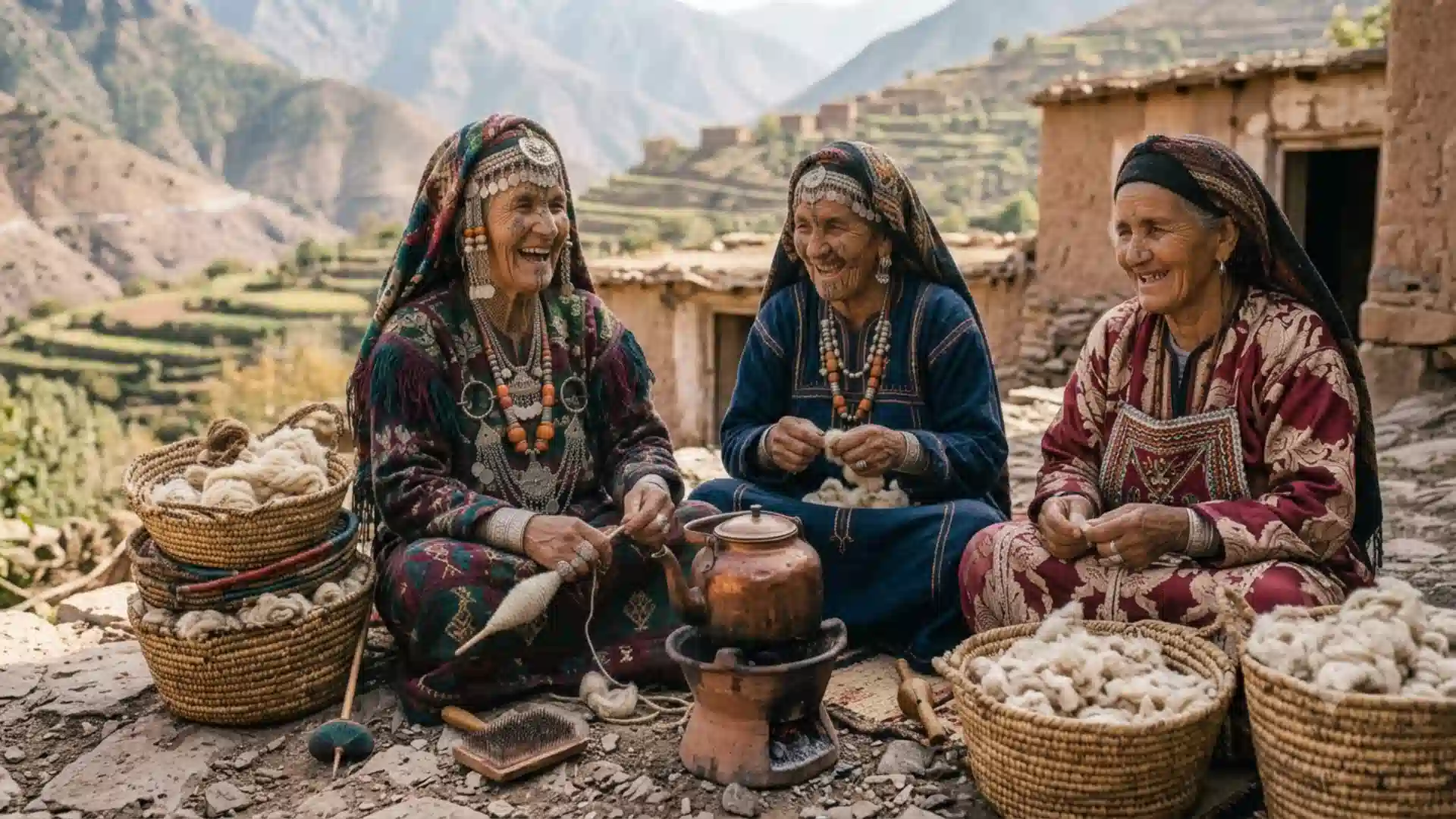
A Moroccan rug carpet is not a decorative object; it is a hand-woven cultural document, created by an Amazigh (Berber) woman working on an upright loom in her home or village cooperative, using symbols passed from mother to daughter for generations, in a craft tradition that predates Islam, predates the Arab conquest, and predates the empires that built the palaces tourists visit in Marrakech. Each one is woven by hand, typically by a woman working on an upright loom in her home or at a village cooperative. A single large carpet can take two to eight months to complete, with every knot tied individually.
That is what you are looking at in the Marrakech souk when a carpet is unrolled at your feet. The question is whether the piece you see reflects that heritage or is a machine-made reproduction designed to look like it does.
For over a decade, we have been guiding travelers through the souk system of Morocco, and we have direct relationships with artisan cooperatives in the Middle Atlas, High Atlas, and Souss Valley. Based on our experience, this guide will provide you with all the tools to know the difference, to know what you are looking at, to know what a fair price is, and to take home an authentic Moroccan rug or carpet, without being scammed, pressured, or disappointed.
Table of Contents
Moroccan Rug carpet Quick Reference: All Types at a Glance
| Rug Type | Region | Material | Style | Price Range (MAD) | Best For |
|---|---|---|---|---|---|
| Beni Ourain | Middle Atlas | 100% natural wool | Cream base, black/brown geometric | 3,000–20,000+ | Modern interiors, minimalist design |
| Azilal | High Atlas | Wool on cotton | Cream base, vivid colors, abstract | 2,000–12,000 | Color, personal expression, artistic feel |
| Boucherouite | Various | Recycled textiles | Multi-color, abstract, rag-style | 300–4,000 | Budget, eco-conscious, bold color |
| Kilim | Various | Flatwoven wool | Geometric, striped, graphic | 400–6,000 | Travel-friendly, lightweight wall hangings |
| Rabat (R’Bati) | Rabat | Fine wool | Central medallion, floral borders | 3,000–25,000+ | Formal rooms, investment pieces |
| Taznakht | Anti-Atlas | Wool | Bold colors, geometric, High Atlas style | 1,500–8,000 | Strong color, traditional feel |
| Boujad | Khouribga/Kasba Tadla | Wool | Irregular, vibrant pinks and reds, abstract | 1,500–9,000 | Eclectic interiors, bold color statements |
| Zanafi | High Atlas | Wool | Black and white, striped | 1,000–5,000 | Graphic minimalism |
What Is a Moroccan Rug carpet? The Complete Definition
A Moroccan rug carpet is a handmade textile produced by Berber (Amazigh) weavers across Morocco’s Atlas Mountain regions, oasis valleys, and plains, using techniques, patterns, and symbolic vocabularies that have been transmitted orally and practically through generations of women for thousands of years. The craft of Moroccan carpet weaving dates back thousands of years, with roots in the indigenous Berber tribes. Originally, these rugs were crafted for practical purposes offering warmth in the harsh Atlas Mountain climate or serving as bedding, seating, blankets, and tent separators.
Two fundamental distinctions separate every Moroccan rug:
Pile rugs vs. flatweave (kilim) rugs:
- Pile rugs (Beni Ourain, Azilal, Boucherouite, Rabati, Boujad, Taznakht): Three-dimensional, hand-knotted, with a raised wool surface that creates depth and texture. Each knot is tied individually around warp threads. The woolen paintings are knotted; the weaver adds small knots of wool separately.
- Flatweave (kilim) rugs (Moroccan kilim, Zanafi, Zemmour): Two-dimensional, woven rather than knotted, with no raised pile; the design is created entirely by the interlacing of warp and weft threads. Unlike antique Berber carpets, those are woven, where a long woolen thread runs throughout the width of the carpet.
Hand-knotted vs. machine-made:
The single most important distinction a buyer needs to make. Check the back: handmade rugs show irregular knots; machine-made carpets have uniform loops. The fringe should extend from the warp threads, not be sewn on.
Beni Ourain Rug: Morocco’s Most Famous Berber Carpet
The Beni Ourain rug is the most internationally recognized Moroccan carpet type, a thick, plush pile rug woven from undyed natural wool in creamy off-white with bold black or dark brown geometric motifs, produced by the Beni Ourain confederation of Berber tribes in the Middle Atlas Mountains between Fes and the Algerian border. Beni Ourain rugs work best where softness and neutral geometry are important; they follow modern interiors with minimalist black-on-cream geometry.
The Beni Ourain is the rug that put Moroccan weaving on the global design map. Interior designers from Paris to New York have specified it for decades. Its appeal is not accidental: the undyed natural wool, the bold lozenge and diamond geometry, and the thick high pile translate perfectly into contemporary minimalist interiors in a way that many traditional textile traditions simply don’t.
Beni Ourain rug specifications:
- Material: 100% natural undyed wool from sheep raised in the Middle Atlas, where high altitude and cold winters produce a particularly thick, lanolin-rich fleece
- Colors: Cream, ivory, or off-white base with natural dark brown or black geometric motifs; no synthetic dyes are used in authentic pieces
- Pile height: High (2–5 cm), the deepest and softest of all Moroccan rug types
- Pattern: Bold geometric forms lozenges, diamonds, zigzags, and chevrons arranged symmetrically or in repeating rows
- Size range: From small (60×90 cm) accent rugs to large room-filling pieces (3×5 m and beyond)
- Production time: 2–6 months for a medium-sized authentic piece
The wool of sheep from the Beni Ourain location is very white and that of the Azilal area draws nearer to beige. This is a natural geographical difference and is the reflection of the diverse sheep breeds and altitude circumstances of each place.
Beni Ourain rug prices 2026:
| Size | Cooperative Price (MAD) | Tourist Souk Opening Ask (MAD) | Fair Final Price (MAD) |
|---|---|---|---|
| Small (60×90 cm) | 800–1,500 | 3,000–6,000 | 1,200–2,500 |
| Medium (120×180 cm) | 2,500–5,000 | 8,000–15,000 | 3,500–7,000 |
| Large (200×300 cm) | 6,000–15,000 | 20,000–40,000 | 8,000–18,000 |
| Extra large (250×350 cm+) | 12,000–25,000 | 35,000–60,000 | 15,000–30,000 |
In our experience buying Moroccan carpets for tour customers in the Middle Atlas cooperatives between Azrou and Ifrane, a real hand-knotted medium Beni Ourain from a cooperative is a fair price of 3,500-7,000 MAD depending on density of knots and size. Any quote for a midsize item under 2,000 MAD should be viewed with mistrust.
Azilal Rug: The Most Personal Moroccan Carpet Runner
The Azilal rug is a distinctive style of rug that originated in the town of Azilal in the High Atlas and its surrounding Berber communities. It marries the cream-base look of the Beni Ourain with exuberant, haphazard color, creating abstract compositions in which women weavers encode symbols expressing their personal stories, beliefs, fertility prayers, and life events. Every Azilal rug is a personal tale; the weaver includes symbols for fertility, protection, or life events and no two rugs are the same.
What really sets Azilal carpets apart from any other kind of Moroccan style carpet is that they have a personal signature. Beni Ourain is quite constant in its geometric principles, but an Azilal rug is more like a spontaneous, often asymmetrical painting and a reflection of the particular lady who produced it, rather than a tribal norm.
Azilal rug characteristics:
- Base: Cream or ivory wool (similar to Beni Ourain)
- Colors: Vivid accents in red, orange, yellow, green, blue, and pink added in wool or sometimes cotton thread
- Pattern: Free-form, abstract, with Berber symbols (diamonds, lozenges, crosses, zigzags, and triangles) appearing organically rather than in rigid repetition
- Pile: Thinner than Beni Ourain is more structured, less plush
- Authenticity indicator: If a shop has ten identical-looking Azilal rugs, they are likely workshop copies. Authentic pieces have slight asymmetry and individual character.
- Price range: 2,000–12,000 MAD depending on size and complexity. The most labor-intensive pieces with dense symbol work across the full field justify the higher end of this range.
Boucherouite Rug: Morocco’s Most Democratic Carpet
The Boucherouite rug whose name is derived from the Darija word “bou cherwit,” meaning “a piece of used clothing,” is Morocco’s cheapest and most green kind of carpet Moroccan rug. It is made using recycled textile trash, discarded clothing, nylon threads, and synthetic fabric offcuts instead of virgin wool. Boucherouite carpets came about in times of need, when wool was unavailable or costly, and they used cast-off cloth to become art. They are the most eco-friendly and cheapest sort of Moroccan rug. Boucherouite rugs, or rag rugs, are playful and fluffy resourceful textiles constructed from repurposed parts.
Boucherouite carpets have received much attention from worldwide designers, either because of or despite their basic materials. Their explosive, unpredictable color combinations and the complex, almost Dadaist patterns they generate have made them favorites of collectors and interior designers who respect both their distinctiveness and the actual sustainability of their creation.
Boucherouite characteristics:
- Material: Recycled cotton scraps, nylon strips, synthetic fabric offcuts, old clothing
- Appearance: Dense, sometimes shaggy pile; bold color explosions; checkerboard patterns; abstract forms
- No two pieces are identical: The material constraints of recycling mean every Boucherouite has a genuinely one-off character
- Price range: 300–4,000 MAD, the most affordable entry point into handmade Moroccan rug ownership
Moroccan Kilim Rug: The Traveler’s Choice
A Moroccan kilim is a flatwoven rug with no pile. The pattern is created entirely by the interweaving of colored weft threads across the warp, producing a thin, lightweight, double-sided textile that is significantly easier to transport than pile rugs and just as stunning as wall art, a sofa throw, or a floor covering. Kilims are wonderful for travelers since they are light and simple to roll up but also make lovely wall hangings and blankets.
Morocco’s handmade kilim traditions:
- Zemmour kilim (Middle Atlas): Predominantly red and orange tones with bold geometric patterns, produced by the Zemmour Berber tribe near Khemisset.
- Zanafi kilim (High Atlas): Classic black-and-white striped patterns, simple and graphic, from the Ouarzazate and High Atlas regions.
- Taznakht kilim (Anti-Atlas): Rich reds, oranges, and ochres with complex geometric borders, from the tightly woven traditions of the Taznakht area south of the High Atlas.
Kilim price range: 400–6,000 MAD depending on size, knot density, and age. Antique kilims (pre-1970) carry a significant premium.
Rabati Carpet: Morocco’s Most Refined Rug Tradition
The Rabati (R’Bati) carpet, made in and around Rabat, the capital of Morocco, is the most technically demanding and the most expensive type of Moroccan rug. It features a central medallion design surrounded by elaborate floral and arabesque borders, has a knot density of up to 360 knots per square inch, and takes 6–18 months to produce a single large piece. This is the most elaborate and time-consuming of Morocco’s carpet traditions, reflecting the influence of Ottoman Turkish carpets introduced into Morocco in the 17th century.
The Rabati carpet is the investment rug of Morocco acquired for formal reception rooms, collected by museums, and approved by the Ministry of Handicrafts with an official authenticity mark. The original Rabat carpets bear a certificate of certification from the Ministry of Handicrafts. Rabat carpets are investment carpets with a large number of knots.
Price range: 3,000–25,000+ MAD for small to medium pieces. Large antique Rabati rugs in excellent condition trade as significant collectables.
Boujad Rug: The Bold Expressionist Carpet Moroccan
The Boujad rug comes from the Khouribga and Kasba Tadla provinces of central Morocco, a vibrant, expressive rug type known for its dominant pinks, reds, and purples, irregular abstract compositions, and the confident, painterly quality of its pattern-making that reflects the individual personality of each weaver. While Azilal rugs bring more color and expressive drawing, the same language applies to Boujad rugs, which share the expressive boldness of High Atlas weaving traditions.
Boujad rugs have surged in international popularity among interior designers seeking bold color statements; their saturated palette and the slightly loose, gestural quality of their patterns contrast dramatically with the restrained geometry of Beni Ourain.
Characteristics: Thick pile, vivid pinks and reds, irregular abstract patterns, and often older vintage pieces available.
Price range: 1,500–9,000 MAD depending on age, size, and condition.
Taznakht Moroccan Rug Carpet: The Anti-Atlas Specialty
The Taznakht rug from the High Atlas town of Taznakht, 165 km east of Agadir on the road between Taroudant and Ouarzazate, is produced by a weaving cooperative that is one of Morocco’s most organized and transparent, with tightly woven rugs characterized by rich reds, ochres, and geometric High Atlas patterns.
The Taznakht cooperative is worth visiting if your desert tour route passes through the Draa Valley; it is one of the few places in Morocco where you can watch weavers at work, understand the production process, and buy directly from the source at genuine cooperative prices.
Moroccan Carpet Symbols and Their Meanings
In traditional Moroccan carpets and Berber rugs, each sign has a special meaning based in Amazigh oral history, spiritual belief, and the personal experience of the lady who wove it; therefore, a genuine Moroccan rug is not simply a floor covering but a textile narrative encoded in wool. Most Moroccan carpets were woven by women, and many symbols connect to fertility, childbirth, and protection of the family. These designs translate into an unwritten language handed down throughout generations of Berber weavers. Each knot is a message, a ceremony of protection, a remembrance, or a spiritual goal. These designs are not random; they are thoughts, rituals, and lived stories inscribed into wool.
The Most Common Moroccan Rug Carpet Symbols Decoded:
| Symbol / Motif | Shape | Meaning |
|---|---|---|
| Lozenge / Diamond | Four-sided rhombus | Feminine fertility, wholeness, sacred protection, the womb |
| Triangle | Three-sided form | Femininity, motherhood, mountains, family continuity |
| Zigzag / Chevron | V-pattern bands | Harvest abundance, water/river, life’s journey |
| Cross | Four directions | Spiritual protection, balance, the order of the world |
| Eight-pointed star | Radiating star | Balance, harmony, guidance, and protection from all directions |
| Eye motif | Central eye form | Protection against the evil eye has the same principle as the Khamsa |
| Tree of Life | Branching upward from | Family lineage, bridge between earth and sky, eternal renewal |
| Spider | Fine webbed form | Skill, patience, protective ingenuity, and tribute to weaving itself |
| Frog | Small figured form | Fertility, renewal, rain, return of life after hardship |
The motifs of Moroccan carpets are not random; they are a visual language that tells stories and expresses beliefs and social standing. Some symbols are protective against evil; others represent wealth, fertility, or the interdependence of life.
Moroccan Carpets Colors and What They Mean
The colors of Berber tell a tale as well:
- Red: A powerful hue symbolizing vitality, protection, passion, and strength.
- Blue: Represents spirituality, tranquility, wisdom, and a connection to the divine.
- Yellow: Means energy, transformation, enlightenment, and eternity.
- Green: Symbolizes peace and nature.
- Black and White: Often used in Beni Ourain rugs, these colors represent balance, purity, and the contrast between good and evil.
In the Beni Ourain tradition specifically, the black-on-cream palette carries its own meaning: the dark geometric lines drawn on the white wool ground represent the tension between opposing forces day and night, male and female, and earth and sky held in balance by the weaver’s hand.
How to Tell an Authentic Moroccan Carpet from a Fake
The most critical ability for any Moroccan rug carpet buyer is being able to tell a true hand-knotted item from a machine-made copy, the difference that divides a textile worth 8,000 MAD from one costing 400 MAD that the tourist souk dealers depend on most purchasers not understanding. Look on the back: handmade rugs have uneven knots; machine-made carpets have consistent loops. The fringe should be from the warp threads, not sewn on. When wet, natural wool has a mild lanolin aroma. Vegetable colors subtly change color (abrash); synthetic dyes are flawless in uniformity.
The Five-Point Authenticity Test
Test 1) Turn it over:
The back of a handmade rug shows everything: irregular, slightly unequal knot patterns, each one knotted by a human hand with slightly varied tension. Machine-made carpets feature even loops on the reverse. They appear like factory-made cloth because they are.
Test 2) Check the fringe:
On a real hand-knotted pile rug, the fringe is a continuation of the rug’s warp threads, structural, integral, and continuous with the body of the rug. Fringe is sewed or attached to the finishing edge of a machine-made or inferior product. The integrated fringe pulls the body of the rug; gently pull the sewn fringe, which is a distinct piece.
Test 3) Smell damp wool:
Natural wool smells slightly of lanolin when wet, a mild barnyard fragrance that is totally normal and verifies animal fiber presence. Synthetic fibers have no equal in smell. If you are not sure, wet a little area with your finger and scent right away.
Test 4) Look for abrash:
Vegetable dyes will give you slight color changes, or abras, whereas industrial colors are flawlessly even. Abrash: the subtle, organic fluctuation in color tone over the surface of a rug. This happens because of natural dye processes where various dye lots result in slightly varied strengths. It’s not a fault; it’s evidence of genuineness. A warning sign is the perfect, even, consistent hue over vast natural-dyed carpeting.
Test 5) Examine the pattern:
Real items will have a minor asymmetry and distinct individuality. If a shop has 10 Azilal carpets that all look the same, they are almost certainly workshop reproductions. Human weaving leaves little deviations; a little larger band here, a design that changes a few centimeters there. They are signs of manual manufacturing. The characteristic of machine production is the perfect geometric uniformity over a vast rug.
Natural vs. Synthetic Dyes: Why It Matters for Moroccan Rug Carpets:
Natural dyes made from plant matter (saffron, pomegranate rind, henna, indigo, and madder root), minerals, and insects provide the best Moroccan carpets with their characteristic depth, warmth, and subtle color variation (abrash), and synthetic chemical dyes produce a flatter, more uniform color that is technically consistent but lacks the organic richness of traditionally dyed wool. Moroccan rug-making, shaped by the ancient trade routes that connected Africa, the Middle East, and Europe, has adopted many different styles while keeping its basic symbolic traditions.
Common natural dye sources used in Moroccan carpet runner:
- Red and rust: Madder root (rubia tinctorum), pomegranate rind, henna
- Yellow and gold: Saffron, chamomile, pomegranate
- Blue: Indigo plant (historically imported from West Africa and India via Saharan trade routes)
- Green: Combination of indigo and saffron, or copper mordant with plant tannins
- Brown and cream: Undyed natural wool is the most authentic option and the basis of Beni Ourain’s signature palette
The practical test for natural vs. synthetic dyes: Rub a slightly damp white cloth across a colored area of the rug. Natural dyes may transfer very slightly (this is normal and will stop after the first few washes); synthetic dyes may transfer more dramatically or not at all. This test is imperfect but directional.
Where to Buy Moroccan Rug Carpets: Best Places by City
The best places to buy authentic carpet Moroccan rugs are artisan cooperatives rather than souvenir shops. Cooperatives pay weavers directly, display government-certified fixed prices, and allow comparison of multiple pieces side by side without the social pressure that characterizes tourist-facing souk shops. Visit a cooperative to compare several types of rugs side by side.
Moroccan Carpets in Marrakech
- Artisanal Complex (Mohammed V Avenue): Government cooperative with fixed prices, no pressure, and a good starter reference for fair value
- Carpet Souk (Rahba Lakdima area): Specialist souk with the widest selection where negotiation is expected
- El Badi Carpet Cooperative (near El Badi Palace): Licensed cooperative offering mid-range authentic pieces with English-speaking staff
- Individual artisan workshops (deeper into Medina): Direct from the artisan, most authentic but hardest to find without a trusted guide
Fes Carpet Moroccan Style
The Fes medina contains Morocco’s finest concentration of traditional craft workshops. The carpet souk near the Chouara Tanneries attracts the most visitors, though it also experiences the most tourist pressure. The carpet cooperatives near the Bou Inania Madrasa offer better conditions for a considered purchase.
Rabat
For Rabati carpets specifically — the finest and most formally certified Moroccan rug tradition — Rabat’s medina artisan workshops are the only authentic source. The Ministry of Handicrafts certification label should be present on any piece claimed as a genuine Rabati carpet.
Taznakht (Anti-Atlas)
For travelers on our southern desert tour route (Marrakech → Ouarzazate → Draa Valley → Zagora), the Taznakht cooperative sits directly on the route and represents one of the most transparent direct-purchase experiences available in Morocco — weavers visible at their looms, prices displayed, no commission structure.
Online vs. In-Person Purchasing
An increasing number of Moroccan artisan cooperatives now sell internationally via Instagram, Etsy, and dedicated websites. Working directly with Berber artisan cooperatives allows for better understanding of how symbols are used and what they traditionally represent — and ensures fair wages reach the people who made the item. The trade-off: you cannot apply the five-point authenticity test to a photograph, and the weight, texture, and presence of a rug are only fully apparent in person.
How to Negotiate and Buy a Moroccan Rug Carpet Without Getting Scammed
First is the art of negotiating. Prices in businesses aimed at tourists are usually 3-5 times the final amount a serious buyer will pay. Knowing this takes much of the worry, most of the danger out of the process. Prices can vary greatly. Small Boucherouite carpets start at 300 MAD, and huge Beni Ourain (2×3 m) from 5,000 to 15,000 MAD at cooperatives. Opening requests in tourist souks will be 20,000-40,000 MAD before bargaining.
The Moroccan Rug Carpets Negotiation Framework
Before entering any rug shop:
- Establish your realistic budget in advance and keep it private during negotiation
- Know the approximate cooperative price for the rug type you want (use our price tables as reference)
- Understand that a fair final price typically sits at 50–70% of the opening ask in tourist-facing souk shops and closer to 80% in established cooperatives
During the negotiation:
- Accept the mint tea; refusing tea is impolite and creates an adversarial atmosphere that makes negotiation harder, not easier
- Look at several pieces before expressing strong interest in any single one; enthusiasm is information a seller will use
- State your counteroffer confidently and quietly; this is not a confrontation, it is a conversation
- “La, shukran” (No, thank you) said calmly while preparing to leave is the most effective negotiating tool in any Moroccan carpetstransaction; a genuine move toward the door regularly produces a revised price
- Be prepared to genuinely walk away; the ability to leave is what makes your counter-offer credible
Red flags to watch for:
- A guide who directs you specifically to one shop this almost always means a commission arrangement (your guide earns 20–40% of whatever you pay, which is built into the price you’re quoted)
- Claims of “export license” fees added at the end of negotiation there is no such fee
- Pressure to decide immediately because “this is the last one” rugs are not like airline seats
- Identical rugs in a shop that sells itself as “unique handmade Berber pieces”
The Commission Shop Problem
The carpet shop scam happens when a guide takes you to a shop for “free tea,” and the owner then applies sustained sales pressure for hours. Never enter a shop your guide directs you to without prior agreement. Our approach to private tours: we take clients to cooperatives where our relationship with the staff is transparent and the pricing reflects the actual value of the piece. We do not take commission from any purchase our clients make.
Moroccan Rug Carpet Care: How to Clean, Store, and Maintain Authentic Berber Rugs
Moroccan carpet, particularly high-quality wool pile rugs like Beni Ourain and Azilal, are remarkably durable when cared for correctly but can be damaged by the most common mistakes: folding rather than rolling, direct sun exposure, machine washing, and inadequate air circulation in storage. Roll the rug tightly; never fold it, as folding cracks the foundation fibers. Wrap in clean cotton or muslin, never plastic, which traps moisture.
Daily Care:
- Vacuum regularly on a low setting with the pile, not against it, to avoid pulling knots
- Rotate every 6–12 months to ensure even wear across the surface
- Keep out of direct sunlight; UV exposure fades both natural and synthetic dyes over time, though natural dyes are more resistant
- Use a non-slip rug pad under kilims, and a flatweave non-slip rug pad protects the bottom from friction against hard floors, prevents slipping, and adds cushioning. Choose a natural rubber or felt pad. This step is especially important for kilims and flat weaves, which shift easily on smooth floors.
Cleaning:
- Spot cleaning: Use a clean damp cloth with cold water for small spills; blot, do not rub
- Deep cleaning: Professional cleaning is recommended for large pile rugs every 2–3 years. For smaller pieces, a gentle hand wash in cold water with mild soap (never hot water, which shrinks wool) works well
- Never machine wash a hand-knotted pile rug; the agitation loosens knots and distorts the foundation
- Drying: Lay flat in shade; never hang while wet (hanging a wet wool rug stretches it unevenly)
- Natural lanolin: The faint lanolin scent in natural wool Beni Ourain rugs are not a defect; they are evidence of natural fiber content and diminish with regular airing
Storage:
- Roll tightly along the length; never fold
- Wrap in breathable cotton or muslin cloth, never plastic, which traps moisture and creates mold conditions
- Store flat or standing on the rolled end, never stacked with heavy objects pressing down
- Cedar blocks near stored rugs deter moths naturally
Shipping a Moroccan Carpet Home: What You Need to Know
Shipping a Moroccan rug carpet internationally is straightforward for smaller pieces; a rolled kilim fits as checked luggage or a large tube for shipping, but larger pile rugs require a shipping service, and understanding the weight, dimensions, and customs implications before you buy saves significant post-purchase complications. Kilims are ideal for travelers since they are lightweight and easy to roll.
Taking Your Rug on the Plane:
- Kilims and small flatweaves: Roll tightly and secure with twine. Most airlines accept oversized carry-ons or checked luggage in a tube. Confirm with your airline in advance.
- Medium pile rugs (up to ~120×180 cm): Can usually be rolled and checked as oversized luggage. Weight will be the constraint; a medium Beni Ourain weighs 3–6 kg rolled.
- Large pile rugs (over 200 cm): Almost certainly require shipping. Do not attempt to carry on a transatlantic or European flight.
Shipping from Morocco:
Most established rug shops and cooperatives offer shipping typically via DHL, FedEx, or Amana (Morocco Post’s international service). Key information:
- DHL Marrakech to UK/Europe: Typically 5–10 business days; cost depends on weight and dimensions. Expect 500–1,500 MAD for a medium rug
- DHL Marrakech to USA: 7–14 business days, cost 800–2,500 MAD depending on weight
- Customs and import duty: EU imports of Moroccan rugs under €150 are generally duty-free. Above this threshold, import duty applies at your country’s standard rate for textile goods (typically 12% in the EU, variable in the US). Ask the shop for a commercial invoice accurately reflecting the purchase price, not an inflated “insurance” value.
- Certificate of origin: For larger purchases, request a certificate of Moroccan origin; this simplifies customs clearance in most countries.
Our advice from operational experience: If a shop offers to “declare the rug as a gift” or undervalue it on the customs declaration, decline politely. The small duty saving is not worth the risk of confiscation at customs, and an undervalued declaration means inadequate insurance coverage if the rug is lost or damaged in transit.
Moroccan Rug Carpet Pricing Guide 2026: What a Fair Price Looks Like
The most important thing to know before buying a Moroccan rug carpet is that cooperative prices represent fair market value, and tourist souk first-ask prices represent a starting negotiating position, not a realistic purchase price. In tourist souks, expect opening asks of 20,000–40,000 MAD before negotiating.
Fair Price Reference Table 2026 (Cooperative Prices in MAD):
| Kind | Small (60×90 cm) | Medium (120×180 cm) | Large (200×300 cm) |
|---|---|---|---|
| Beni Ourain (authentic, hand-knotted) | 800–1,500 | 3,500–7,000 | 8,000–18,000 |
| Azilal (hand-knotted) | 700–1,200 | 2,500–6,000 | 6,000–14,000 |
| Boucherouite (recycled textile) | 300–700 | 800–2,500 | 2,000–5,000 |
| Kilim (flatwoven) | 400–900 | 1,500–4,000 | 3,500–8,000 |
| Rabati (certified, high knot count) | 1,500–4,000 | 5,000–12,000 | 12,000–30,000+ |
| Boujad (vintage) | 600–1,500 | 2,000–6,000 | 5,000–12,000 |
| Taznakht | 600–1,200 | 2,000–5,000 | 4,000–10,000 |
Note: These are cooperative reference prices for what a serious buyer pays following bargaining in a respectable environment. The tourist souk opening will be 3-5x higher, as a starting point. They are not similar to the machine-made copies that can be obtained for as little as 200-500 MAD.
How Moroccan Carpets Are Made: From Sheep to Souk
An authentic Moroccan rug carpet begins on the mountain with sheep raised at altitude, shorn twice yearly, the wool washed in mountain streams, hand-spun on a drop spindle, dyed with plant matter, and then hand-knotted on an upright wooden loom for months before the finished piece is cut, trimmed, and washed.
The production process in sequence:
- Shearing: Atlas Mountain sheep are shorn twice yearly (spring and autumn). High-altitude fleece is thicker, lanolin-rich, and produces a superior pile compared to lowland wool.
- Washing: Raw fleece is washed in cold water traditionally in mountain streams to remove excess lanolin and plant matter without stripping the natural oils that give wool its resilience.
- Carding: Washed wool is combed into alignment using hand-held carding paddles, producing a continuous, uniform roving for spinning.
- Spinning: The carded roving is hand-spun on a drop spindle, a technique that has not changed in Morocco for thousands of years. Hand-spun yarn has slight variations in diameter that contribute to the organic texture of finished rugs.
- Dyeing: Spun yarn is dyed in large clay or metal vessels using plant matter (madder root, pomegranate, saffron, indigo, and henna) and mordants (substances that fix the dye to the fiber, traditionally alum mineral or wood ash).
- Warping the loom: The weaver sets up the upright loom with vertical warp threads, the structural skeleton of the rug fixed between two horizontal beams.
- Knotting or weaving: For pile rugs, each knot is tied individually around two warp threads, cut to pile height, and beaten down with a comb before moving to the next row. For kilims, weft threads are woven back and forth across the warp without knotting.
- Washing and finishing: The completed rug is washed (sometimes in a river or irrigation channel), dried flat in sun, and trimmed with large scissors to even the pile height.
- Market: Finished rugs are taken to souk markets or cooperatives traditionally on specific market days determined by the lunar calendar.
According to the customs of each Berber tribe, rugs are supposed to serve as symbolic social companions for each major life event, especially in a woman’s life. For example, it is typical for local women to weave a carpet with superimposed male and female symbols as a wedding gift, or dedicated rugs with only female symbols to indicate fertility for young women of marriageable age.
Moroccan Carpet Interior Design: How to Style Every Type
Each Moroccan rug carpet type suits a different interior aesthetic. Beni Ourain’s cream-and-black geometry works in minimalist modern spaces, Azilal’s vibrant abstraction pairs with bohemian or eclectic interiors, Boucherouite brings playful color to children’s spaces or creative studios, and Rabati elevates formal dining rooms and traditional interiors. Beni Ourain rugs suit modern interiors with minimalist black-on-cream geometry. Azilal carpets are vibrant art pieces. Boucherouite rugs are affordable and colorful. Kilims are lightweight for easy transport. Rabati carpets suit formal spaces.
Room-by-room guidance:
- Living room: A large Beni Ourain (minimum 200×300 cm) centered under a coffee table with at least 45 cm of rug visible beyond the furniture on all sides. The cream base reflects light and opens the space.
- Bedroom: An Azilal or Boujad rug placed under the lower two-thirds of the bed frame, with the foot end fully covered. The vibrant color provides warmth underfoot on morning rises.
- Dining room: A Rabati carpet under the dining table, extending at least 60 cm beyond the chair legs on all sides; chairs should remain on the rug when pulled out.
- Entryway: A Moroccan kilim lightweight, flat, and durable handles high foot traffic without the fragility concerns of a deep pile rug.
- Children’s room: Boucherouite washable, forgiving, and visually joyful in a way that matches how children actually use their floors.
- Wall hanging: Any kilim or small Azilal can be mounted horizontally on a wooden dowel rod a display method that protects valuable pieces from floor wear and shows the pattern at full height.
Frequently Asked Questions: Moroccan Rugs and Carpets
What is the difference between a Moroccan rug and a Berber rug?
They refer to the same thing “Berber rug” describes the ethnic origin of the weavers (Berber/Amazigh people), while “Moroccan rug” describes the geographic origin. All traditional handmade Moroccan rugs are Berber rugs in the sense that they are produced by Amazigh weavers using techniques and symbols from their indigenous cultural tradition.
What is the most famous Moroccan rug type?
The Beni Ourain rug is the most internationally recognized Moroccan rug — its cream and black geometric design has become one of the defining aesthetic objects of modern interior design globally since the mid-20th century.
How can I tell if a Moroccan rug is authentic?
Turn it over: authentic hand-knotted rugs show irregular, slightly uneven knots on the back; machine-made rugs have uniform loops. Check the fringe: authentic fringe extends from the warp threads; fake fringe is sewn on. Smell damp wool: authentic natural wool has a faint lanolin scent. Look for abrash: slight color variation in natural dye is a mark of authenticity.
How much should I pay for a Moroccan rug carpet?
A fair cooperative price for a medium Beni Ourain (120×180 cm) runs 3,500–7,000 MAD. The tourist souk opening asks for the same piece, which will be 8,000–15,000 MAD. The fair final negotiated price in a souk sits between these figures; 50–70% of the opening ask is a reasonable outcome.
Can I ship a Moroccan rug carpet home?
Yes, most established shops and cooperatives offer international shipping via DHL or FedEx. A medium rug ships to Europe for approximately 500–1,500 MAD and takes 5–10 business days. Ensure the invoice accurately reflects the purchase price for customs purposes.
What do the symbols on Moroccan rugs mean?
Moroccan rug symbols are a visual language developed by Amazigh women over thousands of years. Diamonds and lozenges represent feminine fertility and protection; triangles represent motherhood and mountains; zigzags represent water or life’s journey; the eight-pointed star represents balance and harmony; and the eye motif wards off the evil eye. Each region has its own symbolic vocabulary, and authentic pieces incorporate symbols meaningful to the specific weaver who made them.
Are Moroccan carpets good quality?
Authentic hand-knotted Moroccan rugs made from natural wool are extremely durable; a well-maintained Beni Ourain or Rabati carpet can last 50–100 years or more. The key distinction is between genuine hand-knotted wool rugs (excellent quality) and machine-made reproductions (significantly lower durability).
Where is the best place to buy a Moroccan rug carpet?
Artisan cooperatives offer the most transparent buying experience with fixed or near-fixed prices, quality certification, and the confidence that weavers are paid fairly. The Ensemble Artisanal in Marrakech, the Taznakht cooperative in the Anti-Atlas, and the certified workshops in Rabat are the most reliable starting points. If visiting a tourist souk, bring a local guide you trust who has no commission relationship with the shops you visit.
Buy Your Moroccan Rug Carpet with Confidence on an Over Morocco Tours
Understanding what you are looking at in a Moroccan rug carpet the type, the symbols, the authenticity markers, and the fair price transforms a potentially stressful souk negotiation into a genuinely rewarding cultural exchange. The woman who wove the piece in your hands put months of her life into it. Knowing what it is means you can value it accordingly.
On our private Marrakech city tours and Medina walking tours, we visit artisan cooperatives and carpet workshops where our guides can explain what you are looking at, translate the negotiation, and help you distinguish a hand-knotted Azilal from a machine-made reproduction before you have committed to anything.
Our Sahara Desert tours also pass through the Taznakht carpet cooperative on the route between Ouarzazate and Zagora one of Morocco’s most transparent direct-from-weaver purchasing environments, with no commission structure and weavers visible at their looms.
Browse Our Marrakech Medina and Craft Tours →
Plan a Desert Tour That Passes Through Taznakht →
Contact Us With Any Questions →
Based in Merzouga since 2012. Our guides have direct relationships with cooperatives we trust no commission shops, no pressure, no hidden fees.