Morocco Photography Tour: 10 Locations for the Perfect Shoot
Planning a comprehensive Morocco photography tour is the ultimate dream for visual storytellers looking to capture the rich, contrasting textures of North Africa. From the soft, ambient light bouncing off the blue-washed walls of Chefchaouen to the deep shadows cutting across the vast sand dunes of the Sahara, this diverse country presents an incredible playground for professional and enthusiast photographers alike. However, executing a successful Morocco photography tour requires moving far beyond basic sightseeing. To truly capture these landscapes with technical and creative precision, a photographer needs an agile, flexible travel strategy that can adapt seamlessly to changing weather conditions and fleeting lighting windows.
Using a dedicated Morocco photo trip planner approach allows you to structure your travel itinerary around peak creative hours rather than rigid commercial schedules. For serious creators, the secret to unlocking the country’s raw visual essence lies in absolute physical flexibility. Utilizing a modern private transport fleet paired with expert local handlers allows you to chase the golden hour across remote mountain passes, transport sensitive camera gear safely, and access spectacular hidden viewpoints that remain completely inaccessible to standard tour groups. This professional, long-form guide provides optimized, detailed breakdowns for ten hyper-photogenic zones, complete with essential Morocco travel photography tips to elevate your portfolio.
Table of Contents
1. Chefchaouen: Mastering High-Contrast Blue Geometry on a Morocco Photography Tour
The historic medina of Chefchaouen stands as a foundational anchor for any serious Morocco photography tour, offering a world-class study in monochromatic tonal variation. Rather than a single, uniform shade of blue, the ancient walls are coated in distinct layers of cobalt, indigo, powder blue, and cerulean limestone washes. This unique urban landscape creates incredible visual depth, but it also presents a major technical challenge: the steep, narrow stairways cast sharp, dark shadows directly against highly reflective blue surfaces, which can easily trick your camera’s internal light meter into underexposing the frame.
To capture the absolute best Chefchaouen photography spots, you must schedule your shoot during the early morning window between 06:30 and 08:30, long before the harsh midday sun reaches the floor of the medina streets. During these early hours, the entire town is bathed in a beautifully soft, diffused ambient light that eliminates specular highlights and brings out the fine, chalky texture of the hand-painted walls. When executing this phase of your Morocco photography tour, focus your lens on iconic spots like Calle Sidi Buchuka and the famous decorated steps of Calle Al Asri. Utilize a fast prime lens to isolate structural elements like hand-carved cedar doors, vibrant terracotta flower pots, and local cats resting in the shade, ensuring your composition emphasizes the geometric beauty of the town.
2. The Fes Tanneries: Navigating Textural Scale on a Morocco Photography Tour
Entering the car-free labyrinth of Fes el-Bali feels like stepping directly into a living, medieval archive, offering a spectacular environment for raw cultural documentation. For creators on a Morocco photography tour, the absolute peak of this historic texture is found at the ancient Chouara Tannery, a massive open-air matrix of stone vessels filled with natural dyes, clearing agents, and raw hides. This location offers an unparalleled display of industrial grit and human geometry, but capturing it requires shooting from elevated positions while handling intense midday glare from the liquid vats.
To capture the definitive shot of this historic process during your Morocco photography tour, map your strategy around specialized Fes medina camera gear selections. Mount a versatile 24-70mm standard zoom or a dedicated 70-200mm telephoto lens from the high terraces of the leather shops that line the perimeter of the pits. The optimal shooting window occurs in the mid-morning around 10:00, when the sun rises high enough to illuminate the circular dye vats evenly, yet remains low enough to avoid casting heavy, dark shadows from the workers onto the surrounding stone walls. Use the compressed perspective of your telephoto lens to isolate a single artisan standing amid the colorful stone vats, creating a powerful composition that highlights the repeating patterns and immense human scale of the leather-making process.
3. Ait Ben Haddou: Framing Earthen Kasbahs During a Morocco Photography Tour
As your travel route heads south across the mountains, the architectural landscape shifts dramatically from painted plaster to raw earth, positioning the UNESCO-listed ksar of Ait Ben Haddou as a core highlight within your Morocco photo trip planner. This ancient, fortified mudbrick village rises elegantly above the dry Ounila Valley, serving as a brilliant example of traditional clay architecture that blends seamlessly into the surrounding desert environment. The visual goal on this leg of your Morocco photography tour is to emphasize the massive, terraced scale of the defensive watchtowers against the backdrop of the rugged Atlas foothills.
Achieving a perfect, high-impact composition at this legendary site requires planning your arrival precisely around the Ait Ben Haddou golden hour, which occurs roughly 45 minutes before sunset. At this exact moment, the low-angle sun strikes the eastern face of the earthen kasbahs, turning the deep red clay into a glowing, brilliant orange structure. Cross the shallow riverbed and set up your tripod along the opposite bank, utilizing a wide-angle lens to frame the entire valley floor, or use a medium telephoto lens from the base of the hill to compress the layers of terraced homes, creating a powerful sense of timelessness that is a hallmark of a professional Morocco photography tour.
4. Erg Chebbi: Capturing Sand Ridge Shadows on a Morocco Photography Tour
The towering orange dunes of Erg Chebbi, rising dramatically out of the rocky desert just outside Merzouga, offer a pristine setting for capturing spectacular imagery for your Moroccan landscapes photo guide. The desert landscape here is defined by fluid, wind-swept ridges, razor-sharp crests, and dramatic sand formations that shift constantly with the weather. The main creative challenge when filming these massive sand dunes during a Morocco photography tour is avoiding flat, featureless compositions that occur when the sun is directly overhead, washing out all natural texture and form.
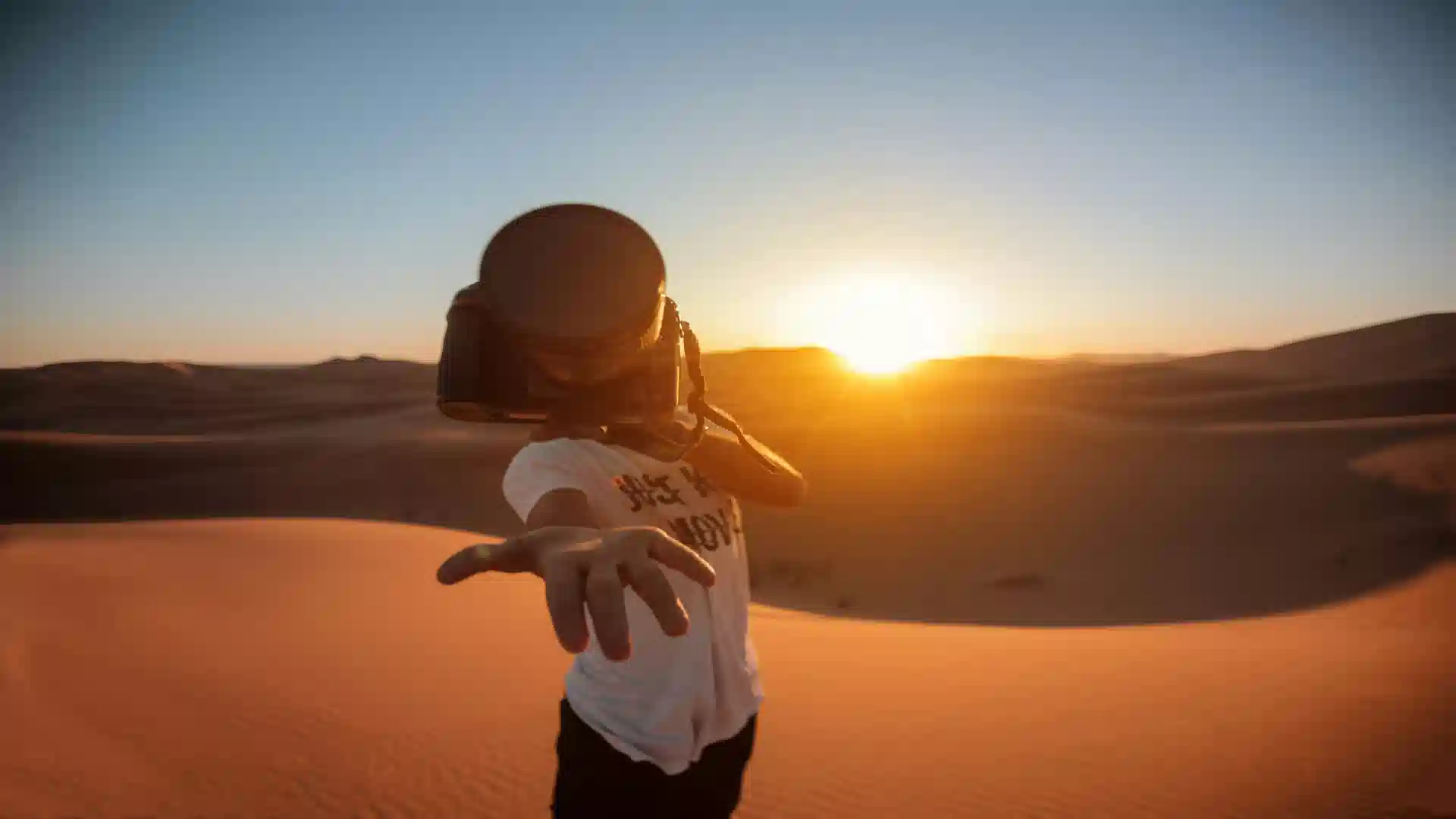
To capture the true, majestic scale of the Sahara, your Morocco photography tour itinerary must prioritize scaling the highest ridges for both sunrise (around 06:00) and late afternoon golden hour. As the sun skims low across the sand dunes, it creates an incredible, high-contrast landscape where one side of a dune ridge glows in brilliant orange light while the reverse slope falls into deep, cool shadow. Walk carefully along the hard crests to avoid leaving footprints in your foreground, and use a circular polarizing filter to deepen the blue sky, cut through airborne dust haze, and maximize the rich color saturation of the iron-rich Saharan sand.
5. Sahara Desert Astrophotography: Documenting Night Skies on a Morocco Photography Tour
Once the sun drops below the desert horizon, the remote dunes of the Erg Chebbi region transition into one of the premier dark-sky destinations on earth, making Sahara desert astrophotography a main highlight of a professional photo expedition. With zero light pollution for dozens of miles around, the night sky becomes incredibly clear, revealing the dense stellar clouds of the Milky Way core with astonishing clarity. This unique environment demands an advanced technical approach, using a sturdy tripod and specialized manual exposure settings to capture the cosmos on your Morocco photography tour.
To capture the night sky successfully during your Morocco photography tour, position your camera gear away from the direct ambient light of your desert camp, using the silhouetted shapes of a camel caravan or a traditional Berber tent in the lower third of your frame to establish scale. Mount an ultra-wide, fast lens (such as a 14-24mm f/2.8) and use manual focus locked precisely onto a bright star using your camera’s live-view magnification. Set your exposure using the “500 Rule” to avoid star trails, keeping your shutter speed around 20-25 seconds, your aperture wide open at f/2.8, and your ISO elevated between 3200 and 6400 to record the brilliant details of the cosmos.
6. The Dades Gorge Hairpin Roads: Tracking Light Trails on a Morocco Photography Tour
Deep within the rugged interior of the country lies the Dades Gorge, a dramatic canyon carved out by the Dades River that offers some of the most dynamic landscape compositions for your Morocco photography tour. The specific visual target here is the famous, winding mountain road known as the Tisdrine zig-zag, where the asphalt snakes sharply up a near-vertical cliff face. This location offers an amazing opportunity to contrast the jagged, organic textures of the canyon walls with the smooth, sweeping geometric lines of modern engineering.
The definitive photograph of this mountain pass is captured from the elevated restaurant terrace perched directly above the loops of the road during the transition from sunset to twilight. Arrive early on your Morocco photography tour transit route to secure your tripod position and wait for the blue hour, when the sky retains a deep azure tone that perfectly balances the exposure of the canyon walls. Screw a neutral density filter onto your lens and execute a series of long exposures ranging from 30 to 60 seconds as vehicles drive up the pass, capturing the vibrant red and white kinetic light trails winding through the heart of the dark mountain.
7. Marrakech Medina: Navigating Street Energy on a Morocco Photography Tour
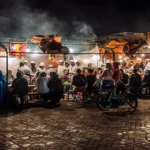
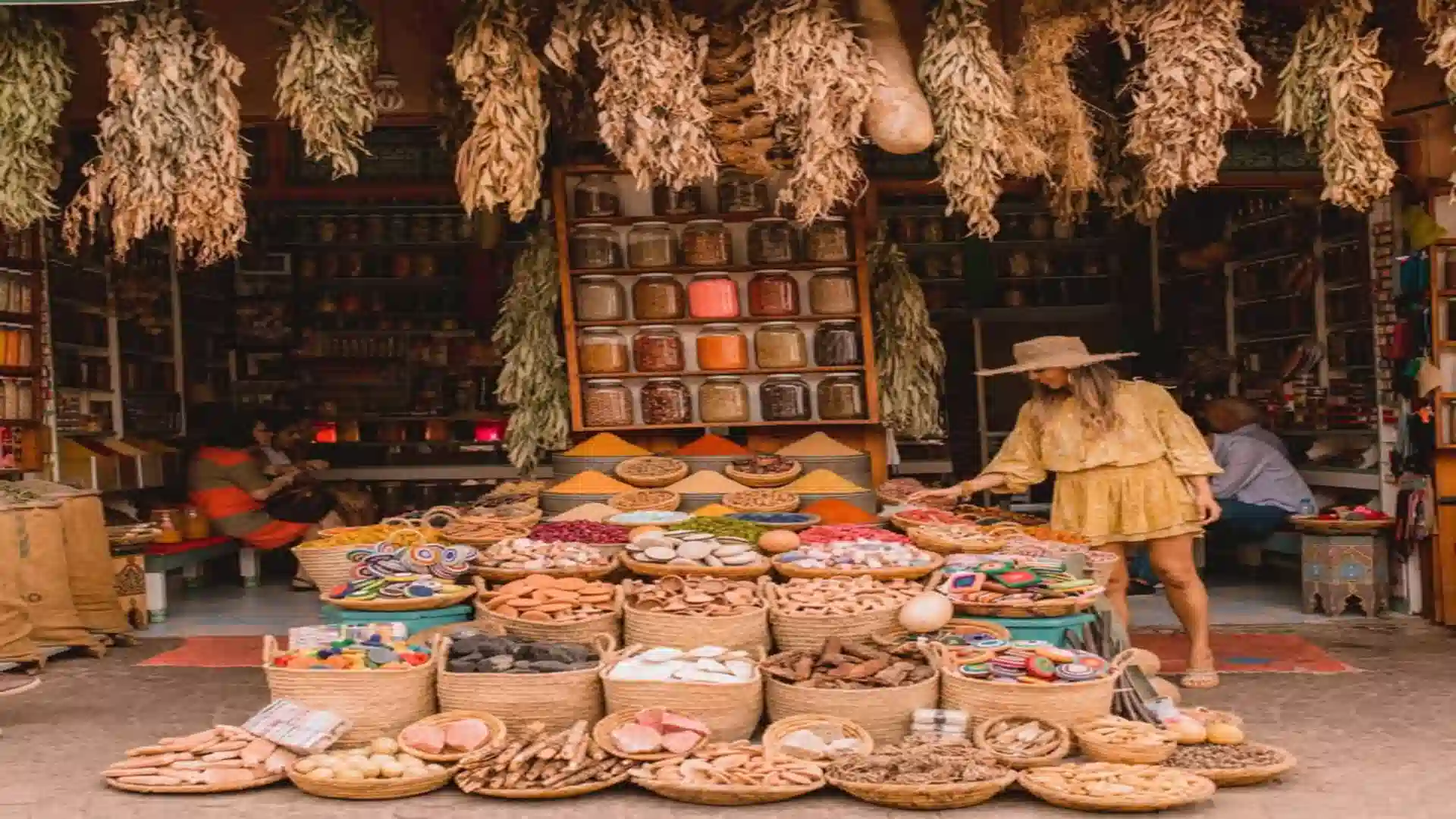
The historic core of Marrakech is an electric environment for street portraiture, demanding a quick, adaptive approach to capture the chaotic energy of the souks during your Morocco photography tour. The visual landscape of Jemaa el-Fnaa square and its surrounding alleys is filled with striking imagery—from rows of glowing brass lanterns to heaps of colorful spices. However, the quick movement of crowds and the tight spaces mean you must carefully choose your Marrakech street photography gear to stay mobile and respectful of local customs.
To photograph the medina effectively without disrupting its natural flow during your Morocco photography tour, carry a compact camera body paired with a fast 35mm or 50mm prime lens, allowing you to shoot quickly in low-light corridors without relying on a bulky zoom lens. Focus your efforts on the specialized artisanal quarters, such as the Souk Sebbaghine (Dyers’ Souk), where strings of freshly dyed wool hang from overhead rafters, catching dramatic shafts of light filtering through the slatted reed roofs. Always seek permission with a polite nod or greeting before taking portraits of local craftsmen, ensuring your cultural documentation is rooted in mutual respect.
8. Bahia Palace: Capturing Symmetric Geometry on a Morocco Photography Tour
For photographers focused on architectural detail, the 19th-century Bahia Palace in Marrakech offers a serene environment to practice capturing symmetric geometry, making it a key stop for any Morocco photography tour. The palace is a spectacular showcase of Islamic design, featuring sweeping marble courtyards, intricately carved cedar ceilings, and walls covered in vibrant zellij tilework. The creative goal here is to use wide lenses to emphasize the repeating architectural lines, carved archways, and reflections across the polished floors.
To capture the palace without crowds filling your frame during your Morocco photography tour, arrange for your private driver to drop you off at the main gates right at the 09:00 opening time. Head straight to the Grand Courtyard, where the expansive white and blue marble floor offers a clean backdrop for wide-angle compositions. Look for natural framing opportunities by positioning your camera inside an ornate archway, shooting toward an adjacent sunlit courtyard to capture the interplay of light and shadow across the tiled surfaces.
9. The Atlas Mountains: Compressing Ridge Lines on a Morocco Photography Tour
The towering peaks of the High Atlas range, dominated by Mount Toubkal, provide a dramatic backdrop that runs through the center of your travel route. This high-altitude alpine environment offers a striking visual contrast to the flat desert plains below, featuring terraced Amazigh villages built directly into steep mountainsides and deep, green valleys carved by river runoff. The challenge here is capturing the immense scale and deep atmospheric layers of these mountain peaks from long distances during your Morocco photography tour.
When traversing the winding mountain passes like the Tizi n’Tichka, utilize a high-quality Atlas Mountains landscape lens—such as a 70-200mm or 100-400mm telephoto lens—rather than a standard wide-angle lens. A telephoto lens allows you to compress the perspective, drawing distant mountain ridges closer together to highlight the repeating patterns of the peaks. Shoot during the early morning hours when mountain mist fills the valleys, creating a beautiful separation between the dark stone ridges and the soft, glowing layers of haze, adding a majestic element to your Morocco photography tour portfolio.
10. Essaouira: Capturing Coastal Blue Hour on a Morocco Photography Tour
Your creative journey concludes along the Atlantic coast at the historic fortress city of Essaouira, offering a coastal finale for your Morocco photography tour. The visual theme here shifts from warm desert tones to cool marine shades, centered around the historic sea wall, active fishing docks, and circling seagulls. The main goal is to balance the bright reflections from the ocean with the weathered, whitewashed stone walls of the old town ramparts.
To capture the definitive coastal shot, walk out onto the Scala du Port during the evening Essaouira blue hour photography window, just after the sun has dipped below the Atlantic horizon. Mount a wide-angle lens to capture the rows of traditional blue wooden fishing boats moored in the harbor, using a slow shutter speed to soften the movement of the tides into a smooth texture. The deep blue twilight sky will perfectly mirror the color of the fishing boats, creating a unified, atmospheric image that captures the calm spirit of this Atlantic port, serving as the perfect ending to your Morocco photography tour.
Detailed Technical Mastery for a Morocco Photography Tour
To trule elevate your portfolio during a Morocco photography tour, a creator must move beyond basic compositions and dive deep into the technical realities of North African light. The light in Morocco is notoriously intense, characterized by a high UV index and sharp clarity that can easily destroy the dynamic range of an unshielded digital sensor. This section breaks down the advanced settings, filtration strategies, and gear calibrations necessary to achieve gallery-quality images on your Morocco photography tour.
Managing the Dynamic Range of Desert Environments
When photographing the vast sand landscapes outlined in your Moroccan landscapes photo guide, your primary technical challenge is the extreme dynamic range between sunlit sand crests and deep dune shadows. Standard matrix metering modes will often average the scene incorrectly, resulting in clipped highlights in the sand or completely muddy shadows that ruin the composition of your Morocco photography tour images.
To solve this, switch your camera gear to Highlight-Weighted Metering or Spot Metering, targeting a mid-tone zone on the sunlit side of the sand dune. Additionally, professional creators on a Morocco photography tour should master the technique of Bracketing Exposures. Set your camera to shoot a 3-frame or 5-frame bracketed sequence at 1.0 EV intervals. This ensures that you capture the full tonal spectrum from the brightest glare to the deepest shadow, allowing you to blend the images seamlessly during post-processing to create a perfectly balanced master file.
Advanced Filtration for Medina Streets and Coastal Ports
Using proper optical filters is non-negotiable when executing a high-end Morocco photography tour. The narrow corridors of the Fes and Marrakech medinas create sharp, localized shafts of light that cut through dark overhead canopies, while coastal destinations like Essaouira present intense marine haze.
- Circular Polarizing Filters (CPL): A premium CPL is an absolute workhorse for your Morocco photography tour. In the desert, it darkens the sky to create dramatic contrast against orange sand dunes. In architectural settings like Bahia Palace, a CPL cuts through the glare on polished marble floors and zellij tiles, revealing the rich, true colors beneath the reflection.
- Graduated Neutral Density Filters (GND): When framing the sweeping vistas for your Morocco photo trip planner, a 3-stop soft-edge GND filter helps balance a bright sky with a darker foreground. This is especially useful during the Ait Ben Haddou golden hour, allowing you to retain the rich gradients of the sunset sky without underexposing the dark adobe walls of the ancient ksar.
Cultural Nuance and Portraiture Etiquette on a Morocco Photography Tour
A truly successful Morocco photography tour balances technical mastery with deep cultural respect. Moroccan society is deeply rooted in traditions of hospitality, privacy, and religious modesty. For international creators, navigating the social landscape of the medinas requires a thoughtful, polite approach to ensure your presence is welcomed and your documentation remains ethical.
The Art of the Respectful Street Portrait
The busy markets of Fes and Marrakech offer incredible opportunities for Marrakech street photography, featuring artisans, spice merchants, and colorful characters. However, snapping photos blindly without consent can lead to tension, as many locals consider unapproved photography an invasion of privacy.
When seeking portraits on your Morocco photography tour, always lead with human connection before raising your camera gear. Spend time browsing a merchant’s shop, strike up a conversation, and ask for permission with a polite smile and a phrase like “Momkin soura?” (May I take a picture?). If they decline, respect their wishes immediately and move on. If they agree, show them the back of your screen after taking the shot—this simple gesture builds trust and creates a memorable, shared experience that enriches your travel journey.
Navigating Sensitive and Prohibited Locations
While exploring historical landmarks on your Morocco photography tour, keep in mind that certain spaces are private or sacred. Active mosques and religious shrines across the country are strictly closed to non-Muslims, and photographing worshippers or interior prayer spaces through open doorways is considered disrespectful.
Additionally, standard Morocco travel photography tips strictly caution against photographing any military facilities, police checkpoints, royal palaces, or government buildings. These areas are heavily guarded for national security, and using a camera near them can result in your memory cards being confiscated or lengthy questioning by local authorities. Your private transit driver can advise you on local regulations, ensuring your Morocco photography tour stays safe, respectful, and trouble-free.
Architectural Geometry and the Science of Islamic Design
A major focus of any high-end Morocco photography tour is documenting the brilliant architectural heritage of the Moorish and Islamic empires. From the sprawling courtyards of Marrakech to the hidden riads of Fes, traditional Moroccan design relies on deep mathematical symmetry, repeating geometric patterns, and symbolic uses of natural light. Understanding these design elements allows you to frame your images with greater intent and clarity.
Decoding Zellij Tile Patterns and Structural Framing
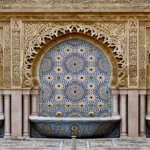
When setting up your Fes medina camera gear inside historic madrassas or palaces, your compositions will center on Zellij—the intricate art of hand-cut terracotta tile mosaics. These tiles are arranged in complex mathematical configurations based on repeating stars, polygons, and calligraphic scripts, designed to create a sense of infinite, harmonious balance.
To capture the true beauty of these designs on your Morocco photography tour, avoid shooting at random, angled perspectives. Instead, align your camera sensor perfectly parallel to the tiled wall, using a bubble level or your camera’s internal electronic level to eliminate perspective distortion. Use an ultra-wide prime lens to capture the vast scale of symmetric courtyards, utilizing the architectural archways as natural frames to guide the viewer’s eye deep into the background of your shot.
The Interplay of Light and Shadow in Riad Architecture
Traditional Moroccan houses, known as Riads, are designed around a central, open-air courtyard garden. This inward-facing layout serves a dual purpose: it maximizes family privacy and provides a natural cooling system against the intense North African heat. For creators on a Morocco photography tour, this architecture creates a dynamic environment where light changes dramatically throughout the day.
During the midday hours, when outdoor landscape photography is flat and challenging, head indoors to a traditional riad courtyard. The overhead sun sends a sharp, theatrical beam of light directly down into the central fountain, casting dramatic geometric shadows from the carved wooden screen balconies onto the tile floors below. Capturing this high-contrast interplay of light and shade is a fantastic way to showcase the peaceful, private side of Moroccan life in your portfolio.
Comprehensive Travel Logistics & Gear Configuration
To ensure your photography expedition runs smoothly across varying terrains, use the quick-reference reference tables below to plan your daily gear configurations and transit stops:
| |Photographic Location| | Recommended Lens| | |Optimal Lighting Window| | |Core Visual Element| | |focus keyword density check| |
| |Chefchaouen Medina| | |35mm / 50mm Prime| | |06:30 – 08:30| | |Monochromatic Blue Geometry| | |Part of a premium Morocco photography tour| |
| |Chouara Tannery (Fes)| | |70-200mm Telephoto| | |10:00 – 12:00| | |Repeating Stone Dye Pits| | |Essential for a Morocco photography tour| |
| |Ait Ben Haddou| | |24-70mm Standard Zoom| | |45 min Before Sunset| | |Glowing Adobe Architecture| | |Classic stop on a Morocco photography tour| |
| |Erg Chebbi Dunes| | |24-70mm + Polarizer| | |Sunrise & Sunset| | |High-Contrast Sand Ridges| | |Highlights a rugged Morocco photography tour| |
| |Saharan Night Sky| | |14-24mm f/2.8 Wide| | |23:00 – 03:00| | |Milky Way & Star Fields| | |Core of a desert Morocco photography tour| |
| |Dades Gorge Road| | |16-35mm Wide + ND| | |Blue Hour Twilight| | |Kinetic Light Trails| | |Adventure stop on a Morocco photography tour| |
| |Marrakech Souks| | |35mm Compact Prime| | |15:00 – 17:00| | |Shafts of Light & Street Scenes| | |Perfect for a custom Morocco photography tour| |
| |Bahia Palace| | |12-24mm Ultra-Wide| | |09:00 – 10:30| | |Symmetric Zellij Tilework| | Art focus of a Morocco photography tour| |
| |High Atlas Passes| | |100-400mm Telephoto| | |07:00 – 09:00| | |Compressed Mountain Ridges| | |Scenery for a flexible Morocco photography tour| |
| |Essaouira Harbor| | |24-70mm Zoom| | |Post-Sunset Blue Hour| | |Blue Fishing Boats & Tides| | |Coastal end to a Morocco photography tour| |
Detailed Itinerary Mapping for Your Expedition Fleet
To execute this comprehensive visual route successfully, absolute flexibility over your transit schedule is mandatory. Standard group tours operate on rigid timetables that place you in beautiful landscapes during flat, harsh midday light, completely ruining your chances of capturing a professional portfolio. Booking a custom itinerary with a dedicated private transit company ensures your travel is optimized entirely around peak creative hours.
A modern, high-clearance 4×4 or premium van fleet provides the physical infrastructure needed to safely transport heavy camera gear, tripods, and lighting setups across rugged mountain passes and desert tracks. More importantly, traveling with an elite local driver who understands the unique light shifts, routing challenges, and regional logistics ensures you can move smoothly between locations. Whether you need to pull over safely on a narrow mountain pass to capture mist clearing from the Atlas peaks, or require a late-night desert transit for a star-gazing session, private transport turns your journey from a basic vacation into an immersive, world-class Morocco photography tour.
Frequently Asked Questions (FAQ)
What is the most important factor when planning a Morocco photography tour?
The single most important factor on a Morocco photography tour is control over your daily schedule. Optimal light windows—such as early morning in Chefchaouen or sunset at Ait Ben Haddou—are brief and require precise timing. Traveling via private transport gives you the flexibility to arrive early, set up your camera gear without stress, and stay until the light fades, ensuring you never miss a critical shot due to rigid group schedules.
How do I protect my camera gear from desert sand and dust?
Dust and fine sand are constant hazards on a Morocco photography tour, especially in the Sahara Desert. To safeguard your equipment, use weather-sealed camera bodies and lenses whenever possible. Avoid changing lenses while out in the open dunes; choose a single versatile lens (like a 24-70mm) before leaving your vehicle or camp, and use a protective cover or sleeve if winds pick up. Always clean your gear at the end of the day using a manual air blower rather than a dry cloth, which can scratch delicate glass elements.
Are drones legal for landscape photography in Morocco?
No, the unauthorized import and use of drones for aerial photography is strictly illegal in Morocco. Unapproved drones will be confiscated by customs authorities at the airport or border checkpoints, and operating one without a formal government permit can lead to steep fines or legal action. Focus your Morocco photography tour strategy on ground-based compositions, utilizing elevated viewpoints, terraces, and telephoto lenses to capture expansive landscape vistas safely and legally.
What is the best season to book a Morocco photography tour?
The ideal windows for a professional Morocco photography tour are during the shoulder seasons of Spring (March to May) and Autumn (September to November). During these months, temperatures across the country are comfortable for outdoor shooting, the air is clear with minimal dust haze, and the High Atlas peaks often feature beautiful snow caps or green valleys, providing a stunning variety of textures and backgrounds for your portfolio.
Can I comfortably charge heavy battery setups during a remote desert trek?
Yes, provided you plan ahead within your Morocco photo trip planner. While deep desert camps utilize solar power or generators that can charge smaller devices, serious creators on a Morocco photography tour should carry high-capacity portable power banks and an inverter that plugs into your private vehicle’s 12V charging ports. This allows you to safely charge camera batteries, laptops, and backup drives while traveling between regional destinations.
Recommended Tours & Visual References
Our Recommended Custom Itineraries
5-Day Desert and Kasbah Photo Route from Fes to Marrakech: Capture the ancient Fes tanneries, cross the Middle Atlas, and document the sand ridges of Erg Chebbi before concluding your Morocco photography tour in the red city.
9-Day Comprehensive Imperial and Coastal Photography Expedition: A premium private transit tour designed specifically for visual creators, connecting the blue alleys of Chefchaouen, the historic architecture of Marrakech, and the blue hour coastal views of Essaouira for an unmatched Morocco photography tour experience.
Visualizing Your Photographic Route
To get a true sense of the visual diversity you will document along this curated travel route, browse the landscapes and real-world environments below:
For deeper context on global architectural preservation and historical documentation, you can explore the UNESCO World Heritage Centre guidelines protecting earth-built kasbahs, or review the Professional Photographers of America resources regarding international travel logistics to learn how an organized Morocco photography tour respects local communities and preserves cultural heritage.
Design Your Custom Morocco Photography Tour Today
Don’t compromise your creative vision by viewing North Africa through the crowded window of a commercial tour bus. Get in touch with our operations team today to secure a modern, air-conditioned vehicle fleet and an experienced local driver who understands the precise timing, lighting shifts, and routing needs of a professional Morocco photography tour. Let us turn your travel itinerary into a seamless, high-impact creative reality.