Marrakech to Fes: Train, Driver or Flight? (2026 Guide)
Marrakech to Fes travel guide options often confuse first-time visitors to the Kingdom of Morocco, but understanding your transit layout is the most critical step of your journey. Marrakech and Fes stand as the twin cultural beating hearts of Morocco. One is a riot of ochre walls, snake charmers, and high-octane energy spilling from the iconic Jemaa el-Fnaa; the other is an ancient, sprawling labyrinth of intellectual history, echoing with the call to prayer, the scent of cedarwood, and the legacy of the ancient Al-Qarawiyyin.
Yet, figuring out the best way to travel from Marrakech to Fes can make or break your Moroccan vacation. Most tourists look at a digital map and assume it is a quick, straight shot across the geography. In reality, the towering, snow-capped High Atlas Mountains stand directly between them, acting as a massive natural barrier that dictates every transit route in the country. Choosing the wrong transportation can result in a wasted holiday, leaving you staring at blurry highway asphalt or trapped inside generic transit terminals.
To give you immediate clarity for your itinerary, this comprehensive Marrakech to Fes travel guide breaks down the primary travel methods, real costs, and transit realities below.
Quick Recommendation: If you are traveling on a tight budget, booking a first-class ticket on the direct rail network is your safest and most predictable transit option. However, if you want to experience the true soul of Morocco’s shifting landscapes, hiring a private driver for a 3 Day Sahara Desert loop turns a long, exhausting transit day into the definitive highlight of your holiday.
| |Travel Method| | |Total Time| | |Cost Range (per person)| | |Best For| |
| |Al Atlas Train| | |6.5 – 7 Hours| | |230 – 460 MAD (approx. $23 – $46 USD)| | |Solo backpackers & budget travelers| |
| |Domestic Flight| | |~5 Hours (Door-to-door total)| | |500 – 1,200 MAD (approx. $50 – $120 USD)| | |Travelers with zero luggage & tight schedules| |
| |Private Driver / Tour| | |3 Days (Recommended Sahara route)| | |Varies by group size| | |Couples, families, and luxury photography| |
| |Public Bus (CTM)| | |8.5 – 10 Hours| | |180 – 250 MAD (approx. $18 – $25 USD)| | |Extreme budget minimalist travelers| |
Table of Contents
Option 1: Taking the Train — The Budget Marrakech to Fes Travel Guide Route
For solo travelers and budget-conscious backpackers, navigating the national rail network is often the default choice. However, a major reality check is necessary before you book your tickets: Morocco’s legendary high-speed bullet train, the Al Boraq, does not service this southern routing yet. Instead, you will be boarding the standard, slower Al Atlas locomotive. As a practical Marrakech to Fes travel guide tip, always note that rail options prioritize affordability over speed.
Because the impassable Atlas ridge prevents a direct eastern rail track, the train must travel far to the northwest. It skirts past the dry coastal plains toward Casablanca Voyageurs or Rabat Ville before cutting sharply back east through Meknes and finally into Fes. You can check schedules and real-time network alerts directly on the Official ONCF Rail Network Portal, which serves as the primary ground transport authority in Morocco.
The current Marrakech to Fes train price sits at roughly 230 to 320 MAD (approx. $23 to $32 USD) for a second-class ticket, while a first-class compartment ticket ranges from 330 to 460 MAD (approx. $33 to $46 USD). Booking a first-class ticket via the official ONCF website or mobile app is highly recommended. Any modern Marrakech to Fes travel guide will tell you that a guaranteed, assigned, air-conditioned seat in a quiet six-person cabin is a non-negotiable luxury during the scorching summer months when cars get packed.
Understanding Class Differences on the Al Atlas Line
When evaluating the rail options in this Marrakech to Fes travel guide, understanding the difference between first and second class is crucial for your physical comfort:
First Class: Arranged in enclosed six-seat compartments. Storage racks are located directly above your head, and legroom is generous. Air conditioning is actively monitored, and access to electrical sockets is common on updated rolling stock.
Second Class: Arranged in an open, coach-style layout with four seats facing each other across small fixed tables. While highly social, these cars frequently fill to standing capacity during national holidays and peak weekend travel hours, making luggage storage highly competitive.
The pros of the rail route are clear: it is affordable, highly reliable, and gives you a window seat to watch the shifting scenery change into the lush agricultural plains of the north. The major downside outlined in this Marrakech to Fes travel guide is the sheer time investment on iron rails. You will spend at least 6.5 to 7 hours in continuous transit without the freedom to stretch your legs at historic landmarks, completely bypassing Morocco’s world-famous mountain passes and Sahara desert dunes.
Read Also: Planning to handle your own transport bookings across the country? Read our complete insider guide on How to Book a Private Tour and Navigate Local Transit in Morocco to avoid common booking pitfalls.
Option 2: Flying — The Deceptive Sky Option
At first glance, a domestic flight seems like the most efficient, lightning-fast option to bridge the gap between these two imperial centers. Carriers like Ryanair and Air Arabia Maroc operate direct regional flights that cross the geographical distance in just about an hour of actual airtime. No standalone Marrakech to Fes travel guide should list air travel without highlighting the complex ground logistics involved.
When you add up these logistical realities—navigating from your Marrakech Medina riad to Marrakech Menara Airport (RAK) at least two hours early for security, waiting at the luggage carousel, and securing a local grand taxi from Fes-Saïss Airport (FEZ) to your final destination inside the ancient walls of Bab Boujloud—your total travel time quickly climbs closer to 5 hours.
Beyond the time sink, regional airlines enforce strict domestic baggage weight restrictions that can lead to steep, unexpected penalty fees for heavy shoppers. Air Arabia Maroc and Ryanair typically limit domestic economy passengers to a strict weight cap, and excess weight fees can add up quickly at the gate. Most importantly, flying strips away the raw romance of seeing the country transition organically. From an airplane window, you miss the breathtaking shift from Marrakech’s sun-baked clay earth to the deep, high-altitude green of the northern cedar forests, which is why a land-based Marrakech to Fes travel guide is often preferred by experiential travelers.
Option 3: The Private Driver & The Desert Route (The Ultimate Journey)
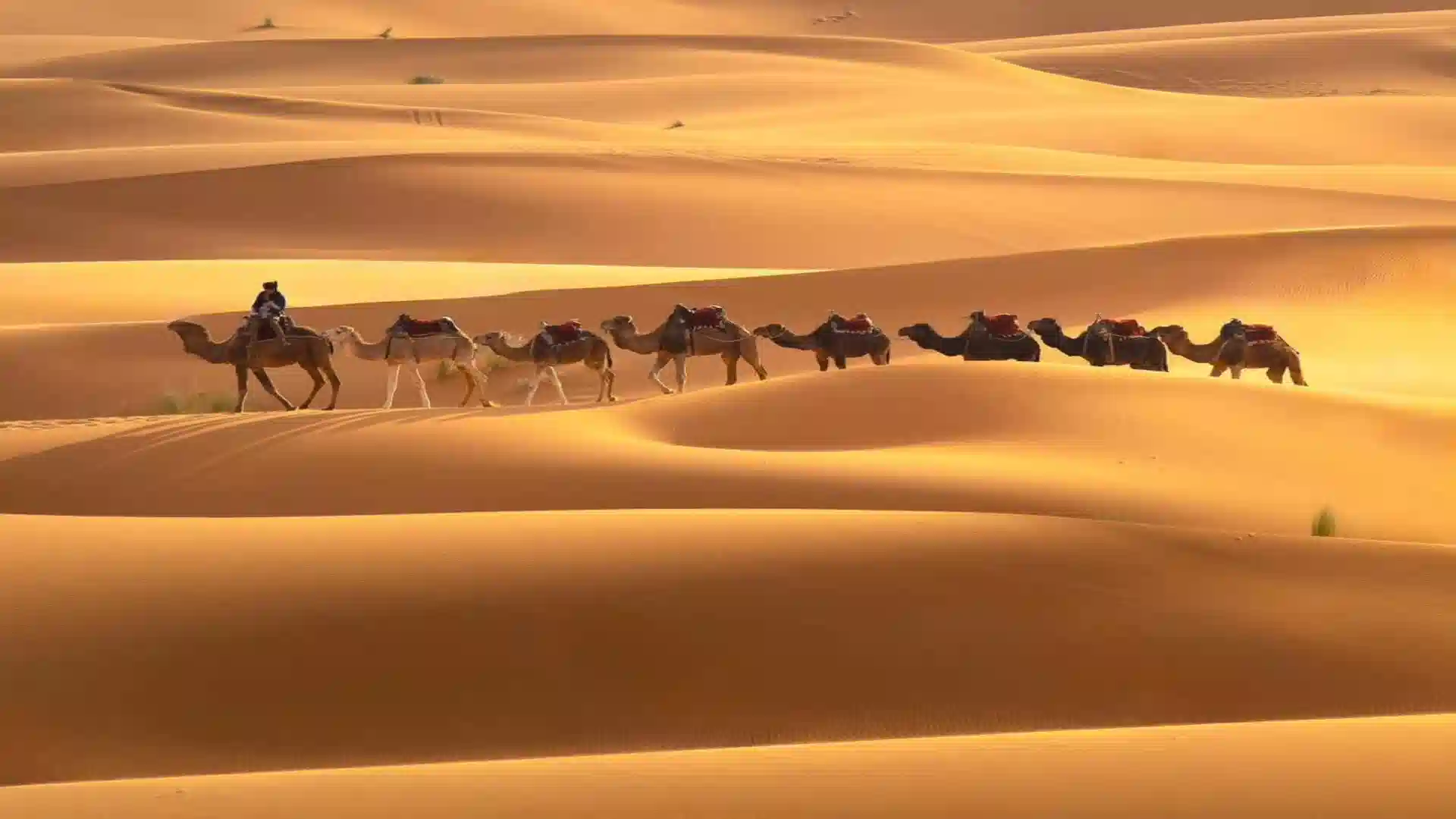
If you choose the train or the plane, you are essentially treating a full day of your vacation as dead time—hours lost to staring at clouds or steel tracks. But if you consult a detailed Marrakech to Fes travel guide and choose to hire an authorized private driver, taking the slow route through the Sahara transforms the journey itself into the definitive highlight of your Moroccan experience.
In the language of the indigenous Amazigh (Berber) people, there is an old nomadic proverb: “Slowly, slowly, the camel walks into the desert.” This exact philosophy anchors the classic 3-Day Sahara connection. Instead of rushing through highways, you follow a deliberate Marrakech to Fes travel guide itinerary that allows the dramatic shift in landscapes to unfold at an authentic pace.
The 3-Day Sahara Route Breakdown
Day 1: High Atlas Mountains to the Dades Valley
Your custom journey begins by ascending the jagged ridges of the High Atlas via the legendary Tizi n’Tichka pass, climbing to an altitude of 2,260 meters above sea level. Along these dramatic, winding curves, the crimson earth gives way to ancient, stacked-stone Amazigh villages that appear to grow straight out of the mountain rock.
Your driver will stop at Ait Benhaddou, a majestic, UNESCO World Heritage ksar (fortified village) made entirely of rammed earth and clay. This site has guarded trans-Saharan trade caravans carrying gold and salt for centuries. For details on conservation and historic structural maps, you can review the UNESCO World Heritage Center Entry for Ait Benhaddou. After exploring its labyrinthine towers, you continue past Ouarzazate, driving deep into the volcanic rock formations and rose-tinted cliffs of the Dades Gorges to spend your first night.
Day 2: Todra Gorge to the Golden Dunes of Merzouga
The second morning coaxes you deeper into the pre-Saharan interior. You will walk beneath the sheer, towering 300-meter-high limestone walls of the Todra Gorge, where natural mountain springs flow through palm groves. From here, the terrain flattens, giving way to vast stone plains before opening up into an ocean of sand. This section forms the literal heart of our overland Marrakech to Fes travel guide route.
By late afternoon, you reach the edge of the breathtaking Erg Chebbi dunes in Merzouga. Here, you leave the 4×4 behind and mount camels to trek into the silent, shifting heart of the Sahara. As the sun dips below the horizon, it paints the dunes in spectacular shades of deep amber, gold, and royal purple. You will spend the night in a traditional nomad desert camp, dining on authentic tagine by a campfire before sleeping under a brilliant, unpolluted canopy of desert stars.
Day 3: The Sahara to Fes via the Ancient Cedar Forests
On your final morning, you wake up early to witness a legendary Sahara sunrise over the crest of the dunes. After an authentic breakfast, your driver guides your vehicle north toward the Middle Atlas mountain range. The arid desert landscape drops away, replaced by vibrant alpine scenery. You will journey through the Ziz Valley gorge, eventually stopping to see the wild Barbary macaques that inhabit the protected, ancient cedar forests of Azrou. After a brief coffee stop in the clean, Swiss-style alpine town of Ifrane, you descend the northern slopes, arriving at the historic gates of the Fes Medina just as the evening lanterns begin to glow.
Read Also: Want to explore the kingdom beyond the standard tracks? Check out our fully detailed 10-Day Tangier to the Sahara Desert Itinerary for an unmissable, comprehensive northern-to-southern grand tour.
Driving Your Own Route Best way to travel from Marrakech to Fes:
For travelers considering a self-drive rental, this Marrakech to Fes travel guide section covers the exact highway options and safety profiles required to complete the crossing without a professional team.
Route A: The Direct N8 Highway (The Inland Mountain Route)
Distance: Approximately 500 kilometers.
The Reality: This path runs straight through the agricultural center of the country via Beni Mellal and Khénifra. It consists of a mix of dual-carriageway and narrow, two-lane national roads that wind tightly through the Middle Atlas foothills. Heavy cargo trucks and agricultural machinery frequently bottleneck traffic along this line, meaning your overall Marrakech to Fes driving time can vary wildly based on local congestion.
Route B: The A1/A2 Expressway (The Coast-and-Capital Highway)
Distance: Approximately 650 kilometers.
The Reality: While geographically longer, this route is composed entirely of modern, fully grade-separated toll expressways. You drive northwest from Marrakech on the A1 toward Casablanca, bypass Rabat via the ring road, and pick up the A2 highway cutting straight east through Meknes into Fes. This route offers the lowest mental friction and highest safety index for foreign drivers, though it sacrifices all mountain views. A complete Marrakech to Fes travel guide must present both options so you can choose between visual scenery and driving efficiency.
Seasonal Weather Variations Across the Atlas Passes
Your choice of transportation within this Marrakech to Fes travel guide should directly account for the time of year you visit Morocco. The geography transitions through multiple distinct microclimates that heavily impact travel infrastructure.
Winter Realities (December through February)
The High Atlas mountain passes, particularly Tizi n’Tichka, regularly experience heavy snowfall and ice formations at altitudes above 2,000 meters. During intense winter storms, the Ministry of Equipment periodically closes the mountain roads entirely for snowplow clearance.
If you are driving a rental car during these months, sudden delays are common. The Al Atlas train remains completely unaffected by these high-altitude winter systems, making rail travel the most reliable choice during the coldest parts of the year according to any seasoned Marrakech to Fes travel guide author.
Summer Endurance (June through August)
During the height of summer, temperatures in the interior plains around Beni Mellal and deep within the Merzouga desert dunes easily climb past 45°C (113°F). If you choose a road transit option, ensuring your vehicle has a heavy-duty cooling system and fully operational air conditioning is mandatory.
ONCF second-class train coaches often suffer from overtaxed climate systems when passenger loads peak, making first-class tickets or private 4×4 transport essential for climate control. A thorough Marrakech to Fes travel guide will always emphasize safety and temperature management during these intense summer months.
Cultural Architecture: What You See Along the Way
Choosing the slow overland route transforms your journey from simple point-to-point transit into an immersive architectural exploration. To act as a proper Marrakech to Fes travel guide, we must highlight how the changing styles of human settlements tell the long story of Morocco’s regional history.
The Evolution of the Kasbah and Ksar
As you cross the Atlas ridge with a private driver, the classic Mediterranean white-and-blue architecture drops away entirely, replaced by the striking earth-toned structures of the pre-Saharan valleys.
- Kasbah: A fortified, square residence belonging to a local leader or family cluster. It features towering corner watchtowers, tapered defensive walls, and intricate geometric brickwork carved directly into the upper mud-brick facades.
- Ksar: A complete fortified village community. Enclosed by massive outer defensive walls with a single heavily guarded entrance gate, a ksar contains houses, collective grain storage facilities (agadir), marketplaces, and mosques. Ait Benhaddou is the most mathematically perfect, preserved example of this earthen architectural style remaining in North Africa.
The Transition to Middle Atlas Alpine Communities
As you journey north from the desert on Day 3, the architecture shifts dramatically once more. Any analytical Marrakech to Fes travel guide will note that in the high valleys of Azrou and Ifrane, the flat mud roofs of the south disappear, replaced by steep, red-tiled gabled roofs built to withstand heavy alpine winter snowfall. Ifrane, constructed during the French protectorate era in the 1930s, intentionally mirrors the layout of a classic Swiss alpine village, complete with manicured gardens, European architectural facades, and wide, tree-lined avenues.

The Hidden Cost Comparison: Public vs. Private
Many independent travelers instantly dismiss a private vehicle transfer or a multi-day desert tour as an expensive luxury meant only for high-end budgets. However, this Marrakech to Fes travel guide breaks down the actual math for a family, a couple, or a small group of three to four friends, showing that the financial gap changes completely when properly calculated.
When navigating Morocco via public transport, a group must purchase multiple individual train or CTM bus tickets, pay separate fares for point-to-point urban grand taxis to transport heavy luggage between historic medinas and distant transit hubs, and book separate hotels and multi-course dinners independently along the route.
A private tour vehicle distributes the core logistical and transport costs evenly across your entire group. When you factor in the massive value of door-to-door service, a professional bilingual driver who understands the nuances of mountain road safety, and the seamless inclusion of boutique desert camps, traditional dinners, and camel treks, a private journey quickly emerges as a highly cost-effective way to maximize your limited travel days in Morocco.
Culinary Heritage of the Transit Corridors
An overlooked advantage of utilizing an overland Marrakech to Fes travel guide strategy is the opportunity to experience the hyper-regional cuisines of Morocco’s interior valleys, far removed from the tourist-centric restaurants of the major cities.
Roadside Tagines of Beni Mellal and the Middle Atlas
Along the direct N8 highway corridor, local roadside spots specialize in slow-cooked mountain lamb and beef tagines, prepared over open charcoal braziers (majmar). These dishes rely on local olive oils, wild mountain thyme, and preserved lemons, offering a deep, rustic flavor profile completely distinct from the sweeter, prune-and-apirot tagines commonly served to visitors in Marrakech.
Traditional Amazigh Hospitality in the Valleys
When breaking up the journey through the Dades or Todra valleys, meals transition into traditional family-style feasts. You will experience authentic Berber Tagine, which is structurally unique: vegetables like zucchini, carrots, potatoes, and chili peppers are meticulously stacked in a tight, conical pyramid over a bed of slow-cooked meat, steaming entirely in its own natural juices without the addition of heavy water bases. This is paired with fresh, wood-fired Tafarnout flatbread, baked directly on hot river stones inside traditional clay ovens. Our custom Marrakech to Fes travel guide approach ensures you know exactly what culinary highlights to look for along the route.
Frequently Asked Questions
Is there a direct train from Marrakech to Fes?
Yes, the national ONCF Al Atlas train network operates direct rail service between Marrakech and Fes without requiring a physical locomotive change. However, please note that “direct” does not mean “express”; the train makes scheduled stops at major coastal stations including Casablanca Voyageurs, Rabat, and Meknes along its path. The total rail journey takes roughly 6.5 to 7 hours, and checking a reliable Marrakech to Fes travel guide for the seasonal Marrakech to Fes train price beforehand helps ensure you secure first-class availability.
Can you do a desert tour from Marrakech ending in Fes?
Yes, this is widely considered the most efficient, popular non-backtracking travel route in Morocco. It allows you to seamlessly experience the High Atlas Mountains, Ait Benhaddou, the Dades Valley, and the Sahara Desert at Merzouga, before continuing straight north to Fes, eliminating the need to waste an extra day driving all the way back to Marrakech.
How long is the drive between Marrakech and Fes if you go directly?
If you choose to bypass the Sahara Desert entirely and drive a rental car or private vehicle directly between the two cities, the fastest land route runs inland via the N8 highway through Beni Mellal and Khénifra. The total direct Marrakech to Fes driving time is approximately 6.5 to 7 hours of continuous, focused driving, navigating through a mix of modern highways and winding two-lane mountain roads.
Is the direct drive from Marrakech to Fes safe for foreign drivers?
Yes, the direct drive is safe provided you exercise standard caution. This Marrakech to Fes travel guide notes that mountain highways are fully paved but feature sharp curves, steep drops, and minimal shoulder space in certain high-altitude sections. Avoid driving after dark at all costs, as mountain roads lack reflective lighting, and unexpected hazards like livestock or broken-down vehicles are difficult to spot.
What is the baggage allowance for the train from Marrakech to Fes?
The ONCF rail network does not enforce a strict weight limit or count your individual bags, making it much more flexible than regional airlines. However, as noted earlier in this Marrakech to Fes travel guide, you must be physically capable of lifting your own luggage onto the high train steps and placing it securely into the overhead racks or designated storage bays at the end of each coach car.
Conclusion For Marrakech to Fes:
Ultimately, choosing the best way to travel from Marrakech to Fes comes down to balancing your available time, overall budget, and vacation goals. If you are a minimalist traveler watching every dirham and simply want a straightforward transit day, purchasing a first-class ticket on the Al Atlas train is your best option.
However, if you want to unlock the true, unfiltered soul of Morocco—the dramatic mountain vistas, the mud-brick architecture of ancient empires, and the warm hospitality of the nomadic Amazigh people—following our overland Marrakech to Fes travel guide recommendations and booking a private multi-day journey is the undisputed winner.
Let Ali, Youssef, or our team of native local experts manage the winding mountain curves and desert tracks while you relax in a fully climate-controlled 4×4 vehicle.