Merzouga vs Zagora: Which Sahara Desert Tour Wins?
Merzouga is the better choice if you want the tallest dunes, the easiest access, and the widest range of desert camps. Zagora and its true Sahara extension, Erg Chigaga, is the better choice if you want fewer tourists, a slower pace through the Draa Valley, and a more remote, off-grid desert camp. Based on our operational data running both routes year-round from Marrakech, roughly 7 in 10 first-time travelers choose Merzouga, while returning clients and photographers increasingly request Zagora or Erg Chigaga for the solitude.
This guide breaks down the real differences in distance, road quality, dune height, camp comfort, and price so you can book the right Sahara desert tour from Marrakech the first time, not the one a generic listicle told you to pick.
Table of Contents
Merzouga vs Zagora: Quick Comparison Table
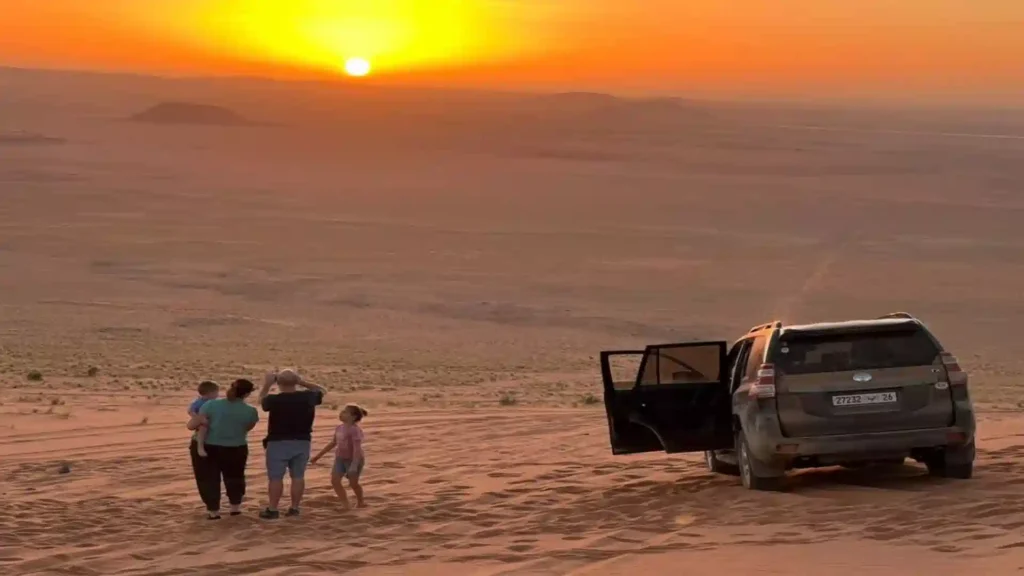
If you only read one section, read this one. The table below reflects what our drivers, Said and Hassan, log on every departure from Marrakech to the best Desert tour in Morocco.
| Factor | Merzouga (Erg Chebbi) | Zagora / M’Hamid (Erg Chigaga) |
|---|---|---|
| Nearest Dune Field | Erg Chebbi | Erg Chigaga |
| Distance from Marrakech | ~560 km (9–10 hours driving) | ~360 km to Zagora; +98 km to M’Hamid; +50–60 km of 4×4 off-road piste to the dunes |
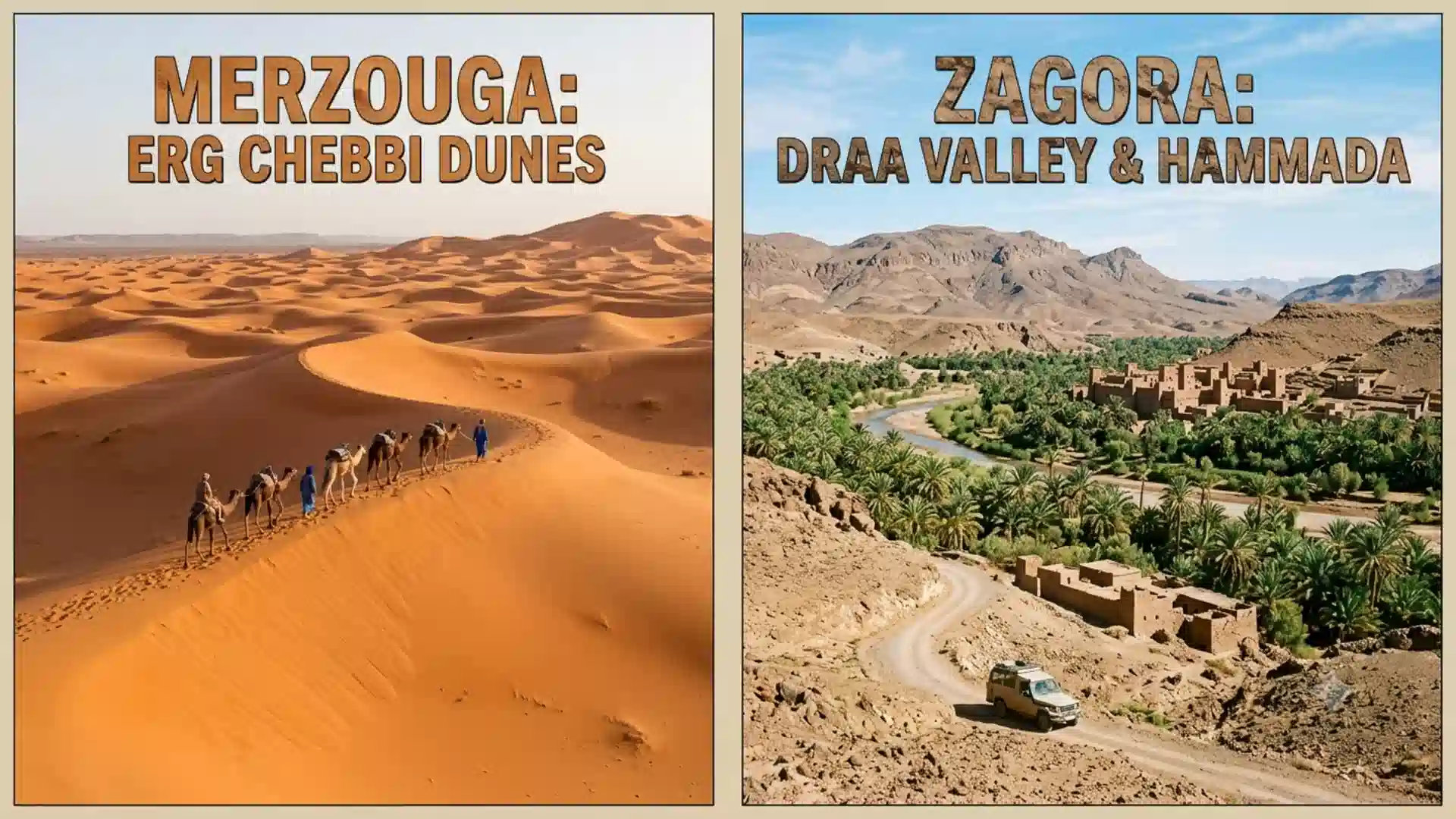
| Dune Height | Up to 150 m (some geographic reports cite 160 m) | Lower on average, though scattered ridges are reported above 50 m. The appeal is absolute scale and isolation, not single-crest height. |
| Dune Field Size | 22–28 km long, 5–7 km wide | ~40 km long, 15 km wide (Morocco’s largest sand erg) |
| Road Type | Fully paved asphalt straight to the dune’s edge. | Paved to M’Hamid, then rugged unpaved 4×4 mountain tracks and sand pistes only. |
| Minimum Trip Length | 2 Days / 1 Night (extremely tight and driving-intensive) | 3 Days / 2 Nights (highly recommended to enjoy the remote location) |
| Crowd Level | Higher — It is the most popular, accessible desert route in Morocco. | Lower — Genuinely remote, peaceful, and untravelled. |
| Camp Variety | Diverse ranges: Basic traditional Berber tents to 5-star ultra-luxury glamping enclaves with desert swimming pools. | Mostly mid-range to luxury off-grid eco-camps; fewer budget or commercial options available. |
| Best For | First-time desert visitors, families, and travelers on tighter schedules. | Repeat visitors, professional landscape photographers, and silence-seekers. |
| Typical Route from Marrakech | Tizi n’Tichka Pass → Ouarzazate → Aït Benhaddou → Dades or Todra Gorges → Erfoud → Merzouga |
Tizi n’Tichka Pass → Ouarzazate → Agdz → Draa Valley Oasis → Zagora → M’Hamid → Erg Chigaga |
What Is the Real Difference Between Merzouga vs Zagora?
Merzouga and Zagora are not competing versions of the same desert — Merzouga is a town that sits directly against the Erg Chebbi dunes, while Zagora is a regional hub roughly 100 km short of the actual Sahara, which only begins past M’Hamid El Ghizlane at Erg Chigaga. This single fact explains almost every other difference on this page: accessibility, comfort, crowd levels, and price all trace back to how close each town sits to true dune terrain.
When managing logistics on the ground, this distinction matters more than most travelers realize before booking:
- Merzouga is the dune. Your hotel, your camel point, and Erg Chebbi’s golden ridges sit within a 10–15 minute walk of each other.
- Zagora is a gateway town. The Erg Chigaga dunes most people picture when they hear “Zagora desert tour” are still a 2–3 hour drive away, accessible only by 4×4 once the tarmac ends at M’Hamid.
A lot of budget tours marketed as “Zagora desert tours” actually stop short — at the small Tinfou dunes near Zagora, which are real sand but a fraction of the size and height of Erg Chigaga. If a “Sahara desert tour” from Zagora costs suspiciously little, ask the operator directly whether the itinerary reaches Erg Chigaga or stops at Tinfou.
Erg Chebbi vs Erg Chigaga: The Two Dune Seas Explained
Erg Chebbi VS Erg Chigaga (the dunes past Zagora) are Morocco’s only two major ergs, and they reward different kinds of travelers. Erg Chebbi wins on height and access; Erg Chigaga wins on size and isolation.
Key technical breakdown:
- Erg Chebbi: 22–28 km long, 5–7 km wide, with peaks commonly cited at 150 m (some sources report up to 160 m). Located roughly 40 km from Erfoud, with Merzouga village sitting at its base.
- Erg Chigaga: Roughly 40 km long and 15 km wide — the largest contiguous dune field in Morocco — located about 50–60 km west of M’Hamid El Ghizlane by 4×4 track, itself about 98 km south of Zagora.
- Drive comparison from Marrakech: Erg Chebbi is reached by a fully sealed road in roughly 9–10 hours total; Erg Chigaga requires that same mountain drive plus an additional 2–3 hours of off-road piste once you leave M’Hamid.
- Film history: Erg Chebbi has hosted productions including Lawrence of Arabia and The Mummy — a small but real differentiator for travelers who care about cinematic landscapes.
In our experience testing this with clients who request “the most authentic desert,” we steer them toward Erg Chigaga only when they have 4+ days available. Anything shorter and the off-road transfer eats too much of the trip.
How Far Is Merzouga from Marrakech Compared to Zagora?
Merzouga sits about 560 km from Marrakech (roughly 9–10 hours of driving spread across two days), while Zagora itself is closer at around 360 km — but reaching the actual Sahara dunes near Zagora adds another 150+ km of mixed paved and off-road driving through M’Hamid. In practical terms, a Zagora-only trip (without continuing to Erg Chigaga) is shorter than a Merzouga trip; a full Erg Chigaga expedition is comparable in length or longer.
Both routes share the same dramatic opening leg: the Tizi n’Tichka pass, climbing to roughly 2,260 meters through the High Atlas Mountains, followed by a stop at the UNESCO-listed kasbah of Ait Ben Haddou. After Ouarzazate, the two routes split:
- Toward Merzouga: continue east through the Dades Valley and Todra Gorge, then south through Erfoud and the Ziz Valley palm groves into Merzouga.
- Toward Zagora/Erg Chigaga: head south through Agdz and the Draa Valley Morocco’s longest river valley and its largest palm oasis — passing kasbahs at Tamnougalt before reaching Zagora, then M’Hamid.
| Leg | Merzouga Route | Zagora / Chigaga Route |
|---|---|---|
| Marrakech → Ouarzazate | ~4 hours (shared segment) | ~4 hours (shared segment) |
| Ouarzazate → Destination | ~4–5 hours (via Dades or Todra Gorge) | ~2.5 hours (to Zagora town) |
| Destination → Dune Field | Walk directly from town (dunes border Merzouga village edge) | 2–3 hours (via off-road 4×4 from M’Hamid) |
| Total One-Way Time | 9–10 hours | 7 hours (to Zagora town) 9–10+ hours (to Erg Chigaga dunes) |
Which Desert Tour Is Better for First-Time Visitors: Merzouga Vs Zagora?
For a first Morocco trip, Merzouga is almost always the better-value choice because it delivers the tallest, most photogenic dunes with the least logistical friction and the broadest range of camp prices. Zagora and Erg Chigaga reward travelers who already have a Morocco trip under their belt and specifically want fewer crowds.
Reasons our operational data consistently favors Merzouga for first-timers:
- Time efficiency: A 3 days Desert tour from Marrakech to Merzouga desert fits the dune experience into a standard long weekend.
- Infrastructure: Merzouga has 70+ hotels and camps, public toilets, restaurants, and reliable phone signal at the town’s edge.
- Camel trek timing: The classic sunset camel trek into Erg Chebbi takes under an hour from most camps, versus a multi-hour 4×4 transfer required to even reach Erg Chigaga.
- Group flexibility: Families and mixed-ability groups handle the paved Merzouga route more easily than the unpaved final stretch to Chigaga.
That said, if your priority is genuinely escaping other tourists and you have 4 or more days, Zagora’s extension to Erg Chigaga is worth the extra driving — more on that below.
What Does a 3 Days Desert Tour from Marrakech to Merzouga Actually Look Like?
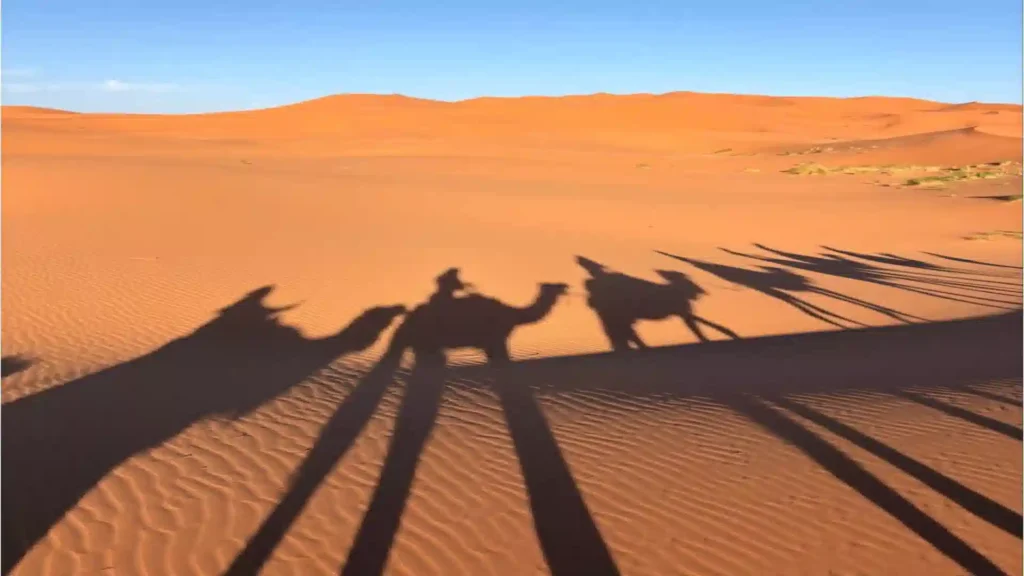
A standard 3 days desert tour from Marrakech to Merzouga covers the Tizi n’Tichka pass, Ait Ben Haddou, the Dades or Todra Gorge, and one overnight camel trek into Erg Chebbi before returning via Ouarzazate. This is the single most-booked itinerary on our route map, and the structure below reflects what we actually run, not a theoretical itinerary.
Day-by-Day Breakdown
Day 1 Marrakech to Dades Valley
- Depart Marrakech early morning by private 4×4 or minivan.
- Cross the Tizi n’Tichka pass (2,260 m), with photo stops over the High Atlas.
- Visit Ait Ben Haddou, the UNESCO-listed kasbah used in numerous film productions.
- Continue through Ouarzazate (“Ouallywood,” Morocco’s film studio hub).
- Overnight in a Kasbah-style hotel near the Dades or Todra Gorge.
Day 2 Dades Valley to Merzouga
- Morning walk or short hike into the Todra or Dades Gorge.
- Drive through the Tinghir palm groves and the Ziz Valley.
- Arrive in Merzouga by late afternoon.
- Sunset camel trek into Erg Chebbi (roughly 45–60 minutes by camel).
- Overnight in a desert camp Berber tent, music around the fire, dinner under the stars.
Day 3 Merzouga to Marrakech
- Sunrise over the dunes (optional, weather-dependent).
- Breakfast, return camel ride or 4×4 transfer back to Merzouga town.
- Long return drive to Marrakech, typically with a lunch stop in Ouarzazate.
If three days feels rushed, our 4 and 5 day Merzouga itineraries add a night in Fes or an extra stop in the Ziz Valley oasis towns of Erfoud and Rissani historically the southern terminus of the trans-Saharan caravan trade.Read the Full 3 days Sahara Desert tour from Marrakech here.,mnbvcxz.
What Does a Zagora Desert Tour Include?
A standard Zagora desert tour covers the Draa Valley’s palm groves and kasbahs, with most 2 day packages stopping at the smaller Tinfou or Mhamid-area dunes rather than continuing on to Erg Chigaga itself. If true Erg Chigaga access matters to you, confirm this explicitly with any operator before booking it is the single most common point of confusion in Zagora desert tour marketing.
A 2 days tour from Marrakech to Zagora typically includes:
- Tizi n’Tichka pass crossing (shared with the Merzouga route).
- Stop at Ait Ben Haddou.
- Drive through the Draa Valley, passing Agdz and Tamnougalt kasbahs.
- Visit to Tamegroute, home to a centuries-old manuscript library and traditional green pottery workshops.
- Camel trek and overnight camp near M’Hamid or the Tinfou dunes.
For travelers who specifically want Erg Chigaga, we recommend a minimum 3 days / 2 nights itinerary that allocates a dedicated 4×4 transfer day from M’Hamid into the deep dunes, with a luxury or standard bivouac overnight directly in the erg.
Merzouga vs Zagora: Cost Comparison
A Merzouga Sahara desert tour from Marrakech typically runs slightly less per day than a true Erg Chigaga expedition, because Chigaga requires a dedicated 4×4 vehicle for the unpaved final leg, while Merzouga is reachable by standard minivan or sedan. Prices below reflect per-person rates for shared group departures; private tours run higher.
| Tour Type | Typical Price Range (per person, shared group) | What Drives the Cost |
|---|---|---|
| 2D/1N Marrakech–Zagora (Tinfou dunes) | €70–€120 | Standard vehicle, shorter distance |
| 3D/2N Marrakech–Merzouga (Erg Chebbi) | €100–€180 | Standard vehicle, longer distance, more inclusions |
| 3D/2N Erg Chigaga via M’Hamid | €200–€400 | Mandatory 4×4 transfer, more remote camp logistics |
| Luxury glamping upgrade (either route) | +€80–€250 per night | Private tents, gourmet menus, hot showers, sometimes pools |
No hidden fees should apply on either route if the operator is reputable at Over Morocco Tours, every quoted price already includes transport, permits, accommodation, and meals, with no extra charges added once you’re on the road.
Which Has Better Desert Camps: Merzouga vs Zagora?
Merzouga has a far wider range of desert camps, from basic shared Berber tents to luxury Erg Chebbi glamping with private pools, while Zagora/Chigaga camps cluster in the mid-range to luxury eco-camp category with fewer ultra-budget options. This is simply a function of tourist volume — Merzouga’s camp economy has scaled over three decades to serve mass tourism, while Chigaga’s camps remain smaller and more curated.
What to expect at each Merzouga vs Zagora:
- Merzouga camps: Range from 6-tent family-run setups to 20+ tent luxury camps with en-suite bathrooms, electricity, and even swimming pools at the high end. Wi-Fi is increasingly common.
- Zagora/Chigaga camps: Typically 4–10 tents, often run on solar power, with composting or basic plumbing. The trade-off is silence no generator hum, no neighboring camps within earshot, genuinely dark skies for stargazing.
In our experience testing this across both regions, clients who prioritize comfort (families, honeymooners, anyone over 60) are happier in Merzouga. Clients who prioritize atmosphere over amenities photographers, long-term travelers, repeat visitors consistently rate Chigaga camps higher in post-trip reviews.
Is Erg Chigaga Worth the Extra Drive?
Yes, if you have at least four days and specifically want fewer tourists, a wider dune field, and a slower-paced Draa Valley route but no, if your trip is three days or fewer, since the extra 4×4 transfer time will outweigh the dune experience itself. This is the most common judgment call we help clients make when planning a Sahara desert tour from Marrakech.
Arguments for the extra drive to Erg Chigaga Sahara Desert tour from Marrakech:
- Morocco’s largest dune field, with a genuine sense of remoteness once past M’Hamid.
- Significantly fewer day-trippers and tour buses than Erg Chebbi.
- A richer cultural detour through the Draa Valley’s kasbahs and Tamegroute’s pottery cooperatives.
- Stronger stargazing conditions due to minimal light pollution.
Arguments against, on a tight schedule:
- The unpaved 50–60 km piste from M’Hamid takes 2–3 hours each way by 4×4, which can feel repetitive for travelers who already crossed several hours of mountain road that day.
- Fewer accommodation and dining options if your camp doesn’t suit your preferences.
- Higher per-person cost due to mandatory 4×4 vehicle hire.
Best Time to Visit Merzouga vs Zagora
Both regions share the same desert climate window late October through early April offers the most comfortable daytime and nighttime temperatures, while July and August bring extreme midday heat that limits outdoor activity to early morning and evening. Based on our seasonal departure data, late March to May and September to November are the highest-satisfaction windows for both routes.
| Season | Merzouga Conditions | Zagora / Chigaga Conditions |
|---|---|---|
| Nov–Feb | Cold nights (near $0^\circ\text{C}$), warm sunny days | Similarly cold; clearer night skies for stargazing |
| Mar–May | Ideal mild days, comfortable nights | Ideal spring desert flowers near Chigaga’s edges |
| Jun–Aug | Extreme heat ($40^\circ\text{C}^+$), avoid midday dune walks | Equally extreme; $4\times4$ transfer is more taxing in heat |
| Sep–Oct | Cooling, fewer crowds than spring | Cooling, good for off-road comfort |
What Activities Are Available in Merzouga vs Zagora?
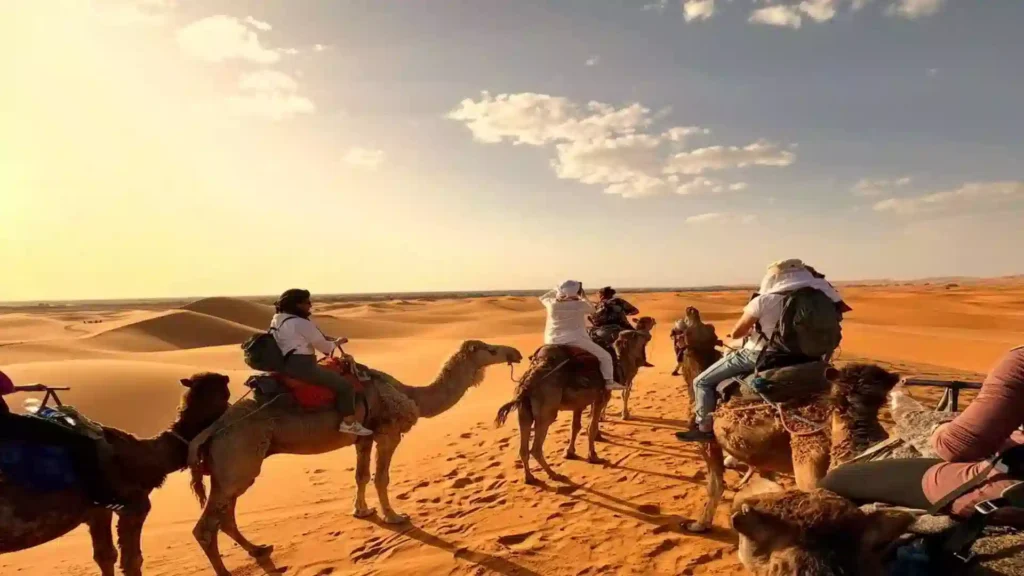
Both regions offer camel trekking, 4×4 dune excursions, sandboarding, and stargazing, but Merzouga has a wider activity menu including quad biking and sand-yoga sessions while Zagora/Chigaga activities lean toward longer camel meharis (multi-day camel expeditions) and deeper cultural visits. Choose based on whether you want variety packed into one or two nights, or a slower, more immersive single activity stretched over several days.
Merzouga activity list:
- Sunset and sunrise camel treks into Erg Chebbi (45–60 minutes each way).
- Quad biking and dune buggy excursions across the erg’s edge.
- Sandboarding down the steeper dune faces.
- Visits to the seasonal Dayet Srji lake, which sometimes attracts flamingos after spring rain.
- Berber music evenings around the campfire, often featuring local drumming traditions.
- Day trips to Khamlia village to hear Gnawa music performed by descendants of West African communities.
Zagora/Chigaga activity list:
- Multi-day camel mehari expeditions, often 4–5 days with several bivouac stops.
- Sandboarding and 4×4 dune excursions around Erg Chigaga.
- Visits to Tamegroute’s 17th-century Zawiya Naciria library and green pottery cooperatives.
- Lake Iriki exploration a vast dried lakebed within Iriqui National Park, known for fossil remnants and otherworldly photography.
- Cultural stops in M’Hamid, including its weekly market and traditional Berber architecture.
In our experience testing this with adventure-focused clients, the Zagora route’s camel mehari option is consistently the highlight for travelers who want to retrace genuine historic trade routes rather than a one-night sampler experience.
How Should You Pack for a Merzouga vs Zagora Desert Tour?
Pack the same core items for either route layered clothing, a headscarf or turban, sun protection, and a reusable water bottle but add extra dust protection and a power bank if you’re continuing on to Erg Chigaga, since camps there rely more heavily on solar power and have less reliable electricity. Desert nights drop sharply in temperature regardless of which erg you visit, so packing for both extremes matters more than packing for one.
Essentials for both routes With Best Sahara Desert Tour From Marrakech:
- Lightweight, breathable layers for daytime heat plus a warm layer (fleece or jacket) for nighttime, which can fall close to freezing between November and February.
- A cotton or linen scarf/turban to protect against sand and sun guides in both regions can show you the traditional Berber wrapping style.
- High-SPF sunscreen, sunglasses, and a hat with a brim or neck flap.
- Closed shoes for camel mounting and dismounting, plus flip-flops or sandals for camp.
- A basic first-aid kit, motion sickness tablets if you’re prone to carsickness on the Tizi n’Tichka switchbacks, and any personal medication.
Extra considerations specific to Zagora/Erg Chigaga:
- A portable power bank, since some Chigaga camps run limited solar electricity with no guaranteed outlet access in tents.
- A dust mask or buff for the unpaved 4×4 transfer, which can be dusty in dry conditions.
- A printed or offline map/itinerary, since mobile signal disappears well before reaching the dunes.
Is It Safe to Travel to Merzouga vs Zagora?
Both regions are well-established tourist routes with low crime rates, and the primary safety considerations are road conditions, heat exposure, and choosing a licensed operator with insured vehicles rather than personal security risks. Assistance in emergencies a flat tire on the Tizi n’Tichka switchbacks, a sudden sandstorm, or a medical concern at camp is the area where operator quality matters most.
Practical safety notes our team applies on every departure:
- All drivers carry official tourism transport licenses, and vehicles undergo routine mechanical checks before long desert legs.
- Camps maintain basic first-aid supplies, and guides carry satellite or radio contact where mobile signal is unavailable, particularly past M’Hamid.
- Travelers with respiratory conditions should be cautious during sandstorm season (more common in spring) and should mention this when booking so guides can adjust the itinerary or camp choice.
- Solo travelers, including solo women, regularly complete both routes safely when booked through agencies that assign a consistent guide for the full trip rather than handing clients between unaffiliated drivers.
Sustainability and Local Communities: Berber-Led Tourism in Both Regions
Both Merzouga vs Zagora’s tourism economies are built substantially on Berber-led guiding, camel handling, and camp hospitality, and choosing operators who employ and fairly pay local guides directly supports these communities rather than outside investors. This matters increasingly to travelers planning a sustainable Morocco travel package, a term that has shifted from niche to mainstream over the past few booking seasons.
Ways this plays out differently across the two routes:
- Merzouga: A larger camp economy means more seasonal employment, but also more competition and price pressure that can squeeze smaller, family-run operations.
- Zagora/Chigaga: Smaller, more concentrated communities around M’Hamid depend heavily on tourism revenue from camel mehari expeditions and 4×4 transfers, making fair-wage guiding especially impactful here.
- Both regions: Visiting cooperatives pottery in Tamegroute, carpet weaving near Agdz, or date cultivation in the Ziz Valley channels spending directly to artisans rather than intermediaries.
When managing logistics on the ground, we prioritize local Berber guides who grew up in the Middle Atlas, Draa Valley, or Tafilalet region over rotating drivers, since continuity of local knowledge consistently produces better client experiences and more direct community benefit.
Can You Combine Both Merzouga vs Zagora in One Trip?
Yes several of our multi-day circuits (8 to 14 days) connect both regions by routing Marrakech → Zagora → M’Hamid → back through the Draa Valley → Ouarzazate → Merzouga → Fes, letting travelers experience both ergs without retracing the same road twice. This is the option we recommend to clients who genuinely can’t choose between the two and have the time to spare.
A combined circuit typically adds 3–4 extra driving days compared to a single-erg itinerary, so it suits travelers on a 10+ day Morocco trip rather than a short break.
Planning Your 2026 Sahara Desert Tour From Marrakech: FAQ
Is Merzouga or Zagora closer to Marrakech?
Zagora town is closer to Marrakech (~360 km) than Merzouga (~560 km), but Zagora alone does not put you in the true Sahara reaching Erg Chigaga’s dunes from Zagora requires continuing on to M’Hamid and then a 4×4 transfer.
Which desert has taller dunes, Erg Chebbi vs Erg Chigaga?
Erg Chebbi near Merzouga is generally cited as having the taller dunes, with peaks commonly reported around 150 meters, compared to Erg Chigaga’s more variable and generally lower ridgeline, though Chigaga covers a larger total area.
Can I visit Merzouga as a day trip from Marrakech?
No. Due to the 9–10 hour one-way drive, Merzouga requires at least one overnight stop en route and one night in the desert a true day trip is not physically realistic from Marrakech.
Is a 4×4 mandatory to reach Erg Chigaga?
Yes. The road is paved only as far as M’Hamid El Ghizlane; the final 50–60 km to Erg Chigaga is unpaved desert track and requires a 4×4 vehicle with an experienced local driver.
Which is more budget-friendly, Merzouga vs Zagora tour stopping at Tinfou?
A Zagora tour that stops at the smaller Tinfou dunes (rather than continuing to Erg Chigaga) is usually the cheapest Sahara-adjacent option, since it avoids the mandatory 4×4 transfer cost.
Do both routes pass through Ait Ben Haddou?
Yes. Both the Merzouga and Zagora/Chigaga routes from Marrakech share the same opening leg over the Tizi n’Tichka pass and through Ait Ben Haddou before splitting toward the Dades Valley (Merzouga) or the Draa Valley (Zagora).
Which route is better for photography?
Erg Chigaga near Zagora generally offers better photography conditions due to lower crowd density and minimal light pollution, while Erg Chebbi near Merzouga offers taller, more dramatic dune silhouettes and easier access for sunrise shoots without a long pre-dawn transfer.
How many nights in the desert is ideal?
One night is the minimum to experience a camel trek, dinner, and sunrise, but two nights particularly at Erg Chigaga allows time to recover from the long drive and properly experience the silence and stargazing that make the remote route worthwhile.
Do I need travel insurance for either route?
Travel insurance covering activity-based travel (camel riding, 4×4 transport) is recommended for both routes, and is particularly advisable for the Erg Chigaga extension given its remoteness and the limited medical access past M’Hamid.
Can children join either tour?
Yes, both routes accommodate families, though Merzouga’s shorter camel transfer and stronger infrastructure make it the more practical choice for younger children, while the longer 4×4 transfer to Erg Chigaga suits older children and teens better.
Final Verdict: How to Choose Between Merzouga vs Zagora
Based on our operational data running both routes for clients of every travel style, here is the decision checklist we actually use when a client asks “Merzouga vs Zagora?“:
- Choose Merzouga if: This is your first Morocco trip, you have 2–4 days, you’re traveling with family or limited mobility, or you want the tallest, most iconic dunes with reliable camp comfort.
- Choose Zagora → Erg Chigaga if: You have 4+ days, you’ve already seen Erg Chebbi or want to avoid crowds entirely, you care more about atmosphere than amenities, or photography/stargazing is a trip priority.
- Choose a Zagora-only tour (Tinfou dunes) if: Your main goal is the Draa Valley’s kasbahs and palm oasis scenery, your budget is tight, and reaching true Sahara dunes isn’t essential.
- Choose a combined circuit if: Your trip is 10+ days and you want both ergs without compromise.
- Always confirm before booking: Ask explicitly whether a “Zagora desert tour” reaches Erg Chigaga or stops at Tinfou this single question prevents the most common disappointment we see in post-trip feedback.
Whichever route you choose, book with an operator that includes transport, permits, accommodation, and meals in one fixed price, provides a private vehicle suited to the actual road conditions, and assigns you a local guide who grew up in the region you’re visiting. That combination not the dune height alone is what determines whether a Sahara desert tour from Marrakech feels authentic or rushed.