What Is a Riad in Morocco? A Complete Guide for First-Time Visitors
What is a riad in Morocco? First thing, a Riad (الرياض, from the Arabic word for “garden”) is a traditional Moroccan townhouse or palace with an interior garden or courtyard. The word “riad” means “garden”; all the rooms are built around an interior courtyard rather than facing the street. From the outside, a riad is a mystery: you enter through an unmarked or near-invisible door in a featureless medina wall, and find yourself in another world: an ornate courtyard with a fountain, fruit trees, tiled floors and carved plasterwork that belies the street. From our experience booking riad stays for clients across Marrakech, Fes and Essaouira, this moment of entering is always one of the trip highlights of any Morocco Desert trips.
In this guide, you’ll learn exactly what a riad is, how it differs from a hotel or dar, what it’s actually like to stay in one (and what it feels like), and what to look for when choosing a riad.
Table of Contents
What is a Riad In Morocco at a Glance: Key Facts
What is the origin of the word “riad”?
The riad meaning Morocco comes from the Arabic “ryad” (رياض), meaning garden — and the defining feature of a true riad is not just the courtyard, but the fact that it contains a planted garden or at minimum a central fountain, as distinct from a “dar,” which is a similar inward-facing townhouse without the garden element. In practical terms, the term “riad” is often used loosely on listings for accommodations in Morocco, to describe any guesthouse with a courtyard, whether it technically qualifies as a garden or not.
Linguistic and architectural sources:
- Andalusian influence : The interior-facing courtyard design of the riad is heavily influenced by Andalusian architecture that was brought to Morocco by Arab and Jewish refugees expelled from Spain after the Reconquista, especially after 1492. That’s why Moroccan riad courtyards look so much like the patios of Seville or Granada.
- Islamic design principles : The inward-facing plan is reflective of a bigger Islamic architectural principle of separating public and private life — the blank exterior wall protects family privacy, while the interior cultivates a lush, ornate private world.
- Practical climate adaptation : The central courtyard provides natural ventilation and shade, greatly cooling the interior in Morocco’s hot summers – a pre-modern air conditioning solution incorporated into the architecture.
Inside a Riad: What it Actually Looks Like
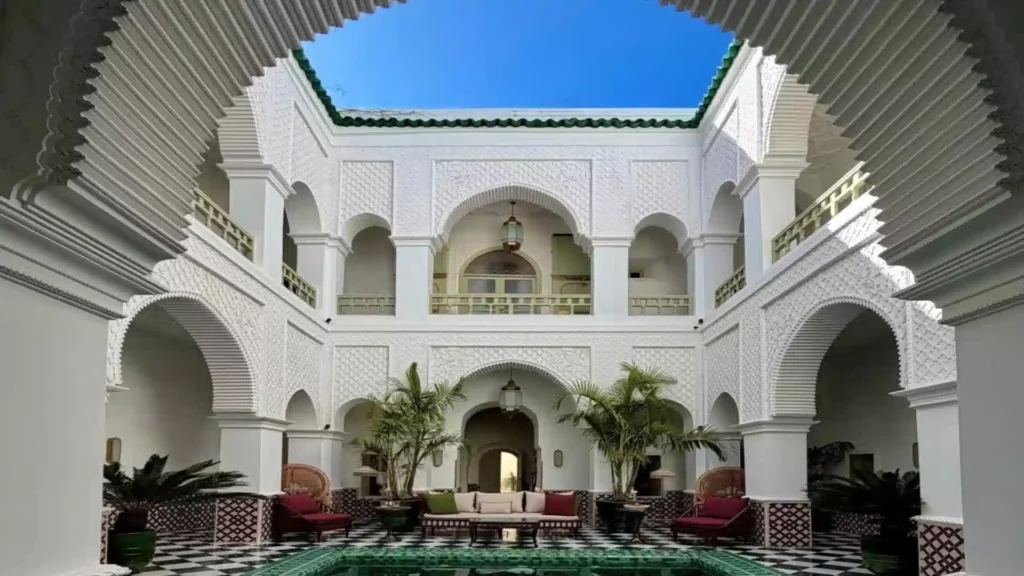
Open to the sky, this grand riad displays symmetrical Moorish arches and masterfully carved white plasterwork (stucco) surrounding a central courtyard.
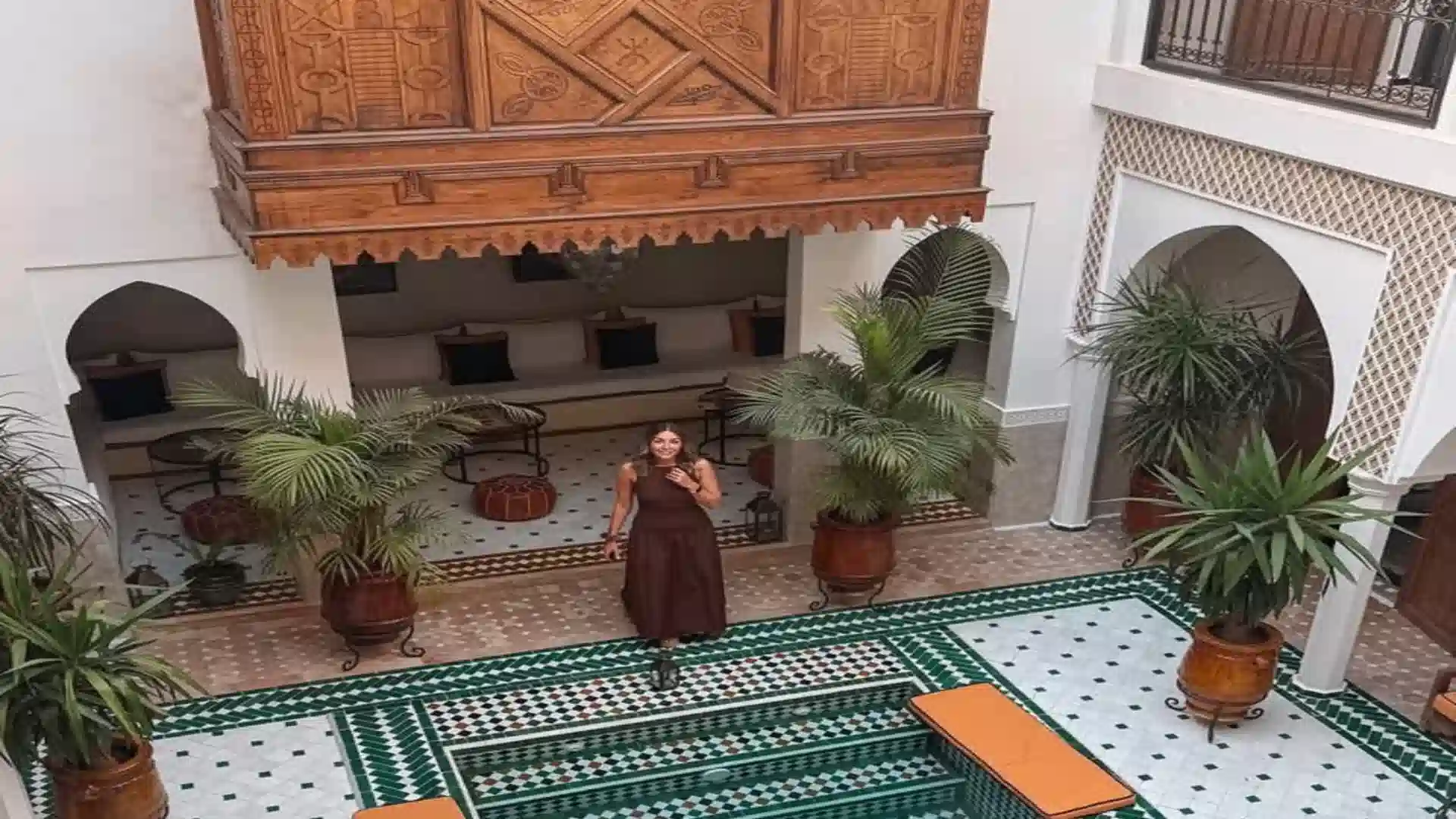
A traditional riad typically has a central courtyard with geometric zellige tilework on the floors and lower walls, carved plasterwork (known as tadelakt) on the upper walls, intricate cedar wood ceilings and screens, and a central fountain or small garden of plants, surrounded by arched doorways leading to rooms on the ground floor and a carved wooden gallery along the upper floors. This is the fundamental architectural language, whether the riad is a budget guesthouse or a $500-a-night luxury renovation.
Most riads have similar architectural features:
- Zellige tilework (zillij) : A geometric mosaic tilework composed of individually glazed terracotta hand-cut pieces. The more intricate the patterns, the more skilled the craftsmen, and the more time. The precision and complexity of the patterns is a direct indicator of quality.
- Tadelakt plasterwork: A hand-applied, polished finish of waterproof lime plaster indigenous to the Marrakech area, “burned” with stones to give it a smooth, slightly shiny surface. On walls. In bathrooms and fountains.
- Carved cedar ceilings and screens (moucharabieh) : Carved geometric screens or coffered ceilings of cedar wood, used as decoration and to provide natural ventilation between spaces.
A central fountain, almost universal, generally fed by a simple pump system and with a hand-painted or zellige-tiled basin. - An internal gallery (saqifa): A covered walkway encircling the upper level of the courtyard, providing a transition between the rooms and the open central space.
- A rooftop terrace: Most riads have a usable terrace on the uppermost level, where breakfast may be served and where guests spend evenings watching the sun set over the medina.
What is it really like to stay in a Riad?
A stay in a riad is a far from standard hotel experience there’s no lobby, no concierge desk, no corridor of identical rooms, no street presence – but in return you get an often extraordinary private architectural interior, very personal service from a small team and the feeling of actually living inside the medina rather than looking at it. The riad experience is one of the most consistent elements guests mention when they speak about what made Morocco feel different from any other place they had traveled in our ground logistics management for tour clients.
What to expect in practice:
- Arrival: You’ll be provided with an address that resembles every other door in a narrow medina alley – no signage, no illuminated hotel sign, just a door. Often your host or a local guide will meet you at a nearby landmark to walk you in as GPS can be imprecise in medieval medina streets on your first visit.
The reveal : Walking through that door and into the courtyard for the first time is really memorable. The outward simplicity and the inward ornateness are at opposite ends of the spectrum by design. - Breakfast: Almost always served on the rooftop terrace or in the courtyard — fresh orange juice, Moroccan pancakes (msemen or beghrir), honey, argan oil, olives and mint tea are standard at every price level.
- Service : Riads tend to be run by a small team – sometimes it’s a husband-and-wife family operation, sometimes it’s a host and two or three staff. The service is not standardized by training, but personal by default.
- Noise: Medina riads are protected from street noise by the inward-facing nature of the design but can sometimes transmit sound between interior rooms because of the open courtyard. It is often naturally masked by a fountain in the central courtyard.
Riad vs Hotel Morocco: What is the real difference?
A riad offers intimacy, architectural character and a more personal, embedded-in-the-medina experience; a standard hotel gives you more standardized comfort, easier street access and predictable amenities like room service, a restaurant and a proper lobby – the right choice depends entirely on what you’re prioritizing. Neither is objectively “better,” but knowing the trade-offs means you won’t be surprised when you arrive.
What Is the Difference Between a Riad and a Dar?
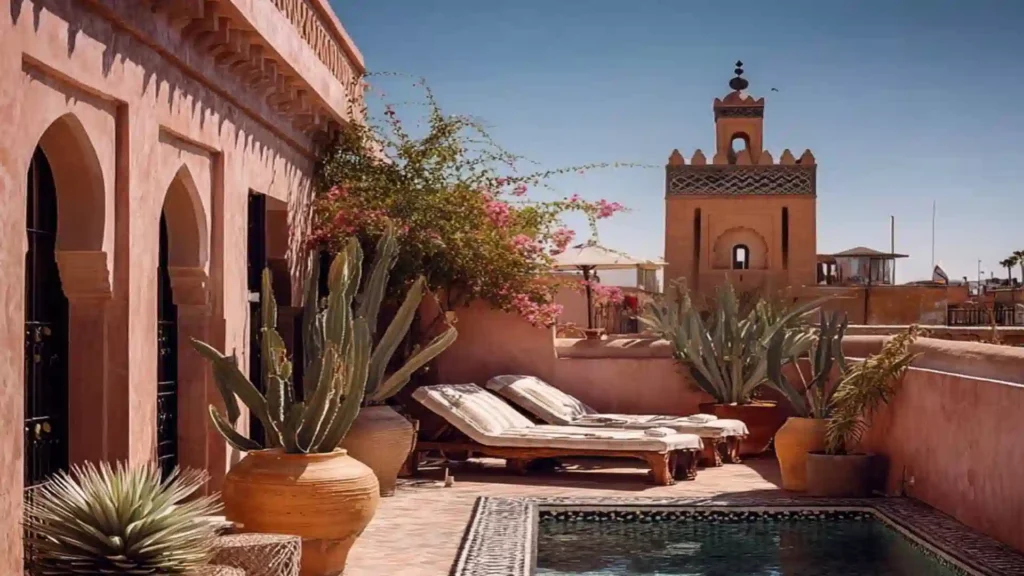
Riad rooftops offer a private escape above the bustling medina, complete with sun loungers, plunge pools, and views of local minarets.
A riad and a dar are both traditional inward-facing Moroccan townhouses. The difference is that a riad technically contains a garden or planted courtyard, whereas a dar (which means ‘house’ in Arabic) has a courtyard but without the garden element. The distinction is often blurred in modern accommodation listings, with many dars marketed as riads simply because the term is better recognized by international travelers. If you’re booking accommodation and see both terms, it’s less important than the actual photos of the courtyard and rooms.
- Riad: Larger, with a central garden or orchard used as the courtyard focal point. Usually made by wealthy families who could pay for the room and maintenance that a garden needs.
- Dar : Smaller, with a central courtyard (often tiled rather than planted) but no garden proper. It is simply the Arabic word for ” house ” and refers to a broader range of traditional domestic architecture .
- Maison d’hôtes The French word for guesthouse, used throughout Morocco, whether in a riad or a dar. This label refers to function rather than architecture.
What is a Riad Cost How Much Does a Riad
Prices for riads range enormously, with budget options in Marrakech, Fes or Essaouira starting around $40-60 per night, mid-range riads are $80-200 and luxury boutique riads can cost $300-600 or more per room per night, the added cost being mainly due to the quality of the renovation, size of suites, private plunge pools and personalised service. Riad accommodation is the most diverse priced type of accommodation in Morocco, from family-run guesthouses to five-star boutique hotels.
Drawing on our experience booking accommodations for our tour clients, the mid-range level consistently offers the best overall balance between quality of renovation and private comfort to feel truly special, without the ultra-luxury premium that does not proportionally improve the core riad experience.
Where To staying in a riad Morocco?
Riads are found in the four Imperial Cities of Morocco Marrakech, Fes, Meknes and Rabat – and in Essaouira. All of these cities have historic medinas with traditional architecture that existed before modern construction. The largest concentration of riads is in Marrakech, with Fes coming in second. Essaouira has fewer, but superb riads, and a very coastal feel.
How to select a Riad vs Hotel Morocco
The most important things to check when booking a riad are actual photos of the courtyard and your specific room (not just the best room), whether breakfast is included, and whether the location puts you inside the medina or on its edge because “medina-adjacent” and “inside the medina” are very different experiences. Look closely and you can see almost all the difference between a good booking and a bad one in the photos for one of the accommodation types, riads.
Checklist before you book What is A Riad:
- Look at pictures of your actual room, not just the shared courtyard. Some riads have stunning common areas and very basic individual rooms.
- Confirm breakfast included this is a standard but not universal, and a Moroccan riad breakfast is one of the real highlights of the stay.
- Don’t rely on “medina” in the listing title, check the map for the exact medina location. Some riads are in nice, quiet medina areas that are great to explore, and some are in busy tourist areas.
- Check recent reviews for noise and navigation a courtyard fountain can mask noise beautifully or amplify sound between rooms depending on the riad’s construction.
- If you have large bags, make sure you can access them, as some alleys in Medina are not wide enough to accommodate wheeled bags and may require a short carry.
- Check pool availability if that matters to you plunge pools are common in higher-tier riads, but far from universal.
The History of the Riad: Why this evolution in architecture? Real Riad Meaning Morocco
With our What is a Riad In Morocco The riad as a building type has existed for over a thousand years, evolving through a mixture of Berber, Andalusian, Islamic and Roman influences into an architectural form that is perfectly suited to the medina cities and climate of Morocco. The more you know about how and why riads evolved the way they did, the richer an experience it is to stay in one – they’re not decorative tradition for its own sake but a deeply functional design response to actual environmental, social and cultural conditions.
A short history of architecture about What is a Riad:
- Roman and Byzantine roots : The inward-facing courtyard house predates Islam in North Africa and has clear precedents in the design of Roman domus, where domestic life was organized around an atrium rather than outward-facing rooms. This principle of organization is clearly evident in the Roman site of Volubilis near Meknes.
- Andalusian influence : Arab and Jewish communities expelled from Andalusia (Spain) after 1492 brought with them refined traditions of courtyard design closely related to what we now recognize as the Moroccan riad the similarity between riad courtyards and the patios of Seville, Córdoba and Granada is not coincidental.
- Islamic social principles : The principle of separation of private (female, family) domestic space from public (male, commercial) street life is always emphasized in Islamic domestic architecture the blank exterior wall and the inward-facing courtyard are the direct architectural articulation of this principle.
- Climate engineering : Morocco’s medina cities, especially Marrakech, are perched on the edge of the desert and subject to extreme summer heat. The riad’s high walls, central courtyard and water feature create a convection-cooling effect that keeps interior temperatures significantly lower than outdoor temperatures – a passive air conditioning system centuries before mechanical cooling.
- Decline in the 19th and early 20th centuries: The urbanisation of Morocco in the 19th century and the new construction techniques and Western housing models introduced by the French colonial period led to the division, neglect or abandonment of many of the traditional riads, particularly in the later 20th century.
- Renovation boom from the 1990s onward : International interest in traditional Moroccan architecture, combined with relatively low medina property prices, sparked a major riad renovation boom from the 1990s through the 2010s, with foreign and domestic buyers converting derelict riads into boutique guesthouses a process that has both preserved significant architectural heritage and, in some cases, raised property prices and displaced traditional residents.
What is a Hammam? Do Riads Have One? and How is It Like Staying In a Riad Morocco?
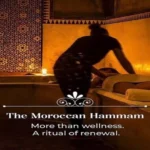
With riad meaning Morocco you will noitice that Many traditional riads have their own private hammam (Moroccan steam bath) or can organize access to a nearby public hammam. The combination of a riad stay with a hammam experience is generally considered one of the most complete ways to experience traditional Moroccan domestic culture. The hammam is to a riad what the medina souk is to the city – an essential complementary stratum of the same cultural experience.
What is traditional in a hammam:
- Three temperature rooms : A traditional hammam sequence goes through a cold room, a warm room and a hot steam room, heat being generated by a wood-fired boiler.
- Kessa exfoliation : A vigorous scrub with a kessa glove (a rough mitt) to remove dead skin, usually one of the most effective exfoliation experiences on offer anywhere.
- Black soap (beldi soap) : A traditional Moroccan soap made from olive oil and pressed black olives, used before the kessa scrub to soften skin.
Rhassoul clay mask A rhassoul clay mask is applied to both the skin and hair in many hammam treatments. The clay is derived from a specific mineral deposit in the Atlas Mountains, only in Morocco. - Public vs. private: Public neighborhood hammams (for local residents) are very cheap (around $2-5) and offer the real community experience; private hammams in riads or tourist-only hammams are more expensive ($20-60), but more comfortable and private.
We’ve been running multi-day tours with riad accommodation and our experience tells us that guests who add a basic hammam session always rate it as one of the highlights of their trip – not just as a spa treatment but a real window into an everyday Moroccan domestic ritual.
Are Riads More Eco-Friendly Than Hotels? Riad Vs Hotel Morocco:
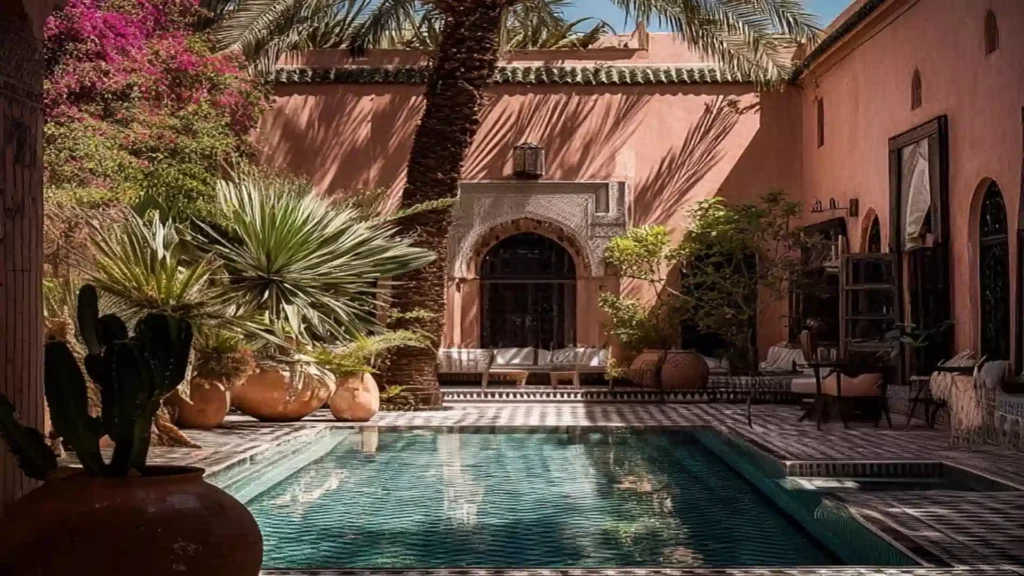
An oasis of calm: a stunning central plunge pool framed by towering palm trees, blooming bougainvillea, and warm terracotta-hued walls.
In many meaningful respects, yes staying in a riad, particularly an independently owned and locally operated one, channels your accommodation spend more directly into local Moroccan families, craftspeople, and medina communities than a large international hotel brand whose profits flow to a corporate chain. Sustainable travel is becoming more and more of a factor in how travelers choose where to stay and the riad model has a real argument to make here.
Why locally owned riads are backing sustainable tourism:
- Local ownership and employment: A lot of riads are family-owned and run, employing a small team from the local Medina neighborhood.
- Architectural heritage preserved When a traditional riad is renovated, not destroyed, it preserves irreplaceable architectural and craft knowledge: the zellige tiles, carved cedar ceilings and tadelakt plasterwork in a well-restored riad are skills passed down through generations of Moroccan artisans.
- Economic integration with the medina : A riad that sources its breakfast produce from nearby market stalls, sends guests to local hammams and craft cooperatives, and hires neighborhood residents, integrates tourism spending into the local economy at the neighborhood level rather than concentrating it in a single corporate property.
- Caveats: Not all riads are equal in this regard foreign-owned riads repatriating profits outside of Morocco, or high-end renovations that price traditional residents out of Medina neighborhoods, are a more complex side of the riad boom that is worth honestly acknowledging.
Frequently Asked Questions for What is a Riad In Morocco
Is it better to stay in a riad or a hotel for a first visit to Morocco?
Yes for most first time travellers, a riad puts you in the medina experience rather than watching it from the outside and the courtyard reveal on arrival is one of the most memorable moments of a Morocco trip; the trade-off is slightly less standardised comfort than an international hotel.
Do the riads have en-suite bathrooms?
Most mid-range and above riads have en-suite bathrooms in each room; budget riads may have some shared bathrooms – always check the specific room listing rather than assume.
Are there riads outside Marrakech?
Yes Fes, Essaouira, Rabat and Meknes all have great riads, with Fes considered to have the most historically authentic riad architecture after Marrakech.
Are riads suitable for children?
Yes – many riads can accommodate families, and the central courtyard is a really lovely shared space for kids; just check the room configuration and check if the riad has a pool if that matters.
Why do riads have no windows to the street?
This is a conscious part of Islamic domestic architecture, to separate private family life from the public street and to maximize interior privacy – the entire visual and social life of the house is directed inward, to the courtyard, rather than outward, to the world.
Will I need a guide to find my riad in the medina?
Your host is highly recommended to meet you at a nearby landmark (a named gate or main square) upon your first arrival, as GPS can be imprecise in the dense medieval medina streets, but after your first walk-in you will easily enough find your own way.
What is the difference between a riad and a kasbah in Morocco?
What is a riad, As of our years of experience a riad is a townhouse in a medina city, centered around an interior courtyard. A kasbah is a fortified building or district, usually in the old town center or as a separate desert fortress. When we talk about a hotel that is advertised as a “kasbah-style hotel”, we are usually talking about a building whose architecture takes after the fortified earthen-clay look of a kasbah. You will most often find these kinds of hotels in the Dades Valley and Ouarzazate routes, and less often in the Medina cities.
Riad vs hotel Morocco which one is more expensive ?
No, budget riads in Marrakech and Fes start around $40 a night, about the same as or cheaper than budget hotels in the same area, and the price range is broad enough that riads compete at every level of accommodation, from basic guesthouses to ultra-luxury boutiques.
A Glossary of What is A Riad Architecture Terms You Should Know
When you stay in a riad, you’ll often hear a handful of Arabic, Amazigh and French architectural terms used by hosts and guides that aren’t always explained in the booking listings. Knowing what these terms mean dramatically enhances both the booking decision and the experience on the ground. Here is the vocabulary our guides Ali and Yidir often explain to curious clients on Medina walks and riad visits. Below are what is a riad in Morocco made off essintial things that connect the history with art:
But if you learn the vocabulary before you get there, then when a host mentions “the tadelakt hammam” or points to the “moucharabieh screens above the saqifa”, you’ll know exactly what you’re looking at and why it took a craftsman months to build.
Pre-booking riad vs hotel Morocco checklist: What to know before you go
- A riad is a traditional inward-facing courtyard house, not a hotel chain or brand they are all architecturally unique.
- The defining feature is the central courtyard with fountain or garden . The blank exterior wall is by design .
- Riads: Marrakech has the most and most diverse. Fes has the most historically authentic.
- Most travelers find the mid-range ($80-180) to be the sweet spot enough quality renovation without the ultra-luxury premium.
- Always look at pictures of your specific room, make sure breakfast is included, and check the exact location in the medina before booking.
- We’ve escorted thousands of travelers through the medinas of Morocco and in our experience the moment when, after passing through the plain exterior door, you step into an ornate courtyard for the first time is one of the details clients most often mention when describing what made Morocco feel truly different from anywhere else they had traveled.
Ready to discover the magic of Staying in A Riad Morocco?
Step through an unassuming medina door into this hidden paradise of carved cedar and trickling fountains and you will have a moment you will never forget. But it takes years of experience on the ground to find a riad that hits the sweet spot between authentic heritage and modern comfort and to find it in the maze that is the medina. But after all staying in a Riad Morocco worth searching even if it took you hours.
We select the best boutique riads for our clients with Our post what is a Riad in Morocco, pairing your style and budget with trusted local hosts in Marrakech, Fes and Essaouira. We’ll take care of the logistics, the transport, the bookings. You just step on board and relax.