Solo Female Travel Morocco: The Complete Safety & Experience Guide for 2026
Table of Contents
Solo Female Travel Morocco: The Honest Guide Nobody Else Will Write
Solo female travel Morocco sits at a fascinating crossroads between extraordinary reward and real-world complexity, and most online guides fail women travelers by defaulting to one of two unhelpful extremes: either dismissing legitimate concerns with a breezy “Morocco is totally fine!” or catastrophizing the experience into something that sounds genuinely dangerous. Neither is accurate, and neither serves you. This guide is written from the ground up by the Over Morocco Tours team, a Moroccan-based operation whose guides have accompanied hundreds of solo female travelers through Marrakech, Fes, the Sahara, and every landscape in between. It gives you the unvarnished truth: Morocco is absolutely visitable as a solo woman, and it is one of the most extraordinary destinations on Earth, but it requires more deliberate preparation than many European or Southeast Asian destinations, and knowing what to expect before you arrive makes the difference between a transformative trip and a stressful one.
The question “is Morocco safe for solo female travelers?” is one of the most searched travel queries about North Africa, and the answer is nuanced. Morocco is politically stable, has a well-developed tourism infrastructure, and welcomes millions of international visitors every year, including hundreds of thousands of solo female travelers who complete their trips without incident. However, harassment of women in public spaces in Morocco, particularly in the medinas of Marrakech and Fes, and around major tourist sites, is a documented and common experience that ranges from persistent verbal attention to occasional physical contact. Understanding this reality, having strategies to deal with it confidently, and structuring your itinerary to minimize exposure to high-risk situations is what separates a smooth Morocco trip from a difficult one. This guide covers all of it.
Is Morocco Safe for Solo Female Travellers in 2026?
The Honest Safety Picture
Morocco consistently ranks as one of the safest countries in Africa for international tourism, and the Moroccan government has invested significantly in tourist police presence in major medinas, improved lighting in historic city centres, and legal frameworks that criminalise harassment of tourists. Violent crime against foreign visitors is genuinely rare Morocco’s violent crime rates are low by global standards, and attacks on tourists are not a feature of the country’s security landscape in the way they are in some other destinations. Women travelling alone in Morocco are overwhelmingly more likely to experience verbal harassment than any form of physical danger, and this is an important distinction to hold clearly.
That said, Morocco solo female safety tips requires active management in a way that solo travel in, say, Portugal or Japan does not. The medinas of Marrakech and Fes in particular are dense, disorienting, and populated by a persistent minority of touts, unofficial guides, and individuals who will follow, call after, or repeatedly approach solo women – especially in the areas immediately surrounding the main souks and tourist attractions. This behaviour is not universal – the majority of Moroccan men are respectful, helpful, and entirely uninterested in bothering tourists – but the minority who do engage in persistent harassment can make navigating a medina alone feel exhausting, particularly on a first day when your orientation is poor and your confidence in the environment is low.
The key insight that experienced solo female travel Morocco report consistently is this: confidence, pace, and preparation reduce harassment dramatically. A woman who walks purposefully, avoids making eye contact with persistent callers, knows where she is going, is dressed appropriately for the context, and responds to unwanted attention with a firm “la shukran” (no thank you in Moroccan Arabic) or simple silence will have a fundamentally different experience than one who appears lost, hesitant, or uncertain. This is not victim-blaming – it is the practical reality of navigating a medina environment, and it applies equally to solo male travellers in certain contexts.
Legal Protections for Women in Morocco
Morocco’s legal framework offers meaningful protections that are worth knowing. Law 103-13 on combating violence against women, enacted in 2018, criminalises sexual harassment in public spaces with penalties of up to 6 months imprisonment and fines of up to 10,000 MAD (approximately EUR900). Tourist police (recognisable by their distinctive uniforms and high visibility in tourist zones) are deployed specifically in the medinas of Marrakech, Fes, Essaouira, and Chefchaouen, and filing a complaint with tourist police is taken seriously – this is not a country where reports are routinely dismissed. The Brigade Touristique hotline (+212 524 384601 in Marrakech) is staffed specifically to assist tourists who encounter harassment or theft.
What to Wear in Morocco as a Woman: The Practical Dress Code Guide
Morocco Female Dress Code: Context Is Everything
What to wear in Morocco as a woman is one of the most-searched practical questions about the country, and the honest answer is that it depends almost entirely on where you are and what you are doing. Morocco does not have a legally enforced female dress code – you will not be arrested for wearing shorts in a tourist resort or a sleeveless top in a riad courtyard. However, dressing with cultural sensitivity is both respectful and practically useful, because clothing that draws attention in conservative neighbourhoods increases the frequency and intensity of unwanted male attention in those spaces.
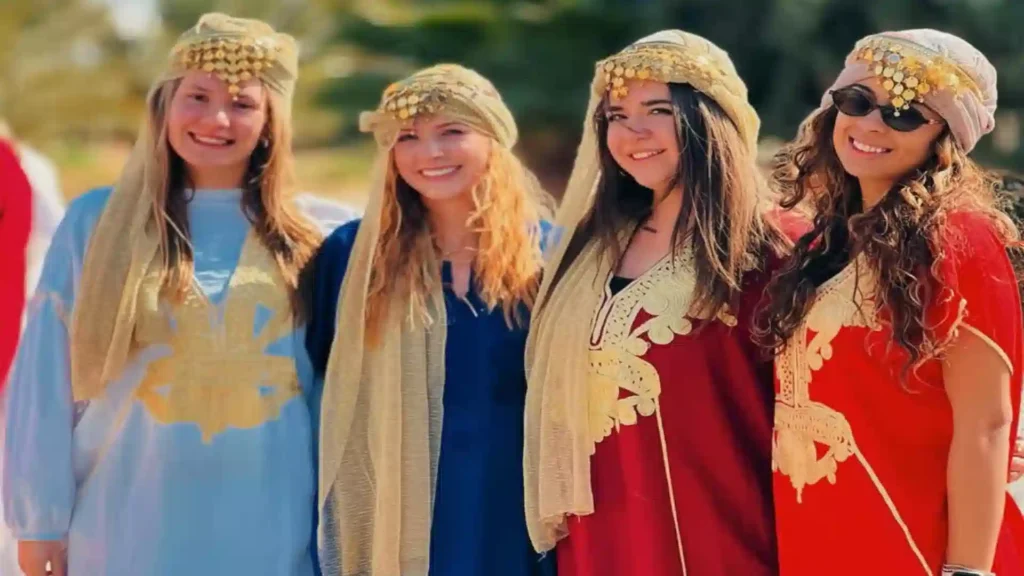
The Morocco female dress code that experienced solo travellers recommend for medina and rural environments is simple: cover your shoulders, cover your knees, and avoid tight-fitting clothing. Lightweight linen trousers, maxi skirts, loose shirts, and a versatile scarf that can cover your hair when entering mosques or more conservative communities cover virtually every situation you will encounter. In the riads, hotel pools, beach resorts of Agadir and Essaouira, and internationally-oriented restaurants and cafes of major cities, Western clothing norms apply and no one will look twice at a woman in a sundress or shorts. The practical approach is to layer – a loose shirt over shorts when walking through the medina, removed in the riad courtyard – rather than choosing between comfort and respect.
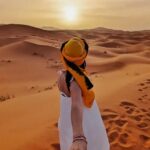
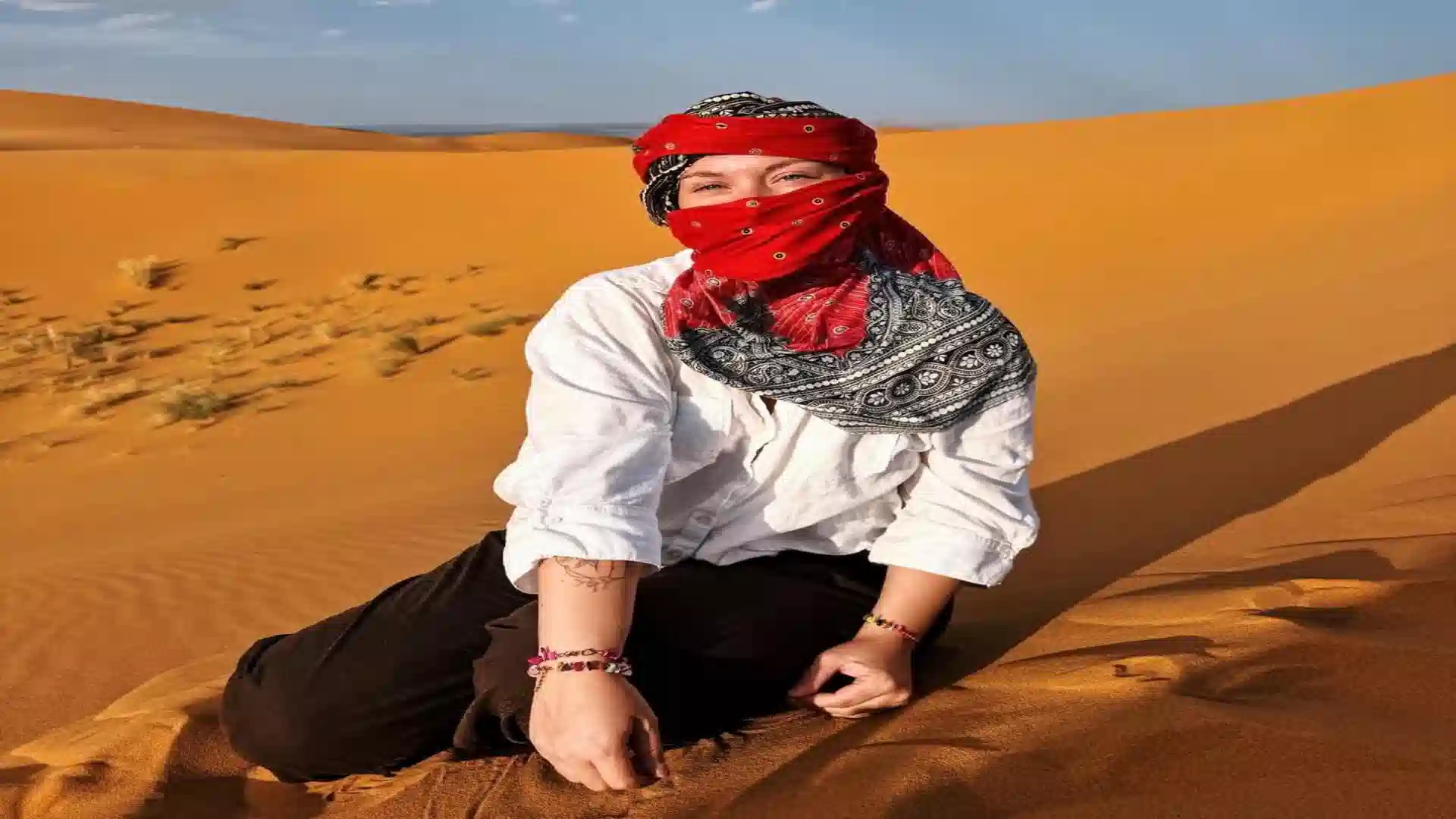
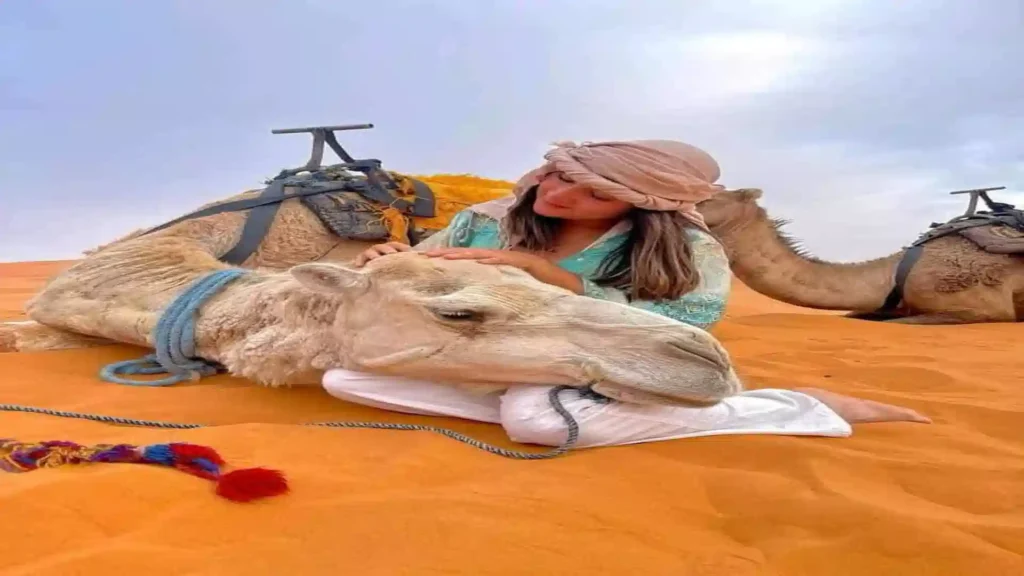
In the Sahara desert specifically, the dress code is even more relaxed in practical terms – the Merzouga area is a small, tourism-oriented community where female travellers in hiking trousers and t-shirts are completely unremarkable. However, covering your shoulders and wearing a headscarf for the camel trek is genuinely useful for sun protection, wind, and blowing sand, in addition to being respectful in a conservative rural community.
Packing List: What to Wear in Morocco as a Solo Female Traveller
For a solo female travel Morocco trip of 7-10 days covering cities, mountains, and desert, the optimal clothing strategy is:
Foundation items (cover everything, pack light): 2-3 pairs of lightweight linen or cotton trousers (not jeans – too hot), 2-3 loose long-sleeved shirts or tunics, 1 maxi skirt (versatile and cool in heat), 1 warm layer (fleece or light jacket for desert nights and mountain passes), comfortable flat walking shoes with closed toes (cobblestones in medinas are uneven), and a large lightweight scarf (dual purpose: sun, modesty, and dust protection in the Sahara).
Optional but recommended: A money belt worn under clothing for passport and emergency cash, a small daypack with a zip (not an open-top tote), and a portable door alarm for guesthouse rooms if travelling independently.
Best Places in Morocco for Solo Female Travellers
Solo Female Travel Marrakech: Navigating the Red City
Solo female travel in Marrakech is simultaneously the most rewarding and most demanding solo female experience in Morocco. The city is breathtaking the Djemaa el-Fna square, the dye-stained leather tanneries of the souks, the formal gardens of the Jardin Majorelle, the terracotta alleyways of the Mellah (Jewish quarter), and the extraordinary Bahia Palace – but the tourist-facing areas of the medina, particularly the lanes immediately north of Djemaa el-Fna and around the main souk entrances, involve consistent navigation of touts and callers.
Practical strategies that work in Marrakech: Stay in a riad within the medina (not a hotel on the periphery) – being embedded in a residential neighbourhood rather than a tourist corridor makes an enormous difference to daily comfort. Hire a licensed local guide for your first half-day in the souks – the cost (approximately EUR15-EUR25 for 3 hours) eliminates the tout problem entirely, since unofficial guides do not approach women who are already accompanied, and you learn the medina layout quickly enough to navigate independently afterward. The evening Djemaa el-Fna is genuinely safe and extraordinary – one of the great public spaces of the world – and solo female travellers regularly spend evenings there without issue.
Is Marrakech safe for solo female travel Morocco? For the large majority of women, yes – with the caveats above. The experience is more intense and demanding than most European cities, but the city’s rewards are proportional to the effort. Women who have travelled independently in India, Egypt, or Southeast Asia will find Marrakech entirely manageable. Women for whom any level of street-level male attention is distressing should consider joining a guided small-group tour for the medina sections of their trip.
Solo Female Travel Fes Medina: The World’s Largest Car-Free Urban Area
Solo female travel in the Fes medina – Fes el-Bali, a UNESCO World Heritage Site and the largest surviving medieval Islamic city in the world – is a different experience from Marrakech. The Fes medina is larger (covering over 340 hectares with an estimated 9,000 alleyways), quieter in terms of tourist-facing commerce in its residential quarters, and generally considered slightly more relaxed for solo female travellers than the Marrakech souks. The famous Chouara tannery viewpoint, the Al-Qarawiyyin mosque and university (founded in 859 CE, widely considered the world’s oldest continuously operating university), and the Bou Inania Madrasa are among the most architecturally significant sites in North Africa and deserve extended exploration.
The same practical strategies apply in Fes as in Marrakech: a half-day with a licensed guide on arrival to learn the medina layout, a riad in the heart of the medina for accommodation, and confident navigation thereafter. The Bab Bou Jeloud (Blue Gate) area, as the main tourist entrance to the medina, concentrates most of the hustle; moving deeper into the residential quarters quickly reduces it. The Andalusian quarter on the east bank of the Oued Fes is particularly calm, architecturally beautiful, and sees significantly fewer tourists than the main medina.
Female Solo Travel Sahara Desert Morocco: The Most Liberating Part of the Trip
Paradoxically, female solo travel in the Sahara desert Morocco – specifically the Merzouga and Erg Chebbi area – is consistently rated by solo female travellers as the most comfortable and liberating part of their Morocco journey. The Merzouga community is small, tourism-dependent, and deeply accustomed to international visitors of all genders travelling alone. The desert camp environment – where you are among a small group of guests and staff in a fixed location – is inherently secure and intimate, and the camel trek, the campfire, the music, and the sunrise dune experience are all conducted in a group or accompanied setting.
Over Morocco Tours offers dedicated Morocco women-only desert tours specifically designed for solo female travellers who want the Sahara experience in an all-female group with a female co-guide – removing any residual discomfort about solo desert travel entirely. These tours depart from both Marrakech and Fes, cover the full Erg Chebbi overnight experience, and include additional cultural elements – visits to Berber women’s cooperatives, henna sessions with local women artists, and cooking lessons with desert families – that are less easily arranged on mixed-group tours. See our women-only Morocco tour page for current departure dates.
Best Places in Morocco for Solo Female Travellers: Beyond the Imperial Cities
Chefchaouen is the famous blue-painted mountain town in the Rif Mountains of northern Morocco is consistently rated as the most relaxed and female-friendly destination in Morocco by solo female travellers. The town’s compact size, its heavy orientation toward international tourism, its cool mountain climate, and the genuine warmth of its residents make it an ideal starting or ending point for a solo Morocco circuit. Essaouira, the Atlantic-facing port city on Morocco’s southwestern coast, is similarly relaxed – its constant ocean breeze, its arts and music culture, and its genuinely cosmopolitan atmosphere make it the closest Morocco comes to a Mediterranean beach town in terms of social norms.
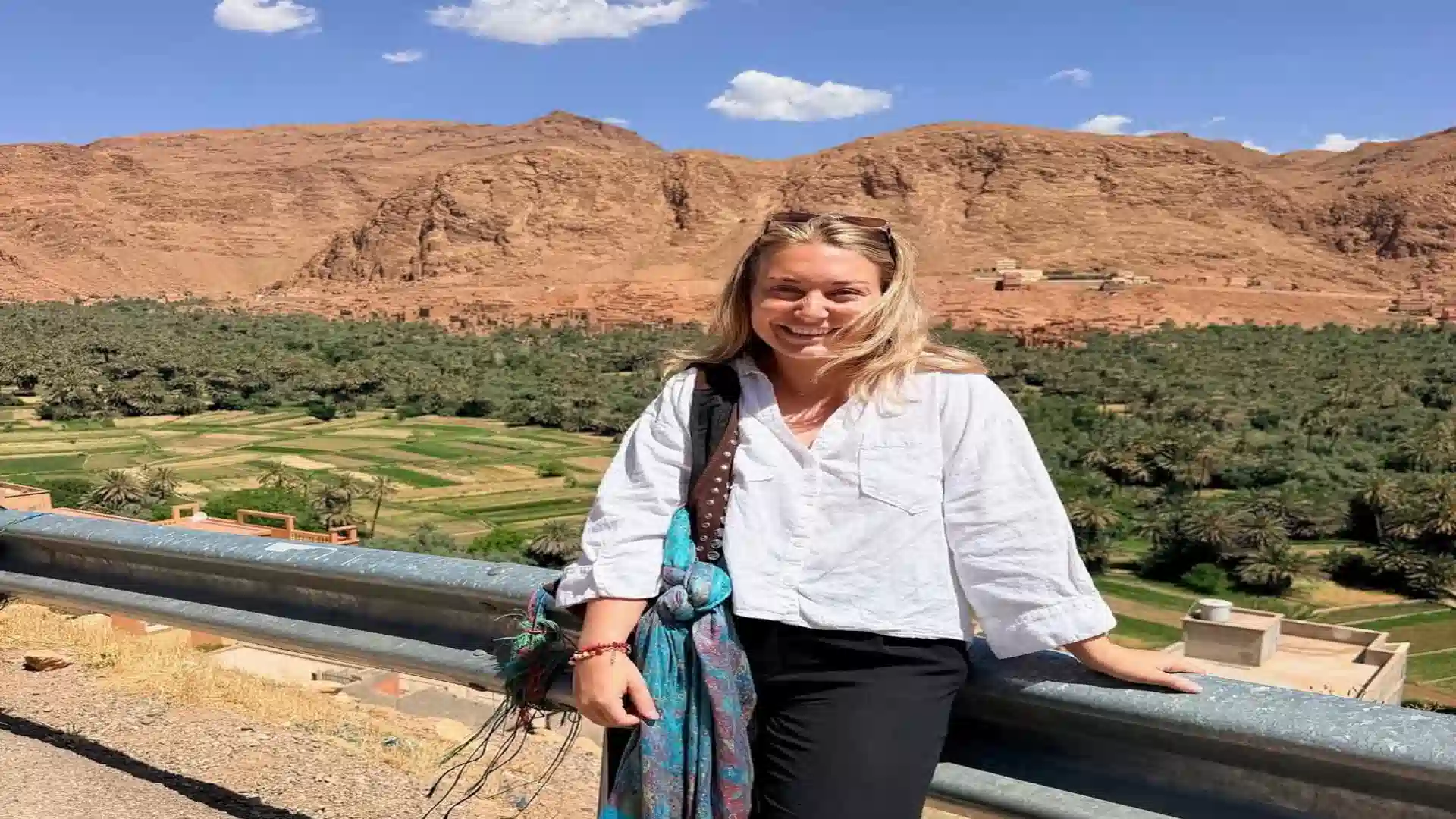
Ouarzazate and the pre-Saharan south, while more conservative in terms of dress code expectations, are overwhelmingly safe and welcoming for solo female travel Morocco – the communities of the Drâa Valley, the Dades Gorge, and the Todra Gorge have been hosting international visitors for decades and have a deep cultural hospitality tradition (rooted in the Berber concept of tifawin – unconditional welcome) that makes solo women feel genuinely hosted rather than merely tolerated.
Morocco Solo Female Safety Tips: Practical Strategies That Work
Morocco Solo Female safety tips:
Travelling alone in Morocco as a woman is most comfortable when built around a few consistent habits that experienced solo female travellers develop quickly:
Navigation: Download Maps.me or Google Maps offline for your destination cities before arrival – knowing where you are going eliminates the body language of uncertainty that attracts attention. In the Fes and Marrakech medinas, the offline maps are accurate to individual alleys and are the single most useful tool for independent navigation.
Accommodation: Morocco riads for solo female travellers are the gold standard of accommodation choice. A riad – a traditional Moroccan townhouse built around a central courtyard – is inherently private, typically family-run, and located within the residential medina fabric rather than on a tourist-facing street. The owners and staff are almost invariably protective toward solo female guests, and a good riad host will happily advise on routes, restaurants, and safe navigation for every day of your stay. Budget riads start from EUR25-EUR40 per night for a private room; mid-range riads with breakfast run EUR50-EUR90 per night; luxury riads cost EUR100-EUR300 per night.
Transport: Use petit taxis (the small coloured taxis that operate within city limits) rather than walking unfamiliar routes at night. Petit taxi fares within medinas are minimal – typically EUR1-EUR3 for most journeys – and the drivers are licensed and regulated. Avoid unmarked vehicles. For intercity transport, CTM buses (Morocco’s premium long-distance bus company) and private tour transfers are the safest options; train travel between Marrakech, Casablanca, and Fes is also excellent and very safe.
Communication: Learn five phrases in Darija (Moroccan Arabic): “la shukran” (no thank you), “safi” (enough/stop), “ana mzawja” (I am married – culturally effective at ending unwanted conversation), “bghit nmshi” (I want to leave), and “ayda police” (I will call the police). These are not expressions of weakness – they are efficient tools for ending unwanted interaction quickly and moving on.
Morocco harassment women situations are best handled with calm, firm, zero-engagement responses. Do not smile apologetically, do not explain yourself, do not engage in extended conversation with the aim of being polite. A flat “la shukran” said once while continuing to walk is the most effective response. Engaging – even to argue or complain – extends the interaction and signals availability for further conversation.
Solo Female Travel Morocco Budget: What Does It Actually Cost?
A solo female travel Morocco budget for a well-structured 10-day trip – covering 2 imperial cities, the Sahara, and a mountain or coastal town – runs approximately as follows:
| Category | Budget Tier | Mid-Range | Comfort Tier |
|---|---|---|---|
| Accommodation (riad, private room) | €25–€40 | €50–€80 | €90–€200 |
| Food (3 meals, local restaurants) | €12–€18 | €20–€35 | €35–€70 |
| Local transport (taxis, buses) | €5–€10 | €10–€20 | €20–€50 |
| Activities & entrance fees | €5–€15 | €15–€30 | €30–€60 |
| Desert tour (per day, private) | — | €130–€190 | €190–€320 |
| Total (Excluding flights & desert) | €47–€83/day | €95–€165/day | €175–€380/day |
For the Morocco desert tour specifically, solo female travel Morocco have two options: joining a shared group desert tour (2–3 days) at €110–€170 per person, or booking a women-only tour at a comparable or slightly higher rate. The women-only tour includes a female co-guide and additional cultural programming. Both options offer strong value compared to similar experiences in East African safari or Jordanian desert tourism.
Morocco Women-Only Tours: The Over Morocco Tours Offering
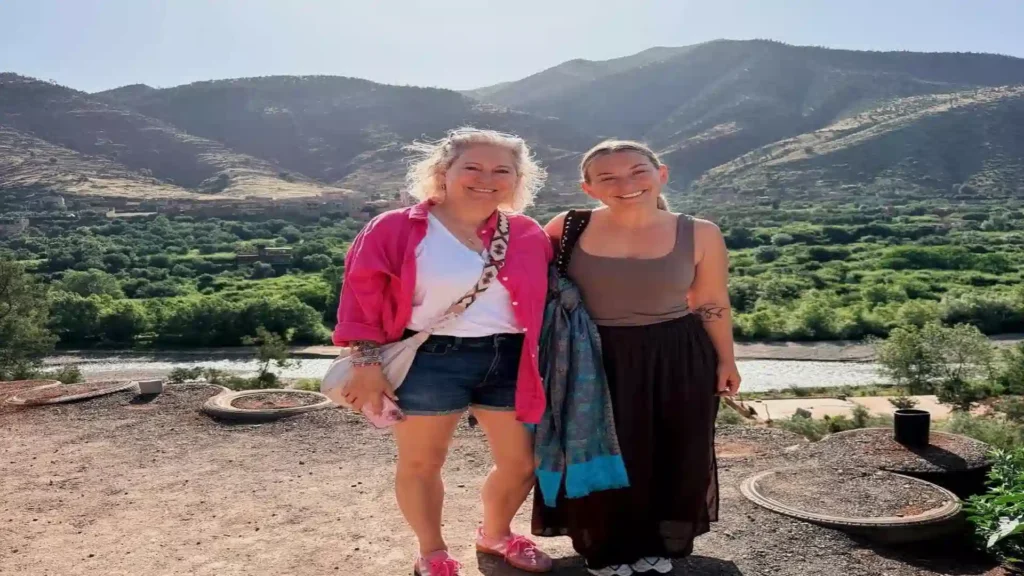
Morocco women-only tours represent one of the fastest-growing segments of Moroccan tourism, driven by the combination of Morocco’s extraordinary landscapes and the desire of solo female travellers to experience them in a comfortable, all-female environment. At Over Morocco Tours, our women-only departures are designed specifically around the solo female travel experience – small groups of maximum 8 women, a female co-guide for all city and medina sections of the tour, accommodation exclusively in owner-run riads vetted for solo female safety tips, and cultural programming that prioritises direct engagement with Moroccan women: visits to women’s argan oil cooperatives in the Sous Valley, cooking lessons with riad cooks, henna sessions with female traditional artists, and tea ceremonies with Berber women in the pre-Saharan villages.
Our Morocco women-only desert tour to Merzouga includes the full Erg Chebbi camel trek and overnight camp experience, conducted with an all-female group and positioned at our preferred private camp location deep in the dunes – away from the road-facing camps that larger mixed-group tours use. The feedback from guests who have done both mixed and women-only Morocco tours is consistent: the women-only format creates a level of openness, spontaneity, and shared experience that mixed tours rarely replicate, particularly in the medina sections of the journey where navigating male attention is a shared challenge rather than a private one.
Important Tip from Guide Yidir: What the Guidebooks Don’t Tell Solo Women
“The thing I tell solo female guests before they arrive is this: the first two hours in a new Moroccan city are always the hardest. You don’t know the layout, you haven’t found your bearings, and every person who calls out feels like a threat. By hour six, you know the neighbourhood, you know the faces, and you walk with completely different energy. The city hasn’t changed – you have.
The single best investment a solo female travel Morocco can make in Morocco is one hour with a licensed guide on the morning of her first day in each new city. Not a full day tour – just one hour of walking the main routes with someone who knows them, pointing out landmarks, showing you the safe shortcuts and the streets to avoid at night. After that one hour, 90% of women tell me they feel completely confident navigating alone. The guide pays for itself immediately.
In the desert, solo women are often the most at ease of any guest we host. There are no medina touts, no souks, no navigation pressure – just the dunes, the camels, the fire, and the stars. Every single solo female guest I have guided in Merzouga has told me the Sahara was their favourite part of Morocco. That never surprises me.”
Yidir, Senior Guide & Co-Founder, Over Morocco Tours
Frequently Asked Questions: Solo Female Travel Morocco
Is Morocco safe for solo female travellers in 2026?
Yes – Morocco is safe for solo female travellers in 2026, with important caveats. Violent crime against tourists is rare. The primary challenge is verbal harassment in busy medina areas, which is manageable with preparation, confident body language, and cultural awareness. The majority of women who travel solo in Morocco describe it as a deeply rewarding experience. Joining a guided tour or women-only group for the first Morocco trip is the most frequently recommended approach by experienced solo female Morocco travellers.
What should a woman wear in Morocco?
In medinas and rural areas, women should cover shoulders and knees – lightweight linen trousers, loose shirts, and maxi skirts are ideal. In resort areas, hotel pools, and internationally-oriented restaurants, Western clothing norms apply. A large lightweight scarf is the single most versatile item to pack. Morocco has no legally enforced female dress code, but dressing modestly significantly reduces unwanted attention in conservative neighbourhoods.
What is the best city in Morocco for solo female travellers?
Chefchaouen is consistently rated the most comfortable and relaxed city for solo female travel Morocco, followed by Essaouira. Among the imperial cities, Fes is generally considered slightly more manageable than Marrakech for solo female navigation. All cities are visitable solo with appropriate preparation.
How do I deal with harassment in Morocco as a woman?
The most effective response to street harassment in Morocco is a single firm “la shukran” (no thank you) while continuing to walk without making eye contact or engaging further. Do not smile apologetically. Do not explain yourself. Continued walking with no further engagement ends the majority of interactions within seconds. Serious harassment can be reported to the Brigade Touristique (tourist police) who are present in all major medinas.
Are there women-only Morocco desert tours?
Yes. Over Morocco Tours offers dedicated Morocco women-only desert tours from both Marrakech and Fes, covering the full Erg Chebbi Sahara experience in a maximum group of 8 women with a female co-guide. These tours include cultural programming specifically designed around engagement with Moroccan women – argan cooperative visits, cooking lessons, henna sessions, and tea ceremonies with Berber families.
Is solo female travel in the Sahara desert safe?
The Merzouga and Erg Chebbi area is one of the safest and most comfortable environments for solo female travel Morocco. The desert camp setting, the small-community environment of Merzouga village, and the tourism-oriented local culture make harassment a non-issue in this part of Morocco. Solo female travellers consistently rate the desert experience as the highlight of their Morocco trip.
What is a good budget for solo female travel in Morocco?
A comfortable solo female travel Morocco budget for a 10 day desert trip (excluding flights) runs EUR95-EUR165 per day at mid-range, covering a private riad room, 3 meals at local restaurants, local transport, and entrance fees. The desert tour portion (2-3 days) adds EUR130-EUR290 per person depending on camp tier and whether you choose private or group travel.
Book a Morocco Women-Only Tour or Private Desert Tour
Over Morocco Tours offers year-round Morocco women-only tours and solo female-friendly private Morocco desert tours from Marrakech and Fes. Our female co-guides, vetted riad accommodation, and small group sizes (maximum 8) are designed specifically around Morocco solo female safety tips experience. Contact our team to discuss your travel dates, budget, and the experience you are looking for – we will build an itinerary that works for you.
Written by the Over Morocco Tours team, Merzouga and Fes, Morocco. Our guides have accompanied solo female travellers through Morocco since 2012 and contribute directly to the first-hand knowledge in this guide.