Is Morocco in Africa? The Complete Answer with Facts, Maps, and Context
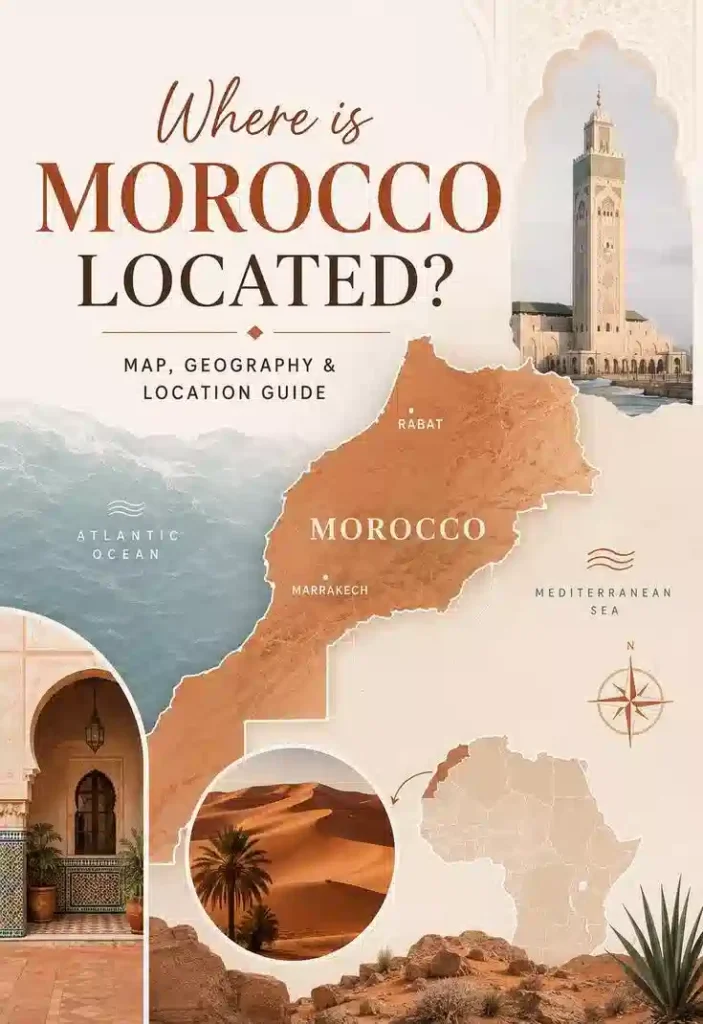
Discover where is Morocco in Africa with this helpful map, geography breakdown, and regional location guide.
Morocco is Arabic-speaking. It follows Islam. It is a member of the Arab League. The same goes for Middle Eastern countries. That overlap leads millions of people to Google questions like “Is Morocco in Africa or the Middle East?” and “What continent is Morocco in?” Or even Where is Morocco located in Africa?” before booking their trips each year. Here’s your definitive answer to that question, with all the geographic information you need about the location of Morocco and the reasons behind the confusion.Short answer: Yes. The longer answer to why so many people ask this question is in the rest of this guide.
Where Is Morocco in Africa? The Direct Answer
Morocco is in Africa unequivocally, geographically and politically, as a North African country in the Maghreb sub-region, a member of the African Union since 2017, and listed under Africa in all international classification systems, including the United Nations, the World Bank, UNESCO, and the International Monetary Fund.
There is no geographic ambiguity here. Morocco:
- Sits on the African continental plate
- Shares its only land borders with African countries (Algeria and Mauritania via Western Sahara)
- Is a full member of the African Union
- Is classified as Africa by every international body
- Has its capital, its largest city, its Sahara Desert, and its Atlas Mountains all on the African continent
Where Is Morocco Located in Africa: The Geographic Facts
Morocco is located in the north-western corner of Africa between 27° and 36° north latitude and between 1° and 13° west longitude. This places Morocco in the Northern Hemisphere at the westernmost part of North Africa, where the continent narrows as it approaches the Strait of Gibraltar.
| Geographic Fact | Detail |
|---|---|
| Continent | Africa |
| Sub-region | North Africa / Maghreb |
| Position on continent | Northwestern corner |
| Closest country (different continent) | Spain, 14 km across the Strait of Gibraltar |
| Northern coast | Mediterranean Sea |
| Western coast | Atlantic Ocean |
| Eastern border | Algeria |
| Southern territory | Western Sahara (administered) |
| Total area | 710,850 km² |
| Africa ranked by size | 5th largest country |
| Global rank by size | 57th |
What Continent Is Morocco In? Morocco On Map
Morocco is in Africa, the continent’s northwestern corner, to be precise.
Morocco’s continental identity is confirmed by every classification, including the following:
- United Nations: Morocco is grouped under the Northern Africa sub-region of Africa
- African Union: Morocco rejoined the African Union in 2017, confirming its continental political identity
- World Bank: Classifies Morocco in the Middle East and North Africa (MENA) region for economic reporting. Note that MENA is an economic and cultural grouping, not a geographic continent classification
- FIFA: Morocco competes in the African Football Confederation (CAF), not UEFA (Europe) or AFC (Asia)
- Olympics: Morocco competes as an African nation
- Geographic convention: All major atlases and geographic reference systems place Morocco in Africa
The one nuance worth understanding: the World Bank’s MENA classification groups Morocco economically with Middle Eastern countries because of shared economic characteristics (oil-adjacent economies, development patterns, and trade relationships). This classification is an administrative convenience, not a geographic statement: Morocco remains in Africa regardless of which economic reporting group it belongs to.
Where Is Morocco in Africa or the Middle East? Why People Ask
But the confusion remains, since Morocco shares four major elements with the Middle Eastern countries: the Arabic language, the Islamic religion, membership in the Arab League, and a broadly shared cultural history that traces back to the 7th-century Islamic expansion.
Here is why the confusion exists and why each factor, on examination, does not change the geographic answer:
Morocco Speaks Arabic, But That Does Not Make It Middle Eastern
Arabic is Morocco’s official language (alongside Tamazight since 2011), but Arabic-speaking countries exist across North Africa, East Africa, and the Arabian Peninsula. Language does not determine continent. The Arabic-speaking countries of Morocco North Africa; Algeria; Tunisia; Libya; and Egypt are all geographically in Africa, regardless of the language they share with the Middle East.
Morocco’s dialect, Darija, is also distinctly Moroccan, heavily influenced by Tamazight (Berber), French, and Spanish in ways that distinguish it clearly from Gulf or Levantine Arabic.
Morocco Is Muslim But So Are Many African Countries
Islam is Morocco’s state religion, practiced by approximately 99% of the population. However, Islam is practiced across a vast geographic range that includes Indonesia, Pakistan, Sub-Saharan Africa, Central Asia, and the Balkans, none of which are considered Middle Eastern for that reason alone. Senegal, Mali, Niger, Somalia, and Nigeria are all predominantly Muslim African countries.
Morocco Is in the Arab League But the Arab League Is Not a Geographic Term
The Arab League is a political and cultural organization whose membership is based on linguistic and cultural criteria, not geography. Its 22 members span a geographic range from Mauritania on Africa’s Atlantic coast to Oman on the Arabian Sea, a distance of over 8,000 km across two continents.
The Middle East Begins East of the Suez Canal
By the most commonly accepted geographic definition, the Middle East refers to the region spanning the Arabian Peninsula, the Levant, Mesopotamia (Iraq), and Persia (Iran). Morocco is over 4,000 kilometers west of the nearest Middle Eastern country, Libya, which separates Morocco from Egypt, which is itself considered a bridge between North Africa and the Middle East. Morocco shares no land border with any Middle Eastern country.
Where Is Morocco in Africa? A Breakdown by Region
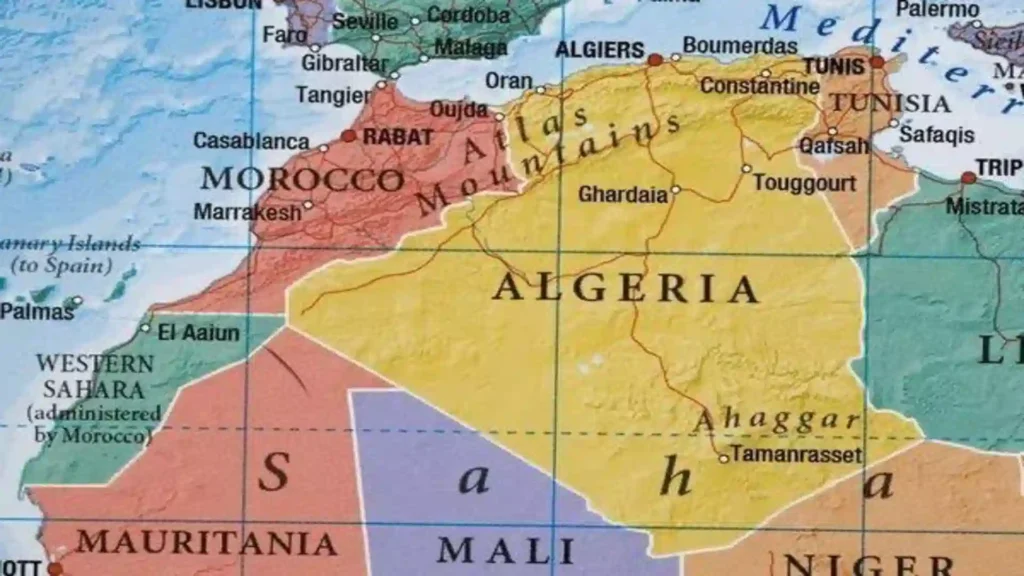
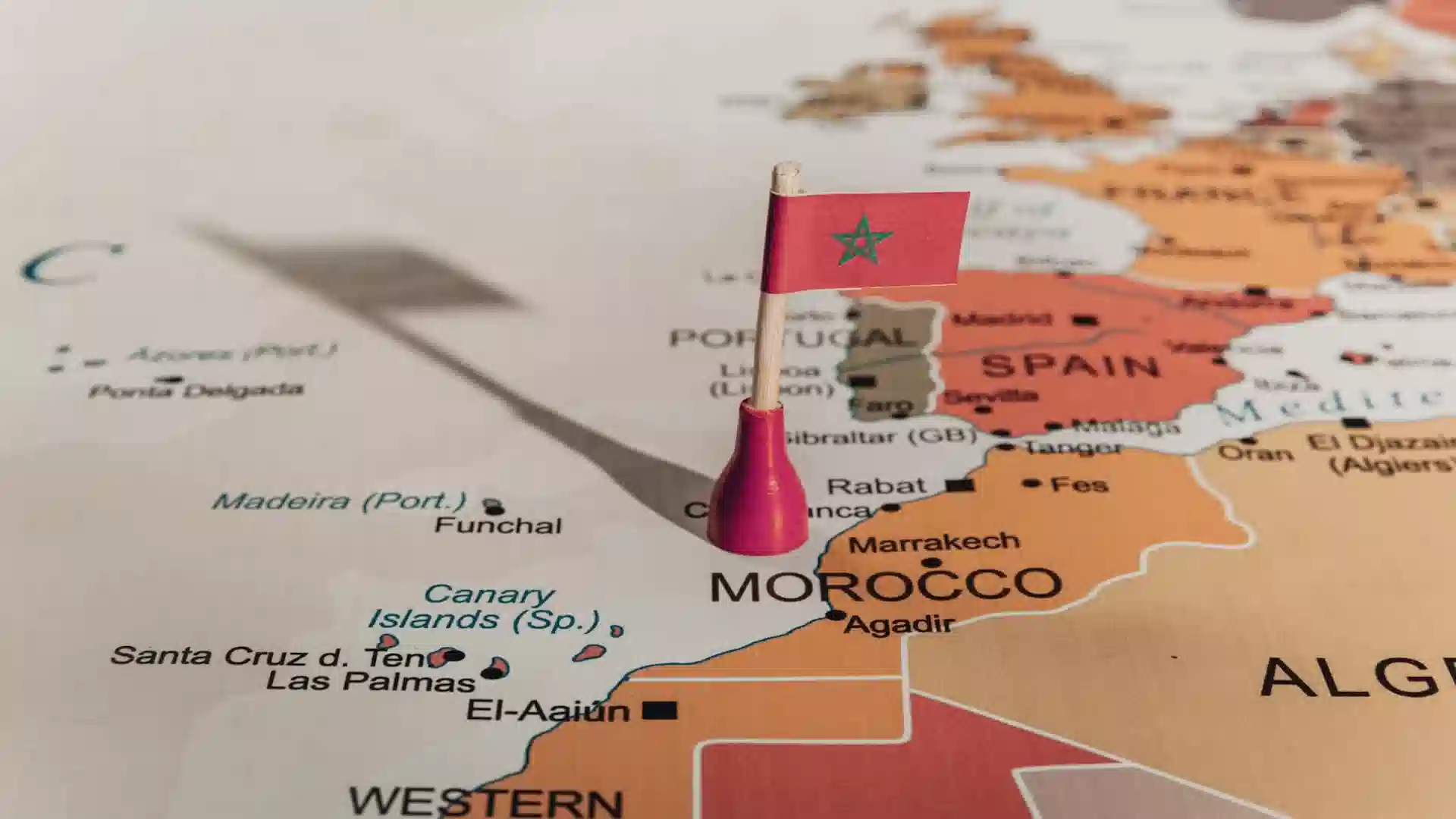
Understanding where is Morocco in Africa on a regional map relative to Northern Africa and the Atlantic coastline.
Morocco is a member of a subregion of Africa called the Maghreb (from the Arabic word for “west,” الـــمَغرِب, al-Maghrib), the North African countries having a common geographic position in the western Mediterranean and Atlantic.
| Country | Position in Maghreb | Capital |
|---|---|---|
| Morocco | Westernmost | Rabat |
| Algeria | Central | Algiers |
| Tunisia | Central-East | Tunis |
| Libya | Eastern | Tripoli |
| Mauritania | Southwestern | Nouakchott |
Morocco is the westernmost of these, positioned where the Maghreb meets the Atlantic Ocean, which is why the country’s Arabic name, Al-Maghrib, translates literally as “the place where the sun sets” or “the West.”
How Close Is Morocco to Europe? Africa’s Gateway to Europe
Morocco is the African country closest to Europe separated from Spain by just 14 kilometers of water across the Strait of Gibraltar, a distance small enough that on clear days the coastlines of both continents are visible to the naked eye from either shore.
This 14-kilometer crossing explains Morocco’s unique position in Africa: a North African country with strong Saharan and sub-continental links to the south and the African country most deeply influenced by European proximity and exchange to the north. In 711 CE, the Umayyad army crossed this stretch and then proceeded to shape the Iberian Peninsula for almost 800 years. And the result is a country that seems neither a simplified “African” nor “Middle Eastern” destination, but something all its own.
Travel distances from Morocco’s major cities to Europe:
| Route | Distance | Flight Time | Ferry Time |
|---|---|---|---|
| Tangier → Tarifa, Spain | 14 km (Strait) | 25 min flight | 35–60 min ferry |
| Casablanca → Madrid | ~1,500 km | ~2h 30m | N/A |
| Marrakech → London | ~2,400 km | ~3h 30m | N/A |
| Marrakech → Paris | ~2,100 km | ~3h 00m | N/A |
| Marrakech → Lisbon | ~1,100 km | ~1h 30m | N/A |
It is roughly 3,600 miles from the US East Coast. Direct flights from New York to Casablanca take about 7 to 8 hours, making Morocco one of the closest African and Arab-world destinations to the United States.
Morocco’s African Geography: Mountains, Desert, and Two Oceans
Morocco is the only country in Africa with coastlines on both the Atlantic Ocean and the Mediterranean Sea at the same time, a dual-ocean coastal position that gives it more than 3,500 kilometers of combined shoreline and one of the most geographically diverse landscapes of any country on the continent.
Morocco’s internal geographic diversity is distinctly African in character:
- The Sahara Desert (south and southeast): Morocco contains two of Africa’s most spectacular dune fields, Erg Chebbi at Merzouga (dunes reaching 150 m) and Erg Chigaga near M’Hamid. The Moroccan Sahara connects directly to the same desert that stretches across Algeria, Mali, Niger, and beyond.
- The Atlas Mountains (center): Three ranges High Atlas (peaking at 4,167 m at Jebel Toubkal, the highest point in North Africa outside the Tibesti), Middle Atlas, and Anti-Atlas form the country’s geological spine and divide the Mediterranean north from the desert south.
- The Atlantic coast (west): Over 2,500 km of Atlantic shoreline, including the major port cities of Casablanca, Rabat, and Agadir, and the world-class surf of Taghazout.
- The Mediterranean coast (north): A 500-km Mediterranean coastline from Tangier to Nador, sharing the same geological plate as southern Spain and the Rif Mountains that mirror the Sierra Nevada across the water.
- The Rif Mountains (north): A distinct mountain chain running parallel to the Mediterranean coast, connected geologically to the Spanish Betic Cordillera on the other side of the Strait.
This combination of Saharan desert, Atlantic coast, Mediterranean coast, and three mountain ranges within a single country is uniquely North African no Middle Eastern country contains this specific geographic combination.
Is Morocco in Africa: Historical Context
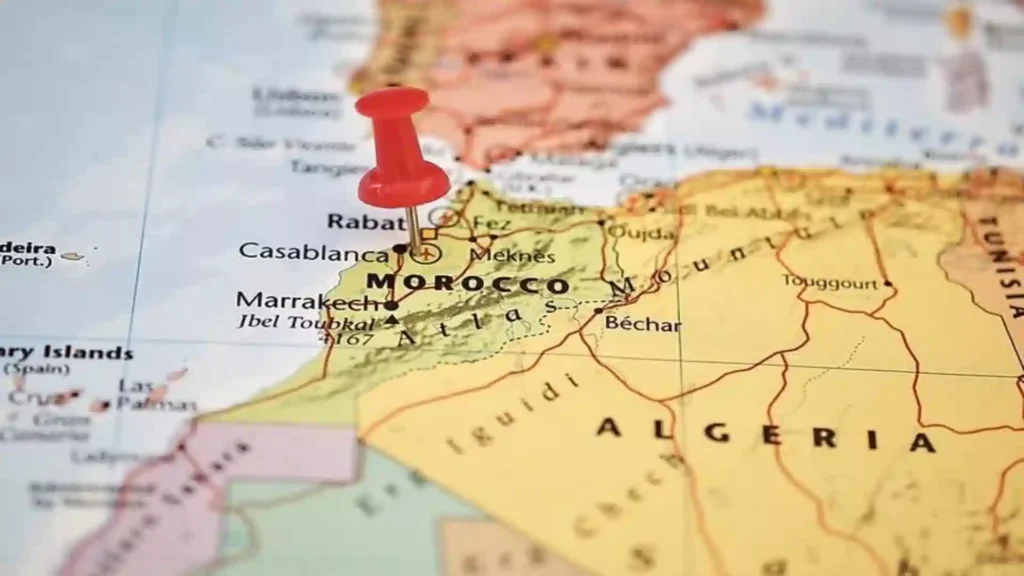
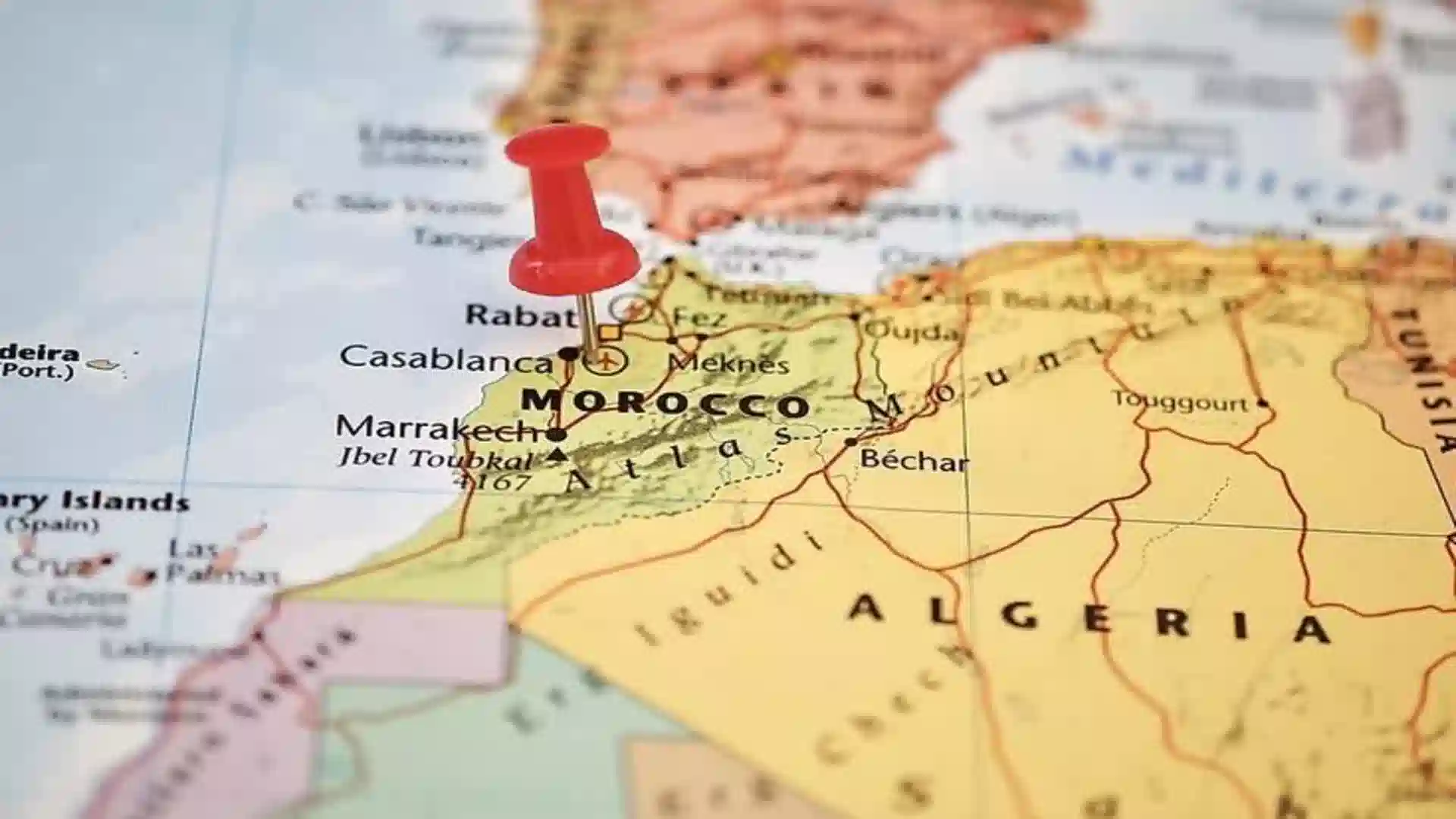
A close-up map view pinpointing exactly where is Morocco in Africa for travelers planning a visit.
Morocco is the only country in Africa with coastlines on both the Atlantic Ocean and the Mediterranean Sea at the same time, a dual-ocean coastal position that gives it more than 3,500 kilometers of combined shoreline and one of the most geographically diverse landscapes of any country on the continent.
Key moments in Morocco’s African historical identity:
- Trans-Saharan trade: For over a millennium, Moroccan merchants, particularly from Marrakech and Fes, controlled the northern terminus of trade routes connecting sub-Saharan Africa (gold, slaves, ivory, and salt) to Mediterranean markets. The city of Sijilmassa near Rissani was the most important trans-Saharan gateway in the medieval world.
- Amazigh (Berber) indigenous heritage: Morocco’s indigenous Amazigh people predate the Arab conquest by thousands of years and share cultural and linguistic roots with Berber communities across North Africa, from Morocco to Libya to the Tuareg of the Sahara.
- Saadian dynasty expansion into West Africa: In 1591, Sultan Ahmad al-Mansur sent a Moroccan army across the Sahara to conquer the Songhai Empire (present-day Mali), establishing Moroccan political authority over Timbuktu for several decades, the furthest south any Moroccan empire extended.
- African Union membership: Morocco was a founding member of the Organisation of African Unity in 1963, withdrew in 1984 over the Western Sahara dispute, and rejoined the reconstituted African Union in 2017, reaffirming its continental political identity.
Is Morocco African or Arab? Understanding the Identity
Morocco is both African and Arab these are not mutually exclusive identities, and reducing Morocco to either one misses the full picture. A more complete answer is that Morocco is an Amazigh (Berber) country with an Arab cultural and linguistic overlay, a Saharan geographic connection to sub-Saharan Africa, a Mediterranean cultural connection to southern Europe, and an Atlantic coastal identity all its own.
| Identity Layer | What It Means | Evidence |
|---|---|---|
| Geographically African | Located on the African continent | Continental plate, African Union membership |
| Indigenous Amazigh | Berber people predate Arab arrival by millennia. | Tamazight is the official language since 2011, ~40% identify as Berber. |
| Arabically | Arab language and Islamic culture since 7th century | Arabic official language, Arab League member |
| Mediterranean | Northern coastline, historical Andalusian connection | Chefchaouen’s blue architecture from Andalusian refugees |
| Atlantic | Western coastline, Atlantic-facing | Essaouira, Agadir, and Casablanca economies |
| Saharan | Southern desert, trans-Saharan trade history | Merzouga, Zagora, Draa Valley |
Visitors who arrive in Morocco expecting it to resemble either a simplified “African” or “Middle Eastern” destination typically discover within the first day that it is neither and that this specificity, this in-between quality that is actually a fully developed identity of its own, is one of the most compelling things about it.
Morocco Compared to Its African Neighbors
Morocco is one of the more developed and diversified countries in Africa, both geographically and culturally and economically a lower-middle-income developing country according to the World Bank, the 6th largest economy in Africa by purchasing power, and also one of the continent’s top tourism destinations, with nearly 17 million international visitors in 2024.
| Country | Location in Africa | GDP per capita (PPP) | Notable Feature |
|---|---|---|---|
| Morocco | Northwest | ~$10,600 | Closest to Europe; two coastlines |
| Algeria | Northwest | ~$14,000 | Largest country in Africa; oil/gas exporter |
| Tunisia | North | ~$12,000 | Smallest Maghreb country; strong olive oil sector |
| Egypt | Northeast | ~$14,500 | Most populous Arab country; Nile civilization |
| Senegal | West | ~$4,200 | Predominantly Muslim West African country |
| South Africa | South | ~$15,400 | Most developed sub-Saharan economy |
Morocco’s position in this table, which is comparable to Algeria and Tunisia in per capita wealth, places it firmly in North Africa’s middle tier, distinctly above the sub-Saharan average but well below European standards.
Where Is Morocco in Africa? : What This Means for Travelers
Travelers care that Morocco is in Africa, not the Middle East or Europe, because it correctly sets expectations for climate, landscape, infrastructure, cultural norms, and accessibility.
What Morocco’s African location means practically for your trip:
- Climate: Morocco’s Saharan south can reach 44°C in summer, distinctly continental African desert heat, not the Mediterranean heat of coastal European countries
- Landscape: The Atlas Mountains, Erg Chebbi dunes, Draa Valley oases, and Atlantic surf beaches are all expressions of a specifically North African geography
- Culture: Morocco’s Amazigh Berber indigenous heritage, older than Arab, older than Islamic, and older than Roman, is an African cultural foundation that shapes everything from the architecture to the carpet patterns to the food
- Accessibility: From Europe, Morocco is the closest African country, 14 km by sea, 1.5 hours by air from Lisbon, and 3.5 hours from London making it uniquely accessible for a first African travel experience
Frequently Asked Questions: Is Morocco in Africa?
Is Morocco part of Africa?
Yes, Morocco is part of Africa. It is located in the northwestern corner of the African continent, in the North African sub-region known as the Maghreb. Morocco’s territory, its borders, and its political membership in the African Union all confirm its African identity.
What continent is Morocco in?
Morocco is in Africa specifically North Africa. Despite sharing linguistic and cultural characteristics with Middle Eastern countries (Arabic language, Islamic religion, and Arab League membership), Morocco is geographically on the African continent and is classified as African by every international geographic and political authority.
Is Morocco in Africa or the Middle East?
Morocco is in Africa, not the Middle East. The Middle East geographically begins east of the Suez Canal and encompasses the Arabian Peninsula, the Levant, and Mesopotamia. Morocco is over 4,000 km to the west. The confusion arises because Morocco is Arabic-speaking and Muslim, characteristics shared with Middle Eastern countries, but these cultural similarities do not change Morocco’s geographic location on the African continent.
Is Morocco part of North Africa?
Yes, Morocco is a North African country and one of the five core members of the Maghreb sub-region of North Africa, alongside Algeria, Tunisia, Libya, and Mauritania.
Is Morocco the closest African country to Europe?
Yes, Morocco is the African country closest to Europe, separated from Spain by just 14 kilometers of water across the Strait of Gibraltar. The ferry from Tangier to Tarifa takes 35–60 minutes.
Does Morocco consider itself African?
Yes, Morocco rejoined the African Union in 2017, competes as an African nation in all international sporting competitions, including FIFA’s African Football Confederation (CAF), and officially identifies as both an African and Arab world nation. Morocco hosted the 2025 Africa Cup of Nations and is preparing to co-host the 2030 FIFA World Cup alongside Spain and Portugal.
Is Morocco part of the Arab world?
Yes, Morocco is a member of the Arab League and considers itself part of the Arab world culturally and linguistically. This Arab identity coexists with its African geographic identity. Morocco is simultaneously African and Arab; just as Egypt is simultaneously African and Arab, these are complementary identities, not contradictory ones.
Is Morocco a Middle Eastern country?
No, Morocco is not a Middle Eastern country by any geographic definition. It is a North African country. The confusion between Morocco and the Middle East arises from cultural and linguistic similarities (Arabic language, Islam), not from geographic facts.
What is Morocco’s capital city in Africa?
Morocco’s capital city is Rabat, located on the Atlantic coast of North Africa at the mouth of the Bou Reggah river. Casablanca is Morocco’s largest city. Marrakech is its most visited tourist city.
Visiting Morocco: Africa’s Most Accessible Destination
Now that you know Morocco is in Africa, specifically the northwestern corner, 14 km from Spain, at the crossroads of the Sahara Desert, the Atlas Mountains, and two oceans, the natural next question is what to do when you get there.
At Over Morocco Tours, we are based in Merzouga and Marrakech, Morocco, Africa. We run private desert tours across the Atlas Mountains and into the Sahara every week of the year, starting from the city that most European visitors land in first and radiating outward toward the dunes, the gorges, the ancient kasbahs, and the palm oases that make this corner of Africa one of the most extraordinary landscapes on earth.
Our most popular starting points:
- First-time visitor: 3 days tour from Marrakech to Merzouga → Ait Ben Haddou → Merzouga
- One week: 7 days Morocco itinerary, Sahara, and Fes
- Two weeks: Grand circuit from Casablanca or Tangier through every major region
Contact Us to Plan Your Africa Trip →
*Based in Merzouga, Morocco, North Africa. Running private tours since 2012.*