Camel Trekking in Merzouga: Everything You Need to Know Before You Go (2026)
Table of Contents
Camel trekking in Merzouga is, without question, the single most iconic experience Morocco has to offer. The moment you climb onto the back of a single-hump dromedary and watch the golden Erg Chebbi dunes rise around you, time stops. The Sahara — endlessly wide, completely silent except for the soft crunch of camel hooves on warm sand — unfolds in every direction, and everything you thought you knew about travel quietly disappears. This is not a tourist gimmick. It is a 3,000-year-old mode of transport across one of the world’s most extraordinary landscapes, still practiced by Berber nomads who have crossed these same sands for generations.
Quick Summary: Camel Trekking in Merzouga at a Glance
What Is Camel Trekking in Merzouga? A First-Timer’s Introduction
Camel trekking in Merzouga means riding a dromedary camel into the Erg Chebbi dune field — the most spectacular sand dune formation in Morocco and either returning after a sunset ride or continuing deeper into the desert to spend the night in a traditional Berber camp. Merzouga itself is a small village of roughly 3,000 people sitting at the precise boundary where the paved road ends and the Sahara Desert begins. The village has existed for centuries as a waypoint on ancient trans-Saharan caravan routes, and camel travel remains embedded in local Berber culture in a way that no other experience in Morocco quite captures.
The camels used for Merzouga camel trekking are dromedaries — single-hump camels native to the deserts of North Africa and the Arabian Peninsula. Unlike their Bactrian relatives in Central Asia, dromedaries are built for extreme heat and long distances on flat sandy terrain. A healthy adult dromedary can carry a rider at a comfortable pace for 6–8 hours without water, covering up to 40 km per day in moderate conditions. In practice, your camel ride Merzouga will cover far shorter distances — typically 4–8 km round trip for a standard sunset trek — but riding the same animal that Saharan traders relied on for millennia adds a layer of historical weight that no 4×4 jeep can replicate.
The Erg Chebbi dune field rises to a maximum height of approximately 150 metres and stretches roughly 22 km from north to south and 5 km from east to west. These dunes are geologically classified as “barchan” dunes — crescent-shaped formations created by winds blowing predominantly from the northeast. The deep orange-red colour that makes Erg Chebbi dunes so visually extraordinary comes from the high iron oxide content in the sand — the same mineral that gives the Sahara its warm, cinematic glow in every photograph you have ever seen of Morocco’s desert.
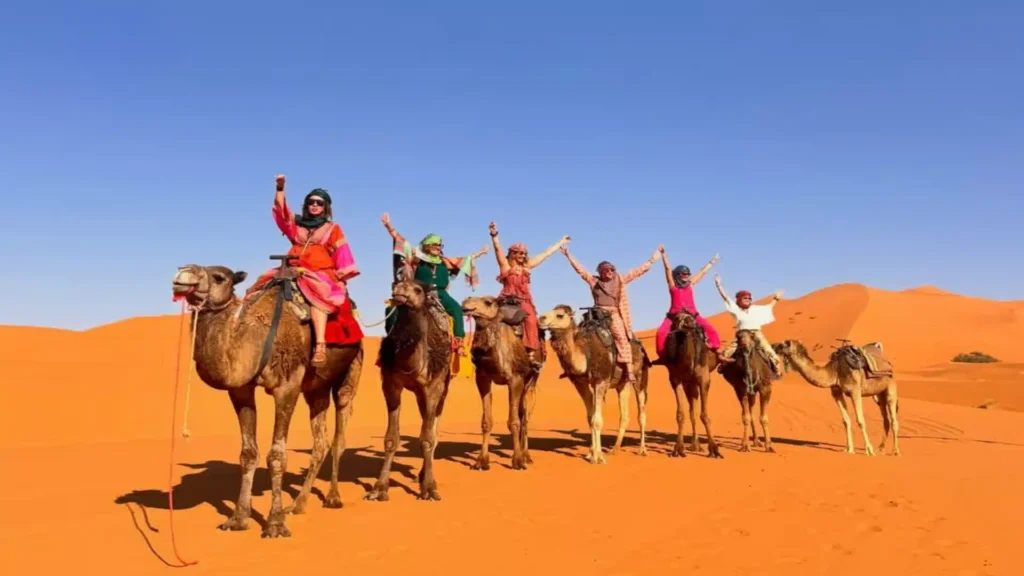
Ready to Book Your Merzouga Desert Camel Tour Now?
Our native Berber guides have been proudly leading authentic camel treks across the expansive Erg Chebbi sand dunes since 2012. We feature private excursions, cooperative group treks, and premium luxury overnight glamping packages fully customized for the 2026 travel season.
Types of Camel Trekking in Merzouga: Which Experience Is Right for You?
Not all camel rides in Merzouga are created equal. Before you book, it is worth understanding exactly what the different types of Merzouga camel trekking involve — because the experience of a 45-minute sunset ride is profoundly different from a full overnight camel trek in the Sahara that includes sleeping in the dune heart under a ceiling of unpolluted stars. Below is an honest breakdown of every option available in 2026.
1. The Sunset Camel Ride (1–2 Hours)
The most popular entry-level option, a sunset camel ride in Morocco typically departs from the edge of Merzouga village around 4:00–5:00 pm (depending on the season) and takes you 3–5 km into the dunes, stopping at a high dune crest to watch the sun sink behind the Atlas Mountains in the west. The return ride back to the village takes place in soft dusk light. Duration: 1 to 2 hours total. This is ideal for travelers who are short on time, physically cautious, or traveling with young children who may not be ready for a full night in the desert.
2. The Overnight Camel Trek in the Sahara (Our Most Popular)
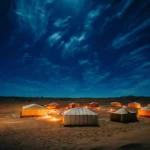
The overnight camel trek Sahara Morocco experience is what most visitors to Merzouga have dreamed about. You depart in the late afternoon — typically 5:00–6:00 pm — riding approximately 1.5 hours into the heart of the Erg Chebbi dune field to reach a traditional Berber camp that is completely invisible from any road. There, you eat dinner under the stars, listen to Gnawa music played by your guides around a campfire, fall asleep in a Berber tent (or under the stars if you prefer), and wake before dawn for the sunrise. The return camel trek back to Merzouga completes the circuit by around 8:00 am. Total camel riding time: approximately 3 hours across two legs.
3. The Multi-Day Camel Safari Across the Erg Chebbi
For serious adventurers and those seeking a genuinely immersive experience, a multi-day camel safari in Morocco involves spending 2–4 consecutive nights in the desert, moving camp each day and covering significant distances through the dune field. This is the closest modern equivalent to the historic trans-Saharan caravan experience. Our guides at Over Morocco Tours plan these routes carefully to ensure each camp is positioned for maximum privacy and sunrise/sunset viewing. Multi-day camel safaris are available from October through April only — the summer heat makes this physically inadvisable.
4. The Private Luxury Camel Trek with Glamping
Over Morocco Tours offers a premium private camel trekking in Merzouga package that combines the overnight camel trek with a luxury Erg Chebbi glamping experience — private en-suite tent with a proper bed, gourmet Moroccan dinner, a personal Berber guide, and a dedicated photographer to capture your Sahara moments. This is the choice of honeymooners, anniversary travelers, and anyone who wants the full emotional impact of the Sahara without compromising on sleep quality. See our luxury glamping section below for the full breakdown.
| Trek Feature | Sunset Camel Ride | Overnight Camel Trek | Luxury Glamping Trek |
|---|---|---|---|
| Total Duration | One to two hours total | Three hours riding plus one night | Three hours riding plus one night |
| Camel Riding | ✔ Included | ✔ Included | ✔ Included |
| Overnight in Dunes | ✘ Not Available | ✔ Deep Dune Camp | ✔ Private Luxury Oasis |
| Dinner Included | ✘ Excluded | Traditional Berber Feast | Gourmet Three-Course Meal |
| Tent Architecture | None Provided | Shared Traditional Tent | Private En-Suite Suite |
| Sunrise Viewing | ✘ Excluded | ✔ Full Sunrise Trek | ✔ Full Sunrise Trek |
| Saharan Stargazing | Limited Twilight View | Full Unpolluted Night | Full Unpolluted Night |
| Price Per Traveler | From €20 – €35 | From €60 – €90 | From €120 – €200+ |
Not Sure Which Camel Trek Is Right for You?
Every traveler holds a unique vision for their journey into the sands. If you are balancing distinct options, simply message our team directly on WhatsApp. One of our local, Merzouga-based guides will personally review your target dates, seasonal group size, and specific budget parameters to help you select the ideal Sahara itinerary with absolutely zero obligation.
The Overnight Camel Trek Experience: A Hour-by-Hour Guide
The overnight camel trek in Merzouga is the experience that most travelers remember for the rest of their lives. To help you know exactly what to expect, here is a detailed hour-by-hour breakdown of what happens during a standard overnight camel ride in Morocco with Over Morocco Tours.
4:00–5:00 PM — Meeting Your Camel at the Edge of the Dunes
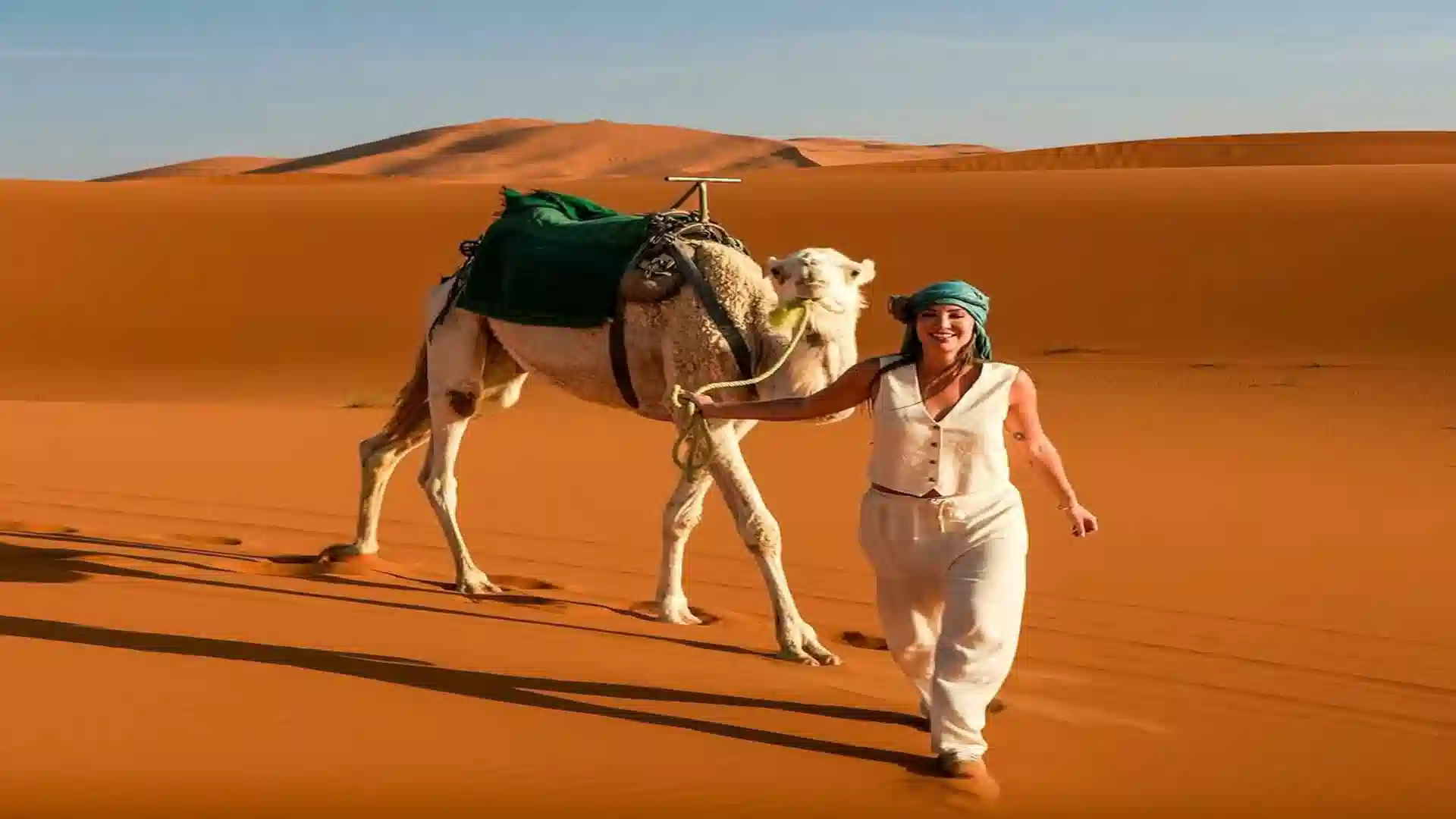
Your guide collects you from your hotel or riad in Merzouga and drives 5–10 minutes to the dune edge, where the camels are waiting. Each camel wears a traditional Berber saddle — a wooden frame covered with woven blankets and padding — with stirrups on both sides for stability. Your guide will introduce you to your camel by name (yes, they have names — common ones include Nour, Barraq, and Sable, meaning “light,” “flash,” and “sand” in Arabic), explain the mounting process, and demonstrate how to hold the saddle properly. Mounting happens while the camel is kneeling; brace your core as it stands, first raising its hindquarters, then its front legs — this rocking motion surprises first-timers every time.
5:00–6:30 PM — The Trek into the Erg Chebbi Dune Heart
The actual camel trekking in Merzouga portion begins. Your Berber guide leads the caravan on foot, holding the lead rope of the first camel while the others follow in single file — a technique unchanged from ancient caravan practice. The pace is a gentle walk: approximately 4–5 km/h. You will notice immediately that the swaying, rolling gait of a dromedary at walking pace is deeply rhythmic and, once you relax your hips and stop gripping with your legs, genuinely comfortable. The dunes grow progressively larger and more dramatic the further you travel from the village. By the time you reach the camp, you will be entirely surrounded by sand in every direction, with no road, no building, and no electric light visible anywhere.
6:30 PM — Sunset at the Crest of the Dunes
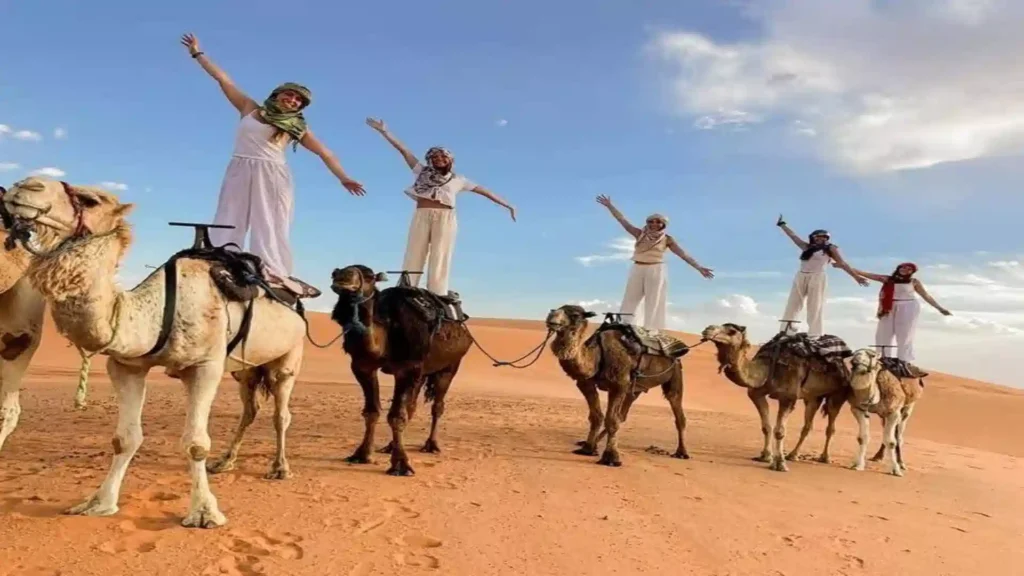
Your guide will time the trek to arrive at a high dune crest precisely as the sun begins to set. The western sky turns amber, then deep orange, then red, then violet. The shadows cast by the dunes grow impossibly long. The temperature, which may have been 30°C+ during the day, begins to drop noticeably. This is the moment every photograph of the Moroccan Sahara attempts to capture, and the real thing — experienced from camelback or from the top of a 50-metre dune — is always more extraordinary than any image can convey.
7:00–10:00 PM — The Desert Camp: Dinner, Music, and Stars
Upon arrival at camp, your guide offers the traditional Moroccan welcome: a glass of sweet mint tea, referred to by locals as “Berber whiskey,” served alongside dates from the Ziz Valley. Dinner is a three-course traditional Moroccan meal: harira soup, a slow-cooked tagine of vegetables and meat, and fresh fruit with honey. After dinner, Berber musicians play guembri and hand drums around the campfire — the same hypnotic Gnawa rhythms that have echoed across the Sahara for centuries. The night sky above Erg Chebbi, completely free of light pollution, reveals the Milky Way in a density rarely visible from anywhere in Europe or North America. Stargazing is simply a function of looking up.
5:00–6:00 AM — Sunrise Over the Sahara Desert
Your guide wakes you 45 minutes before sunrise. You climb a dune — either on foot or via the camel — and watch the eastern horizon shift from black to deep blue to gold. The dunes, which are orange-red in the day, appear silver-blue in pre-dawn light, then transform to copper and flame as the sun clears the horizon. This is, without exception, the most photographed moment of every Merzouga camel trekking experience, and consistently rated by travelers as the highlight of their entire Morocco trip.
6:30–8:00 AM — The Return Camel Trek to Merzouga
After breakfast — mint tea, bread, amlou (almond and argan oil paste), honey, and eggs cooked on a camp stove — you mount your camels for the return journey. The morning light is cool, the dunes cast long shadows in the opposite direction from the evening, and the Erg Chebbi landscape looks completely different from how it appeared at dusk. Back at the village by 7:30–8:30 am, your guide returns you to your accommodation, ready for a day of rest or onward travel toward Fes or Marrakech.
How Much Does Camel Trekking in Merzouga Cost in 2026?
Camel trekking in Merzouga cost varies significantly depending on the type of experience, whether you book privately or as part of a group tour, and which operator you choose. Here is an honest, transparent 2026 price breakdown based on what Over Morocco Tours currently charges — with no hidden fees, a policy we are firm about.
Standalone Camel Trek Prices (Without Tour Package)
- 1-hour sunset camel ride in Merzouga (group): €20–30 per person
- 2-hour sunset camel ride (private, 2 people): €35–50 per person
- Overnight camel trek Sahara Morocco (group camp, shared tent): €60–90 per person, including dinner and breakfast
- Overnight camel trek (private camp, private tent): €90–130 per person for 2 people
- Luxury overnight camel trek + Erg Chebbi glamping (private en-suite tent, gourmet meals): €150–220 per person for 2 people
- Multi-day camel safari (2 nights/3 days): from €250 per person, full board
Camel Trek Included in a Desert Tour Package
When you book one of our multi-day Morocco desert tours — such as the popular 3-day tour from Marrakech to Merzouga — the overnight camel ride in Morocco and desert camp are included in the tour price. In this case, the effective cost of the camel trek itself drops to €40–60 per person equivalent within the overall package, making it significantly better value than booking a standalone trek with a separate local operator after arrival.
💡
Understanding Exclusions & Inclusions
When evaluating the total cost of your journey, it is helpful to note what is typically not included in a standard Merzouga camel trek price. Personal expenses such as discretionary gratuities for your hard-working camel guide, where a baseline of €5 to €10 per traveler is standard and deeply appreciated, are handled independently. Additionally, specialized alcoholic beverages at the desert camp, optional recreational activities like sandboarding down the high crests or renting quad bikes, and your personal travel insurance policies remain outside the base rate. Beyond these specific items, everything else required for a seamless experience is fully covered. Your assigned dromedary, the traditional riding saddle, heavy wool blankets for cool desert nights, a multi-course dinner, a fresh morning breakfast, and the complete return trek come standard in all Over Morocco Tours packages with absolutely no hidden additional charges.
Should You Haggle on Camel Trek Prices in Merzouga?
If you book directly in the village after arrival, you may encounter operators quoting lower initial prices and then adding charges for “tent upgrades,” dinner, and return transport. At Over Morocco Tours, we quote a single all-inclusive price before you confirm — what we quote is what you pay, with no surprises at camp. This is one of the reasons our TripAdvisor rating sits at 10.0 Superb with consistent reviews praising our transparency.
Get Your Custom Camel Trek Quote for 2026
Every desert safari across Erg Chebbi can be fully tailored to match your specific style. Simply reach out to share your target travel dates, estimated group size, and personal camping preferences. Our local team will compile and deliver a comprehensive, completely no-obligation custom price calculation directly to you within 24 hours. Best of all, we maintain a strict honest-pricing policy, meaning you will face absolutely zero hidden fees or surprise upcharges at camp, ever.
Best Time for Camel Trekking in Merzouga: Month-by-Month Guide
Knowing the best time for camel trekking in Merzouga is essential — the Sahara Desert has extreme seasonal variations, and the wrong month can turn your dream experience into something genuinely uncomfortable. The good news is that Merzouga has two excellent windows for camel trekking, one in spring and one in autumn.
Merzouga Climate & Seasonal Experience Matrix
Spring (March–May): The Best Season for Camel Trekking in Merzouga
Spring is the finest time for camel trekking in Merzouga. Daytime temperatures between 25°C and 34°C are warm enough to feel like a genuine desert but comfortable enough for prolonged camel riding. The nights cool pleasantly to 9–16°C — perfect for sleeping under the stars. The Erg Chebbi dunes display their most dramatic orange-red colouring in spring light, wildflowers briefly dot the rocky plain around the village after winter rains, and the Draa and Ziz Valleys on the drive south from Marrakech are at their most lush and green.
Autumn (October–November): Second-Best Season for Sahara Camel Riding
October and November offer the second peak window for camel riding in Morocco. The summer heat has dissipated, temperatures are near-ideal (25–30°C by day, 8–14°C by night), and the crowds of peak March–April have thinned. October in particular often produces extraordinary visibility — the air is exceptionally clear after the summer heat haze, and sunrises over Erg Chebbi in mid-October are among the most spectacular of the entire year.
Summer (June–August): Can You Still Trek?
Technically, camel trekking in Merzouga operates year-round, and some of our most adventurous guests specifically choose a summer visit. However, midday temperatures in July and August regularly exceed 43°C. Our summer departure for camel treks shifts to 6:00 am (to catch the cooler morning) or 6:30 pm (sunset into the cool night), and all midday activity is abandoned. Luxury camps close their outdoor activities during peak summer. If you visit in summer, an overnight camel trek from 6:30 pm onward remains genuinely enjoyable — the nights cool rapidly after dark, and the Sahara at midnight in August is a uniquely beautiful experience.
Winter (December–February): Cold Nights, Empty Dunes
Winter camel rides in Merzouga offer something few travelers expect from the Sahara: genuine cold. Desert nights in January can drop to 0–3°C, and frost is occasionally observed on the sand surface. Daytime riding is comfortable and clear-skied, but the overnight camel trek requires serious layering. The dramatic upside is that the dunes are nearly empty of other tourists, camp fires burn all night, and the winter Milky Way above Erg Chebbi is astonishing. Bring your warmest jacket.
Moonphase Tip: When planning your overnight camel trek Sahara Morocco, check the lunar calendar. A new moon (no moonlight) gives you the darkest skies and the most extraordinary stargazing. A full moon floods the dunes in silver light and creates a completely different — equally magical experience. Both are worth planning around.
What to Wear for Camel Trekking in Merzouga: The Complete Packing Guide
Knowing what to wear for camel trekking in Merzouga can make the difference between a comfortable, joyful experience and a sore, sunburned, chilly one. The Sahara Desert presents an unusual clothing challenge: it can be intensely hot during the afternoon ride, cool rapidly after sunset, and genuinely cold by 3:00 am. Layering is the entire strategy.
The Complete Sahara Packing Guide
Essential preparation guidelines for an optimal Erg Chebbi desert experience
Essential Clothing & Riding Gear
Selecting proper apparel is vital for a comfortable journey across the dunes. We highly recommend wearing long, loose linen or cotton trousers, as standard shorts will cause severe chafing on rugged camel saddles while exposing your skin to intense UV rays. Pair these with a long-sleeve, lightweight breathable shirt to maintain all-day sun protection. Because the desert climate drops rapidly after dusk, always pack a warm fleece or down jacket, even during the milder spring months. For winter expeditions, adding a thin wool or thermal underlayer is indispensable for a comfortable sleep inside the desert camps. To protect your face, a traditional tagelmust cotton headscarf is highly functional; our local guides will gladly show you how to wrap this Berber turban to keep out sun, sand, and cool night winds. Finally, bypass open sandals which sink quickly into soft sand, opting instead for sturdy closed-toe sneakers alongside thick socks if riding during cooler weather patterns.
Sun, Skin, & Environmental Protection
The Saharan atmosphere is incredibly arid and demanding on your skin, requiring dedicated protection regardless of the season. Bring along a premium sunscreen rated SPF50+ or higher and make it a habit to reapply every two hours, as the desert reflection amplifies solar exposure even during peak winter months. Protect your vision with high-quality UV-blocking sunglasses, ideally choosing a wrap-around style that seals your eyes against sweeping fine sand particles. The dry desert air will also crack unprotected skin very quickly, so keep a dedicated SPF lip balm in your pocket for continuous application. It is also wise to bring a small tube of soothing aloe vera gel to address any mild skin irritation or unexpected sunburns, though these can also be sourced at local pharmacies in Merzouga prior to setting out.
Camera Equipment & Electronics Protection
Capturing the vast scale of Erg Chebbi requires specialized care to prevent environmental damage to your electronics. If you are packing a mirrorless or DSLR camera, a wide-angle lens is highly recommended to properly frame the towering dune landscapes. Be sure to carry multiple extra camera batteries, as the cold desert night temperatures drain modern lithium cells significantly faster than normal. The fine, microscopic silt of the Sahara can easily ruin delicate focus rings and ports, so keep all smartphones, lenses, and memory cards sealed tightly inside secure ziplock bags whenever they are not actively in use. Additionally, pack a high-capacity portable power bank because standard wilderness bivouacs do not provide electrical outlets, and keep a small headlamp or torch easily accessible to safely navigate your way around the dark camp spaces at night.
Essential Overnight Logistics
Managing your personal luggage strategically ensures a smooth transition from your main vehicle to the camel caravan. You should isolate your overnight gear into a small daypack restricted to a maximum capacity of 30 liters, as standard camel saddlebags feature limited physical space. Leave your primary hard luggage secured safely in our locked transit van back at the dune-line basin. Because automated teller machines do not exist deep within the Erg Chebbi dune heart, remember to carry a sufficient amount of cash in local currency to handle guide tips, driver gratuities, and optional beverage add-ons. Do not forget to include your daily personal medications alongside a basic compact first-aid kit. If you happen to be a light sleeper, packing a reliable pair of earplugs is highly recommended; while the deep desert environment is profoundly silent, ambient noise or snoring from neighboring guest tents can carry across the camp. Finally, maintain a physical photocopy of your passport within your bag to satisfy any official desert safety registration protocols required by local regional authorities.
What NOT to Bring on a Merzouga Camel Trek
Streamlining your luggage prior to setting out is essential for the comfort of our animals and the preservation of our pristine natural surroundings. Please be aware that rigid, hard-shell suitcases are completely impossible to secure safely onto camel saddles, making them entirely impractical for the journey across the dune line. Leave all high heels, formal dress shoes, and aerosol sprays behind, as specific aerosol products are restricted across ecologically sensitive desert preservation zones. In strict alignment with local conservation practices, our regional guides strictly follow leave-no-trace ethics and ask all guests to avoid carrying single-use plastics into the dunes. Finally, minimize risk by leaving any unnecessary valuables, corporate laptops, fine jewelry, and spare electronic gadgets securely inside our locked storage facilities or at your staging hotel in Merzouga, allowing you to immerse yourself fully in the desert environment without distraction.
Is Camel Trekking in Merzouga Safe? What Every Traveler Should Know
Camel trekking in Merzouga is safe when conducted with a reputable operator whose guides are trained, whose camels are healthy, and whose itineraries account for weather and physical limitations. Over Morocco Tours has operated in the Erg Chebbi dune field for over 14 years without any serious incident on our camel treks — a record we attribute to strict guide training, regular camel health checks, and honest communication with clients before departure.
Camel Health and Welfare Standards
The dromedaries used for camel riding in Morocco by reputable operators are working animals whose health and wellbeing directly affects the quality of your experience. Over Morocco Tours’ camels receive regular veterinary checks, are never ridden during the hottest hours of the day in summer, and carry a maximum of one adult rider per camel at a time. We do not operate “double loading” of camels regardless of request. If you book with any Merzouga operator, you are entitled to ask about their camel health protocols — a good operator will answer without hesitation.
Physical Considerations for the Camel Ride
Most healthy adults can complete a standard camel trek Merzouga without issue. However, be aware of the following: the mounting and dismounting motion (which involves a sudden rocking as the camel kneels and rises) can be jarring for people with lower back conditions, hip replacements, or weak knees. For guests with these conditions, we recommend a 4×4 vehicle to the camp instead, followed by a short 15-minute ceremonial camel ride on flatter ground near camp. Pregnant travelers beyond 12 weeks should not ride camels. Children as young as 5 can comfortably ride in front of an adult on a single camel with a guide walking alongside.
Getting Lost in the Sahara: Is It a Real Risk?
The dunes of Erg Chebbi are navigated by our Berber guides using generational knowledge of the terrain — the same landmarks, wind patterns, and star positions that their ancestors used across the same desert. Modern GPS backup is also carried by every Over Morocco Tours guide on overnight camel safaris in Morocco. Getting lost is genuinely not a risk with a professional operator. Attempting to wander independently into the dune field, however — which a small number of overconfident visitors do each year — is a different matter entirely and strongly discouraged.
Safety Checklist Before You Mount
Prior to officially mounting your camel caravan and heading into the vast wilderness of the Erg Chebbi dunes, executing a few brief safety protocols ensures a completely seamless experience. Always confirm that your lead desert guide’s name is registered clearly with the front desk of your staging hotel, and share your expected return timeline with a trusted contact or property manager who is not joining the trek. Keep your local guide’s cellular phone number saved on your device for immediate access. Hydration remains the single most important factor under the Saharan sun, so always carry significantly more bottled water than you assume you will need, maintaining a strict minimum of two liters per person for a brief sunset ride and upwards of three liters or more for a complete overnight stay. Finally, to ensure total physical safety amidst the shifting sands where landmarks look identical in the dark, never leave the perimeter of your base camp alone at night without explicitly informing your guide of your movements.
Photography Tips for Your Merzouga Camel Trek: Get the Perfect Shot
The Merzouga camel trekking experience is one of the most photogenic on earth — dromedary silhouettes against a burning Sahara sky are among the most reproduced images in all of travel photography. But getting those iconic shots requires more than just pointing your phone at the horizon. Our guides take photographs for every guest during the trek, and over 14 years they have developed a clear set of techniques that consistently produce the images you see on our website. Here they are.
Timing Is Everything for Erg Chebbi Photography
The “golden hour” in Merzouga — the 45 minutes before sunset and 30 minutes after sunrise — is when the angle of the sun creates the long, dramatic shadows across the dune faces that define Sahara photography. Midday light is flat and harsh; the dunes lose their three-dimensional drama entirely. This is another reason why the overnight camel trek Sahara Morocco automatically delivers better photographs than a midday excursion — you are in the dunes during both peak lighting windows.
Shoot from Behind, Not From the Front
The iconic “camel silhouette against the sunset” shot is always taken from behind the last camel in the caravan, with the sun ahead and low. Ask your guide to let you dismount briefly and position yourself 20 metres behind the procession for a 60-second shoot, then remount. Our guides are very used to this request and always accommodate it.
Protect Your Gear from Sand
Fine Sahara sand is extraordinarily invasive. A single gust of wind at a dune crest can introduce particles into lens mechanisms in seconds. Always carry a soft lens cloth, keep your lens cap on between shots, and store cameras in a ziplock bag inside your daypack when not actively shooting. Mirrorless cameras with sealed bodies (such as the Sony A7 series or Fujifilm XT-5) perform significantly better in desert conditions than older DSLR bodies with larger gaps around the mirror box.
How to Combine Camel Trekking in Merzouga with a Full Morocco Desert Tour
Most travelers who experience camel trekking in Merzouga do not arrive directly from an airport. Merzouga is located approximately 350 km from Marrakech and 400 km from Fes — both of which require a full day of driving to reach, though the road passes through some of Morocco’s most spectacular landscapes. The most popular structure for combining a Merzouga camel trek with the broader Morocco experience is a 3, 4, or 5-day desert tour that departs from Marrakech or Fes, spending 1 night at the Erg Chebbi camp, and either returns or continues to the other city.
The Marrakech to Merzouga Desert Tour (Most Popular Route)
The classic private Marrakech to Merzouga camel trek itinerary travels south through the Tizi n’Tichka pass (2,260 metres), visits the UNESCO-listed Ait Ben Haddou kasbah, passes through Ouarzazate (known as “the Hollywood of Morocco”), winds through the Dades Valley and Todra Gorge, and arrives at Merzouga in time for the sunset camel ride in Morocco. This entire route — not just the camel trek itself — is what makes a Merzouga desert tour an extraordinary week of travel rather than a simple dune-and-camel day trip.
Connecting Merzouga to Fes (Marrakech–Desert–Fes Circuit)
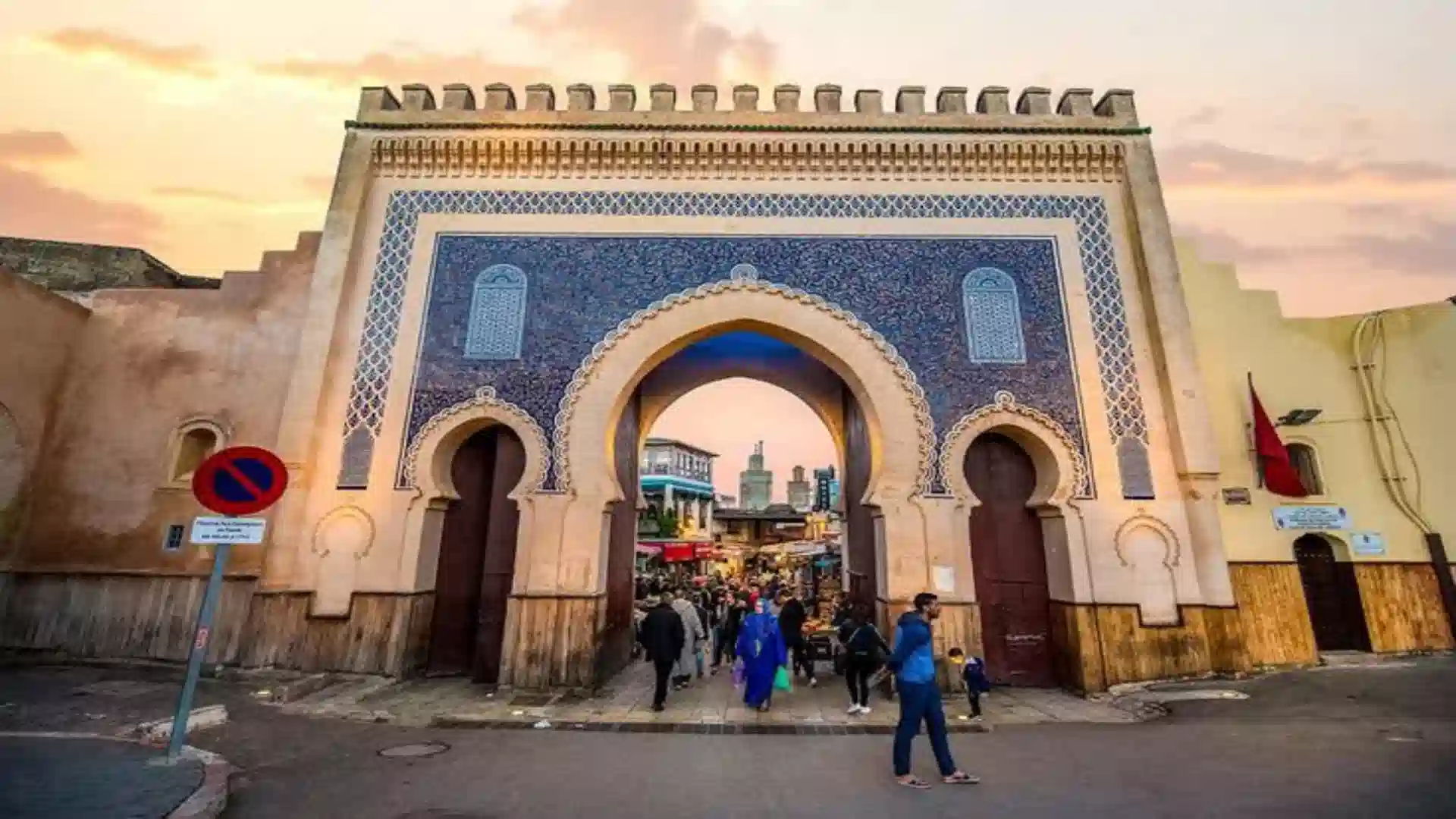
For travelers flying in and out of different cities, the Marrakech → Merzouga → Fes circuit (typically 3–5 days) is the single most efficient way to combine a camel safari Morocco with visits to Morocco’s imperial cities. You see the Sahara, the Atlas Mountains, the ancient medina of Fes, and the desert kasbahs of the south — all without backtracking. Over Morocco Tours runs this as a private or shared circuit year-round.
Why Book Your Camel Trek with Over Morocco Tours?
There are dozens of operators offering camel trekking in Merzouga. Here is why thousands of travelers choose Over Morocco Tours for their camel ride in Morocco, and why our TripAdvisor rating has held at a perfect 10.0 Superb for over three years running.
We Live in Merzouga — This Is Our Home
Unlike tour companies based in Marrakech that subcontract desert activities to local operators, Over Morocco Tours is headquartered at the Centre of Merzouga, N13 — on the edge of the Erg Chebbi dune field itself. Our guides are native Berbers who grew up with this desert as their backyard. They know which dune faces catch the best morning light, which wind directions indicate incoming sandstorms, which camp locations provide the deepest silence and the clearest sky. This is not information you can learn from a guidebook. It comes from a lifetime in the Sahara.
Transparent Pricing with No Hidden Fees
Our policy is simple: what we quote for your Merzouga camel trek is the final price. We do not add “tent upgrade” charges, “dinner supplement” fees, or “return transport” extras at camp. Traveler after traveler in our TripAdvisor reviews cites our pricing transparency as one of the primary reasons they chose us and would choose us again. One guest — Des1963, writing in April 2025 after a 10-day tour — specifically praised: “Communication with Hassan was always excellent… As the owner of the company, he understands customer care.”
Sustainable, Berber-Led Desert Excursions
Our camel trekking in Merzouga is designed to benefit the local Berber community directly. All of our camel guides are from Merzouga and the surrounding desert villages. Our camps source their food from local producers in the Ziz Valley and Draa region. We practice a strict Leave No Trace policy: all waste generated at our desert camps is packed out. This is sustainable Morocco travel in practice, not just in marketing language — and it matters to the long-term health of the desert environment that makes the Merzouga camel trek so extraordinary in the first place.
“Visiting Morocco with Mohammed and Said was an amazing experience. Their warmth and hospitality made the trip enjoyable and interesting. Seeing an oasis, the river that gives it life, and tasting the dates and olives that are harvested there — the music and landscapes of Morocco are mesmerizing.”
Receiving feedback highlighting the local hospitality of our team, including Mohammed and Said, underscores our primary operational philosophy. We take great pride in showing travelers the true pulse of southern Morocco’s ecosystems—guiding you into hidden palm oases, illustrating how ancient river channels sustain agricultural communities, and sharing authentic cultural elements from traditional drum rhythms to locally harvested provisions. This attention to detail ensures your desert exploration transitions seamlessly from a standard vacation into a genuinely life-changing immersion.
Merzouga Camel Trekking: Frequently Asked Questions
Expert local insights to help prepare you for an unforgettable desert expedition
Is camel trekking in Merzouga suitable for beginners who have never ridden a camel?
Yes, camel trekking across the Merzouga region is entirely suitable for absolute beginners, and no prior equestrian or riding experience is required. The dromedary camels selected for our desert treks throughout Erg Chebbi are meticulously trained, remarkably calm, and thoroughly accustomed to carrying first-time riders of all ages. Your dedicated Berber guide walks directly alongside the lead camel on foot, maintaining complete control over the caravan’s pace at all times. The only specific moment requiring a bit of focus is the initial mounting and dismounting motion, which occurs while the camel is kneeling on the ground. As the animal rises or settles, it creates a distinct, dual-stage rocking motion that requires you to lean back slightly. Your local guide will physically demonstrate and support you through this brief process, and most travelers find themselves feeling completely relaxed and comfortable within the first ten to fifteen minutes of starting the trek.
How long does a camel ride in Merzouga take?
The standard duration of a camel ride in Merzouga varies based on your chosen package, ranging from a short one-hour sunset excursion to approximately one and a half hours each direction for a full overnight trek into the deep heart of the Erg Chebbi dune field. Moving at the dromedary’s natural, unhurried walking pace of four to five kilometers per hour, a standard ninety-minute journey safely covers an overland distance of roughly six to seven kilometers into the shifting sands. The return journey the following morning follows the exact same duration and pace. This brings the total camel riding time for an overnight experience to approximately three hours distributed evenly across two distinct legs, which leaves you with plenty of extra hours to enjoy the tranquility and hospitality of our desert camp spaces.
What is the difference between camel trekking in Merzouga and Zagora?
The fundamental difference between camel trekking in Merzouga versus Zagora centers entirely on the sheer scale and visual quality of the dune formations. Merzouga’s world-famous Erg Chebbi dunes reach immense heights of up to 150 meters and stretch continuously across twenty-two kilometers, instantly creating the dramatic, cinematic Saharan horizon that most international travelers envision. In contrast, Zagora’s Tinfou dunes are significantly smaller, topping out at a modest ten to fifteen meters amidst a flatter, more rocky desert landscape that is far less spectacular. Furthermore, Merzouga offers an optimized travel layout from northern transport hubs, requiring an approximate seven-hour drive from Fes. The camel trekking infrastructure in Merzouga is exceptionally well-established, offering an extensive variety of accommodation options ranging from traditional standard bivouacs to ultra-luxury private glamping camps, making it the superior choice for an authentic desert immersion.
Can I do a private camel trek in Merzouga just for my couple or family?
Yes, organizing fully private camel treks tailored exclusively for couples, honeymooners, or families is an absolute specialty of Over Morocco Tours. Securing a private package guarantees that your travel group has its own dedicated Berber guide, a completely independent camel caravan, and a private camp infrastructure separated entirely from external bookings. These customized treks depart strictly on your preferred personal schedule rather than a rigid group timeline. This allows your assigned guide to tailor the pacing, integrate spontaneous photography stops along the crests, and cater closely to your family’s personal interests. While private overnight treks carry a minor premium over shared group rates, they represent the most memorable, intimate, and deeply immersive way to experience the stillness of the Sahara.
What should I wear for a camel ride in the Sahara Desert?
For an optimal camel ride experience, we highly advise wearing long, loose-fitting trousers to prevent the thick leather of the saddle from chafing your inner thighs, paired with a lightweight, long-sleeve shirt to shield your skin from continuous solar exposure. Sturdy closed-toe footwear is essential to prevent hot sand from spilling into your shoes, and carrying a protective headscarf or traditional Berber tagelmust is highly advantageous. Your local guide will gladly help you wrap this turban prior to departure to shield your face from intense sun, sweeping sand, and cool evening winds. Remember to apply premium SPF50+ sunscreen and wear quality UV400 sunglasses before setting out. For overnight treks, it is equally critical to pack a heavy fleece or down jacket alongside thermal underlayers to stay fully insulated during the deep hours between midnight and dawn, when desert temperatures drop significantly.
How much does camel trekking in Merzouga cost in 2026?
In 2026, standalone camel trekking prices in Merzouga typically range from €20 to €35 per traveler for a standard one-to-two-hour sunset excursion. Complete overnight desert experiences range between €60 and €130 per person, encompassing your camel assets, a multi-course traditional dinner, overnight accommodation inside a classic Berber tent, and a fresh breakfast the following morning. For those preferring premium comforts, luxury private glamping packages featuring fully en-suite bathroom facilities and gourmet dining range from €150 to €220 per traveler based on double occupancy. When these desert experiences are booked as part of our multi-day overland tours departing from Marrakech or Fes, the overall cumulative value is highly optimized, and Over Morocco Tours guarantees a strict transparent pricing policy covering all meals, tents, and transport assets with zero hidden operational fees.
Can I combine a camel trek in Merzouga with other desert activities?
Yes, Merzouga serves as a premier adventure hub, and our itineraries are designed to combine camel trekking with a dynamic array of desert excursions. The most popular operational sequence involves executing a peaceful evening camel trek to your campsite on day one, followed by an exhilarating morning of sandboarding down the Erg Chebbi crests or renting private quad bikes on day two before continuing along your route. Travelers can also easily expand their itineraries to include comprehensive 4×4 desert safaris to visit remote nomadic families, book dedicated sunrise photography walks along pristine ridge-lines, or enjoy traditional live Gnawa musical sessions around the evening campfire. Over Morocco Tours handles all coordination behind the scenes, allowing you to build your dream multi-activity desert itinerary without adding any logistical or booking complexity.
Book Your Camel Trekking in Merzouga with Over Morocco Tours — 2026
Camel trekking in Merzouga is not just an activity to tick off a travel list — it is the experience that redefines what travel can feel like. The silence of the Sahara at 3:00 am, the impossible density of stars above Erg Chebbi, the copper-red of the dunes in the first minute of sunrise, the taste of mint tea offered by a Berber guide who has walked these same sands since childhood — these are moments that stay with travelers for decades.
At Over Morocco Tours, we have been creating these moments since 2012. Our Merzouga camel trekking packages — from simple sunset rides to multi-night private camel safaris in Morocco — are designed by people who genuinely love this desert and want you to experience it at its most authentic. No overcrowded camps. No misleading prices. No compromises on the quality of the experience.
Every camel ride in Merzouga we lead is guided by a native Berber from the region, priced transparently, and bookable directly with no middlemen or agent commissions inflating your cost. Whether you are looking for a standalone overnight camel trek Sahara Morocco or want to build it into a complete Morocco desert itinerary from Marrakech or Fes, we are ready to plan it with you.
Book Your 2026 Merzouga Camel Trek Today
Securing your spot ahead of time ensures a seamless arrival at the gateway of Erg Chebbi. Whether you are looking for an intimate private sunset trek for two, a shared group caravan, a luxury glamping package with private en-suite amenities, or a complete overland desert tour departing directly from Marrakech or Fes, we customize every detail to match your preferred travel pace. We operate with a strict policy of transparent pricing, guaranteeing absolutely no hidden fees at camp or along the route so that you can focus entirely on the timeless beauty of the Sahara dunes.