Tipping in Morocco: The Ultimate Riad, Driver, and Restaurant Guide
Navigating the unwritten rules of cash exchange can feel like a stressful guessing game for first-time visitors to the Kingdom of Morocco. You finish an incredible meal, your private driver expertly navigates a chaotic mountain pass, or your riad host serves you mint tea on a terrace—and suddenly you find yourself paralyzed, staring at your wallet, wondering what is culturally appropriate.
The truth is that tipping in Morocco is deeply woven into the daily informal economy, but it does not operate like the strict, automated percentages you find in North America. Instead, it is based on comfort, intent, and local context. While hospitality is a cultural cornerstone, the tourism workforce relies heavily on gratuities to supplement modest base wages.
When you travel across this vibrant North African nation, understanding the micro-economies of different regions is essential. The expectations for tipping in Morocco in a bustling city center like Marrakech or Casablanca differ vastly from rural Berber villages in the High Atlas Mountains or remote outposts in the Sahara Desert. Tourism serves as a major economic engine for the country, and individual tips often support entire extended families. This comprehensive, high-authority resource removes the awkward guesswork completely. It breaks down exact numbers for luxury properties, private transport, and local culinary establishments to ensure you move through the country with absolute confidence.
Table of Contents
The Economics of Baksheesh Morocco Culture

Understanding the foundational elements of baksheesh Morocco culture is essential for any traveler looking to show respect, express genuine appreciation, and build positive local connections during their journey. The concept of baksheesh (and the French term pourboire) functions as a vital economic lubricant across the Kingdom. Historically, baksheesh carried a dual meaning that spanned from charitable almsgiving to rewarding service, but in the modern hospitality sector, it is strictly an expression of gratitude for a job well done.
Whether you are exploring the labyrinthine alleys of the Marrakech Medina, dining on fresh seafood in Essaouira, or crossing the Sahara Desert, carrying the correct pocket change entirely transforms your daily travel experience and shapes how you view the custom of tipping in Morocco.
A common misconception among first-time international travelers is that a single blanket percentage works everywhere. In reality, the appropriate gesture depends completely on the venue type, group size, the complexity of the task, and the specific service delivered. To give you an immediate, scannable baseline before we dive into specific settings and deep-dive scenarios regarding tipping in Morocco, review our high-authority quick-reference overview below.
1. Accommodations: Tipping Hotel Maids Morocco & Tipping in Riads
Staying in a traditional Moroccan boutique property is an intimate experience where the staff quickly feels like extended family. Because onsite hospitality teams are small and work around the clock to arrange custom excursions, prepare morning pastries, and ensure evening security, understanding the nuances of tipping in riads is a crucial element of your vacation planning.
The structural layout of a riad—an inward-facing home centered around a courtyard—means your interactions with the staff are highly personal. You are not just an anonymous room number; you are a guest in a home environment, which naturally elevates the service relationship and the corresponding etiquette of tipping in Morocco accommodations.
A major insider tip that many travelers miss involves who actually receives the cash when managing tipping in Morocco hotels. If you simply leave a lump sum at the front desk or add a generic amount to a credit card terminal at checkout, backend staff members might miss out entirely. The maintenance of these historic structures requires an immense amount of manual labor that happens entirely behind the scenes, from polishing brass lanterns to hand-washing intricate linens.
Tipping Hotel Maids Morocco
When outlining your daily trip budget, allocating specific funds for tipping hotel maids Morocco teams should be prioritized above general checkout tip boxes. Leaving 20 to 30 Moroccan Dirhams (MAD) visibly on your pillow or bedside table each morning ensures that the specific individual who scrubbed and organized your suite receives the direct benefit.
Riad shift schedules rotate frequently, meaning a different housekeeper may handle your room layout each day, making daily cash placement far more effective than a single checkout gratuity. If you leave a single large bill at the end of a week-long stay, the person who cleaned your room for the first four days might be on their scheduled day off, missing out on your appreciation. This daily habit is a cornerstone of smart tipping in Morocco.
Riad Bag Porters and Breakfast Staff
When arriving at a riad inside a historic, car-free medina like Fes el-Bali or Marrakech, vehicles cannot reach the front door. Your travel agency will often coordinate a local baggage porter who utilizes a wooden handcart (karrossa) to transport your heavy luggage through the winding maze of cobblestone alleys. The standard protocol is 10 to 20 MAD per suitcase. If the walk from the drop-off point is exceptionally long, hot, or involves climbing steep steps, a gesture of 30 to 40 MAD is an appropriate reflection of the heavy physical labor involved.
For the dedicated kitchen staff who prepare your custom morning tagines, fresh-squeezed orange juice, and layered msemmen pancakes, leaving a collective 50 MAD tip in the common dining area at checkout is an excellent sign of appreciation that recognizes their early morning efforts.
2. On the Road: Tipping Private Drivers Morocco & Tipping Taxi Drivers Morocco
When evaluating your regional transportation expenses, managing your cash strategy for tipping private drivers Morocco and professional guides scales up significantly because these individuals manage your physical safety, logistical routing, and cultural translation across hundreds of kilometers of mountain passes and desert terrain.
An experienced tour driver is your lifeline on the road, navigating the intense switchbacks of the Tizi n’Tichka pass in the High Atlas Mountains, tracking weather patterns, and communicating with local authorities. They transform a stressful transit day into a smooth, educational sightseeing journey, altering the dynamics of how you approach tipping in Morocco.
A dedicated private driver is much more than a standard taxi service. They monitor local road conditions, manage security checkpoints, recommend authentic roadside culinary spots, point out unique geological formations, and act as your primary ambassador to the country.
Tipping Private Drivers Morocco
For a comprehensive overland tour—such as a multi-day private loop connecting Marrakech to the Sahara Desert—the standard benchmark for tipping private drivers Morocco is 100 to 200 MAD per traveler, per day. For example, if a couple completes a 4-day private journey, a total tip ranging from 800 to 1,600 MAD is standard practice, depending on the quality of care, vehicle cleanliness, and overall road comfort. If you are traveling as a larger multi-generational family or a private group of six or more in a luxury Mercedes Sprinter van, the collective pool should lean toward the higher end of the spectrum (150 to 250 MAD per day total from the group).
The best practice for presenting this gratuity for tipping in Morocco transit is to place the total amount in a discreet envelope and hand it over at the very end of your multi-day itinerary, accompanied by a warm handshake and a personal word of thanks.
How Much to Tip Tour Guide in Morocco
Official, licensed city walking guides who carry badge credentials charge a set baseline fee for historic medina tours, which is typically paid directly to them or bundled into your primary agency package. However, if you are wondering how much to tip tour guide in Morocco excursions after they navigate you through busy souks, architectural marvels like the Bahia Palace, and complex artisan cooperatives, the standard industry framework is based on the duration and exclusivity of the tour:
Half-Day Private City Tour: 100 to 150 MAD total for your private party.
Full-Day Private Excursion: 200 to 300 MAD total for your private party.
Large Group Excursions: If you are on a larger group bus tour, a tip of 20 to 30 MAD per person for the guide is standard. Knowing these parameters makes tipping in Morocco simple.
Tipping Taxi Drivers Morocco
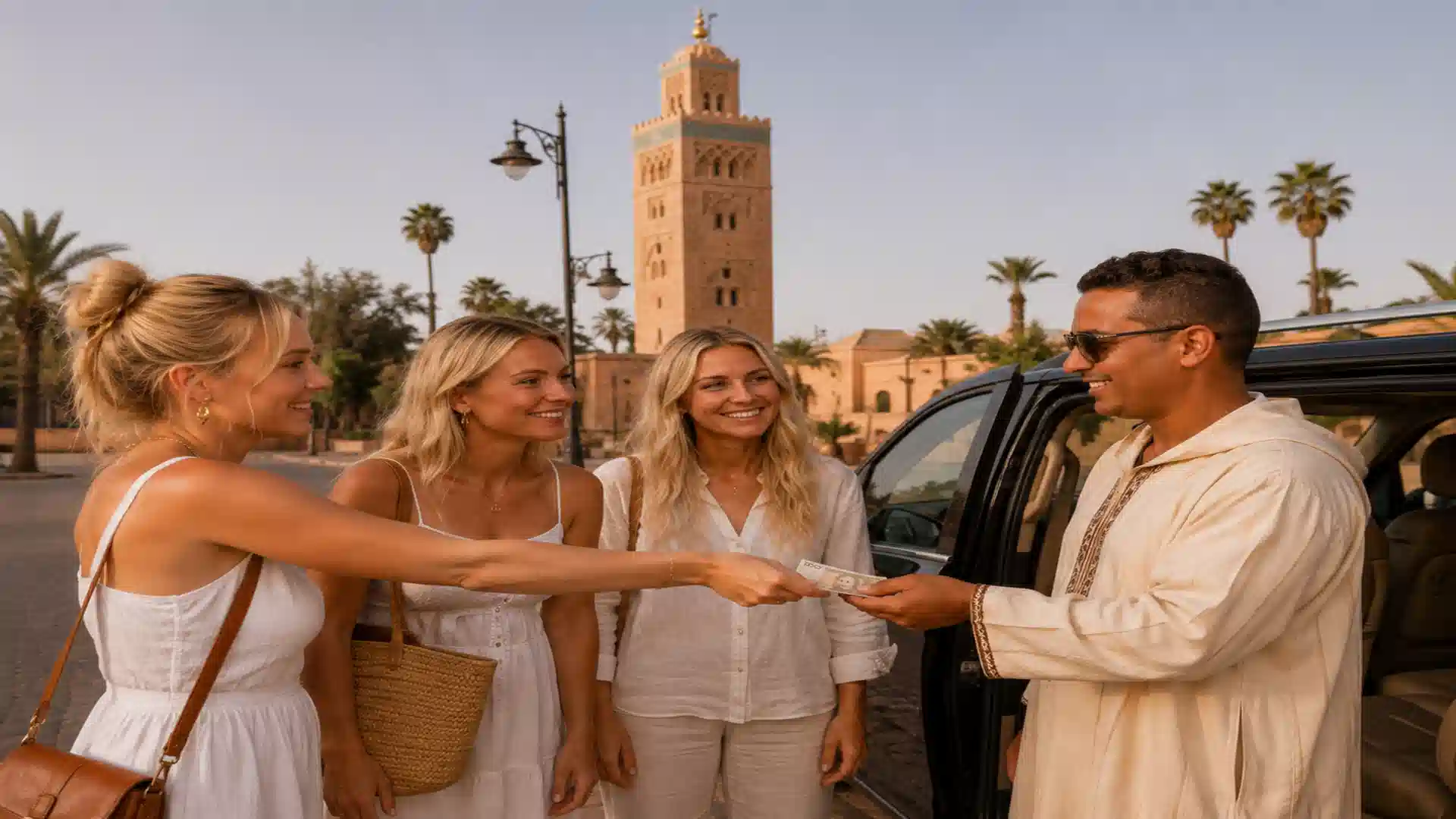
Inside major urban centers like Casablanca, Rabat, or Tangier, small colored city taxis operate on digital meters. Your approach to tipping taxi drivers Morocco is remarkably straightforward: simply round up to the nearest 5 or 10 MAD milestone. If the dashboard meter reads 16 MAD, hand the driver a 20 MAD note and tell them to keep the change (“Saf, Shukran”).
If a driver proactively turns on the meter without you having to ask, delivers you directly to your destination without taking a convoluted route, or handles heavy luggage, adding a flat 10 MAD bonus on top of the rounded fare is an excellent way to reward professional behavior. For Grand Taxis (larger shared or private long-distance vehicles) where fares are negotiated before you sit down, tipping in Morocco drivers is not strictly required unless unique detours or heavy luggage handling are requested.
3.Restaurant Tipping Etiquette Morocco
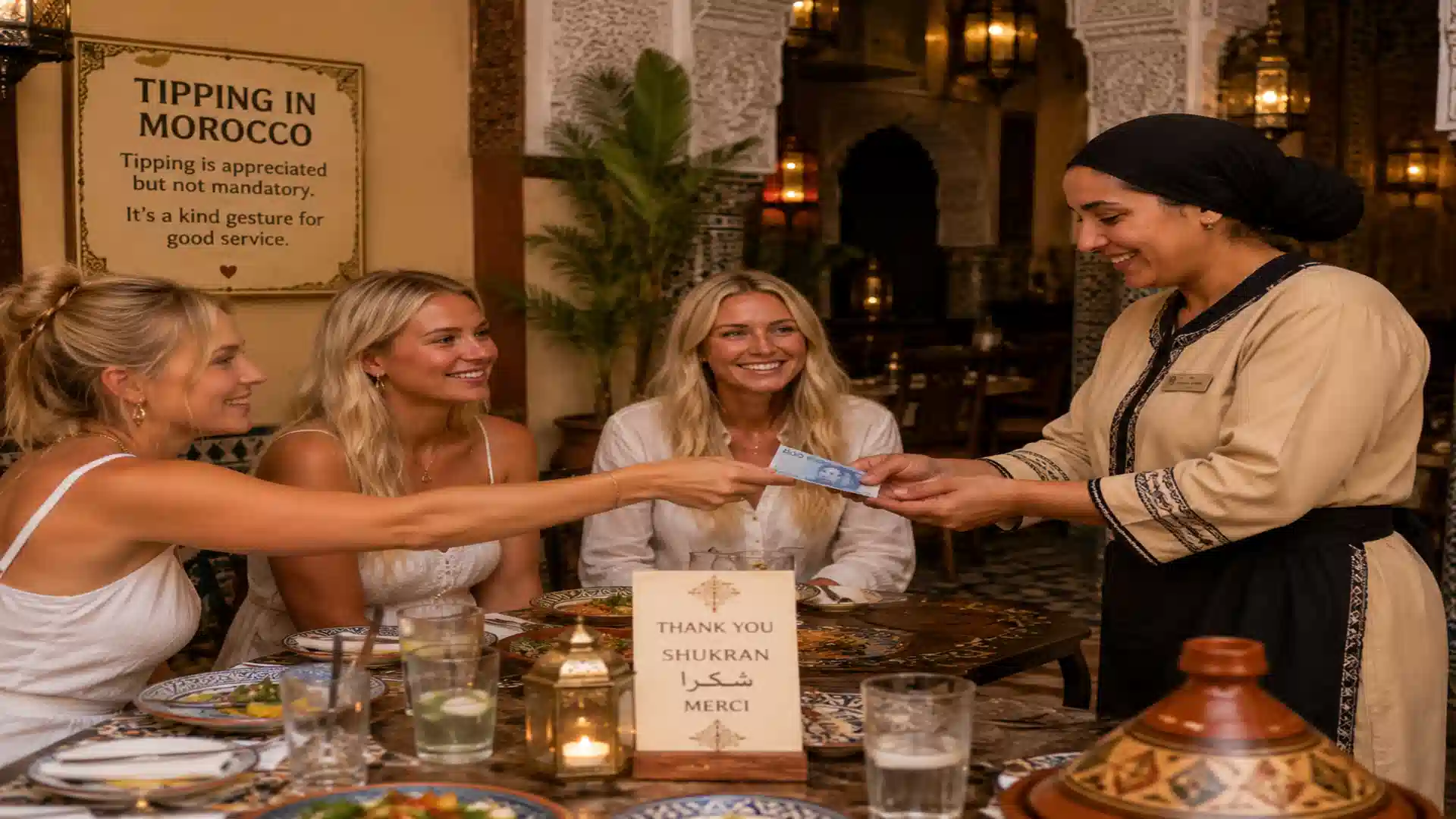
Dining out is where visitors encounter the most frequent transactional interactions and experience the most anxiety regarding the local customs. Practicing proper restaurant tipping etiquette Morocco shifts dramatically based on the style of the establishment, ranging from basic street food stalls to elite, high-end rooftop dining rooms in the modern quarters.
Moroccan cuisine is a slow, methodical art form, and table service reflects this pace. Meals are meant to be lingered over, which means your server is dedicated to your table for a significant portion of the afternoon or evening, framing the etiquette of tipping in Morocco restaurants.
An important accounting detail to check on your printed receipt is the phrase “Service Compris” (Service Included). While rare in traditional family-run spots, some upscale European-style restaurants in Marrakech’s Gueliz district or Casablanca’s Corniche automatically add a 10% to 12% service charge to the final bill. If this appears, your baseline obligations for tipping in Morocco are technically met, and you are not required to leave a standard tip, though rounding up the change to the nearest 20 or 50 MAD note is still appreciated for exceptional service.
Street Food Stalls and Café Terraces
At a local juice stand, a casual snail-broth stall, or a small neighborhood café where you enjoy traditional mint tea, tipping is light and optional. Most locals do not tip at casual counters, but for foreign travelers, simply rounding up the bill to the nearest 5 or 10 MAD is polite. If your café bill is 22 MAD, handing over a 25 MAD note or leaving the remaining coins on the small metal tray is perfect. It shows you appreciate the seat and the view, especially on busy panoramic terraces overlooking major squares.
Mid-Range Sit-Down Tagine Houses
This category represents the vast majority of your vacation lunches and dinners—traditional riad dining rooms, courtyard settings, and beachside seafood grills. Plan to leave a cash tip of 10% to 15% of the total bill for attentive service. If your family dinner bill totals 400 MAD, leaving a 40 MAD note satisfies your restaurant tipping etiquette Morocco obligations beautifully. Always hand the cash directly to your waiter when paying, as table tips left out in the open can easily be cleared away by busboys or management before the server returns. It is one of the golden rules of tipping in Morocco.
4. Everyday Scenarios: Tipping Parking Attendants Morocco & Tipping Rules for Taking Photos Morocco
Beyond your main hotels and dining reservations, moving through the country brings you into contact with several unique service roles where a small dirham note is required. These micro-transactions form the backbone of the street-level economy and are vital for handling everyday instances of tipping in Morocco.
Tipping Parking Attendants Morocco
The moment you park a rental car on a public street, near a beach, or adjacent to a historic monument, you will notice a man wearing a fluorescent vest step forward to guide your vehicle into the space. When managing your budget for tipping parking attendants Morocco, remember these are Gardiens de Voiture—semi-official street parking attendants who guard vehicles against theft and vandalism.
Daytime Street Parking: 2 to 5 MAD is standard when you return to your vehicle.
Overnight Parking: 10 to 20 MAD is appropriate if they watch your car through the night.
Note: Never pay them before you park; always hand the coins directly over as you are physically getting back into the car to depart. They serve a valuable role in organizing chaotic parking zones, and paying them keeps your vehicle secure. This is an indispensable element of tipping in Morocco transit.
Tipping Rules for Taking Photos Morocco
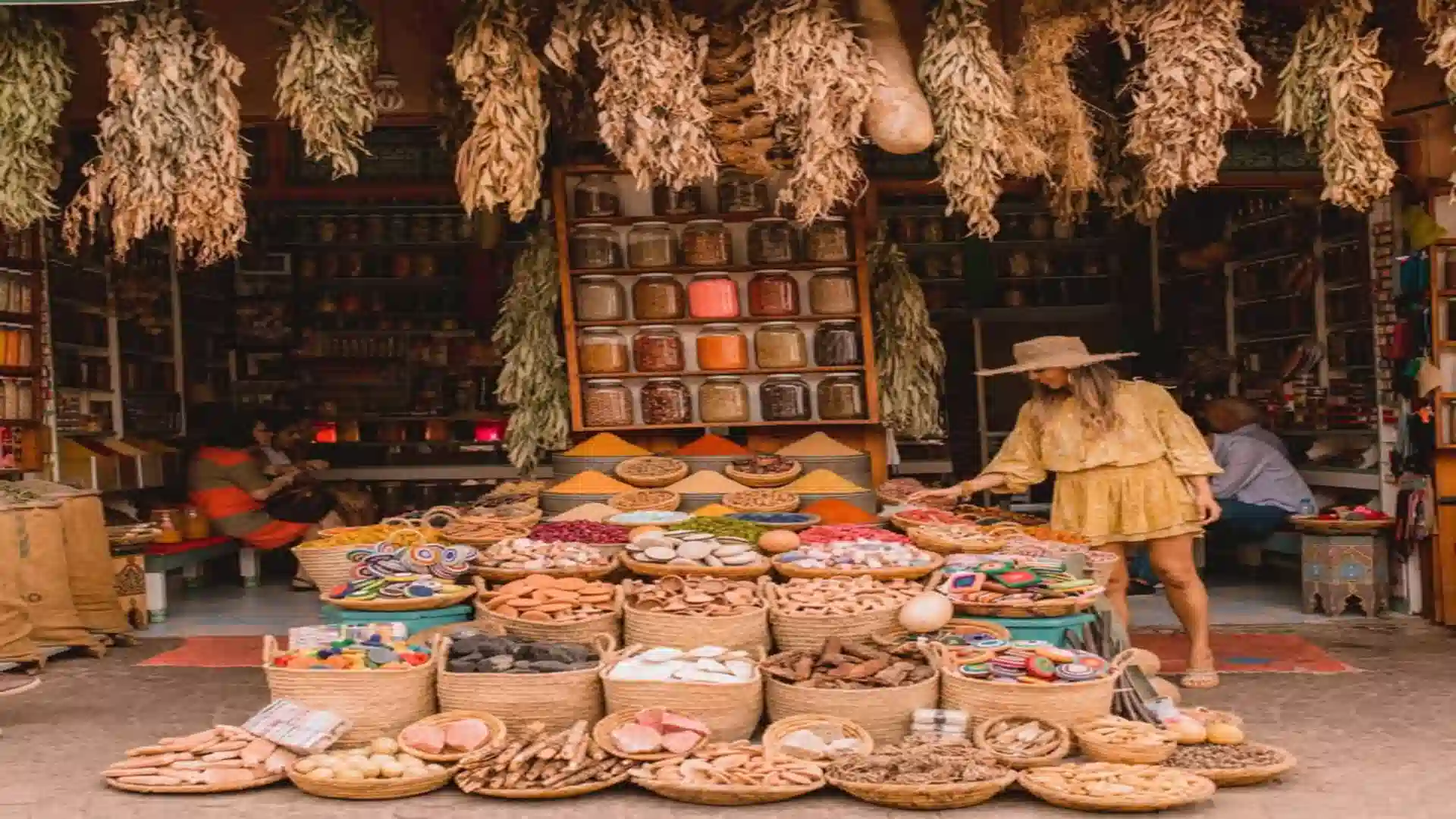
The vibrant colors of the region make it a photographer’s dream, but human subjects require strict boundaries. If you want to take a photograph of a colorful spice display, a street performer in Jemaa el-Fnaa, an artisan weaving a complex rug, or a water seller in traditional red attire, always ask permission first.
Under the strict tipping rules for taking photos Morocco, once they agree and you capture the shot, it is standard etiquette to present a small tip of 5 to 10 MAD per person as a respectful trade for their portrait. If you take multiple photos or video clips of a structured street performance, scale this up to 20 to 50 MAD. If you do not wish to tip, do not take the photo; unauthorized photography can lead to tense verbal confrontations in busy tourist zones, making it a critical nuance of tipping in Morocco.
5. Cash Management Logistics: Carrying Cash for Tips Morocco & Tipping with Credit Card Morocco
To keep your daily financial transactions seamless and avoid awkward moments at the end of a service, you must understand how local businesses process payments and how the local banking infrastructure operates regarding tipping in Morocco.
Moroccan Dirham Tipping (MAD)
All day-to-day gratuities must be executed using the local currency. When considering Moroccan Dirham tipping parameters, understand that handing a driver or server foreign coins (like Euros or US Dollars) creates an immediate financial burden for them. Foreign coins cannot be legally exchanged at local banks or currency booths in Morocco, rendering them completely useless to the recipient unless they hunt down another tourist willing to swap them for dirhams. While foreign paper banknotes (€5 or $5 bills) are accepted in emergency situations, local currency is always preferred for consistent tipping in Morocco.
Carrying Cash for Tips Morocco
Cash is absolute king across the country’s historic medinas. ATMs in Morocco almost exclusively dispense large 100 MAD and 200 MAD bank notes, which local shopkeepers, taxi drivers, and waiters cannot easily break for small tips. Therefore, carrying cash for tips Morocco means making a conscious effort to break large notes inside major supermarkets, gas stations, or hotel front desks early in the day so your pockets are always stocked with 5, 10, and 20 MAD coins and bills. Keep your coins in a separate pouch so you can access them quickly without flashing a wallet full of large banknotes, simplifying your routine for tipping in Morocco.
Tipping with Credit Card Morocco
Unlike in Western countries, you cannot easily add a tip to a credit card terminal at checkout in most Moroccan establishments. When analyzing tipping with credit card Morocco limitations, remember that even if a luxury restaurant or riad accepts plastic, that tip money rarely filters down to your specific server or housekeeper due to complex accounting setups. Always pay the base bill on card if you wish, but deliver the gratuity directly via physical cash to ensure it reaches the right hands, satisfying the rules of tipping in Morocco.
6. Cultural Nuances: Is Tipping Mandatory in Morocco & Overtipping in Morocco Mistakes
To round out your cultural understanding, let’s address the exact behavioral anxieties and social contracts you will navigate as a foreign traveler exploring the country.
Is Tipping Mandatory in Morocco
The question of is tipping mandatory in Morocco is one of the most common inquiries from first-time visitors. Legally, the answer is no—there is no law forcing you to pay a gratuity. However, culturally and practically, it is highly expected in tourist areas and directly impacts the livelihoods of local families. Many workers in the hospitality industry receive a base salary that covers only basic entry-level living costs, relying on tips to achieve financial stability. View it as a fundamental social gesture rather than an optional bonus when researching tipping in Morocco.
Overtipping in Morocco Mistakes
While being generous is wonderful, making major overtipping in Morocco mistakes can inadvertently distort the local economic equilibrium. Throwing down a 100 MAD note for a basic 20 MAD taxi ride or giving hundreds of dirhams to casual street children creates unsustainable social dynamics and can price locals out of their own services. Stick to the traditional 10% to 15% parameters for structured hospitality services, and utilize small coins for everyday street helpers to avoid these common tourism missteps. Keeping within these boundaries ensures your approach to tipping in Morocco remains highly respectful of the local environment.
Deep Dive: Tipping Across Specialized Activities
As your itinerary expands beyond basic dining and hotel stays, you will encounter specialized services that require a clear understanding of proper protocol for tipping in Morocco.
Traditional Hammams and Luxury Spas
Visiting a steam-filled hammam for an intense kessa olive-soap body scrub is a mandatory cultural experience. How you handle your tipping protocol depends entirely on the tier of the venue you select:
- Local Neighborhood Hammam: If you visit a neighborhood bathhouse and pay a local worker to scrub you down, tipping them 20 to 30 MAD directly in the changing area is the standard custom.
- Boutique Riad Spa: At high-end, luxury wellness centers where treatments cost hundreds of dirhams, tip your specific massage therapist or aesthetician 10% to 15% of the total package price to match the premium service standard.
Desert Camps and Sahara Treks
An overnight stay in a luxury desert camp involves a dedicated team of hosts, chefs, musicians, and camel handlers who work in extreme environmental conditions to deliver a seamless experience.
- Camel Handlers: If you complete a sunset or sunrise desert trek, tipping your direct camel guide 30 to 50 MAD per person is highly appropriate and aligns with common expectations for tipping in Morocco outdoor excursions.
- Camp Staff Pool: Most luxury camps utilize a centralized tip box located in the main dining tent. Leaving 100 to 200 MAD per night from your party covers the musicians, kitchen staff, and site maintenance crew equitably.
Frequently Asked Questions
What should I do if a restaurant bill already includes service?
If your bill clearly states “Service Compris” or lists a distinct 10% service charge, the gratuity is technically included in your total. You do not need to add an additional standard cash tip on top of this. However, if your specific waiter delivered exceptional, personalized service, leaving an extra 10 to 20 MAD coin on the tray is a kind, voluntary sign of appreciation.
Should I tip shopkeepers when buying a rug or souvenirs?
No, you should never tip a retail shopkeeper or artisan after bargaining for goods inside the souks. The final pre-negotiated purchase price of the item represents a complete, self-contained business transaction. The only exception is if a young shop assistant carries a massive, heavy rug all the way back to your riad front door, in which case a 20 MAD delivery tip is appropriate.
Is it appropriate to tip with goods like clothes or electronics?
While trading or gifting items was common in past decades, modern Moroccan service professionals prefer standard currency to manage their household expenses. Gifting clothes or personal items should only occur if a deep personal friendship has developed over a long period, and it should supplement, rather than replace, a standard cash tip when considering tipping in Morocco.
Conclusion For Tipping In Morocco:
Mastering the art of distributing gratuities comes down to being prepared with local currency and understanding the human value behind the service. A tip is never just a cold transaction; it is a direct, tangible way to say “Shukran“ Tanmirt in Berber“ (Thank you) for the deep hospitality that defines the country.
By keeping a steady supply of small dirham coins in your pockets and following these high-authority tier guidelines for tipping in Morocco, you will eliminate all travel friction and build warm, authentic connections with the local guides, drivers, and hosts who make your journey unforgettable.