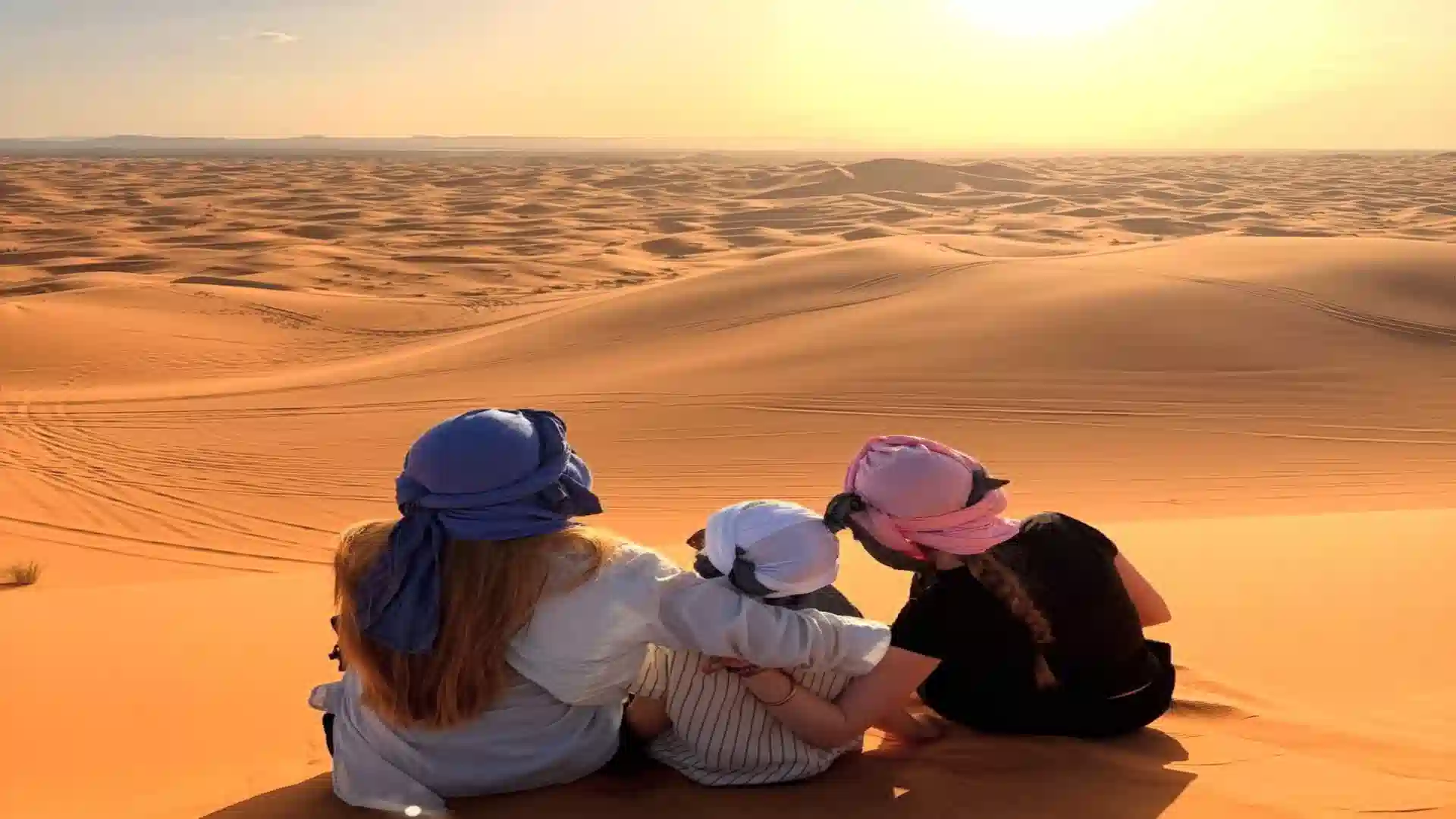
Morocco Family Holiday: The Complete Guide for Families with Kids (2026)
Table of Contents
Morocco Family Holiday: The Best Destinations In Morocco For Families Aren’t Expecting to Love
Morocco with kids is one of the most consistently underestimated family travel experiences for European and North American families, a destination that many parents approach with cautious curiosity and leave as passionate advocates, already planning the next visit. It’s understandable to be reticent. On paper, Morocco is the sort of place you visit before you have kids – complex medinas, long driving distances, an unfamiliar language, no obvious hotel-pool-plus-kids-club infrastructure in the beach resort sense. What most families find on arrival, though, is something more interesting and more valuable than any resort: a country that genuinely, culturally loves children, offers more genuinely memorable experiences per day than almost any equivalent destination, and delivers the specific kind of family holiday where conversations that start with “remember when we…” continue for years rather than weeks.
At Over Morocco Tours, we’ve been running Morocco family itinerar
y tours since 2012 and the feedback pattern from hundreds of family groups is consistent: the moments families remember most are not the monuments they are the camel trek at sunset where a six-year-old decided the camel was their best friend, the Marrakech cooking class where a child who “eats nothing” discovered they could make flatbread, and the Saharan night sky seen from the entrance of a desert camp that rendered the entire family silently, companionably speechless. Is Morocco safe to travel with kids? With the right preparation, the right itinerary structure and practical knowledge in this guide, a Morocco family holiday is one of the most achievable, rewarding and truly extraordinary trips a family can make.
Is it safe in Morocco for children?
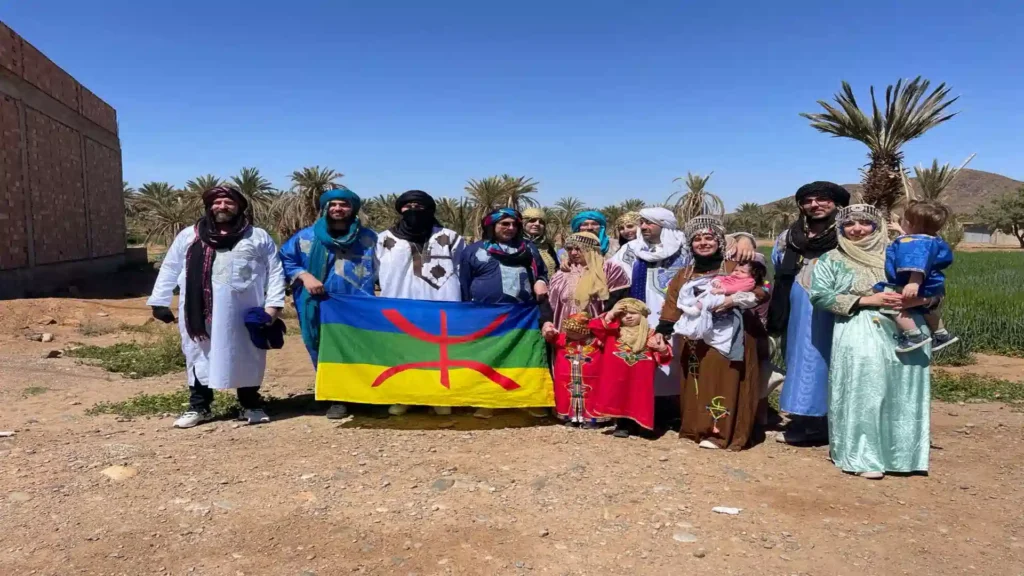
International traveling families and local Amazigh Berber guides holding the Amazigh flag in Morocco.
Is Morocco safe for families is the foundational question every parent asks before booking and the direct answer is: yes, Morocco is widely considered one of the safest destinations in the North of Africa for international family travelers. Violent crime against tourists is really rare, and the country’s cultural ethic of hospitality and family life means children are happily accepted in just about any environment – restaurants will bring extra bread and juice without being asked, shopkeepers will give small gifts to young visitors, and the natural warmth Moroccans extend to children is one of the most consistently mentioned aspects of any family trip to the country.
The specific, non-dramatic safety issues that experienced family travelers always mention are keeping children close in busy medina souks where the density of movement makes it easy to lose a small child, if only for a few minutes but with potentially distressing consequences; drinking bottled or filtered water, not tap water, throughout, for drinking and teeth-brushing; using private transfers rather than standard taxis for families with infants or toddlers, since car seats are not routinely available in shared taxis and must be arranged specifically in advance; and carrying a basic travel medical kit that includes children’s pain relief, oral rehydration salts, and an antihistamine appropriate for your children’s ages. With these simple precautions in place, the great majority of families with children of all ages complete Morocco trips without incident.
Quick Summary for Morocco Family Itinerary:
Morocco With Kids Vaccination Programme
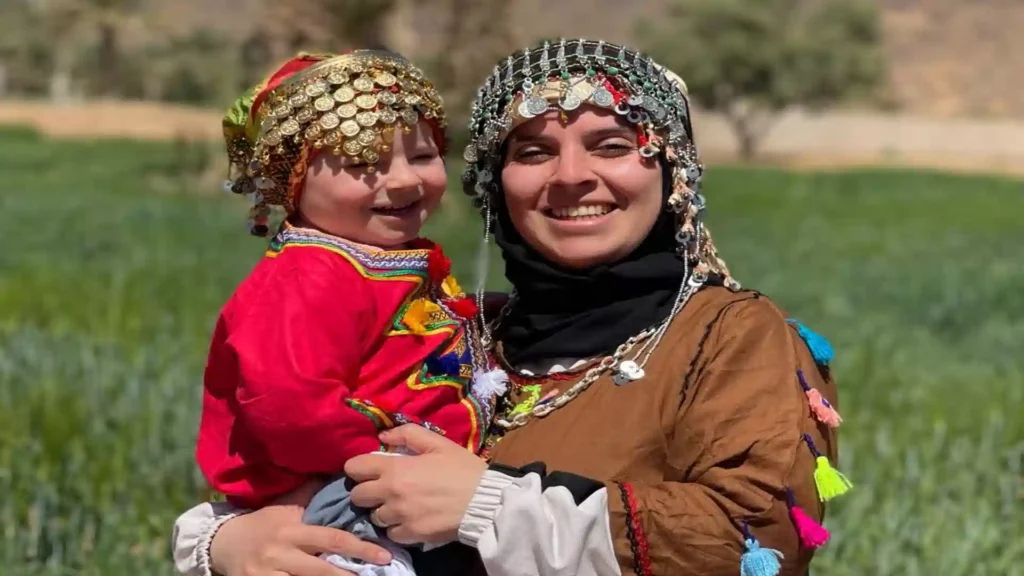
A smiling mother holding a young child in beautifully detailed, traditional Moroccan Amazigh attire.
Morocco is not a high risk destination by any objective measure but is worth discussing vaccinations for children with your family doctor or travel health clinic prior to departure. The most important step is to make sure that routine childhood vaccinations are up to date. For most children coming to the mainstream tourist routes (Marrakech, Fes, the desert, the coast), the vaccines most often also advised by travel medicine practitioners are Hepatitis A (spread via food and water, easily preventable) and Typhoid (also food and water borne). Malaria prophylaxis is not necessary for the normal Morocco tourist trail. Don’t just follow the general guidance, but do check with your GP or travel health clinic about the particular ages and medical histories of your children. Ask the question at least 6-8 weeks before travel, to allow time for any vaccination courses that require multiple doses.
Best Places to Visit in Morocco with Kids
Marrakech With Kids: The Must Read Introduction
Morocco with kids In Marrakech is the near-universal starting point for Morocco family holidays and with good reason the city’s international flight connectivity, its concentration of family-friendly activities within manageable distances, and its infrastructure of family riads (traditional Moroccan courtyard guesthouses, many of which now feature small plunge pools, courtyard play space and family room configurations) make it the most practically accessible entry point. Djemaa el-Fna, the city’s central square, is an amazing place for children of almost any age: the street performers, the acrobats, the musicians, the evening food stalls combine to make a spectacle that children can enjoy with a particular, unadulterated joy that adults sometimes have to work harder to feel. The energy slowly builds from about 4:00 PM and the square is best approached in the late afternoon and evening.
Family activities outside the square include: the Majorelle Garden (a shaded botanical garden in vivid cobalt blue and yellow, really beautiful and quiet enough for young children to move freely, adult entry about 150 MAD, children under 10 often at reduced rate or free); the Menara Gardens (large outdoor gardens with a pool and pavilion, popular with local families and great for a picnic); family cooking classes in riad kitchens (widely available, typically 2-3 hours, children enthusiastically involved in making flatbread, tagine and mint tea — most riads in the medina can arrange these and they are one of the best half-days available to families with children of school age and above); and camel rides in the Palmeraie (the palm grove on the outskirts of the city, a gentler and more relaxed camel experience than in the desert, suitable for young children). The medina souks are great for older children who love to explore and haggle but can be overwhelming and tiring for kids under 5 shorter, focussed souk visits with a clear objective (a specific craft quarter, a specific purchase) work better than long undirected wanderings for younger families.
Agadir Morocco Family Holiday: The Beach Choice
Agadir Morocco family holiday planning caters for families seeking conventional beach resort infrastructure with the Moroccan cultural experience a balance Agadir offers better than any other Moroccan city. Agadir is Morocco’s favourite beach resort. The town sits at the head of a sheltered Atlantic bay with a wide flat sandy beach that stretches for several kilometres. The shallow waters are calm and ideal for young children. The seafront promenade the Corniche – is lined with cafes and restaurants and in the evening the activity here has a more familiar European beach resort feel. Unlike Marrakech and Fes, Agadir’s modern layout means the city centre is relatively easy to navigate with pushchairs and young children, and the abundance of hotel pools, playgrounds in the Corniche area and family-orientated restaurants provide more conventional infrastructure for families with toddlers specifically. Crocoparc is a popular wildlife park, consistently rated by families visiting Agadir as one of the best things to do with kids in the city. It houses over 300 Nile crocodiles, as well as a cactus garden and botanical displays.
Essaouira: Best Coastal Town for Families with Teens
For families with older children and teens in particular, Essaouira offers a different, and especially beguiling, take on the Morocco experience. The wide, flat beach of the Atlantic-facing port city – shallow and sandy, stretching for over 2 kilometers is great for surf and windsurf lessons (surf schools run beginner lessons from around 250-350 MAD per person, suitable for children from around 8 years and teenagers), kite-flying and long beach walks. The medina is small enough to navigate quite easily with older children, without the density and pressure of the main souk area of Marrakech. The artistic, cosmopolitan character of the city provides a more relaxed environment for teenagers who find the more intensively tourist-managed sections of Marrakech too overstimulating. Check out our full Essaouira guide for the full breakdown.
Chefchaouen is a family friendly place
Families often mention Chefchaouen as one of the most fun places to go, because of its size and relaxed medina. The old town painted blue is actually easy for children to find their way around without getting lost as Marrakech or Fes medinas allow, the vendors are considerably less aggressive and the cool mountain air of the Rif Mountains makes it a really comfortable place for active children to be even in warmer months. The walk to the Spanish Mosque viewpoint is doable for kids from about 6-7 years old and offers up an incredible panoramic view that even small children consistently find impressive.
Morocco Desert Camp with Children: An Experience Everyone Remembers
A Morocco desert camp with kids is often the highlight of a Morocco family holiday that creates the most vivid and lasting memories and it is more accessible to families across a broader age range than most parents first think. We frequently have families with children of all ages in our Merzouga desert camps, from toddlers to teenagers at Over Morocco Tours. The desert experience can be adapted to different age groups with the right operator.
Age Limit Camel Ride Morocco With Kids
One of the most important practical questions for families planning a desert experience in Morocco is the age limit for camel rides. Most good camp operators in Merzouga, including Over Morocco Tours, adhere to the standard advice that children from the age of 3 years can ride camels when sitting in front of or sharing a saddle with a parent, with an adult physically in control and the camel handler walking the animal at a slow, gentle pace. Children from around 6-7 years and up are usually confident enough to ride in their own saddle and the 45-60 minute trek into the dunes is well within the endurance range of most children of this age who are used to moderate physical activity. The desert camp experience, the campfire, the dinner, the night sky, the morning, is totally accessible and really extraordinary for toddlers and infants under 3, even without the camel trek part, which can be replaced with a walk to the edge of a nearby dune for the sunset.
The most common thing families remember years later about the Morocco Family holiday is the dune crest at Erg Chebbi at sunrise, reached by camel or on foot. You just cannot get the same experience at the regular family holiday spots as when you climb a 150 metre sand dune at dawn and watch the desert come alight in the first light, with nothing but sand and silence stretching away in every direction. The logistics, the early morning, the long drive to get there is worth it.
Desert Camp Tips for Families
Some practical adaptations that make the desert camp experience genuinely comfortable for families with young children include: choosing a mid-range or luxury camp that provides private en-suite bathroom facilities in each tent (the shared bathroom block at budget camps requires a walk along a sandy path in the dark, which is less of an issue for adults than for small children who wake up in the night); ensuring the camp offers warm blankets and extra layers for children (desert night temperatures drop significantly even in summer, the pre-dawn temperature at Erg Chebbi can be 15-18°C, cold enough for a small child without adequate covering); and packing a small headlamp for each child rather than relying on phone torches. Most mid-range camps offer generous and flexible meals, and the standard camp dinner of harira soup, tagine and fresh bread works well for most children, with most operators able to cater for advance requests for simpler food for very young or fussy eaters.
Structures for Morocco Family Itinerary by Age Group
Morocco Family Itinerary For Families With Young Kids (Ages 3-8)
A well-paced Morocco family itinerary for families with young children features less driving time each day, guaranteed access to a pool for mid-afternoon recovery, and a flexible schedule that won’t fall apart if a small child unexpectedly needs a nap. Over Morocco Tours’ most frequently suggested structure for this age group: Marrakech base (3 nights) cooking class, Djemaa el-Fna evening, day trip to the Ourika Valley for the waterfall and Barbary macaque spotting — 2-night circuit to the Merzouga desert (taking the southern route with stops at Aït Benhaddou and the Dades Valley, overnight Sahara camp, returning via the Ziz Valley). Total: 7-8 days , best matching the school holiday week most efficiently.
The Ourika Valley works particularly well for young children: the 60-90 minute drive from Marrakech, the Setti Fatma waterfall (which is accessible and genuinely exciting for children), the opportunity to see Barbary macaques at close quarters in the cedar forest, and the riverside lunch together make a condensed but genuinely varied day that most children aged 4-8 find completely engaging. For the full lowdown, check out our Ourika Valley day trip guide.
Morocco With Kids Family Travel Plan for Families with Older Children and Teens (9-17 years old)
If the family has older children and teens, the itinerary can include a much wider range of activities and driving time, without the schedule flexibility younger children require. (10 days) Casablanca, Fes (medina, licensed guide, tanneries, Al Quaraouiyine university), Chefchaouen (blue medina, Spanish Mosque hike), Merzouga desert (full camel trek, overnight camp, sandboarding), Aït Benhaddou, Marrakech (cooking class, souks, Djemaa el-Fna) This is a full-on Morocco experience for teens that won’t feel rushed. For the full day-by-day breakdown check out our Morocco 10 Day Itinerary Guide. Teenagers like the cooking class format (giving them a skill and an active role rather than passively viewing monuments), the sandboarding option at Erg Chebbi (more physically engaging than the camel trek for older kids), and the Todra Gorge walk (genuinely dramatic and accessible, requiring no technical skill but providing an immediately impressive sense of adventure).
Morocco With Kids Family Budget: How Much Does a Family of Four Spend?
Here is a rough estimate for Morocco family holiday budget planning for a 7-day private tour for a family of four (two adults, two children under 12) across the standard accommodation tiers:
A few practical cost notes for families: most Moroccan riads and hotels charge nothing for children under 6 years old sharing a room with parents, and children 6-12 are usually charged at a discounted rate of 50-70% of the adult room supplement. Kids under 12 often get reduced or free entry to attractions check at each attraction, as prices aren’t always obvious. Most operators will consider a family of four to be a private vehicle at the standard two-person private tour rate, because a standard 4×4 or minivan can comfortably seat four people so the per-person cost of a private Morocco family itinerary tour is much more reasonable than most families expect when they start their planning.
Morocco With Kids: What Kids Will (and Won’t) Eat
Kids food Morocco is a practical issue for parents of picky eaters and the real picture is more reassuring than anxious parents normally expect. Moroccan cuisine is really quite varied, so there are a few things most children find acceptable: freshly baked khobz bread (flat, round, soft, and universally loved by bread-eating children); chicken tagine with vegetables (mild-tasting, familiar source of protein, readily available); fresh orange juice (Morocco produces amazing citrus fruits and fresh-squeezed juice is available everywhere for a few dirhams); crepes (a legacy of the French Protectorate, available at street stalls all over Marrakech and Essaouira for around 15 MAD each); fresh fruit from market stalls; and the grilled meat at the Djemaa el-Fna food stalls, which most children approach enthusiastically once they realize they can choose their own skewers.
The practical food safety rule for families is simple and effective: choose freshly cooked hot food instead of cold buffet or pre-prepared dishes left at room temperature; peel all fruit; use bottled water for drinking and tooth-brushing; and carry children’s oral rehydration salts for safety. Larger riads and hotels in Marrakech and Fes are used to preparing simpler, plainer versions of standard dishes if asked it’s always worth speaking in advance to your accommodation about any significant dietary restrictions or selective eating patterns.
Morocco Stroller Medina Reality: What to Pack for Toddlers
Every parent of a toddler wonders about Morocco stroller medina compatibility, and the honest answer is: full size pushchairs are very difficult in the medinas of Marrakech and Fes. The historic streets of the Medina are cobbled, narrow, uneven and punctuated by steps, drains and sudden changes in level which make the use of a standard pushchair really impractical in the main souk areas. If you are experienced family travelers, then you may want to consider one of three options: a compact, foldable pushchair that can be folded up and carried when needed, a baby carrier or front/back pack for toddlers who will tolerate it, or that in the medina specifically, young toddlers are carried or walked, with the pushchair left at the riad for use on flatter streets and gardens outside the medina core. Agadir and Essaouira, with their more modern layouts and promenade-style seafronts, are much more pushchair-friendly than the imperial city medinas, and more suited to families with very young children.
Morocco family itinerary Toddler Travel Tips: The Practical Must-Haves
Morocco toddler travel tips that veteran family travelers most consistently cite as the difference between an easy trip and a tough one:
- Bring your own napkins/diapers from day 1. Larger Moroccan supermarkets such as Carrefour and Marjane stock the usual international brands, but you won’t find them in the medina shops or smaller towns, and running out in the village of Merzouga is a scenario best avoided. Bring more than you think you will need.
- Hire a private car for all the inter-city travel, the ability to stop when you need to, the air-conditioning, the lack of a fixed departure schedule, all of which matter so much more when you are travelling with toddlers than with older children.
- See to afternoon rest. Morocco’s natural rhythm – quieter between 1:00 PM and 4:00 PM, especially in summer – almost works perfectly with toddler nap schedules, and adding a riad rest period to the daily plan instead of fighting through it improves the experience for everyone.
- Select family riads that have a ground-floor or an accessible room. The architecture of the Riad often has steep, narrow stairways which are a real challenge when you have a toddler in your arms. A common, and easily avoidable, difficulty is to not confirm room placement when booking.
Important Tip from Our Guide Team: What Families Say After Every Trip
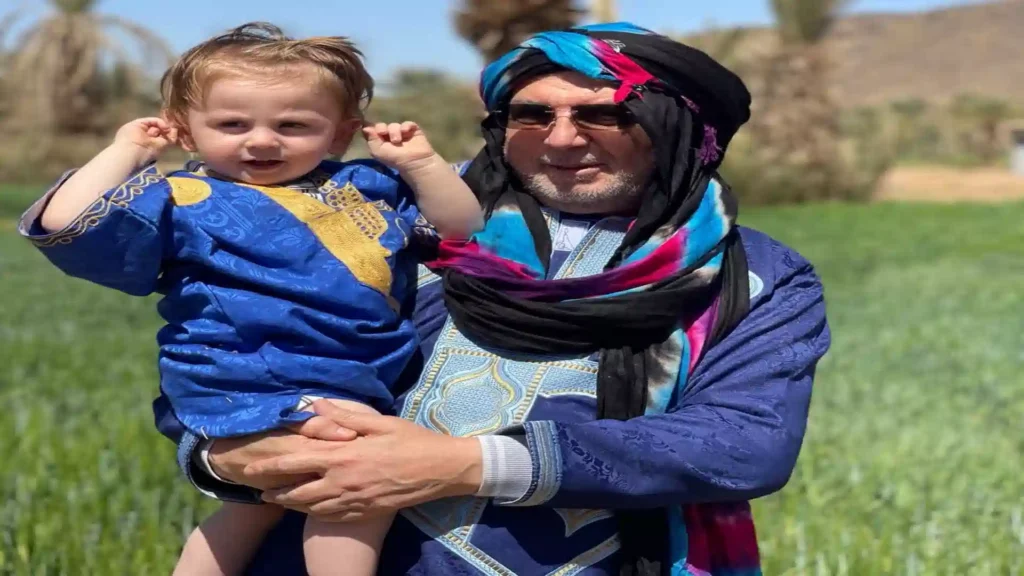
A smiling Father holding a young child in beautifully detailed, traditional Moroccan Amazigh attire.
The most surprising thing for families every single time is the love Moroccan people actually have for children. Not in a polite, hotel-service way, but really. Strangers in medinas congratulate you on your children. tea. This is no exception, this is a normal Tuesday in Morocco.
The practical thing we always tell families before they arrive is: don’t worry about the food, don’t worry about the driving, don’t worry about navigating the medina. The early morning is a concern in the desert as it is the only logistical time where the energy levels of young children and the best time for the experience need some managing. The 5.30am sunrise camel trek is amazing, but a 4-year-old woken at 5.00am needs different prepping than a 12-year-old. “We adjust the timing and approach for every family, that’s what a real family tour operator does, not just put every family on the same schedule as everyone else.
Over Morocco Tours Guide Team
FAQs: Morocco Family Holiday in Marrakesh
Is Morocco a good destination for families with young children?
Yes. Morocco is truly family-friendly a deep-seated cultural warmth for children that visitors invariably notice and appreciate. Morocco trips with proper planning for accommodation, transport, food safety and daily pacing are very successful and deeply memorable for families with children of any age from infants to teenagers.
What age do children need to be to ride a camel in Morocco?
Camel rides are available for children from about 3 years old, who can sit in front of a parent or on a shared saddle. For standard 45-60 minute desert treks most children ride confidently in their own saddle from around 6-7 years. Over Morocco Tours will adapt camel ride arrangements to the ages and confidence levels of children in each group.
What Is the Best Time of Year To Travel on a Family Holiday in Morocco?
For families, the best time is in spring (March-May) and autumn (September-October) when comfortable temperatures prevail in all regions – cities, mountains and desert, when the school holidays fit well with these windows (especially spring half-term and Easter) and when the full range of outdoor activities are possible without the restrictions of summer heat.
Is the Sahara desert suitable for children?
Yes, and for children of almost any age it is usually the highlight of a Morocco family holiday. The desert camps cater to families with children of all ages and the camel trek can be adapted for even the youngest members. The night sky, the campfire, the dunes in the morning and the incredible stillness of the desert make for an experience that kids talk about for years.
How much does a family vacation in Morocco cost?
A 7-day private Morocco family tour at mid-range level will cost roughly €2,200-3,500 for a family of four (two adults, two children under 12) including private vehicle, driver-guide, accommodation and desert camp. Kids under 6 are often free to stay in riads and will get a discounted or free entry to attractions, so the cost per child is lower than the adult equivalent.
Should I bring a car seat for Morocco With Kids?
Standard taxis in Morocco don’t typically have car seats. For families with infants and toddlers, private transfers booked in advance through Over Morocco Tours can accommodate car seat arrangements bring your own portable car seat or confirm availability in advance. This is one of the reasons why it is highly recommended to have private transport when traveling with young children.
What vaccinations do children need for Morocco?
Up-to-date routine childhood immunizations. For children visiting Morocco, the most common travel medicine vaccine recommendations beyond routine vaccines include the Hepatitis A and Typhoid vaccines. Ask your GP or travel health clinic for advice at least 6-8 weeks before travel to get recommendations based on your children’s ages and health histories.
Morocco Family Holiday Tour Planner
Over Morocco Tours has been organizing Morocco family holidays tours since 2012 private circuits tailored to the ages, interests and pace of each family group and not a fixed group itinerary. We tailor camel trek timings, daily driving distances, camp selection and activity scheduling to the ages of your children and our locally based driver-guides understand how to read a family’s energy and adjust the day accordingly. Get in touch with our team today to begin planning your family holiday to Morocco.
By The Over Morocco Tours team, Morocco. Our guides have been guiding family tours throughout Morocco from desert camps at Merzouga to the blue medina of Chefchaouen for over a decade.