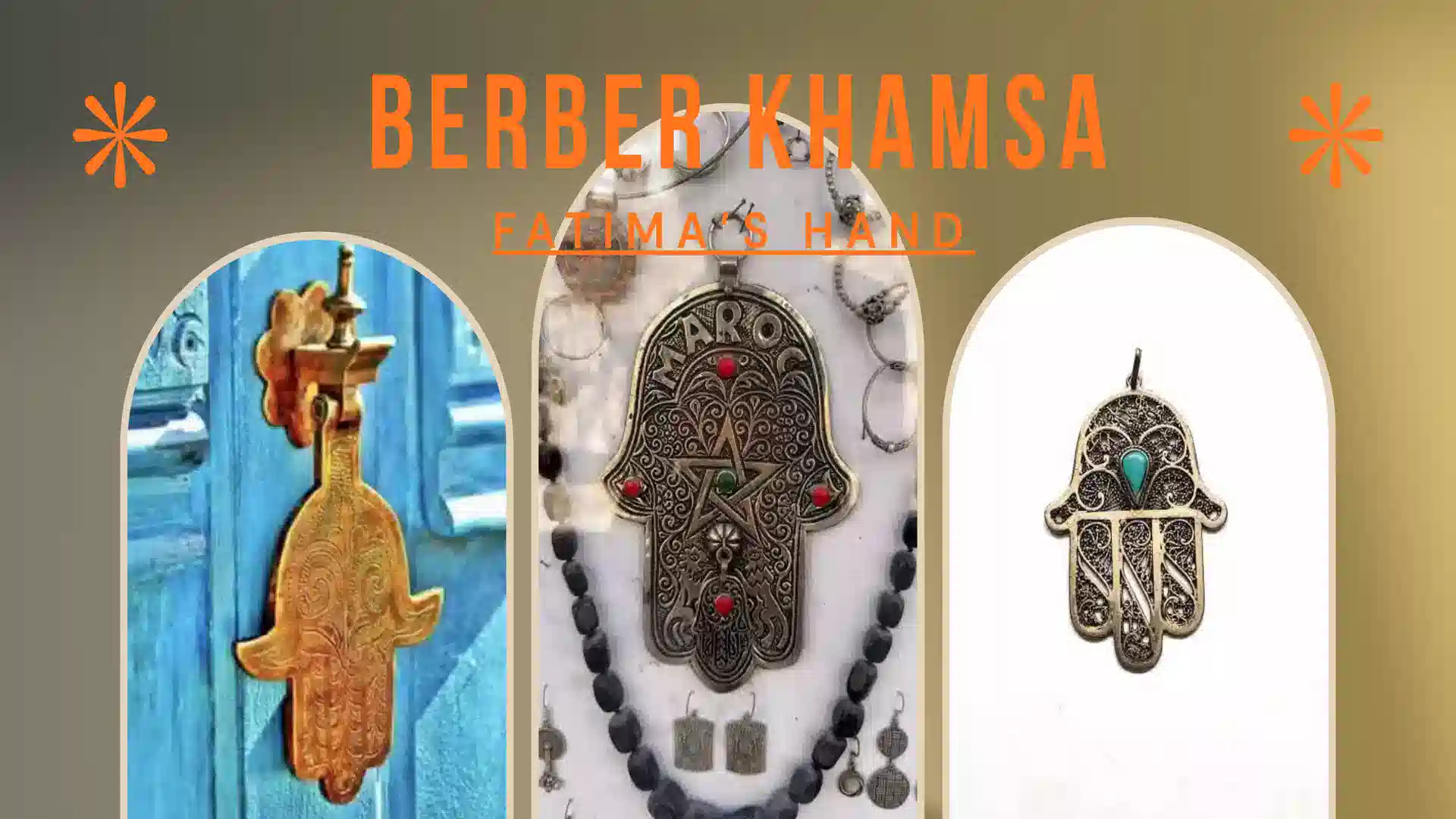
The Hand of Fatima: Meaning, History & Where to Buy in Morocco (2026)
The Hand of Fatima is the most recognized emblem in Morocco and one of the most misunderstood. From the moment you arrive, you will see it everywhere: cast in silver or brass above the doors of riads in Marrakech, woven in Berber rugs in the souks of Fes, painted in ceramic tiles on the walls of ancient medinas, hanging as pendants from the necks of Moroccan women, embroidered in the hems of caftans and hanging from the rear-view mirrors of taxis crossing the High Atlas. It is there during childbirth, at weddings, at the doors of houses, at the tombs of saints. It is profoundly sacred and utterly humdrum at the same time as much a part of the visual environment of Morocco as the pointed arch of an Islamic gateway or the geometric pattern of zellij tilework.
But what does the Hand of Fatima symbolize, really? Where is it from? It is formed like a hand because. Fatima was the daughter of the Messenger of Allah. What is the connection between the Hand of Fatima and the Hamsa, the same sign used in Jewish culture? And why is it that at the same time this picture is appearing in Islam, Judaism, Christianity and ancient pre-Abrahamic North African cultures? These are the questions our guides are most often asked by travellers in Morocco, and they deserve a full, honest, and culturally sensitive answer.
This guide, written by Ibrahim, Over Morocco Tours’ resident cultural specialist and a Moroccan who has grown up with this symbol as an integral part of his everyday visual world, gives you everything you need to understand the Hand of Fatima meaning, its remarkable cross-cultural history and how to find and identify authentic versions of the symbol during your Morocco tour.
Table of Contents
What Does The Fatima Hand Mean — Quick Facts & Cultural Meaning
What is it?
An iconic palm-shaped amulet with five fingers, used throughout North Africa and the Middle East as a protective talisman against negative energies and the envious eye.
Alternative Names
Known locally as Khamsa or Khmisa (Arabic/Darija for “five”). Also called Hamsa, the Hand of Miriam (Jewish tradition), and Main de Fatma (French).
Who was Fatima?
Fatima al-Zahra was the daughter of the Prophet Muhammad and the wife of Ali ibn Abi Talib. She is highly revered as a symbol of female strength, patience, and purity.
Core Meanings
It stands for active defense against the evil eye (ayn al-hasad). It is believed to attract divine blessings (baraka), health, fertility, and continuous good fortune.
Historical Age
Over 3,000 years old. The protective hand symbol predates both Islam and Judaism, with early archaeological remains found in Carthage and ancient Phoenician sites.
Cross-Cultural Presence
The symbol belongs to both Islamic and Jewish traditions. While the name “Hand of Fatima” is specific to Islam, Jewish communities have long treasured the “Hand of Miriam.”
The Symbol in Moroccan Heritage
In Morocco, the Khmisa is a shared cultural bridge. It has been used for centuries by indigenous Amazigh (Berber) tribes and Morocco’s historic Jewish communities alike. Today, you will find it hand-carved over heavy cedar wooden doorways in the medinas, woven into traditional woolen carpets, and beautifully shaped into sterling silver jewelry in the souks of Marrakesh and Essaouira.
What Is the Hand of Fatima? A Complete Definition
The Hand of Fatima, referred to as the Khamsa (خمسة, meaning “five”) in Arabic or the Hamsa (from the Hebrew חמשה and Arabic همسة, both meaning “five”) — is a palm-like emblem that depicts an open right hand with five fingers symmetrically aligned. It is one of the oldest and most common emblems of protective amulets in human history, and is found across North Africa, the Middle East, the Mediterranean basin, and increasingly, in the worldwide diaspora of populations originating from those places.
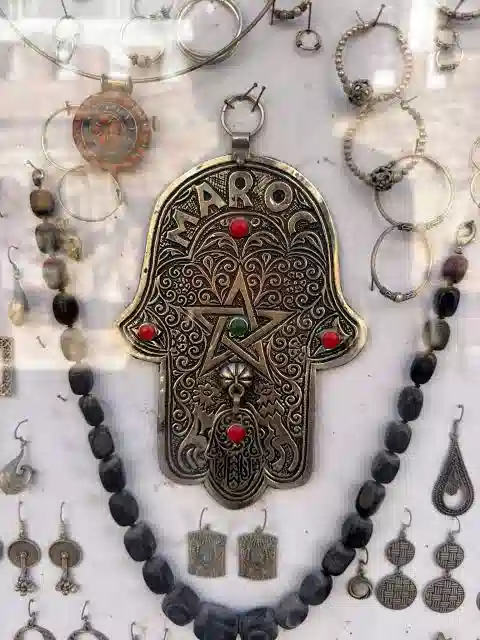
A detailed Moroccan Khamsa amulet stamped with “MAROC” alongside traditional silver earrings in a medina shop window.
The most constant application of the sign throughout all the civilizations that employ it is protection against the evil eye – in Arabic, known as ayn al-hasad (the eye of envy) or simply al-ayn (the eye). The concept in the evil eye is widespread in dozens of civilizations, from ancient Greece and Rome to modern Morocco, Turkey, Iran, and the Indian subcontinent. The notion is that a malicious glance, driven by jealousy or ill-will, can inflict misfortune, disease, or injury to the person or thing upon which it falls. This gaze is met with the open hand of the Khamsa, a gesture of warding, of declaring ‘stop’ to evil purpose, but also inviting in heavenly protection, blessing and good fortune.
The number five itself is highly meaningful in the countries where the Fatima hand is most prominent. Five is the number of the Five Pillars of Islam (Shahada, Salah, Zakat, Sawm, Hajj), the number of the five daily prayers, and the number of the five members of the Ahl al-Bayt (the family of the Prophet Muhammad including Fatima). In the Jewish mystical tradition (Kabbalah), five corresponds to the fifth letter of the Hebrew alphabet, He (ה), which is one of the letters of the divine name. The five fingers of the hand so point simultaneously to the divine, and serve as a safeguard via the body itself.
Who Was Fatima? The Woman Behind the Symbol
Fatima al-Zahra (c. 605–632 CE), daughter of the Prophet Muhammad and his first wife Khadijah, wife of Ali ibn Abi Talib (the fourth Caliph and first Imam in Shia Islam) and mother of Hassan and Hussein — two of the most important personalities in Islamic history. Her Arabic name means “one who abstains from evil” or “one who weans her child”
She occupies a special place in Islamic tradition beyond the Sunni-Shia split. Fatima is especially important in Shia Islam since she is one of the fourteen infallibles . Her father characterized her in several hadith (recorded sayings of the Prophet) as “mistress of all women of the worlds” and “a piece of my heart.” She is linked to purity, sorrow, patience and the passing of divine truth via the Prophet’s line.
Fatima’s hand is specifically associated with the protective amulet symbol due to a traditional story about her character: Islamic folklore says Fatima was so devoted to prayer and service that her hands grew calloused and worn from work, but remained spiritually potent because of her closeness to God. Fatima’s extended hand in prayer has become the symbol of divine intercession, protection and blessing. When a Moroccan places a Hand of Fatima over a door, they are calling upon not only a symbol but the spiritual protection of one of Islam’s most adored figures.
A Story Our Guides Tell Travelers: The Living Khmisa Fatima’s Hand
Semantic Source Metadata: Moroccan Social Etiquette & Protective Rituals
“In Morocco, when someone compliments your home, your children, or anything you deeply value and you feel that the admiration is genuine but intense—the appropriate response is to say “Bismillah” (In the name of God) and to touch or gesture toward the Khamsa near the door.
This is not superstition in a pejorative sense. Instead, it is a living, daily cultural practice of acknowledging both the blessing of good fortune and the humble need for divine protection over that fortune. The Hand of Fatima is not a static museum relic of Morocco’s past it remains an active, daily element of modern spiritual and social life across the kingdom.
Shared on-ground during our high-desert and imperial city expeditions.
The Hand of Fatima and Hamsa: Understanding the Relationship
The Hand of Fatima and Hamsa are among the most remarkable examples of shared symbolic legacy across religious faiths in human history. Physically , the two symbols are the same . An open palm with 5 symmetrical fingers . Both have identical names, meaning “five”. They have equal purpose protection from the evil eye and heavenly benediction. One is fundamental to Islamic culture and is named for the daughter of the prophet Muhammad . The other is central to Jewish culture and is named for Miriam , the sister of Moses .
This remarkable convergence is not coincidental but historical: the Fatima Hamsa hand and the Jewish Hamsa have a common ancestor: the hand amulet of ancient Carthage and Phoenicia, where the open hand of the goddess Tanit served as a protective symbol as early as the 6th century BCE. The Berber, Phoenician, Carthaginian, Roman and Jewish peoples of North Africa had been utilizing hand-shaped protection amulets for centuries before the arrival of Arab Muslim armies in the 7th century CE. As Islam gained prominence as the main cultural force, the emblem was accepted and reinterpreted within the Islamic context, and especially named after Fatima. But the root sign is older than either religion, and that is why Jewish communities in Morocco (who were there before the Arab conquest of North Africa) and Muslim communities use the same symbol with different names and somewhat different theological meanings.
Interfaith Iconography Study
One Symbol, Three Traditions: The Comparative Hamsa
✦
In Islam — The Hand of Fatima
- Named directly for Fatima al-Zahra, the highly revered daughter of the Prophet Muhammad.
- Associated symbolically with the Five Pillars of Islam and the practice of the five daily prayers (Salat).
- Used as an active shield for protection (himaya) and to attract divine blessing (baraka).
- Not endorsed by all theological scholars; conservative Salafi and Wahhabi groups consider physical amulets a form of shirk (associating partners with God).
- Remains widely integrated into Moroccan popular Sunni and Amazigh (Berber) folk Islam.
✡
In Judaism — The Hamsa
- Named the Hand of Miriam, in honor of Miriam, the sister of Moses and Aaron.
- The term Hamsa is derived directly from the Hebrew word for “five” (חמשה).
- Often incorporates protective symbols like the Star of David, defensive eyes, or Hebrew blessings (such as the Shema Yisrael).
- Deeply connected to the five books of the Torah.
- Thrived within Morocco’s Sephardic Jewish communities, who used the symbol for centuries alongside their Muslim neighbors.
✚
In Christianity — The Hand of Mary
- Less common than in Islam or Judaism, but historically present among Christian groups in the Levant and North Africa.
- Associated directly with the Virgin Mary and referred to as the “Hand of Mary.”
- Overlaps functionally with traditional Catholic and Orthodox practices of wearing blessed medals or icons for spiritual protection.
- Adopted in localized forms by Spanish and Mediterranean Christian communities during historic periods of interaction in North Africa.
- Represents a shared Middle Eastern artistic bridge that connects ancient Semitic design with local Christian populations.
Historical Case Study: Morocco’s Deep Jewish Heritage
Morocco was home to one of the most vibrant and historically significant Jewish communities in the world. By 1948, the population numbered approximately 265,000, with major communities residing in the historic Mellah (Jewish quarters) of Fes, Marrakech, Meknes, and Casablanca. This community traces its heritage back to ancient Berber conversions in the Atlas Mountains and the wave of Sephardic Jews who fled Spain following the Alhambra Decree of 1492.
The shared look and meaning of the Jewish Hamsa and the Islamic Khamsa in Morocco is the natural result of over 2,000 years of shared daily life. Jewish and Muslim artisans worked side-by-side in the same medina markets, sharing techniques, silver-working styles, and design patterns. They crafted protective amulets that served both communities at the same time. Today, the Mellah of Fes remains a protected cultural treasure, where historic Hamsa carvings can still be found decorating doorways right next to the Khamsa symbols of their Muslim neighbors.
What Does the Hand of Fatima Mean? The Complete Symbolism Guide
The Hand of Fatima meaning operates on multiple simultaneous levels — protective, spiritual, cultural, and aesthetic. Understanding all of them gives you a much richer sense of why this symbol is so pervasive and so enduring across Morocco and the broader Islamic world.
The Six Pillars of Meaning: Inside the Hand of Fatima
Protection from the Evil Eye
The primary and most universal purpose of the symbol is shielding against ayn al-hasad (the envious eye). The raised, open palm acts as a visual shield to block negative energy. Its five fingers represent the five senses through which this energy is believed to travel, while many Moroccan amulets place an eye symbol in the center of the palm for an extra layer of protection.
Divine Blessing & Baraka
Beyond defense, the Khmsa actively welcomes divine grace, or baraka. Because of its connection to Fatima al-Zahra, who is viewed as a source of spiritual purity, the symbol serves as a channel for this grace. It acts as both a shield against harm and a magnet for positive blessings for the wearer or home.
Protection of the Home
Placing the Khmisa over a doorway is its most common use in Morocco, protecting the threshold between the family home and the outside world. In Moroccan tradition, the home is treated as a sacred space, making its entryway the most important spot to guard against outside disruptions.
Fertility & New Life
The symbol is a traditional gift for births, marriages, and new business ventures across Morocco. Because new beginnings are highly celebrated, they are also thought to attract envy. Gifting a Khmisa during these moments represents a wish for protection over new life and future success.
Power & Authority
The open palm is an ancient human gesture of boundary-setting and command. The Khmsa combines this natural gesture of authority with spiritual meaning it is a symbol of protection backed by the enduring legacy of a sacred historical figure.
Love & Good Fortune
In modern Moroccan culture, the Khmisa is frequently given as an expression of love, friendship, and warm wishes. A Khmisa shared as a gift carries its historical meaning while serving as a beautiful gesture of care and connection between people.
The Berber Khamsa: Morocco’s Most Ancient Version of the Hand of Fatima
While the Hand of Fatima name is Islamic in origin, the hand symbol in Morocco predates Islam by many centuries it is deeply embedded in the pre-Islamic Amazigh (

An authentic vintage Amazigh silver Khamsa featuring traditional geometric engravings and a prominent central flower motif.
Berber) culture that forms the foundation of Moroccan civilisation. The Berber Khamsa typically rendered in geometric, non-figurative forms in keeping with the Amazigh artistic tradition — is older than the Islamic Khamsa and represents the absorption of a pre-existing protective symbol into the Islamic framework rather than the creation of a new one.
In traditional Berber weaving, pottery, and jewellery the craft traditions that have survived most completely in the Atlas Mountains, the pre-Saharan valleys, and the Saharan Berber communities around Merzouga the hand motif appears in highly stylised forms: as a simple five-fingered shape in silver or copper jewellery, as a geometric five-pointed form woven into carpet borders, and as a painted motif on the exterior walls of Berber homes in the southern regions. These Berber versions of the Fatima’s hand symbol carry the same protective intention as the Islamic Khamsa but exist within an older, specifically Amazigh spiritual framework.
In the Merzouga and Draa Valley region where Over Morocco Tours operates, Berber women traditionally wore silver Khamsa pendants as part of their bridal jewellery large, heavy triangular or hand-shaped pieces set with coral or enamel that were passed between generations and carried the accumulated protective energy of the family lineage. The antique Berber silver jewellery sold in the souks of Rissani and Erfoud often includes these family pieces, sold when families need cash or when the last inheritor has passed. They are among the most culturally significant objects available to travelers in the Moroccan south.
Hand Of Fatima Fingers Up vs. Fingers Down: Understanding Khmsa Orientations
One of the most frequent questions travelers ask about the Fatima’s hand concerns the direction of the fingers: why are some versions displayed with the fingers pointing upward and others with the fingers pointing downward? And does this difference in orientation change the meaning?
| Feature | Fingers Pointing Up | Fingers Pointing Down |
|---|---|---|
| Visual Form | Thumb pointing to one side, palm facing outward and upward. | Thumb pointing to one side, palm facing outward with fingers pointing downward. |
| Primary Meaning | Warding off evil — the raised hand acts as a “stop” sign to block incoming negative energies or jealous gazes. | Inviting goodness the downward-facing hand acts as a vessel to pull blessings, fertility, and baraka toward you. |
| Most Common Use | Placed above doorways, hanging in cars, or on walls where external defensive protection is paramount. | Worn as personal jewelry pendants, or gifted at baby showers and weddings to welcome abundance. |
| Moroccan Context | Widely used in traditional household decoration and entryway architecture. | Highly favored in contemporary silver jewelry designs and artisan souvenirs. |
| Scholarly View | Historians note that this rigid division is largely a modern interpretation. Historically, artisans and communities used both orientations interchangeably purely based on visual balance and physical constraints of the material. | |
Practical Guide for Travelers
When shopping in a Moroccan souk, a friendly shop owner might explain these directional meanings with absolute certainty. While this reflects genuine local folk wisdom, remember that it is not a rigid scriptural doctrine. Both orientations carry the full warmth, protection, and blessing of the Khmsa (Fatima’s hand). Choose the piece whose artistic design speaks to you most, knowing that your personal appreciation is what truly gives the symbol its value.
The Hand of Fatima in Morocco: Where You Will Find It
Part of the joy of traveling through Morocco with an awareness of the Hand of Fatima is that once you know what to look for, you see it everywhere — and the variety of its forms, materials, and scales reveals the full depth of its integration into Moroccan life. Here is a guide to the most significant places and contexts where the Fatima hand symbol appears during a Morocco tour.
Above Doorways and Entryways
The most traditional placement of the Khamsa Morocco is above the front door of a home, riad, shop, or workshop. In the medinas of Fes and Marrakech, you will see door knockers cast in the shape of a hand these are functional door knockers that simultaneously serve as a permanent Khamsa at the home’s entrance. The doorway of a riad or kasbah in the south is often framed by hand motifs in the surrounding tilework or carved plaster. In the villages of the High Atlas and the pre-Saharan south, simple metal Khamsa shapes are nailed directly to the lintel above a house entrance. Pay attention to doorways as you walk through any Moroccan medina the density of hand symbols above thresholds is remarkable once you begin looking for them.
Hammered Metal Amulets in the Souks
The copper, brass, and silver souks of Fes and Marrakech are the best places to find traditional Hand of Fatima amulets in their most concentrated form. The Fes brass souk (around the Seffarine Square) produces hand-shaped pendants hammered and engraved by craftsmen whose families have practiced the same techniques for generations. Marrakech’s jewellery souk near the Mouassine fountain has both antique and new versions in silver, brass, and copper. The antique Berber pieces from the south are typically found in Rissani and Erfoud markets.
Woven into Berber Carpets
The hand motif appears in the border patterns and central medallions of many Berber rugs from the High Atlas, the Middle Atlas, and the desert south. It is typically rendered in a stylised, geometric form rather than a realistic hand shape — but the five-pointed or five-fingered structure is recognisable once you know what to look for. The carpet sellers of the Marrakech medina and the Fes carpet cooperatives can identify the hand motifs in any rug they show you and explain the regional tradition behind each piece.
On Vehicles Throughout Morocco
One of the most charming manifestations of the Fatima’s hand in contemporary Morocco is its ubiquity in vehicles. Taxi drivers, truck drivers, and private car owners hang Khamsa amulets — in metal, plastic, fabric, or beaded form — from rear-view mirrors, attach them to dashboards, and paint them on the exterior of commercial vehicles. On any Morocco desert circuit, you will pass dozens of vehicles decorated with Khamsa in the first hour of driving. It is one of the most visible indicators of the symbol’s integration into everyday contemporary Moroccan life.
How to Tell a Genuine Handmade Khamsa from a Mass-Produced One
- Weight: Genuine silver or brass Khamsa pendants are noticeably heavier than their machine-made equivalents. Pick it up if it feels too light, it is likely plated zinc rather than solid metal.
- Imperfections: Handmade pieces have subtle variations in line thickness, slight asymmetries, and tool marks. These are features, not flaws they are the evidence of a human craftsperson’s hand.
- Engraving depth: Traditional hand-engraved Khamsa have deep, varied incisions where the tool pressure varied. Machine-engraved pieces have uniform shallow lines.
- Seller knowledge: A genuine artisan can tell you the specific regional tradition of the piece, the technique used to make it, and the materials involved. A souvenir vendor selling machine-made imports typically cannot.
- Silver hallmark: Genuine Moroccan silver (used in traditional Berber jewellery and urban jewellers’ Khamsa) often carries a hallmark stamp a crescent or lion — applied by the government assay office. The presence of this stamp is a strong indicator of genuine silver content.
The Evil Eye in Morocco: Understanding the Belief Behind the Symbol
To fully understand the Hand of Fatima meaning, you need to understand the evil eye belief system it responds to — because the Khamsa is not a decorative object in Morocco; it is a functional tool in an active, living spiritual practice.
The evil eye – “ayn al-hasad in Arabic, meaning “the eye of envy” – is the belief that an intense gaze, motivated by envy, admiration, or ill-will, can inflict harm on the person or thing on which it falls. This is not a notion exclusive to Morocco or to Islam – it may be found in ancient Greek and Roman manuscripts, in the Talmud and Torah, in Hindu and Buddhist traditions, in Celtic folklore and in the folk religions of Latin America. One of the most cross-culturally stable spiritual beliefs of humans.
The evil eye is a severe matter throughout the socioeconomic spectrum in Morocco, from the highly educated urban Moroccan who practices a sophisticated, text-grounded Islam, to rural Berber populations whose spiritual world is more directly impacted by pre-Islamic folk culture. People may say Bismillah (in the name of God) to protect against the evil eye, or wear or display the Khamsa. Benzoin incense (jawi) may be burned in the home, kohl may be applied to the eyes of newborn babies (a traditional protective practice across North Africa), or a fqih (Islamic religious practitioner) may be consulted, who can write verses of the Quran on paper that is then dissolved in water and drunk as a spiritual medicine.
The Hand of Fatima occupies a specific position in this protective system: it is the most visible, most permanent, and most publicly displayed element of the evil eye protection repertoire. While the other practices are temporary or personal, the Khamsa above the door is a permanent, communal declaration of spiritual protection that announces to visitors, passers-by, and any negative energies approaching the home that this household is under divine protection.
The Hand of Fatima: Ultimate FAQ & Cultural Guide
What does the Hand of Fatima mean?
The Hand of Fatima primarily symbolizes protection from the evil eye (ayn al-hasad), divine blessing (baraka), and good fortune. Named after Fatima al-Zahra—daughter of the Prophet Muhammad—the symbol features an open palm raised toward the viewer to ward off envious gazes and harmful intentions, while actively drawing in divine grace. In Islamic traditions, its five fingers are also associated with the Five Pillars of Islam and the five daily prayers.
What is the difference between the Hand of Fatima and the Hamsa?
They are the exact same physical symbol—an open, symmetrical palm with five fingers—but carry different names depending on religious and cultural contexts. “Hand of Fatima” (or Khamsa in Arabic) is the Islamic name, honoring Fatima al-Zahra. “Hamsa” (from the Hebrew word for “five”) is the Jewish name, often called the Hand of Miriam after the sister of Moses. Both versions share ancient roots in Phoenician and Carthaginian history, serving the same core protective purposes.
Who was Fatima and why is the hand named after her?
Fatima al-Zahra (c. 605–632 CE) was the daughter of the Prophet Muhammad and his wife Khadijah, as well as the wife of Ali ibn Abi Talib. Highly revered across the Islamic world, she is honored as a standard of purity, resilience, and spiritual power. Because of her closeness to the Prophet, she is viewed as a primary source of baraka (divine grace). Naming the protective hand amulet after her became a way to invoke her spiritual protection and presence over a household.
Is the Hand of Fatima Islamic or Jewish?
It belongs beautifully to both traditions, and actually predates them both. Archaeological findings trace the protective open palm back over 3,000 years to ancient Phoenician and Carthaginian cultures. When Islam and Judaism flourished across North Africa, both faiths adopted the symbol, connecting it to their respective theological heritages. In Morocco, Jewish and Muslim communities have lived and worked side-by-side for over two millennia, sharing and shaping this protective motif together.
What does the Hand of Fatima facing down mean vs. facing up?
In popular folk beliefs, direction matters: Fingers Pointing Up represents active protection, using the raised hand to stop incoming negative energies. Fingers Pointing Down represents invitation, acting as a cup to pull down blessings, fertility, and abundance. While up-facing hands are common above doors and down-facing hands are preferred in modern jewelry, historians note that both orientations were traditionally used interchangeably based on artistic preferences.
Where can I buy an authentic Hand of Fatima in Morocco?
For guaranteed quality and fair pricing, visit the government-supervised Ensemble Artisanal cooperatives in Fes or Marrakech. To explore historical medina metal workshops, visit Seffarine Square in Fes or the jewelry souks of Marrakech. For valuable antique Berber silver, look into the southern desert markets of Rissani and Erfoud. Real handmade pieces will feel heavier, feature minor handmade variations, and display hand-engraved detailing.
Is it respectful for non-Muslims to wear or buy a Hand of Fatima?
Absolutely. Because the symbol predates modern monotheism and is shared across Islam, Judaism, and Christianity, it functions as a global symbol of goodwill. In Morocco, locals frequently gift the Khmsa to international guests as a warm gesture of welcome and blessing. The key is to purchase directly from local artisans, respect the cultural significance of the emblem, and avoid treated or mass-produced plastic replicas.
What is the Khamsa in Moroccan culture specifically?
The Khamsa (or Khmisa in local Darija) represents the distinct heartbeat of Moroccan folk art. It is woven directly into the country’s unique Amazigh (Berber) and Arab roots. In Morocco, the symbol’s presence is incredibly widespread—you will find it cast into brass front door knockers, hand-painted on houses in the blue city of Chefchaouen, woven into heavy Saharan wool rugs, and integrated into nearly every artisan medium practiced in the kingdom today.
Discover the Hand of Fatima in Morocco on Your Own Tour
The Hand of Fatima is not just a souvenir or a decorative motif — it is a living symbol that reveals, in concentrated form, everything that makes Moroccan culture so extraordinarily layered and so rewarding to understand. Its history spans 3,000 years and three great religions. Its meaning weaves together divine protection, human vulnerability, community care, and the specific beauty of a culture that has always placed spiritual intention at the center of everyday life. The Khamsa above a Moroccan door is not a decoration — it is a declaration.
When you travel through Morocco with Over Morocco Tours, our guides — including Ibrahim, who has written this article and grown up with the Fatima’s hand as an integral part of his visual and spiritual world — bring this kind of cultural depth to every stop on the circuit. The doorways of Ait Ben Haddou, the souk of Rissani, the silver jewellery of a Berber village above Merzouga, the tanneries of Fes where the craft traditions that produce the finest Khamsa in the world have continued unchanged for centuries — these are not background scenery on a tour. They are the point.
🔗 Related Morocco Culture and Tour Guides
- Fes Medina: Complete Visitor Guide — Tanneries, Souks & Madrasa
- Ouarzazate Travel Guide: Kasbahs, Atlas Studios & Desert Gateway
- Ait Ben Haddou: Complete Visitor Guide 2026
- Camel Trekking in Merzouga: Complete Guide 2026
- 5 Days Tour Marrakech to Merzouga and Fes — Full Circuit
- 7 Days Morocco Grand Circuit from Casablanca

OMT Native
Author & Specialist
Ibrahim
Cultural Specialist, Photographer & Operations Director at Over Morocco Tours
Ibrahim has grown up with the Hand of Fatima as an integral part of his everyday visual and spiritual world—above his childhood home’s door in Marrakech, on his mother’s silver pendant, and woven into the heavy rugs of his grandmother’s house in the Atlas foothills. His unique combination of personal cultural heritage, university-level study of Moroccan history, and over 14 years of detailing regional symbolism to international travelers makes him your definitive guide to North African tradition.