Moroccan Hammam Guide 2026: What to Expect Step by Step
A Moroccan hammam is a traditional communal steam bathhouse: a deep-cleansing ritual and a social institution. Steam, black olive oil soap (savon beldi) and vigorous kessa glove exfoliation combine to remove dead skin better than any shower can, leaving your skin noticeably smoother, lighter and deeply cleansed. We’re always recommending hammams to clients visiting Marrakech, Fes and Essaouira, and it’s consistently one of the highest-rated experiences of any trip to Morocco and one of the most anxiety-inducing for first-timers who don’t know what to expect.
This guide takes all the guesswork out of it: what to do step by step, the real difference between a public hammam and a luxury spa hammam, what to bring, how much to pay, the words you need to know, and what that kessa scrub actually feels like.
Table of Contents
Moroccan Hammam at a Glance: Hammam Morocco first timer guide
What is a Hammam in Morocco?
A Moroccan hammam is not a sauna, not a Turkish bath, and not a Western spa; it is a functional, centuries-old communal bathing institution that Moroccan families attend weekly as a core hygiene and social ritual, built around a specific three-step sequence of steam, black soap, and exfoliation that remains essentially unchanged from the version practiced a thousand years ago. The word “hammam” (حمام) is derived from an Arabic root meaning “to heat,” which is a pretty good description of the experience — intense, purifying heat is the foundation on which everything else is built.
The difference between the Moroccan hammam and similar experiences elsewhere in the world:
- The kessa glove : A rough exfoliating mitt made from viscose that, when used on skin softened by steam and black soap, removes the accumulated dead skin in a way that nothing else does. The visual effect of the dead skin rolling off in gray ribbons is genuinely starting the first time.
- Beldi soap (black soap): A soft, treacle-dark Moroccan soap made from crushed olive pulp and olive oil that is generously applied and left to work on the skin before rinsing and scrubbing. It smells a little smoky and earthy, and the texture is more paste-like than bar-like.
- Ghassoul clay: A volcanic clay from deposits found in the Middle Atlas Mountains of Morocco. Used as a hair and body mask. It is one of the few natural ingredients in the world that absorbs excess oil, gently exfoliates and conditions at the same time and is applied after the kessa scrub to leave skin velvety rather than raw.
- More than a spa, a social institution: in the days before running water, and continuing by cultural habit long after it arrived, Moroccan families have used the hammam weekly as their main method of deep cleansing, socialization and community ritual, not as a treat.
The Moroccan Hammam: The Full Story
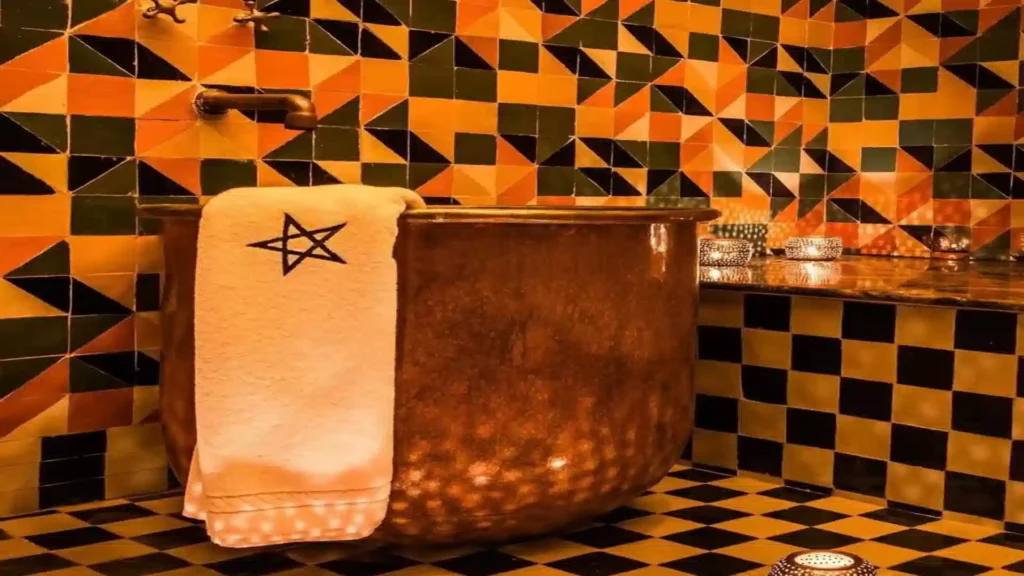
A traditional hand-hammered brass bucket sits against vibrant geometric zellige tiles, ready for the rinsing ritual.
The Moroccan hammam is a direct descendant of the Roman bathhouse tradition, brought to North Africa by the Roman settlers more than 2,000 years ago, and of Islamic ritual purification practices that gave the institution its deeply communal and spiritually significant character. The Moroccan hammam can be traced back to the first original bathhouses created by the Roman Empire more than 2,000 years ago to improve public hygiene a lineage that can be seen in the multi-room steam structure of the hammam, which mirrors the Roman sequence of tepidarium (warm room), caldarium (hot room) and frigidarium (cold room).
How this history has shaped the modern hammam:
- Roman origins : The bathhouse infrastructure Rome built across North Africa most visibly at Volubilis near Meknes set communal bathing as a public social norm across the region centuries before Islam arrived.
The religious ritual of purification (ghusl, or full-body washing, before prayers) gave the hammam a spiritual significance, raising it from a practical necessity to a religious obligation, thus ensuring its place in the quotidian life of Morocco at a cultural level that no purely practical institution could ever hope to attain - Location near mosques: Historically, Moroccan hammams are situated close to mosques to enable the cleansing of the body and spirit before prayer ritualsa spatial connection still observable in the medinas of Marrakech, Fes, and Meknes today.
Present tense Modern plumbing has made the hammam unnecessary for basic hygiene but its social and cultural role continues to be central to Moroccan community life. “I can’t say, no. I’m not going to say anything. I’m not going to tell you anything. My lawyers have told me not to talk to anyone.”Today, even though most homes have modern plumbing, Moroccans still go to the hammam on a regular basis. It’s not just about getting clean, it’s about ritual, community and the simple pleasure of getting thoroughly warmed up.
public hammam vs luxury hammam Morocco Which Is Right For You?
The right kind of hammam is virtually just a question of whether you want authentic cultural immersion or guided comfort a public neighborhood hammam gives you real Moroccan daily life for under $5, a luxury spa hammam gives you the same ritual in a beautifully designed private space for $30-80+. Neither is objectively “better.” They appeal to completely different traveler priorities.
Public Neighborhood Bath (Hammam Baladi)
The real experience is the communal hammam. This is where Moroccan families go every week and costs between 15 and 30 MAD (€1.50–3 approx). Men and women bathe at different times or in different sections.
What To Expect At A Moroccan Hammam:
- At The Entry you need Pay at the door usually 10–30 MAD. No reservations required. Just show up for the right gender session.
- Changing room: An area with a bench to change clothes, leave clothes and store valuables. Cheaper hammams don’t have lockers, so bring your valuables in a small bag that you take into the steam room.
- Facilities : Three rooms with varying temperatures warm, hot and sometimes cold with stone or marble benches and tap stations for filling buckets along the walls.
- The tayaba/kessala : A female attendant (tayaba) or male attendant (kessala) who can do the scrub for an extra 30-150 MAD. This is optional, but highly recommended on your first visit.
- Supplies: Bring your own kessa glove and beldi soap (you can buy these at any souk stall for a total of 10-20 MAD) or buy them at the door. A small towel and flip-flops are a must.
You’ll sit side-by-side with local Moroccan families, hear the language all around you, and get a sense of what daily Moroccan life really feels like on the inside, in a way that no medina walk or cooking class can replicate.
The Tourist / Hammam Boutique
Designed or adapted for international travellers, with French and often English speaking staff, supplied products and a guided experience. Staff speak French and often English, the process is explained in advance and it is all provided. The experience is comfortable, well organised and authentically Moroccan. Most feature a full body scrub with black soap, a ghassoul clay masque and a brief massage. The story is told in the English language.
Best for: First time visitors who want the full experience without language uncertainty or navigation anxiety.
Luxury Spa Hammam Riad
Five-star spa experiences in beautiful spaces with interiors of marble, tadelakt and zellige. The hammam ritual is followed by a professional massage, treatments with argan oil, facial care and relaxation in peaceful lounges. Much of the produce is organic and locally sourced. These experiences are comparable to the world’s best spas for a fraction of the European price. Based on our own testing, the riad hammam tier is the one most consistently cited by honeymooners and couples as the highlight of their Marrakech stay, not just for the treatment itself but for the quality of the architectural surroundings.
What is Inside a Moroccan Hammam: What Really Happens Step by Step
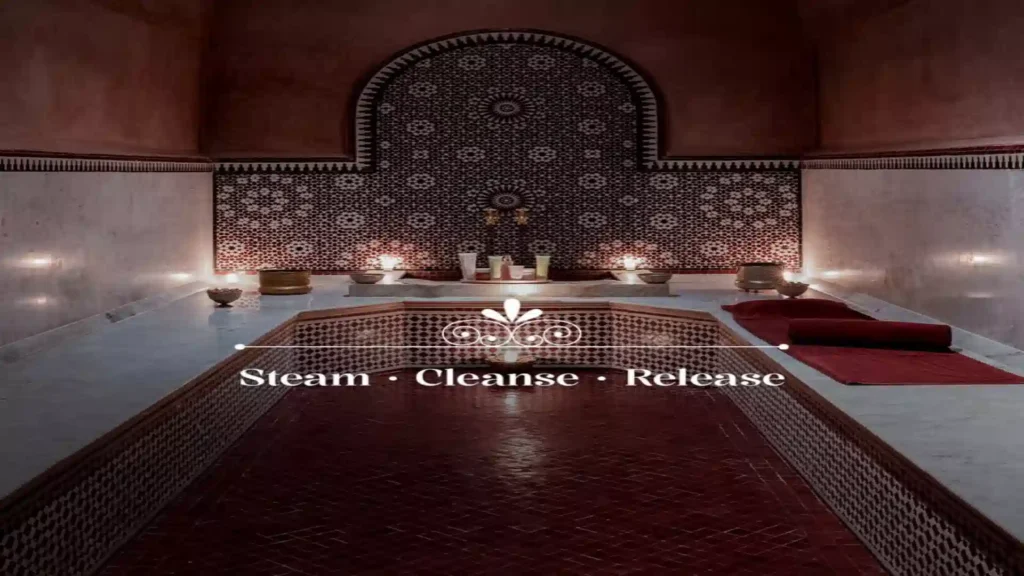
Inside a luxury riad hammam, where intricate mosaic tilework and gentle steam set the stage for total relaxation.
The traditional Moroccan hammam sequence has five steps: undress, get used to the steam room, black soap, kessa exfoliation and ghassoul clay mask/rinse. The rest period at the end is as much a part of the ritual as the scrub. If you know the sequence ahead of time, there is no uncertainty and you can just enjoy the experience.
Step 1. Change the Room : Remove your clothes and put them away. Women generally wear underwear or a swimsuit; men wear shorts. Nudity is not expected nor appropriate. Wear flip-flops before walking on wet floors.
Step 2 — Steam Room Orientation (10 – 15 Minutes): First enter the warm room, and then slowly move into the hotter room. Sit, breathe, sweat. This step is important – the heat opens the pores and softens the outer layers of skin, so the soap and exfoliation that follows will be much more effective than they would be on dry, unprepared skin.
Step 3: Apply Black Soap (5 to 10 minutes): The attendant (or you, in a DIY public hammam) slathers Savon Beldi all over your body liberally. I was gently washed from head to toes with Moroccan black soap made from argan oil husks, then covered with a rich mixture and left to rest for about 20 minutes in a steam-filled room. As you continue to steam the soap works into soft skin.
Step 4 — The Kessa Scrub Your attendant dons the kessa, a coarse, textured exfoliating mitt made from viscose fibers, and begins scrubbing your body in long, firm strokes across the marble slab. Then another alarming and deeply satisfying thing happens and that is you start to see rolls of dead skin coming off your body. You’ve never been cleansed like this, with black soap and steam loosening the grey-brown ribbons of accumulated dead cells your daily shower has never touched and you wash them away.
The word to know if it gets too vigorous: bshwiya “softly” in Moroccan Darija.
Step 5 — Ghassoul Clay Mask (luxury and tourist hammams) Apply as a hair and body mask after the kessa scrub. The volcanic clay from the Middle Atlas draws out any remaining impurities while conditioning the surface of the skin. You generally leave it on for 5 to 10 minutes before rinsing.
Step 6 — Rinse and Cool Down Rinse well with warm water, then slowly change to cooler water. Circulation is stimulated alternately by warm and cool water. For a final splash of orange blossom water(ma zhar) over your hair for a fragrant finish. Rest Period When you are dry, sit down in the changing room or relaxation lounge. You will feel the unbelievably soft skin. Locals sip mint tea and gossip at public hammams. Luxury spas will serve you tea, dried fruits and pastries in a quiet lounge. Don’t hurry. The rest of the time is a part of the ritual. Your body needs time to cool down and reabsorb the moisture.
What to Bring for a Moroccan Hammam
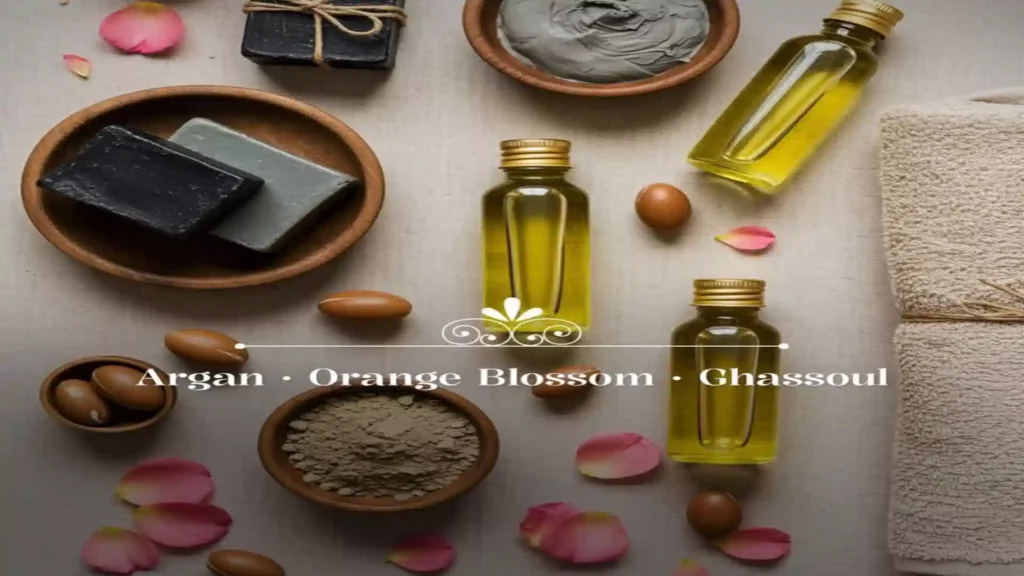
The natural essentials of the ritual: pure argan oil, volcanic ghassoul clay, and olive-based black soap.
For a public hammam, take a kessa glove (10-15 MAD from any souk), a pot of beldi soap (10-20 MAD), a small towel, flip-flops and a change of clothes. For a tourist or luxury hammam, take nothing but a change of clothes, as everything is provided. This is the single most useful practical thing to know before you walk in.
What is the price of a hammam in Morocco? Marrakech hammam price 2026
Public Moroccan hammams are as cheap as 10-30 MAD (about $1-3) to enter plus 30-150 MAD for an attendant scrub, while tourist hammams cost 150-300 MAD for a full guided experience, and luxury riad spa hammams range from 300-1,000+ MAD for a full ritual including massage and argan oil treatments. Third parties are all great value compared to equivalent spa treatments in Europe or North America.
Pricing is seasonal for the peak tourist months of October to April and may increase by 20–30%.
What You Should Know Before You Go: Hammam Etiquette
How to behave in a Moroccan Hammam No phones or cameras, no loud talking in luxury settings, no nudity, drink water before you go in, wait at least two hours after eating and understand that personal space expectations are different inside a communal bathhouse than anywhere else you’ve probably been. These unwritten rules help make your experience and the experience of the Moroccan families around you comfortable.
Practical etiquette checklist:
- No photos, period this rule is universal and non-negotiable in both public and tourist hammams.
Make sure to drink at least 500 ml of water before going in. The steam is very intense and makes you sweat a lot. If you are not used to the heat for the first time you will get dizzy from dehydration. - Wait at least 2 hours after eating — on a full stomach, steam and intense heat reliably cause nausea.
- Men and women use separate sessions or sections – always check the schedule for your gender before arriving. public hammams are busiest on Thursday evenings and Friday mornings (before Friday prayer), so for a quieter experience go on weekend mornings. Speak in moderation public hammams are social, but not raucous; luxury spas expect near-silence.
- Get in the communal spirit – a public hammam has little personal space and the attendant will wash parts of you a Western spa would not touch. That is normal and expected, not a boundary violation.
- Tip your attendant 20–50 MAD is appropriate at a public hammam; 50–100 MAD at a tourist hammam for a satisfying scrub.
Why Moroccans Go to the Hammam Every Week Benefits of the Hammam
Regular visits to the Moroccan hammam improve blood circulation, deeply exfoliate the accumulated dead skin, open and cleanse the pores with steam, relieve muscle tensions and, according to Moroccan tradition and increasingly modern dermatology, keep the skin much healthier than washing alone. This is probably a big part of the reason why the skin quality that you can easily spot in medina communities is so common in Moroccan families. Most families visit the hammam once a week.
Benefits of the Hammam Ritual:
- Exfoliation depth: On steam-softened skin, the kessa scrub removes layers of accumulated dead cells that daily showering never reaches.
- Circulation : The alternating hot steam and cooler rinse water stimulates the blood circulation in a similar manner as contrast therapy.
- Muscle relief: long-lasting heat relaxes stiff joints and muscles, a traditional recovery tool used after physical work, used by Moroccans for centuries
- Skin conditioning: The olive oil in Beldi, the mineral content of the ghassoul clay and the argan oil treatments found in luxury hammams really do leave the skin softer and more supple for days after the visit.
- Mental reset: The required disconnection from screens, the warmth, and the slow ritual pace reliably generate a profoundly relaxed mental state that most visitors label as the best they’ve felt during their entire trip.
What You’ll Need for a Moroccan Hammam: The Full Guide
The four core Moroccan hammam products avion beldi (black soap), the kessa glove, ghassoul clay and argan oil are unique Moroccan artisan products with centuries of documented use. All four are widely available in medina souks at prices dramatically lower than their Western wellness-market counterparts. Knowledge of what each product is and does adds to the hammam experience itself and your subsequent shopping decisions.
A note on buying these products in the souk : Argan oil in particular is frequently adulterated with cheaper oils in tourist-facing stalls; buying from a women’s argan cooperative (found across Marrakech and along the Essaouira road) guarantees both purity and fair-wage production.
Moroccan Hammam vs Turkish Bath (Hamam):
What Is the Difference? The Moroccan hammam and the Turkish bath (hamam) share the same historical Roman bathhouse roots and the same basic steam-and-scrub structure, but differ in their specific products, physical setup, and cultural context the Moroccan version centers on black olive oil soap and the kessa glove, while the Turkish bath traditionally uses a loofa-style scrub mitt and soap foam, with more elaborate marble architecture in its classical form. Travelers who have experienced Turkish baths often ask this question specifically, and the differences are meaningful enough to describe clearly.
Both are well worth experiencing for a traveler exploring the broader Mediterranean and Islamic bathing tradition but they are genuinely different enough that experiencing a Moroccan hammam after only having Turkish baths before will still feel new and distinct.
Frequently Asked Questions About the Moroccan Hammam
Is a Moroccan Hammam Good for First-Timers?
Yes, but for a first visit, a tourist or boutique hammam is much more comfortable than a public one, as staff will walk you through each step in French or English, and you won’t have to deal with language or etiquette uncertainty by yourself.
You don’t have to be naked in a Moroccan hammam.
No, women wear a bathing suit or underwear, men wear shorts. Nudity is neither expected nor appropriate in any Moroccan hammam environment.
Does the kessa scrub sting?
It is more vigorous than gentle – firm, methodical strokes all over the body, which can feel intense, especially on sensitive areas. If it’s too much say “bshwiya” (softly) and the attendant will decrease pressure.
Can men and women go to the bathhouse together?
No, in the traditional public hammams men and women use entirely separate facilities or time slots. In tourist and luxury hammams, there are private rooms for couples, where partners can share the ritual in the same room.
What to do immediately after a hammam?
Rest. No alcohol for a few hours at least. Drink mint tea or water. After the session, when you are completely cooled and dry, apply a light moisturizer or argan oil to seal in the benefits, as your skin will continue to absorb moisture.
Can I buy hammam products to take away?
Yes kessa gloves (10–15 MAD), beldi soap (10–20 MAD per pot), ghassoul clay (15–30 MAD per packet) and argan oil are all widely available in medina souks across Marrakech, Fes and Essaouira and are some of the best-value, most authentic souvenirs you can buy.
Is it okay to go to a hammam in Ramadan?
Yes, hammams are open during Ramadan and are very popular, especially in the evening after iftar (the fast-breaking meal).
How long does the skin stay different after a hammam?
Most visitors experience a profound softening and clearing of the skin for 3-5 days after a full kessa scrub and ghassoul treatment enough to still be feeling the effects on the last day of a typical one-week Morocco trip.
The hammam is, across every type of traveler and every budget, the one experience that most consistently turns a good Morocco Sahara Desert trip into an unforgettable one. Not because of spectacle, but because of how deeply it connects you to the way Moroccan daily life has worked for a thousand years. Plan for it on every schedule, whether you’re there for two nights or two weeks.
Get Ready To Treat Yourself With The Ultimate Moroccan Hammam Ritual?
Don’t let first-time jitters keep you from the best experience of your trip. If you want an intimate, luxury marble oasis or highly recommended guided boutique experience, booking ahead will ensure you get the best times slots (and avoid peak-season price hikes).
At Over Morocco Tours, Our selection of customer approved, curated Moroccan hammam experiences in Marrakech and Fes.
See and Book Our Top Recommended Moroccan Spas.