What Does “Yalla Yalla Habibi” Meaning? Full Arabic Guide
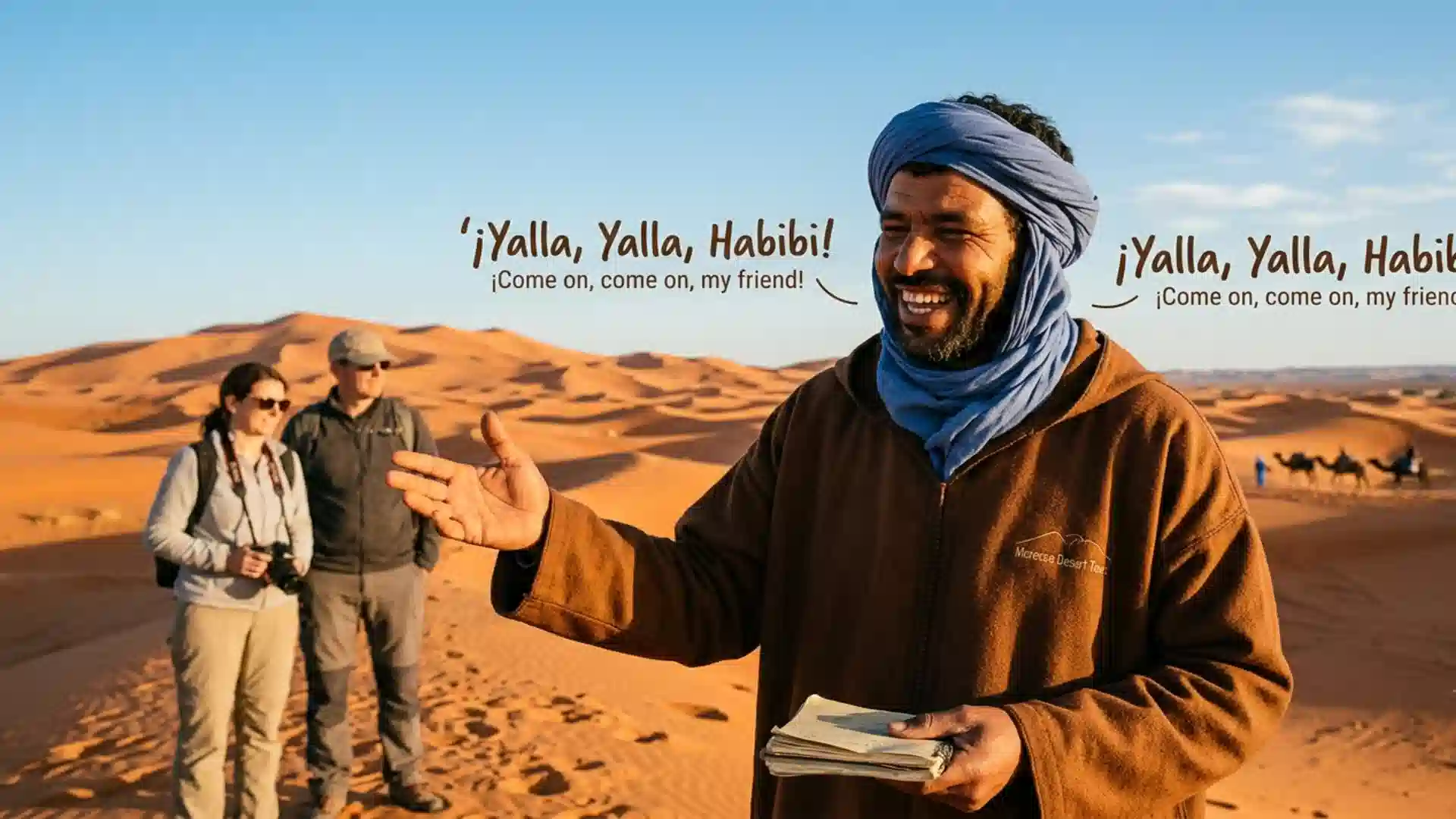
“Yalla yalla habibi” means “come on, come on, my dear” or “let’s go, my love. ” Yalla is Arabic for “let’s go/hurry up,” and the repetition is for emphasis, while habibi is a term of affection meaning “my beloved” or “my dear”. It’s one of the most common phrases heard throughout the Arabic-speaking world, used much more often among friends, family, and even strangers than in romantic contexts. This is one of the first phrases we learn from our experience leading travelers through the medina and desert routes of Marrakech on a daily basis, and one of the most misunderstood.
This guide explains what each word means, where the phrase comes from, how it’s really used in typical Moroccan and wider Arabic conversation, and why you’ll hear it all the time the second you hit the ground in Morocco.
Table of Contents
“Yalla Yalla Habibi“: Quick Breakdown for Common Moroccan Arabic Words
What Does “Yalla” Meaning in Arabic?
Yalla (يلا) is the Swiss army knife of Arabic words. It means “come on”, “let’s go” or “hurry up”. You will hear it used dozens of times a day in every single Arabic dialect.
It’s used by native speakers in just about any casual context you can imagine:
- To begin an activity: “Yalla, let’s eat!” or “Yalla, let’s get this meeting going.”
- To make someone leave: “Yalla, let’s go” when putting money on the table at a café to get up and go.
- To cheer : Cheering for a football player or a friend trying to do something hard .
- As a standalone exclamation: A quick, sharp “Yalla!” usually means “Alright, let’s do this!” or “Get a move on!”
(Linguistic Note: Culturally, “yalla” is believed to have originated centuries ago as a contraction of Ya (oh) and Allah (God). Regardless of origin, its modern usage carries no religious connotation in everyday speech. If you are interested in how root systems form the basis of the language, you can explore more about Classical Arabic etymology and grammarto see how modern slang evolved
What Does Habibi Mean on Its Own?
Habibi (حبيبي) means “my beloved,” “my love,” or “my dear,” and comes from the Arabic root H-B-B, which relates to love and affection. The feminine form, habibti (حبيبتي), is used when addressing a woman, though in casual usage outside the Arab world, “habibi” is sometimes used informally for both genders.
Key things to understand about what does habibi mean:
- It’s not exclusively romantic. Parents call their children habibi, friends call each other habibi, and even a shopkeeper might greet a customer with “habibi” as a warm, welcoming gesture.
- It’s used constantly in daily speech. Many Arabic speakers use habibi multiple times a day across completely different relationships family, friends, romantic partners, and casual acquaintances.
- It’s culturally universal, not religious. While Habib (the root word) appears in religious and poetic contexts as well, habibi itself is a cultural term of affection used regardless of religion.
- It’s not professional. Using habibi in a business meeting or formal setting would generally come across as too informal, even though it’s completely natural in casual conversation.
Where Does the Phrase “Yalla Yalla Habibi” Come From?
“Yalla yalla habibi” isn’t a fixed idiom with a single origin it’s a natural combination of two extremely common Arabic words that pair together so often in daily speech that the phrase has become recognizable as a unit, further popularized globally through Arabic pop music, films, and viral social media content. This is why you’ll hear slight variations of it across different Arabic-speaking countries and contexts, rather than one “correct” version.
The phrase has also crossed into mainstream Western pop culture through:
- Music: Arabic and Arabic-influenced pop songs frequently feature “yalla habibi” in choruses and hooks, since the rhythm and repetition work naturally in lyrics.
- Film and television: Middle Eastern characters in film often use the phrase in dialogue, reinforcing its recognizability to non-Arabic-speaking audiences.
- Social media trends: TikTok and Instagram content featuring Arabic music or Middle Eastern and North African culture has introduced the phrase to a much broader international audience over the past several years, often without full context on its everyday, non-romantic usage.
This global pop-culture exposure is part of why many travelers arrive in Morocco already familiar with the phrase, even if they don’t fully understand when or how it’s actually used in daily Moroccan conversation.
How Is “Yalla Habibi” Actually Used in Everyday Conversation?
“Yalla habibi” is used constantly in casual, everyday situations far more often as a friendly nudge to hurry up or get moving than as a romantic expression and you’ll hear it from drivers, guides, shopkeepers, and friends alike throughout Morocco and the wider Arabic-speaking world. In our experience guiding travelers, this is usually one of the first phrases they recognize, and one of the first they start using themselves within a day or two.
Real-world examples of how it’s used:
- Between friends heading out: “Yalla habibi, let’s go” said when leaving a cafe or starting an outing together.
- Urging someone to hurry: “Yalla habibi, we’re late” a warm but urgent nudge.
- From a driver or guide: A guide might say “Yalla habibi, let’s continue” when it’s time to move to the next stop on a tour.
- As an affectionate greeting: A shopkeeper or host might use “habibi” or “habibti” as a warm welcome, independent of the “yalla” portion.
- In music and celebration: The phrase shows up constantly in Arabic pop songs and celebratory contexts, often sung or chanted with enthusiasm.
Is “Yalla Habibi” Romantic or Just Friendly?
Context determines the tone “yalla habibi” can be romantic when said between partners, but it’s just as commonly platonic, used between friends, family members, or even casually with strangers in service settings like shops, restaurants, and taxis. Unlike English, where “my love” or “darling” would almost always signal a romantic relationship, Arabic terms of endearment like habibi carry a much broader, warmer, and more casual everyday usage.
A simple way to think about it: in Morocco and across the Arabic-speaking world, habibi functions somewhat like how “buddy,” “dear,” or “love” might be used casually in British or Irish English friendly and warm, but not inherently romantic unless the relationship and context make it so.
Other Common Moroccan Arabic words You’ll Hear Paired with Habibi
“Habibi” frequently pairs with other common Arabic expressions beyond “yalla,” including “wallah habibi” (I swear, my dear), “shukran habibi” (thank you, dear), and “marhaba habibi” (welcome/hello, my dear) each adding a different emotional flavor to the base term of affection. Recognizing these combinations helps travelers understand much more of the warmth and rhythm of everyday Moroccan and broader Arabic conversation.
Does Morocco Use the Same Arabic as the Phrase “Yalla Habibi“?
Morocco’s everyday spoken language is Darija (Moroccan Arabic), a dialect distinct from Modern Standard Arabic, but “yalla” and “habibi” are both widely understood and used across Darija as well, since these words are common to nearly every Arabic dialect in the region. This is part of why the phrase travels so well across different Arabic-speaking countries it’s not tied to one specific dialect.
A few practical notes for travelers in Morocco specifically:
- French and Darija mix constantly in everyday Moroccan speech, especially in cities, but “yalla” and “habibi” remain consistent across both.
- Berber (Amazigh) communities, particularly in the Atlas Mountains and southern desert regions, often speak Tamazight as a first language, though Darija (including phrases like yalla habibi) is widely understood as well given its role as Morocco’s lingua franca.
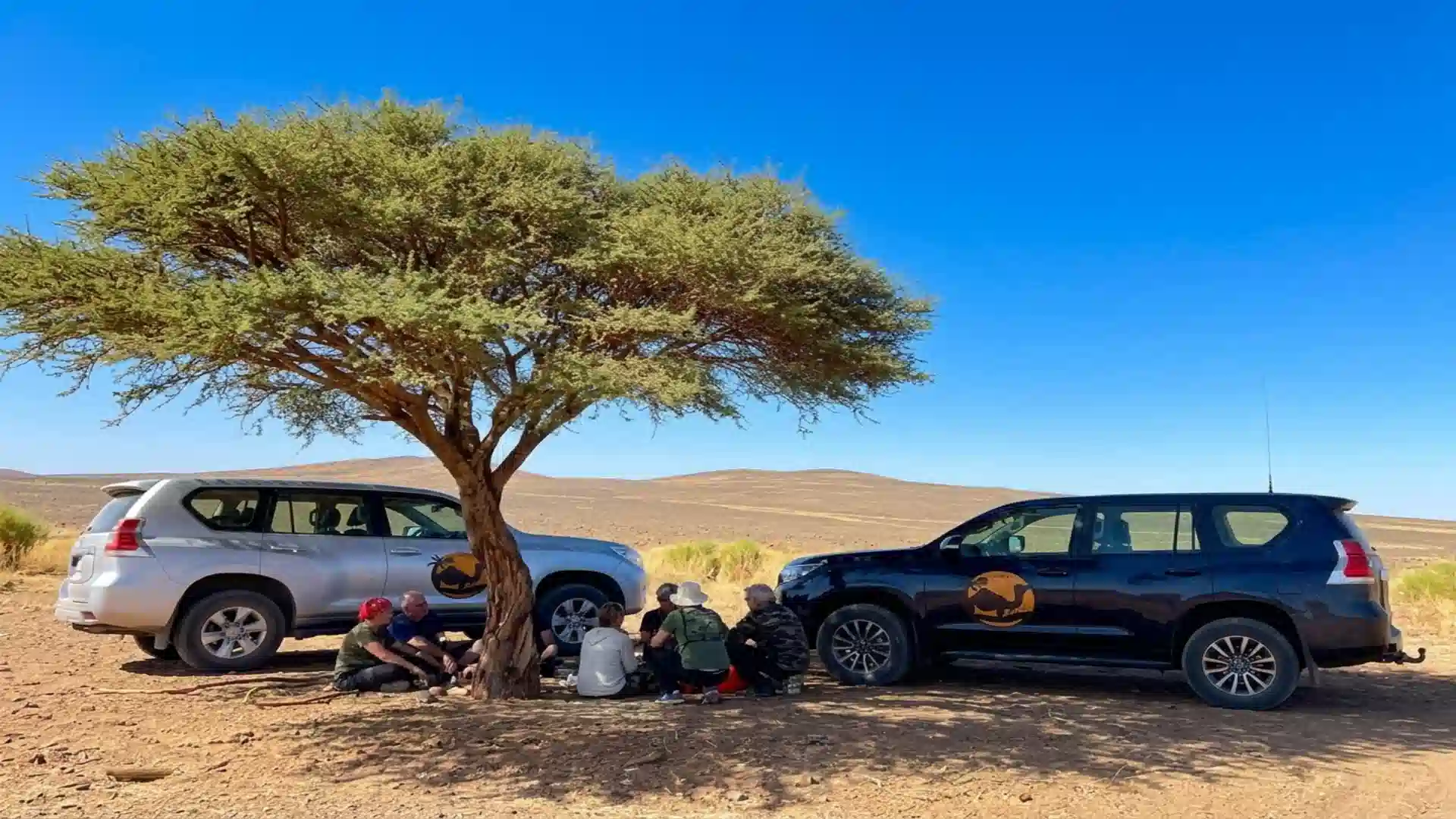
- You’ll hear it everywhere: from your driver during a desert tour, from shopkeepers in the Marrakech medina, and from fellow travelers who’ve picked up a few words during their trip.
Should Travelers Use “Yalla Habibi” Themselves?
Yes using “yalla habibi” as a visitor is generally well received and seen as a friendly, low-stakes way to engage with local culture, as long as it’s used in casual, appropriate contexts rather than formal or professional settings. Moroccans and Arabic speakers broadly tend to appreciate visitors making an effort with basic phrases, even imperfectly pronounced ones.
A few tips if you want to use it naturally during your trip:
- Use it casually with guides, drivers, or in friendly exchanges with shopkeepers — it’s a warm, appropriate way to engage.
- Avoid it in formal or business settings, the same way you’d avoid overly casual language in a professional meeting back home.
- Don’t worry about perfect pronunciation — the effort itself is what’s appreciated, not flawless delivery.
- Pair it naturally: “Yalla habibi, let’s go see the dunes” works perfectly as an enthusiastic, friendly phrase during a desert tour.
How Does “Yalla Habibi” Vary Across Different Arabic Dialects?
While “yalla” and “habibi” are understood almost universally across Arabic-speaking countries, pronunciation, frequency, and accompanying slang shift noticeably between regions Levantine Arabic (Lebanon, Syria, Jordan, Palestine), Gulf Arabic, Egyptian Arabic, and Moroccan Darija each put a slightly different spin on the phrase. While the phrase is universally understood, the exact flavor shifts depending on where you land. Audio courses covering various Arabic dialects like Moroccan Darija and Egyptian show just how much pronunciation can change from region to region
In our experience working with Berber and Arabic-speaking guides across Morocco’s different regions, the phrase travels seamlessly even between Darija-speaking cities like Marrakech and more Tamazight-influenced areas near the Atlas Mountains and Sahara, since “yalla habibi” has become close to a shared cultural shorthand across the wider Arabic and North African world.
“Yalla Yalla Habibi” in Music, Film, and Pop Culture
The phrase owes much of its global recognizability to decades of use in Arabic pop and Levantine wedding music, followed more recently by viral exposure through TikTok trends, Western collaborations, and Middle Eastern-influenced mainstream pop and hip-hop tracks. This is part of why travelers often arrive in Morocco already familiar with the sound of the phrase, even without understanding its everyday, largely non-romantic usage.
A few notable ways the phrase has spread internationally:
- Levantine and Egyptian pop music: “Yalla Yalla habibi” and close variations have appeared in countless Arabic-language songs for decades, often used in choruses because the rhythm and repetition fit musical phrasing naturally.
- Wedding and celebration songs: The phrase carries an upbeat, celebratory energy that makes it a natural fit for festive Arabic music played at weddings and parties across the region.
- Western crossover tracks: Several Western and international artists have incorporated “habibi” or “yalla habibi” into song lyrics or titles, introducing the phrase to listeners with no Arabic background.
- Social media virality: Short-form video platforms have turned Arabic music featuring the phrase into recurring trends, often stripped of full cultural context but still spreading recognition of the words themselves.
- Film and television dialogue: Middle Eastern and North African characters in international film and TV frequently use the phrase, reinforcing both its sound and its general “let’s go, my dear” meaning to non-Arabic-speaking audiences.
This pop-culture exposure is a double-edged sword from a cultural standpoint: it’s made the phrase globally recognizable, but it’s also led some international audiences to assume it’s exclusively romantic or musical in nature, when in reality it’s overwhelmingly a tool of everyday, casual conversation.
Arabic Phrases For Travelers Morocco: Other Words You Hear Alongside “Yalla Yalla Habibi“
Beyond “yalla” and “habibi,” a handful of other everyday Arabic and Darija words come up constantly during a Morocco trip, and learning a few of them rounds out your understanding of how locals communicate warmth, urgency, and hospitality. This is the same small phrasebook our guides naturally teach curious travelers over the course of a multi-day desert tour.
Pairing a few of these with “yalla habibi” gives travelers a genuinely useful, well-rounded handful of phrases to use respectfully and naturally throughout a trip — far more functional than memorizing formal textbook Arabic that locals rarely use in casual daily conversation.
Common Mistakes Travelers Make with “Yalla Yalla Habibi“
The most common mistakes non-native speakers make are assuming the phrase is always romantic, using it in inappropriately formal settings, or over-pronouncing it in a way that sounds performative rather than natural. None of these mistakes are likely to cause offense Arabic speakers are generally warm and forgiving toward visitors making an effort but understanding them helps the phrase land more naturally.
- Assuming it’s always flirtatious: As covered earlier, context is everything; using it with your guide, driver, or a shopkeeper is completely normal and not remotely romantic.
- Using it in formal correspondence or business settings: Save it for casual, warm interactions rather than emails or professional meetings.
- Mispronouncing the emphasis: “Yalla” is typically pronounced with stress on the first syllable, and rushing or flattening the word can sometimes make it harder for native speakers to immediately recognize, though context almost always makes the meaning clear regardless.
- Overusing it performatively: A little goes a long way sprinkling it naturally into conversation lands better than repeating it as a forced “local” catchphrase in every sentence.
Why Learning a Few Local Phrases Improves Your Trip
Learning even a handful of everyday Arabic or Darija phrases like “yalla habibi” genuinely improves the quality of interactions with guides, drivers, and shopkeepers during a Morocco trip, since it signals respect and curiosity about local culture rather than treating the destination as purely a backdrop. Based on our experience hosting travelers from dozens of countries, the guests who make even a small effort with language consistently report warmer, more memorable interactions throughout their trip.
A few practical reasons this matters beyond simple politeness:
- It builds rapport quickly: A driver or guide who hears you attempt “yalla habibi” naturally relaxes into a warmer, more conversational dynamic for the rest of the day.
- It opens cultural conversations: Locals often enjoy explaining the nuance behind phrases like this, leading to richer cultural exchange than a purely transactional tourist interaction.
- It’s genuinely useful, not just symbolic: Unlike memorizing formal phrasebook Arabic, words like “yalla” and “habibi” are used so constantly that you’ll actually hear and use them dozens of times throughout even a short trip.
How Do You Actually Pronounce “Yalla Yalla Habibi“?
“Yalla” is pronounced YAH-lah, with a soft, slightly rolled emphasis on the first syllable, while “habibi” is pronounced ha-BEE-bee, with the stress falling on the middle syllable. Getting the rhythm right matters more than perfect phonetic accuracy Arabic speakers generally recognize and appreciate the attempt regardless of minor pronunciation differences.
A simple breakdown for English speakers about Yalla Yalla Habbi:
- Yalla: Rhymes loosely with “holla,” but softer think “YAH” followed by a quick “lah.”
- Habibi: Broken into three even beats — “ha,” “BEE” (the stressed syllable), and “bee” again at the end.
- Together: “YAH-lah YAH-lah ha-BEE-bee” — said with energy and a slight rising tone, since the phrase is almost always delivered with warmth or urgency rather than flatly.
Listening to how guides, drivers, or local hosts say it naturally during your trip is the fastest way to pick up the right rhythm — far more effective than studying written pronunciation guides alone.
A Brief Look at the Etymology Behind the Phrase Yalla Meaning in Arabic:
Both “yalla” and “habibi” have roots that trace back centuries within Classical and Quranic Arabic, though their modern everyday usage has evolved considerably into the casual, conversational tone heard across the Arab world today. Understanding this history adds depth to a phrase many travelers hear constantly without realizing its linguistic background.
- Yalla’s possible origin: Some linguists trace “yalla” to a contraction of “ya” (a vocative particle, similar to “oh”) and “Allah” (God), though scholars also note alternate theories about its evolution purely as a colloquial expression over time. Regardless of origin, its modern usage carries no religious connotation in everyday speech.
- Habib and the H-B-B root: The word “habib” (beloved) comes from the Arabic root H-B-B, a root associated with love and affection that appears throughout Arabic literature, poetry, and even religious texts, where the Prophet Muhammad is referred to with terms derived from this same root by his companions.
- From formal root to casual daily word: Like many words with deeper linguistic or religious roots, both “yalla” and “habibi” have shifted over generations into purely secular, everyday vocabulary a common pattern across many languages where formal or sacred-adjacent roots evolve into casual conversational staples.
This evolution from formal linguistic roots into one of the most casually repeated phrase combinations in modern Arabic is part of what makes “yalla habibi” such a genuinely interesting entry point into the broader rhythm and warmth of Arabic conversational culture.
Frequently Asked Questions About “Yalla Yalla Habibi“
Is “yalla habibi” only used in romantic relationships?
No — while it can be romantic between couples, it’s used far more commonly in everyday platonic contexts between friends, family, and even casually with strangers in service settings.
What’s the difference between “yalla” and “yalla yalla”?
Repeating “yalla” adds urgency or playful emphasis, similar to saying “come on, come on” in English rather than just “come on” once.
Is “habibi” only used for men?
Habibi is traditionally masculine, with habibti as the feminine form, though in casual or informal usage — especially among non-native speakers “habibi” is sometimes used for both genders.
Does “yalla habibi” have any religious meaning?
No while “yalla” may have linguistic roots tracing back to a contraction involving “Allah,” the phrase itself is entirely secular and used by Arabic speakers of all religious backgrounds in casual daily conversation.
Will I hear “yalla yalla habibi” on a Morocco desert tour?
Very likely guides and drivers commonly use it as a warm, friendly way to signal it’s time to move to the next stop, board the vehicle, or continue the day’s itinerary.
Is it rude to say “yalla habibi” to someone you just met?
Generally no, particularly in casual or service settings like shops, taxis, or restaurants, where it’s a normal part of warm, friendly Moroccan and broader Arabic communication style.
Can non-Arabic speakers use “yalla habibi” without sounding awkward?
Yes, as long as it’s used in casual, appropriate moments rather than forced into every sentence a single well-placed “yalla Yalla habibi” when heading out somewhere tends to land naturally and is usually met with a smile rather than judgment.
Does Moroccan Darija use “yalla yalla habibi” the same way as Egyptian or Levantine Arabic?
The core meaning and usage are nearly identical across dialects, though Moroccan Darija frequently blends the phrase with French (for example, “yalla habibi, on y va” “come on, my dear, let’s go”), reflecting Morocco’s bilingual everyday speech patterns.
What’s a polite way to respond if someone says “Yalla Yalla habibi” to you?
A simple smile and following along, or replying with a casual “yalla” or “okay habibi” in return, is a natural and well-received response there’s no formal reply required.
Quick Recap: Yalla Yalla Habibi Meaning
- Yalla = “come on” / “let’s go” / “hurry up”
- Habibi = “my dear” / “my beloved” (masculine); habibti for feminine
- Yalla yalla habibi = “come on, come on, my dear” or “let’s go, my love” used far more often casually than romantically
- Context matters most: the same phrase shifts naturally between playful, urgent, affectionate, and warmly casual depending on who’s saying it and why
- Dialect-flexible: understood and used across Darija, Egyptian, Levantine, and Gulf Arabic alike, with small regional flavor differences
- Pop-culture famous, but everyday-functional: while the phrase has spread globally through music and social media, its real value for travelers lies in how often it’s used in completely ordinary daily conversation
- Travelers are welcome to use it: a small, well-received way to connect with local culture during a trip to Morocco, alongside other everyday phrases like shukran (thank you) and bslama (goodbye)
Get Ready to Say “Yalla!” In the Sahara desert?
There’s no need to walk alone through the winding alleys of the Marrakech medina or the vast dunes of Erg Chebbi. Let our local expert team show you the real Morocco!
Check out our signature 14 Day Grand Morocco Itinerary or customize your private desert tour with Youssef, Ali and the team today!
Next time your guide says “yalla yalla habibi” as the camels are ready or the van is loaded up, you’ll know exactly what’s being said, why it’s said with a smile, and maybe even feel comfortable saying it back one small phrase that captures the warmth running through everyday Moroccan hospitality far better than any formal greeting ever could.