The Ultimate 14-Day Morocco Road Trip: 2026 Guide for German Travelers
The Ultimate 14-Day Morocco Road Trip is more than just a vacation; it is a transformative journey through the “Gateway to Africa.” For travelers arriving from cities like Munich, Berlin, or Hamburg, Morocco offers a sensory explosion that is both exotic and surprisingly accessible. Whether you are navigating the hairpin turns of the High Atlas or cruising along the Atlantic coast, having a structured 14-day plan is the only way to ensure you capture the soul of the Maghreb without burning out.
Table of Contents
Morocco Travel Safety for Germans 2026: What You Need to Know
When planning The Ultimate 14-Day Morocco Road Trip, the first question usually involves security. Morocco travel safety for Germans 2026 is currently at an all-time high. The Moroccan government has invested heavily in infrastructure and “Tourist Police” units ahead of major international events.
For German citizens, the environment is very welcoming. You will find that the local Gendarmerie is professional and frequent along major highways. Unlike the chaotic traffic in some neighboring regions, Morocco’s 2026 safety protocols ensure that solo travelers and families can explore the rural south with peace of mind. However, always keep your Ausweis (ID) and vehicle documents handy for the routine checkpoints that help maintain this high level of safety.
Renting a Car in Morocco with German License: Logistics and Tips
To execute The Ultimate 14-Day Morocco Road Trip, you need a reliable set of wheels. Renting a car in Morocco with German license is a seamless process. Your standard EU plastic card license is fully recognized. You do not strictly need an International Driving Permit, though having one can sometimes speed up interactions in very remote Berber villages.
Choosing the Right Vehicle for the Atlas and Sahara
When renting a car in Morocco with German license, don’t just go for the cheapest option. If your itinerary includes the Marrakech to Sahara road trip logistics, we highly recommend a mid-size SUV or a 4×4. While the main roads (like the N9 over Tizi n’Tichka) are paved, they can be subject to “Moroccan surprises”—sudden rockfalls or sand drifts. Brands like Dacia and Toyota are local favorites because every mechanic in the country knows how to fix them.
Marrakech to Sahara Road Trip Logistics: Crossing the High Atlas
The most iconic segment of The Ultimate 14-Day Morocco Road Trip is the drive from the “Red City” to the dunes. Mastering the Marrakech to Sahara road trip logistics requires understanding the geography. You will climb from 466 meters in Marrakech to over 2,200 meters at the Tizi n’Tichka pass.
Fueling Strategy: In Germany, we are used to a gas station every 5km. In the Draa Valley, they can be 100km apart. Always top up in Ouarzazate.
Driving Times: A distance that looks like a 2-hour drive on Google Maps often takes 4 hours in Morocco due to mountain curves and slow-moving trucks.
The “Golden Local” Rule: When driving through rural areas, pedestrians and livestock have the right of way. Be patient; this is part of the local rhythm.
Hidden Gems in Morocco for European travelers: Beyond the Souks
German travelers typically seek authenticity and nature. While the major cities are impressive, the hidden gems in Morocco for Germans are found in the silences of the landscape.
The Ounila Valley: The Secret Shortcut
Instead of taking the main highway to Aït Ben Haddou, take the detour through the Ounila Valley. This is one of the premier hidden gems in Morocco for Germans because it features crumbling Kasbahs and salt mines that look like a film set, yet you will see almost no other tourists.
Aït Bouguemez: The “Happy Valley”
For those who miss the hiking trails of the Black Forest or the Alps, Aït Bouguemez offers high-altitude trekking through apple orchards and Berber villages. It is a “living museum” and a vital part of The Ultimate 14-Day Morocco Road Trip for anyone wanting to escape the digital world.
Day by Day Strategic Expansion For The Ultimate 14-Day Morocco Road Trip:
Day 1-3: Marrakech – The Magical Starting Point
Begin your Marrakech to Sahara road trip logistics in the “Red City.” Immerse yourself in the chaos of Jemaa el-Fna. For the German temperament, the noise might be overwhelming at first, but once you drink a Thé à la Menthe on a roof terrace (e.g., Café de France) at sunset, you will understand the rhythm of the city. Visit the Jardin Majorelle early at 8:00 AM to avoid the crowds. Marrakech is the logistical hub to pick up your rental car and buy supplies for the drive south.
Day 4-6: Over the High Atlas to Ouarzazate and Skoura
The drive over the Tizi n’Tichka is the first major highlight of your road trip. Be sure to visit the UNESCO World Heritage site Aït Ben Haddou. My tip: Don’t stay in Ouarzazate itself, but drive 40 km further into the palm oasis of Skoura. Here you can sleep in one of the many restored Kasbahs amidst thousands of date palms. It is the perfect place to unwind before heading into the deep desert.
Day 7-9: The Gorges and the Gateway to the Desert
From Skoura, you head through the Valley of the Roses (Kelaat M’Gouna) to the Dadès Gorge. The famous switchbacks of the “Monkey Fingers” are a must for every driver. Further east, the Todra Gorge awaits with its rock walls up to 300 meters high. In 2026, these areas are very well developed for tourism, yet they still retain their raw charm. Use the morning for a short hike through the palm groves of Tinghir before starting the final leg towards Merzouga.
Day 10-12: Merzouga and the Magic of Erg Chebbi
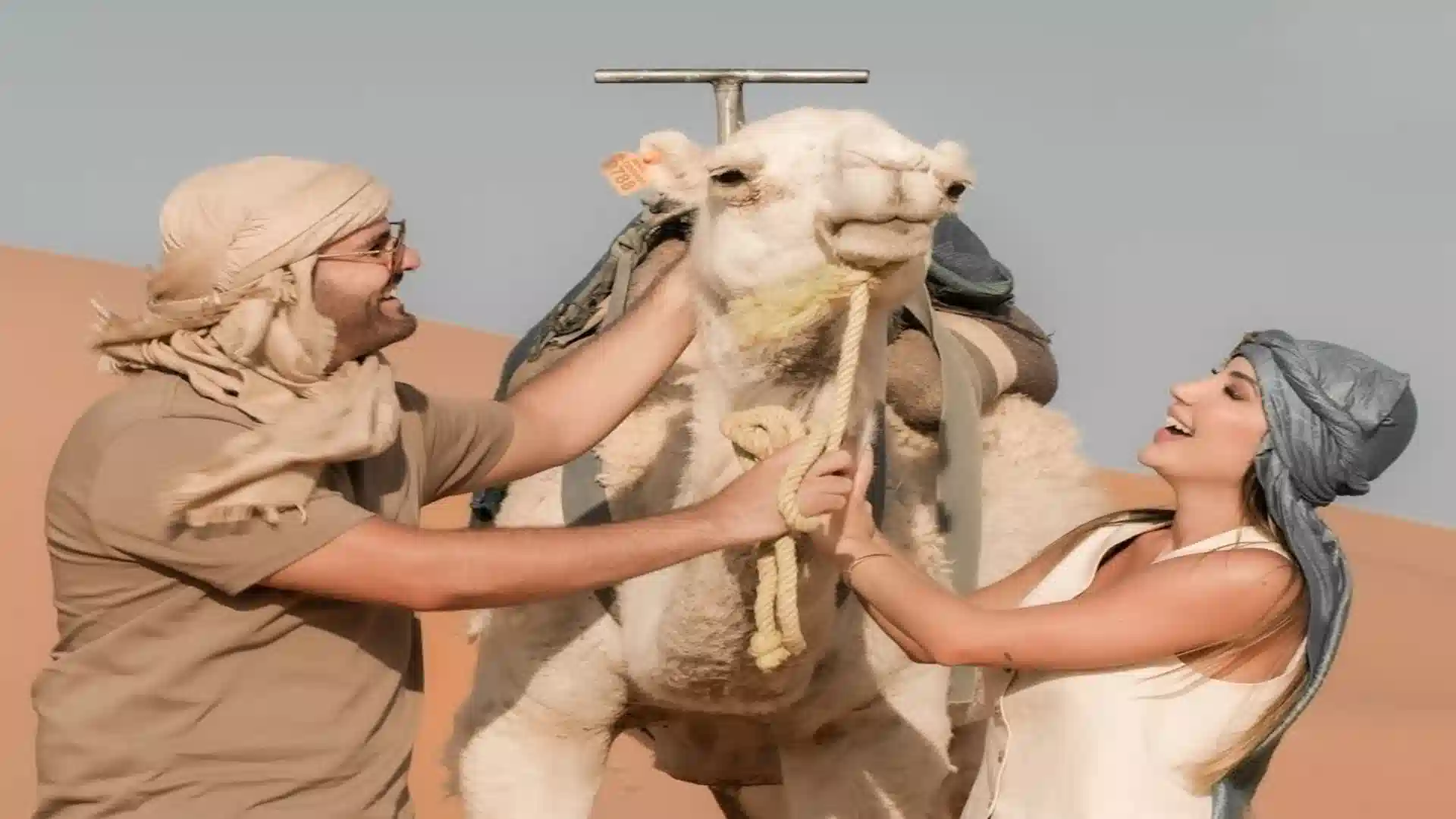
This is where the asphalt ends and the adventure begins. In Merzouga, leave your rental car safely at the hotel and switch to the “ship of the desert” (camel) or a 4WD. A night in a luxury desert camp under the starry sky of the Sahara is the absolute highlight for many. Since it can get quite cold at night even in spring and autumn, a good fleece jacket (something we Germans always have in our suitcases) is worth its weight in gold. The sight of the sun rising over the 150-meter-high dunes is a moment you will never forget.
Day 13-14: Return or Onward Travel to Agadir
For the return journey, you have two options: either drive back via the Draa Valley (Zagora) towards Marrakech or choose the route west towards Agadir. Especially for German vacationers who like to add a few beach days to their road trip, Agadir is a popular destination with its modern hotels and German bakeries. The highway from Agadir back to Marrakech can be covered in less than 3 hours.
Book Your Moroccan Adventure Now With Local Experts
FAQ: What German Travelers Are Asking About Morocco 2026
1. Do I need a visa for Morocco as a German citizen?
Answer: No. German citizens can enter Morocco for tourism for up to 90 days without a visa. However, you must have a passport that is valid for at least six months from your date of entry. A Personalausweis (ID card) is not sufficient for entry; you will be turned away at the airport without a full passport.
2. Can I use my German driver’s license to rent a car?
Answer: Yes. Your standard EU “check-card” style license is fully recognized by all major rental agencies like Hertz, Sixt, and local providers. While an International Driving Permit (Internationaler Führerschein) is not legally required for Germans, it is recommended for remote areas in the High Atlas where local police may not be familiar with German text.
3. How safe is driving in Morocco compared to the Autobahn?
Answer: While the highways (Autoroutes) are excellent and mirror European standards, urban driving in cities like Marrakech is much more chaotic than in Berlin or Munich. Expect “flexible” lane usage and many scooters. In rural areas, the biggest hazards are animals (donkeys and sheep) on the road. Note: Speeding fines are frequent and must usually be paid in cash (Dirhams) on the spot to the Gendarmerie Royale.
4. Is the tap water safe to drink for Germans?
Answer: Generally, no. Most German travelers find the mineral content and bacterial profile of Moroccan tap water leads to “Reisedurchfall” (traveler’s diarrhea). Stick to bottled water (brands like Sidi Ali or Ain Saiss), and use it even for brushing your teeth. In 2026, many eco-conscious Riads offer filtered water stations to reduce plastic waste.
5. What is the best time for a Morocco road trip to avoid the heat?
Answer: For the Ultimate 14-Day Morocco Road Trip, the best windows are March to May (Spring) and September to November (Autumn). During these months, temperatures are a pleasant 22°C to 28°C. July and August can see temperatures exceed 45°C in the Sahara, which makes long drives uncomfortable for those used to the German climate.
6. Do I need special vaccinations?
Answer: There are no mandatory vaccinations for entry from Germany. However, the Ständige Impfkommission (STIKO) recommends ensuring your standard vaccinations (Tetanus, Polio, Diphtheria) are up to date. Hepatitis A and Rabies vaccinations are often advised for travelers planning to spend significant time in rural Berber villages or hiking the Atlas Mountains.
7. Is Morocco safe for solo female travelers from Germany?
Answer: Yes, Morocco is safe, but it requires a different level of awareness than Western Europe. Cat-calling can occur in busy Medinas. The best approach is to dress modestly (covering shoulders and knees) and act with confidence. Most German women find that staying in reputable Riads and using official guides makes the experience very comfortable.
8. How do I pay? Can I use my Sparkasse or Deutsche Bank card?
Answer: ATMs (Guichets) are everywhere in cities and accept most German Girocards (with the Maestro/V-Pay logo) and Credit Cards. However, Morocco is still a cash-heavy society. You will need cash for souks, small cafes, and mountain fuel stations.
Tip: Inform your bank before you travel so they don’t block your card for “suspicious activity” in North Africa.
Pro-Tip for German “Technik” Lovers: The Connectivity Hack
When renting a car in Morocco with German license, the first thing you should do after leaving the airport is visit a Maroc Telecom or Orange kiosk. For about 100-200 MAD (€10-20), you can get a local SIM card with 20GB+ of data.
In 2026, Morocco travel safety for Germans is enhanced by staying connected. Having a local number allows you to use WhatsApp to coordinate with Riad owners—who often send “Live Locations” via GPS—saving you from getting lost in the winding streets of the Medina. This is a crucial part of your Marrakech to Sahara road trip logistics, ensuring you can call for assistance even in the heart of the Atlas Mountains.
German Efficiency vs. Moroccan “Inshallah”
As a German traveler, you likely value a tight schedule. On The Ultimate 14-Day Morocco Road Trip, you will encounter the concept of Inshallah (If God wills). While the infrastructure is modern, the pace of life is slower.
Our Advice: Build a 20% “buffer” into your daily driving times. If a map says 3 hours, plan for 4. This allows you to stop at those roadside grills for authentic Tajine without feeling the “Termindruck” (time pressure) we usually feel back home.
Book Your Moroccan Adventure Now With Local Experts
Best Photo Spots for German Photographers:
For many, The Ultimate 14-Day Morocco Road Trip is a photography expedition. Morocco offers a unique “Golden Hour” that lasts longer than in Northern Europe due to the dust particles in the air reflecting the desert sun. If you are traveling with high-end gear, here are the technical spots you cannot miss.
1. The “Ait Ben Haddou” Viewpoint at Sunrise
Most tourists visit this UNESCO site at noon when the light is harsh and flat. For the best shot, set up your tripod on the hill across the river at 6:30 AM.
- Lens Recommendation: 24-70mm for the scale, or a 70-200mm to compress the ancient clay towers against the Atlas peaks.
- Pro-Tip: This is a vital part of Marrakech to Sahara road trip logistics—staying overnight in the village allows you to beat the tour buses from Marrakech.
2. The Blue “Rues” of Chefchaouen
While not always on a 14-day desert-only loop, if you extend your trip North, the “Blue Pearl” is a paradise for street photography.
- German Context: The blue shades here are more vibrant than the maritime blues of the Ostsee.
- Technical Tip: Use a wide aperture (f/1.8 or f/2.8) to isolate the architectural details against the blue walls.
3. Astrophotography in the Sahara (Erg Chebbi)
This is where Morocco travel safety for Germans 2026 pays off. The desert is extremely safe at night, allowing you to venture away from camp for long-exposure shots.
- The Shot: The Milky Way over a lone camel or a Berber tent.
- Settings: ISO 3200, f/2.8, 20-second exposure. Because there is zero light pollution (unlike the Ruhrgebiets-Skyline), the stars will appear 3D.
Day 9-11: Deep Dive into the Sahara – The Heart of the Journey
The transition from the lush valleys to the dunes is the most dramatic part of The Ultimate 14-Day Morocco Road Trip. This is where your preparation for Marrakech to Sahara road trip logistics truly matters.
Arriving in Merzouga: The End of the Asphalt
As you drive through Erfoud, the landscape turns into a “Hamada” (black stone desert). When you first see the orange glow of the Erg Chebbi dunes on the horizon, it feels like a mirage.
Renting a car in Morocco with German license: Park your car in a secured “Parking Gardien” in Merzouga. Do not attempt to drive a standard rental car into the deep sand—even a Dacia Duster can get stuck without lowered tire pressure and sand-driving experience.
The Camel Trek vs. 4×4 Luxury
Most Germans prefer the authentic camel trek for the “Slow Travel” experience. It takes about 1.5 hours to reach the deep desert camps.
Safety Tip: Carry a power bank. While most luxury camps in 2026 have solar power, it’s always better to be self-sufficient—a trait we Germans pride ourselves on.
A Night Under the Stars: Culture and Cuisine
The “Ultimate 14-Day Morocco Road Trip” isn’t complete without a traditional Berber drum circle around a campfire.
Local Example: Try the “Berber Pizza” (Madfouna), a stuffed flatbread unique to this region. It’s the desert equivalent of a hearty Flammkuchen, filled with meat, onions, and local spices.
The Technical Packing List: Essential Gear for German Road Trippers
A successful The Ultimate 14-Day Morocco Road Trip depends on your gear. Unlike a beach holiday in Agadir, a road trip through the Atlas and Sahara requires a “layering system” similar to hiking in the Alps. Here is what every German traveler should have in their suitcase (or Osprey backpack) before renting a car in Morocco with German license.
1. The “Zwiebelprinzip” (Layering) Clothing
In Morocco, you can experience 25°C in the sun and 5°C at night in the desert.
- Base Layer: Breathable merino wool (like Icebreaker or Ortovox) is perfect. It doesn’t hold odors—essential when you’re driving long hours during the Marrakech to Sahara road trip logistics.
- Mid-Layer: A high-quality fleece or a “Lightweight Down Jacket” (the classic Jack Wolfskin or Patagonia Nano Puff). Even in 2026, the desert nights remain chilly.
- Footwear: Sturdy hiking boots for the hidden gems in Morocco for Germans, like the rocky paths of the Todra Gorge.
2. High-Tech Navigation & Electronics
While we discussed Morocco travel safety for Germans 2026 being excellent, being “off-grid” requires backup.
- Power Bank: At least 20,000mAh. If your rental car’s USB port fails, you need your GPS for the Marrakech to Sahara road trip logistics.
- Offline Maps: Download the entire Morocco map on Google Maps and Maps.me before you leave Germany.
- Anker Car Charger: Fast-charging adapters are better than the built-in car ports.
3. The “German Pharmacy” (Reiseapotheke)
We Germans love to be prepared for every medical eventuality.
- Sun Protection: SPF 50+ is mandatory. The Moroccan sun at high altitudes in the Atlas is much stronger than on the Sylt beaches.
- Hydration: Electrolyte powders (Elotrans or Saltaden) are life-savers if you experience the dreaded traveler’s diarrhea.
- Water Purification: Even though you’ll buy bottled water, a LifeStraw or Grayl bottle is a great backup for the hidden gems in Morocco for Germans found in remote mountain springs.
Conclusion for your Morocco Road Trip 2026
Morocco is a country that will challenge you and reward you richly at the same time. With the right planning, a respectful approach to the local culture, and a reliable rental car, this 14-day road trip will become the gold standard by which you measure all future travels. Pack your camera, trust your intuition, and let yourself be enchanted by the magic of the Maghreb!