Aït Benhaddou: The Complete Visitor Guide to Morocco’s Most Filmed UNESCO Site (2026/2027)
Table of Contents
Aït Benhaddou: The Place That’s On Every Morocco Tour For A Reason
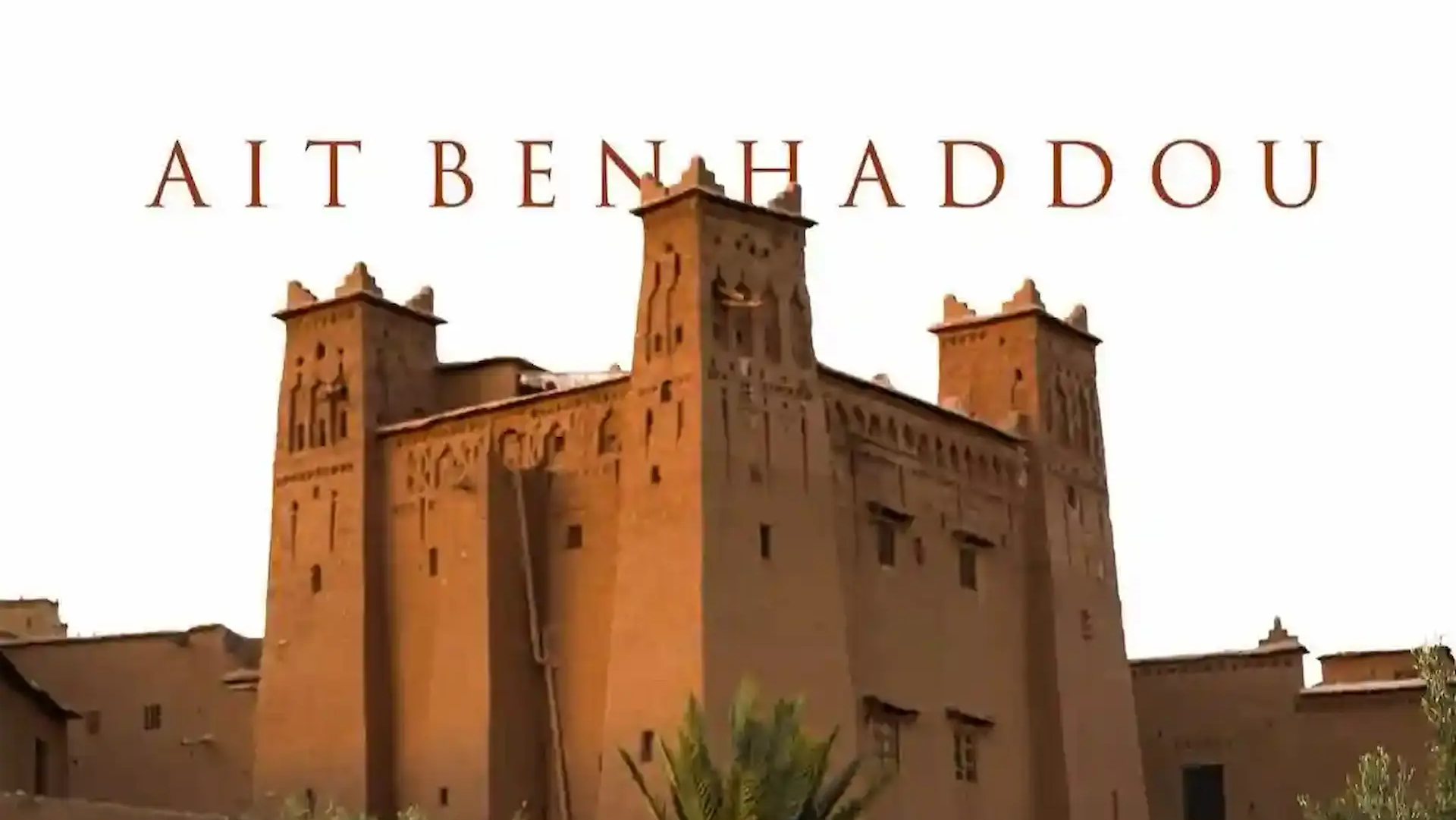
Aït Benhaddou also spelled Ait Ben Haddou, Ait Benhaddou, and in Arabic (آيت بن حدّو ), which in the Berber Language ( Ighram N’Ait Haddou )is Morocco’s most photographed historic site, the most filmed location on the African continent, and one of the finest surviving examples of pre-Saharan earthen architecture anywhere in the world. The fortified earthen village, perched on a hillside above the Ounila River in the Ouarzazate Province of southern Morocco, approximately 180 kilometers southeast of Marrakech and 30 kilometers northwest of Ouarzazate, has been a UNESCO World Heritage Site since 1987 and has been a setting for more major international film productions than any other place in Africa. At Over Morocco Tours, we include Aït Benhaddou on every single desert tour we run from Marrakech and Fes, and we say plainly on our tours page that visitors will notice this, because the site earns its place on every itinerary without question. This is the dedicated guide our site has been missing everything you need to know what Ksar Aït Benhaddou really is, why it is so important, how the films have contributed to its global fame and how to visit it in a way that respects its extraordinary character.
What Is a Ksar? Understanding the Architecture of Ait Benhaddou
To get to grips with Aït Benhaddou, it is useful to first understand the category of architecture it belongs to, because the difference between a ksar, a kasbah and a riad confuses many first-time visitors to Morocco. A ksar (plural ksour) is a collective fortified village a whole community of homes, communal buildings, granaries, mosques and public squares surrounded by a single defensive outer wall with corner towers. The kasbahs are the individual family residences and tower houses within the ksar; in southern Morocco, the word kasbah is used specifically to refer to a tower-house or fortified family residence, not the whole settlement. So Ksar Aït Benhaddou is a fully fledged community of several kasbahs, which share a common defensive perimeter one of the finest and best preserved specimens of this specific settlement type, once typical of the whole Draa and Dades valleys of southern Morocco, but now largely extinct elsewhere because of abandonment and the rapid erosion to which pisé (rammed earth) construction is inherently vulnerable.
Aït Benhaddou Architecture Pisé: What Are the Walls Made Of?
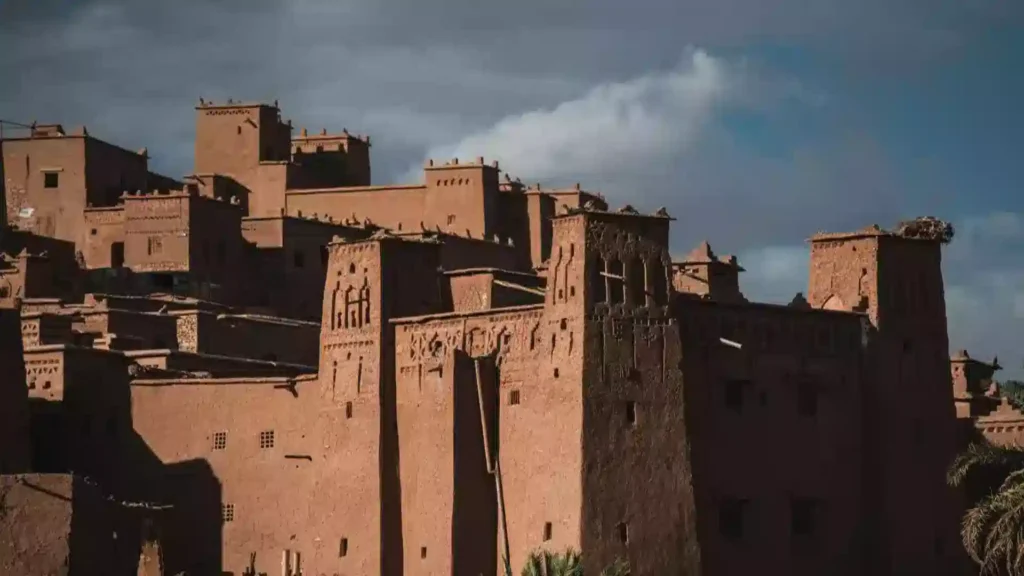
The technical term for the rammed earth construction method used throughout the ksar is pisé Aït Benhaddou architecture, and understanding it addresses both the extraordinary visual quality of the site and the ongoing conservation challenge it presents. Pisé (from the French for “rammed” and equivalent to the Arabic tabia or al-luh ) is made by compacting a mixture of raw earth, straw and water into wooden formwork in horizontal layers, each layer being left dry before the next one is added. The result is a wall of remarkable structural integrity when maintained, but acutely vulnerable to erosion by rain, ground movement and simple neglect when not. At Aït Benhaddou, the construction of taller buildings was carried out with pisé on the first floor, lighter adobe (sun-dried mud brick) on the upper floors, to reduce the load on the lower walls: an architectural innovation that shows centuries of accumulated knowledge of the load-bearing limits of the material. The ksar’s characteristic deep ochre-orange colour is a direct result of the iron-rich clay content of the local earth, lending the structures a tone that shifts from pale amber in the morning light through deep gold at midday to glowing terracotta in the late afternoon and making the site one of the most photogenically extraordinary landscapes in North Africa at the right hour.
The History of Aït Benhaddou: From Caravan Trade to Hollywood
The Trans-Saharan Trade Route and the Origins of the Almoravids
The history of Ksar Aït Benhaddou dates back to the 11th century, the Almoravid period the Amazigh (Berber) dynasty that unified Morocco and much of the western Maghreb, and established the strategic fortification of key routes across the southern Atlas region. The site was of both commercial and military importance, located in the Ounila Valley, on one of the main trans-Saharan caravan routes linking the Saharan interior to the imperial cities of Marrakech and Fes. For hundreds of years caravans carrying gold, salt and other goods from sub-Saharan Africa to the north and manufactured goods, cloth and spices travelling south in exchange passed through or stayed at Aït Benhaddou. None of the structures still standing are believed to be older than the 17th century in their present form, but they were almost certainly built using the same adobe techniques and spatial arrangements as much older predecessors – a continuity of building tradition rather than a single founding event.
The economic peak of the fortification was in the 17th and 18th centuries, when the wealth created by the trans-Saharan caravan economy enabled the construction of the elaborate towers that make up the skyline of the ksar. Aït Benhaddou’s commercial importance gradually declined with the decline of the overland routes, the development of Atlantic sea trade, the Portuguese coastal trading posts, and finally the fundamental restructuring of global trade geography. In the 20th century, most of the resident population moved across the river to the modern village of Aït Benhaddou on the western bank, leaving the earthen ksar in a semi-inhabited state. Today, there are still between four and six families living year-round inside the ancient walls, looking after the pisé structures through the seasonal repair cycle: re-plastering eroded surfaces, managing the irrigation channels and keeping the ksar a truly lived-in place, not a managed archaeological ruin.
2023 Earthquake and Conservation in Progress
Southern Morocco was also affected by the September 2023 earthquake that struck southern Morocco, resulting in widespread loss of life in the High Atlas region and damage to numerous historic buildings, including Aït Benhaddou. Initial damage assessments in Aït Benhaddou reported cracks in several tower structures and partial wall collapses in the upper sections of the ksar, with risk of further deterioration. The restoration work carried out with the help of UNESCO, the Ministry of Culture of Morocco and local conservation committees addressed the most pressing structural problems. The site is still fully accessible to visitors in 2026, with work still visible in some areas of the upper reaches of the ksar.
Aït Benhaddou Films: Complete Filmography
Over 80 Productions and Increasing
Aït Benhaddou films have one of the longest and most prestigious history of location shooting of any single site in the world. The ksar has served as a backdrop for major international productions since 1962, when David Lean used it in filming sequences for Lawrence of Arabia, and the film industry relationship has deepened every decade since. The nearby Atlas Film Studios in Ouarzazate — one of the largest film production complexes in the world, set up in part due to the established local infrastructure around Aït Benhaddou — has reinforced the region’s position as the de facto filmmaking capital of Africa, drawing major studios to the site repeatedly. More than 80 films and television productions have been shot at Aït Benhaddou since 1962 and this number continues to grow.
Ait Benhaddou Game of Thrones: Yunkai and Slaver’s Bay
Aït Benhaddou . The site’s international popularity has soared in the last decade, thanks in part to its role as a Game of Thrones filming location. In seasons 3 and 4 of the series, the ksar was used as the filming location for Yunkai, one of the cities of Slaver’s Bay that Daenerys Targaryen targeted in her campaign to free enslaved people across Essos. The earthen fortifications, the defensive towers and the arid, ocher landscape of the Ounila Valley offered exactly the visual language the production team was searching for for the ancient, pre-industrial slave cities of the fantasy world. The exterior walls of the ksar are directly echoed in some of the most widely recognized scene sequences of the series. Series fans will instantly recognize specific sections of wall, gate entrances, and tower configurations seen on screen.
Ait Benhaddou Gladiator and the Hollywood Legacy Before
The Gladiator filming in Aï̈t Benhaddou predates the Game of Thrones association by a decade and gave the site another dimension to its cinematic notoriety. The exterior arena battle sequences of Gladiator (2000) were filmed by Ridley Scott on the open ground next to the ksar, with the earthen towers clearly visible in the background — giving the film its signature image of Roman gladiatorial combat against a real ancient African fortified landscape. The film industry’s engagement with the local community around Aït Benhaddou has generated economic benefit to the region for more than six decades, with many Ouarzazate residents working as extras in the production. Other important productions include The Last Temptation of Christ (Martin Scorsese, 1988), The Mummy (1999), Kingdom of Heaven (Ridley Scott, 2005), Babel (Alejandro González Iñárritu, 2006) and Prince of Persia: The Sands of Time (2010), a filmography that together forms the most concentrated film shooting history of any heritage site in North Africa.
How to get to Ait Benhaddou?
The most practical question for planning an itinerary is how to go to Ait Benhaddou, and the options for routes depend on where you are starting from.
The Most Popular Route From Marrakech
A day trip to Aït Benhaddou from Marrakech is around 180 kilometers on the N9 highway. The drive each way takes 3.5 to 4.5 hours and includes a stop at the summit of the Tizi n’Tichka mountain pass at 2,260 meters – the highest paved road in North Africa and a visual highlight in its own right. The ksar is located around 8 km off the main N9 road at the village junction, and it is specifically a stop on all standard desert tour routing. A pure day trip from Marrakech – 4 hours each way plus 1.5-2 hours at the ksar plus lunch – makes for a long day of about 10-11 hours total but is entirely achievable with a 7:00AM departure and is included in all Over Morocco Tours Marrakech desert circuits.
Private tour: Door-to-door from your Marrakech accommodation, included in all Over Morocco Tours desert packages covering this route.
By bus and taxi: Buses from CTM or Supratours run between Marrakech and Ouarzazate (around 4 hours, 80-120 MAD). 30 kilometers from Ouarzazate is Aït Benhaddou which you can reach in about 35-40 minutes by shared or private grand taxi (60-120 MAD).
From Ouarzazate: The Quick Way
Aït Benhaddou vs. Ouarzazate positioning matters for visitors staying in Ouarzazate specifically: the two sites are completely separate Aït Benhaddou is the UNESCO earthen ksar 30 kilometers northwest; Ouarzazate is the larger town with the Taourirt Kasbah and the Atlas Film Studios tour. Most visitors do both in one day. The road from Ouarzazate to Aït Benhaddou takes about 30 to 40 minutes and is therefore the most convenient base for travelers wanting to visit in the early morning before the day-trip buses arrive from Marrakech.
What to See in Aït Benhaddou: Inside the Ksar
Crossing the Ounila River
To get to the ksar from the modern village on its western bank, you have to cross the Aït Benhaddou Ounila River which separates the two communities. In dry seasons, and this is most of the year, the crossing is done by stepping stones or a simple footbridge and takes just a few minutes. The river is significantly higher after rain or during the spring thaw from the High Atlas, and the stepping stones may be covered by water. In this case, the footbridge is the preferred option. The crossing itself is part of the visual drama of the site: the best and most complete first view of the whole profile of the ksar is obtained by crossing the shallow, palm-fringed riverbed, from the other side, towards the earthen towers.
The Six Kasbahs and Inner Streets
Within the defensive perimeter, the ksar is organized around six great kasbahs — family tower-houses of varying sizes and degrees of elaboration — interconnected by a network of narrow earthen lanes and occasional open squares. The interior is genuinely lived-in in places, with the small resident population keeping up their homes and often running small craft workshops and shops at ground level. The upper parts of the tallest towers are decorated with geometric carvings in gypsum and molded earth, motifs that represent the decorative tradition of each originating family, readable as a kind of architectural signature to those who know the grammar of the style. Inside the ksar is also a small mosque (which is accessible from outside, but not to non-Muslim visitors), a caravanserai where the trading caravans used to stay, and a Muslim and a Jewish cemetery — the latter indicative of the historically important Jewish merchant community that formed an important part of the Saharan trade network from the medieval period onward.
A View from the Top: The Aït Benhaddou Agadir Granary
At the summit of the ksar’s hill is the architectural and physical climax of any visit: the Aït Benhaddou agadir granary. This is a fortified communal grain store built at the highest defensible point of the settlement, where the community’s collective food reserves could be protected in times of siege or drought. There are uneven earthen steps and ramps from the entrance level to the agadir, with limited shade, and the climb takes about 20-30 minutes at a comfortable pace, and the physical ascent is well worth the effort: from the summit of the granary the view across the Ouarzazate valley, the Ounila riverbed, the palmery and surrounding desert plain toward the Atlas foothills is the finest panoramic perspective available anywhere on the site, and the one that best conveys the ksar’s strategic logic – positioned to see threats approaching from any direction across the open desert below.
Aït Benhaddou When to Visit: Skip the Crowds
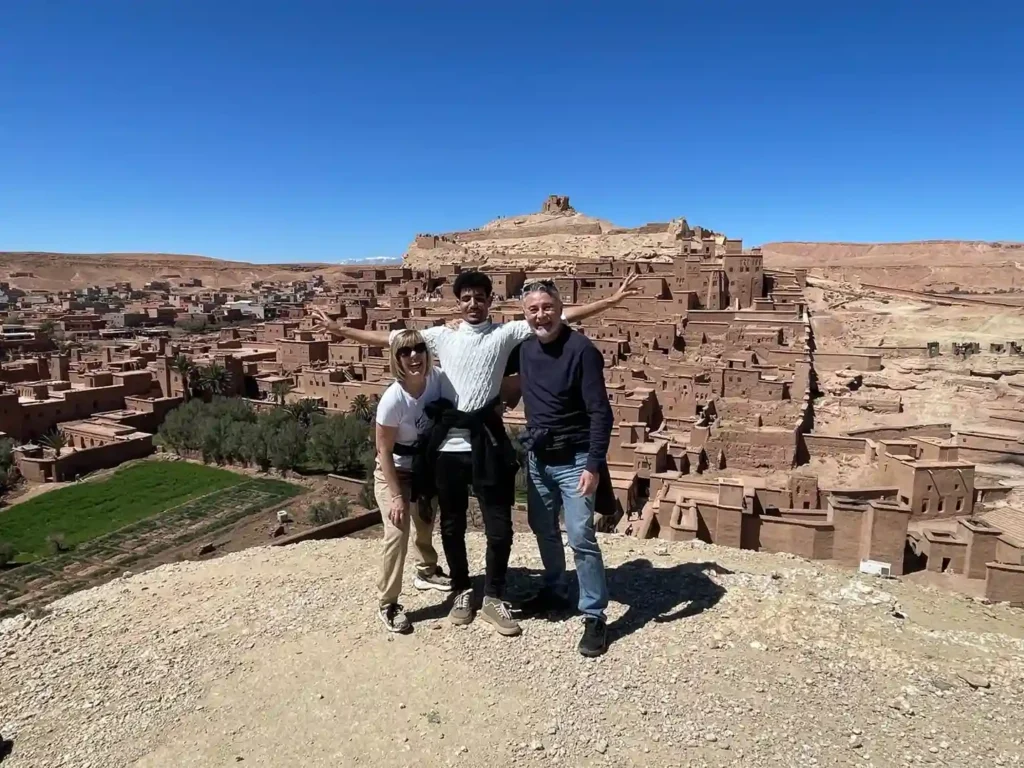
The practical question of when is the best time to visit Aït Benhaddou separates a genuinely memorable experience from a crowded, rushed encounter and is more specific than a simple seasonal recommendation.
The timing that really counts, every day
At Aït Benhaddou, timing is less about what month you visit and more about what hour of the day you arrive. Day-trippers from Marrakech in coaches, leaving the city between 7:00 and 8:00 AM and arriving after 3.5–4 hours, deliver a predictable flood of visitors, peaking at the ksar between 11:00 AM and 2:00 PM, when the site can feel truly crowded, with several groups sharing the same narrow interior lanes at the same time. Arriving before 10:00 AM or after 3:00 PM dramatically alters the experience: the lanes are quieter, the resident community is more relaxed, and the interaction with the site feels genuinely exploratory rather than processional. Every guide source we checked for this article mentions, and Over Morocco Tours guides tell every guest, that the best time to visit is the late afternoon between 4:00 PM and 5:30 PM, when the low-angle sun hits the pisé towers at their most photogenic and the day-trip crowd has already left for the return drive to Marrakech.
Best times of year
The best times for the daytime walk up to the Agadir granary are spring (March-May) and autumn (September-November) with the most comfortable temperatures – an important consideration given the uneven terrain and lack of shade in the upper sections. Summer (June-August) temperatures in the valley are over 40°C by midday, and the climb to the summit is a real challenge. Early morning arrival (before 9:00 AM ) is critical in summer, and retreating to the lower lanes, or the adjacent restaurants, during the midday heat is the practical approach. Winter (November-February) provides cooler, clearer conditions and noticeably smaller crowds – the site’s visual quality is exceptional in winter light, and the ocher towers against a clear blue sky with occasional snow visible on the High Atlas horizon is one of the most striking landscape compositions in southern Morocco.
Aït Benhaddou Opening Hours and Price
Aït Benhaddou opening hours cost is a bit unusual as the site is an inhabited UNESCO village, not a conventionally ticketed monument. There’s no official ticket gate for the ksar itself, and the site is open all day, so you can just walk in for free. Some individual kasbahs (privately owned) and inner structures charge a small entrance fee of 10-30 MAD (around €1-3) to view their interiors. It is customary and appreciated to offer a small tip to resident guides or community members who assist you in finding your way. The climbing route to the Agadir granary passes through sections maintained by individual families and a contribution of 20-50 MAD (€2-5) at these points is standard and directly supports the conservation work that keeps the pisé surfaces maintained.
Aït Benhaddou Overnight: What Most Tourists Miss Out On
If your schedule permits, most experienced Morocco guides recommend spending the night at Aït Benhaddou instead of making it a day trip, and the reasoning is simple: the ksar at dawn, before the day-trippers turn up, is a totally different experience from the ksar at noon. The modern village on the western bank of the Ounila, directly opposite the ksar across the Ounila river, offers a small selection of guesthouses and riad-style accommodation — selected for the way it allows guests to watch the earthen towers change colour across the full arc of a day, from the pale grey of pre-dawn, through a middle hour that most day-trippers never see, to the deep amber of the last light. Expect to pay from around €25-40 per night for a simple guesthouse and €60-120 per night for something more upmarket in riad-style properties with rooftop terraces overlooking the ksar. An overnight stay in Aït Benhaddou can be easily added as a midpoint on any of our Over Morocco Tours desert circuits. Contact our team to tailor your itinerary.
Pro Tip from Our Guide Team: The One Hour That Makes Aït Benhaddou Unforgettable
We have stopped at Aït Benhaddou hundreds of times over the years and the one truth we keep coming back to is this: the ksar is two completely different places depending on the time of day you arrive. If you arrive at 11:30 AM with fifty other tour groups you will photograph a crowded alley and leave thinking it was impressive but busy. If you arrive at 4:30 PM when the coaches have gone and the light is going amber you will stand at the top of the agadir and feel like you are the only person on Earth looking out at the desert, and you will stay longer than you planned.
We design every desert circuit with Aït Benhaddou so that you arrive there in the late-afternoon window. This means changing the departure time from Marrakech and having lunch at a certain point on the road, not at the site itself – small logistical changes that make a big experiential difference. Ask any tour operator, including us, what time you will arrive at Aït Benhaddou. If the answer is ‘around noon,’ that is the time to ask them to restructure the day.
Morocco Tours Guide Team.
Frequently asked questions Aït Benhaddou
What is Ait Benhaddou?
Aït Benhaddou is a fortified earthen village (ksar) in the Ouarzazate Province of southern Morocco, sitting above the Ounila River on the historic caravan route between the Sahara and Marrakech. It’s been a UNESCO World Heritage Site since 1987 and is the most filmed location in Africa, featuring in over 80 productions including Gladiator, Game of Thrones and Lawrence of Arabia.
How was Aït Benhaddou used in Game of Thrones?
In Seasons 3 and 4 of Game of Thrones, Aït Benhaddou was used as the setting for Yunkai, one of the three slave cities of Slaver’s Bay. The ksar’s outer walls, towers and the approach to the gate are seen directly in scenes depicting Daenerys Targaryen’s campaign to free the city’s enslaved populations.
Is Aït Benhaddou worth going to?
Yes, without question — with one timing caveat. It is the best-preserved example of southern Moroccan earthen architecture and one of the most visually extraordinary historic sites in North Africa. The caveat is that the experience varies dramatically depending on when you arrive: the late afternoon (4:00-5:30 PM), when the day-trip coaches have left and the pisé towers are illuminated by the low-angle light, delivers an experience that consistently exceeds expectations, while a midday visit in peak season can feel crowded and rushed.
How much time should I spend at Aït Benhaddou?
It takes 90 minutes to 2 hours to explore the entire Ksar and to climb up to the Agadir Granary at the top for a meaningful self-guided visit. Allow 2.5-3 hours with a local guide and time for the river crossing and photography. A full day trip from Marrakech including driving time takes around 10-11 hours total.
Is Aït Benhaddou free to enter?
There is no official ticket gate and access to the ksar as a whole is free. Small entry fees to individual kasbahs and inner structures may be levied of 10-30 MAD (c. €1-3) Small tips of 20-50 MAD are standard at maintained sections of the ascent route to the Agadir granary, and support local conservation work.
Compared to Ouarzazate, Aït Benhaddou is a much smaller town?
Aït Benhaddou and Ouarzazate are two separate sites 30 kilometers apart. Aït Benhaddou is the UNESCO earthen ksar – the ancient fortified village. Ouarzazate is the larger modern town with the Atlas Film Studios (tour available), the Taourirt Kasbah and most area accommodation. Most tours combine both on a half- or full-day excursion.
Can you spend the night in Aït Benhaddou?
“Yeah. The modern village opposite the ksar has a handful of guesthouses and riad-style accommodation offering guests the chance to see the site at dawn and sunset – the two windows that day-trippers from Marrakech totally miss. Simple guesthouses cost about €25-40, while riad-style properties with direct views of the ksar run €60-120.
See Aït Benhaddou with Over Morocco Tours
Aït Benhaddou is part of every desert tour we run out of Marrakech and Fes and we plan every itinerary to arrive at the end of the afternoon light period, not during the midday crowd peak. If you are on a 3 day Marrakech-Fes circuit, a private day trip combining Aït Benhaddou and Ouarzazate, or a longer Morocco circuit, our driver-guides know this site and the best time to visit it in every seaso n.Book your visit with our team today.
Morocco. Written by the Over Morocco Tours team. All of our desert circuits have had a stop at Aït Benhaddou since 2012, in every season, at every hour of the day, and in every imaginable crowd condition.